

Living With Laryngeal Paralysis: The Everyday Routine
Alastair Greenway
BVM&S MRCVS
The diagnosis is done. The bark has changed, there's that raspy in-breath on a warm walk, and a vet has put a name to it: laryngeal paralysis, very probably the first sign of the wider nerve condition we call GOLPP. What comes next isn't the science again. It's the ordinary stuff: how you actually live with this, week to week, keep your dog comfortable and safe, support those back legs as they weaken, and stop bracing for the next scary moment.
So this piece is the practical half. The daily routine that works, how to help the back end as things progress, what to keep an eye on, and the emotional reality, which deserves honesty rather than a brave face. I'll point you to the right place for the harder clinical detail as we go, so you can read it when you're ready and skip it when you're not.
One plain truth anchors the rest. GOLPP is a slow, generalised degeneration of nerves: the voice box goes first and most obviously, then over months to years the back legs weaken and the gullet gets involved too (Cornell Riney Canine Health Center, n.d.; Kitshoff et al., 2013). Even if your dog has had, or is heading towards, the tie-back operation, hold on to the guardrail that runs through everything here: surgery fixes the breathing, not the nerves. So daily life with laryngeal paralysis is about supporting the whole dog, not just the airway.
The daily routine that works
Most of what helps is straightforward, and you can start today. The established conservative-management bundle for laryngeal paralysis is short and practical: swap neck collars for a harness, keep your dog lean, limit and pace exercise, keep them out of hot and humid weather, lower stress, and use physical therapy to maintain muscle mass (Cornell Riney Canine Health Center, n.d.).
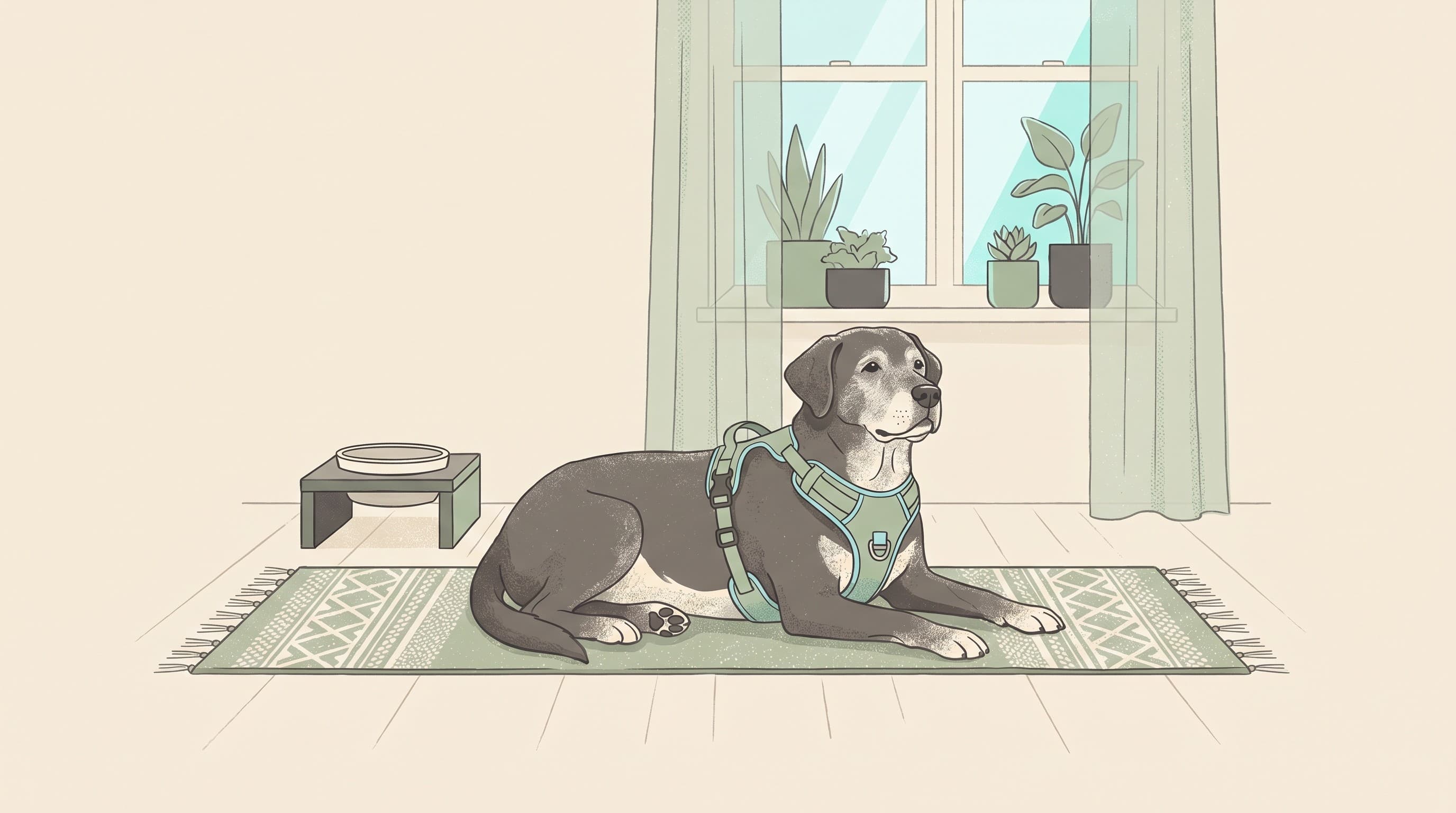
A harness, not a collar, is the single load-bearing daily rule. A collar presses straight on a windpipe that's already working harder than it should, so a comfortable Y-front harness is one of the kindest, simplest changes you can make (American College of Veterinary Surgeons, n.d.). It also gives you something to steady your dog with later, when the back end gets wobblier.
Keeping your dog lean matters more than it sounds. Every spare kilo is more weight for tired hind legs to carry and more air a compromised airway has to shift. You don't need to be hard on yourself or your dog about it: small, steady changes to portions and treats do the work.
Pace the exercise and respect the heat. Dogs with laryngeal paralysis tire more easily on a walk, and because they cool themselves mainly by moving air through that narrowed airway, they overheat far more readily than a normal dog in conditions that wouldn't trouble one (American College of Veterinary Surgeons, n.d.; Cornell Riney Canine Health Center, n.d.). So this is a daily habit, not just a summer one: gentle, shorter outings, in the cool of the day, at a calm pace. The frightening heat-or-exercise breathing crisis you're trying to prevent, and how to respond to one, is covered in full in keeping a dog with laryngeal paralysis safe in heat and on exercise.
Feeding is part of the routine too, because the same nerve condition can weaken the gullet. Two small habits lower the risk of food or water going down the wrong way: raise the bowls onto an elevated feeding station, and pre-form the meals into meatballs so they're easier to swallow cleanly (American College of Veterinary Surgeons, n.d.; Stanley, 2018). I'm keeping this light on purpose. The full mechanism, the feeding protocol in depth and the warning signs to watch for live in the aspiration-pneumonia risk and how to manage it, the page to read carefully, especially after a tie-back.
A calm home ties it all together. Excitement and stress drive faster, harder breathing, which is the last thing a narrowed airway needs, so an unhurried household genuinely helps. Anti-anxiety medication is a recognised part of the bundle for some dogs (Cornell Riney Canine Health Center, n.d.), so do raise it with your vet if your dog is an anxious type. One kindly steer while we're on medication: a double-blinded, randomised, placebo-controlled trial of the drug doxepin in Labradors with laryngeal paralysis found it didn't appear to improve any measure of owner-assessed quality of life (Rishniw et al., 2021). Worth knowing, because it saves you chasing an unproven drug fix when your energy is far better spent on the levers that do help.
Helping the back end as GOLPP progresses
Here's the part the airway-only guides tend to skip, and it's where you can make the biggest practical difference over time. As GOLPP advances, the hind legs weaken and the muscles waste, classically in older large breeds, often Labradors, with an average age around eleven (Stanley, 2018). Your job shifts from protecting the breathing to helping a slightly unsteady dog stay mobile and confident.
Start with the floor. Slippery laminate or tile is the enemy of weak back legs, so lay non-slip rugs or runners along the routes your dog uses most, and add a ramp anywhere they'd otherwise have to jump, in and out of the car especially. A support or handle harness, or a simple sling under the belly, lets you take a little weight off the hind end on stairs or when they're tired, without hauling on the neck.
Movement itself is the headline lever. Physical therapy to help maintain muscle mass is named in the core management list for good reason (Cornell Riney Canine Health Center, n.d.), and veterinary rehabilitation clinicians who work with GOLPP dogs describe what it offers in the same practical terms: there's no cure, but well-chosen rehabilitation can help a dog hold on to strength, balance and coordination and stay as independently mobile as possible for as long as possible, slowing the muscle wasting that comes with the nerve decline (Canine Rehabilitation of Orange County, n.d.). Let me be straight about the limits of that. Rehab is well supported for keeping a dog stronger, steadier and more mobile for longer. It is not proven to lift overall quality of life as a measured outcome, so I won't promise that. But the practical message is encouraging, and it matches what owners notice: as one owner in the Michigan State University research put it, if their dog "gets out and stays active, he has more mobility" (Stanley, 2018). So the aim is gentle, regular activity, not rest into stiffness, with a referral to a qualified veterinary physiotherapist or an underwater-treadmill rehab centre where you can get one.
If this is starting to sound a lot like looking after an arthritic dog, that's because the support overlaps almost exactly: the same rugs, ramps, support harness and physio. The Mobility Check tool is built for precisely this kind of hind-end support, and the deeper reframe of GOLPP as a whole-body nerve condition lives in GOLPP is a whole-body condition.
Keeping watch, and the emotional side
A little monitoring becomes part of normal life, and it's reassuring rather than morbid once it's a habit. Three things are worth tracking: the breathing, the exercise tolerance, and any change in swallowing or coughing around food and water. The single most useful number is the resting respiratory rate, counted while your dog sleeps. Normal is under about 30 breaths a minute at rest; 30 or more is worth watching, and 40 or more needs a call to the vet, and so does a rate that climbs steadily over several days. A slow creep upwards can flag a problem before it becomes a crisis. The Airway Episode and Exertion Diary and the resting respiratory rate tracker are made for exactly this, so the pattern is in front of you and your vet rather than half-remembered.
Now the human part. Living with laryngeal paralysis carries a particular weight, because the breathing scares are real and the decline, though usually slow, only goes one way. In one survey of owners of dogs with late-onset laryngeal paralysis, 94% felt it affected their dog's quality of life, and 47% felt it was a large contributing factor in their dog's death, with the dogs that had the tie-back reported to have a better quality of life (Sample et al., 2020). I share that not to frighten you but because pretending it's all fine would be a disservice, and naming the worry tends to make it lighter.
There is a reassuring counterweight, and it's just as true. This is, for the most part, not a painful condition: the nerve change drives weakness and the airway and swallowing trouble, not the kind of pain that takes the joy out of a dog, and between the difficult moments these dogs typically stay bright, alert and very much themselves. The condition usually develops slowly (Davies Veterinary Specialists, n.d.), the decline is variable, and many older dogs go on to live their normal lifespan before the weakness ever becomes significant (Cornell Riney Canine Health Center, n.d.). With good management, the realistic aim is a genuinely acceptable quality of life with the ease of breathing restored, not a countdown (Davies Veterinary Specialists, n.d.; American College of Veterinary Surgeons, n.d.). Good days are not borrowed time. They're the point.
You're not doing this alone
One of the kindest things about laryngeal paralysis is that there's a ready-made community of people who have walked this exact road. Alongside our own space, I'd point you in good faith to larparlife.com, the long-running, owner-run "21st Century Guide to Laryngeal Paralysis in Dogs/GOLPP" and its worldwide network of Facebook groups (Lar Par Life, n.d.). It's a warm, knowledgeable place for lived experience and peer support, and that's where its value lies. Two caveats so you read it with clear eyes: it's an owner resource rather than a veterinary authority, the site says as much itself, describing its content as the creator's own interpretation and opinions based on personal experience (Lar Par Life, n.d.), and it leans towards the silicone laryngeal stent as an alternative to the tie-back. So lean on it for company and encouragement, and keep the clinical decisions, surgery included, with your own vet and with us. The candid case for and against the tie-back, with UK costs and the referral route, is set out in the tie-back surgery decision.
The day-to-day is mostly small, kind, doable adjustments, and they add up. Sort the harness, the traction underfoot and the cool, calm pacing this week, start logging that resting rate, and book the physio. Then go and enjoy the dog in front of you, because a well-supported dog with laryngeal paralysis has a great many ordinary good days still to come.
References
- American College of Veterinary Surgeons. (n.d.). Laryngeal Paralysis. Retrieved from
- Canine Rehabilitation of Orange County. (n.d.). Rehabbing GOLPP (T. Downing, RVT). Retrieved from
- Cornell University College of Veterinary Medicine, Richard P. Riney Canine Health Center. (n.d.). Laryngeal paralysis. Retrieved from
- Davies Veterinary Specialists. (n.d.). Laryngeal Paralysis & Collapse Fact Sheet. Retrieved from
- Kitshoff, A. M., Van Goethem, B., Stegen, L., Vandekerckhove, P., and de Rooster, H. (2013). Laryngeal paralysis in dogs: an update on recent knowledge. Journal of the South African Veterinary Association, 84(1), Art. #909.
- Lar Par Life. (n.d.). Lar Par Life: The 21st Century Guide to Laryngeal Paralysis in Dogs/GOLPP. Retrieved from
- Rishniw, M., Sammarco, J., Glass, E. N., and Cerroni, B. (2021). Effect of doxepin on quality of life in Labradors with laryngeal paralysis: a double-blinded, randomized, placebo-controlled trial. Journal of Veterinary Internal Medicine, 35(4), 1943-1949.
- Sample, S. J., Stilin, A., Binversie, E. E., Baker, L. A., and Hardie, R. J. (2020). Late-onset laryngeal paralysis: owner perception of quality of life and cause of death. Veterinary Medicine and Science, 6(3), 306-313.
- Stanley, B. J. (2018, April 23). Laryngeal Paralysis Is First Sign of General Neurological Paralysis. Purina Pro Club. Retrieved from
Keep track of how your pet is doing
The owners who cope best are the ones who notice changes early. A simple health log shows you what is working, and what is not, before the next vet visit.
Start tracking, freeYou're not doing this alone
Compare treatment journeys and talk to owners managing breathing & airways. Free to join.
Join PetsLikeMine