

Anaesthesia-free teeth cleaning: why UK vets (and the RCVS) say no
Alastair Greenway
BVM&S MRCVS
Somewhere between the groomer's price list and a Facebook advert, you've probably seen it: "anaesthesia-free dental", "conscious teeth cleaning", "no sedation needed". Your pet stays awake, someone scrapes the visible tartar away, and you walk out with a mouthful of white teeth for a fraction of what your vet quoted for a proper dental under anaesthetic. Put like that, it sounds like the sensible, gentle, thrifty choice, and the instinct behind it is a good one. Nobody wants to put their dog or cat under a general anaesthetic if they don't have to, and nobody enjoys a three-figure bill.
So let's be straight with you, without any finger-wagging. The problem isn't that you were tempted. The problem is that the leaflet doesn't tell you what the procedure can and can't do, and in the UK it doesn't mention the law. Once you know both, the "cheaper option" stops looking like a bargain and starts looking like paying real money for something that leaves the actual disease untouched.
Where dental disease actually lives
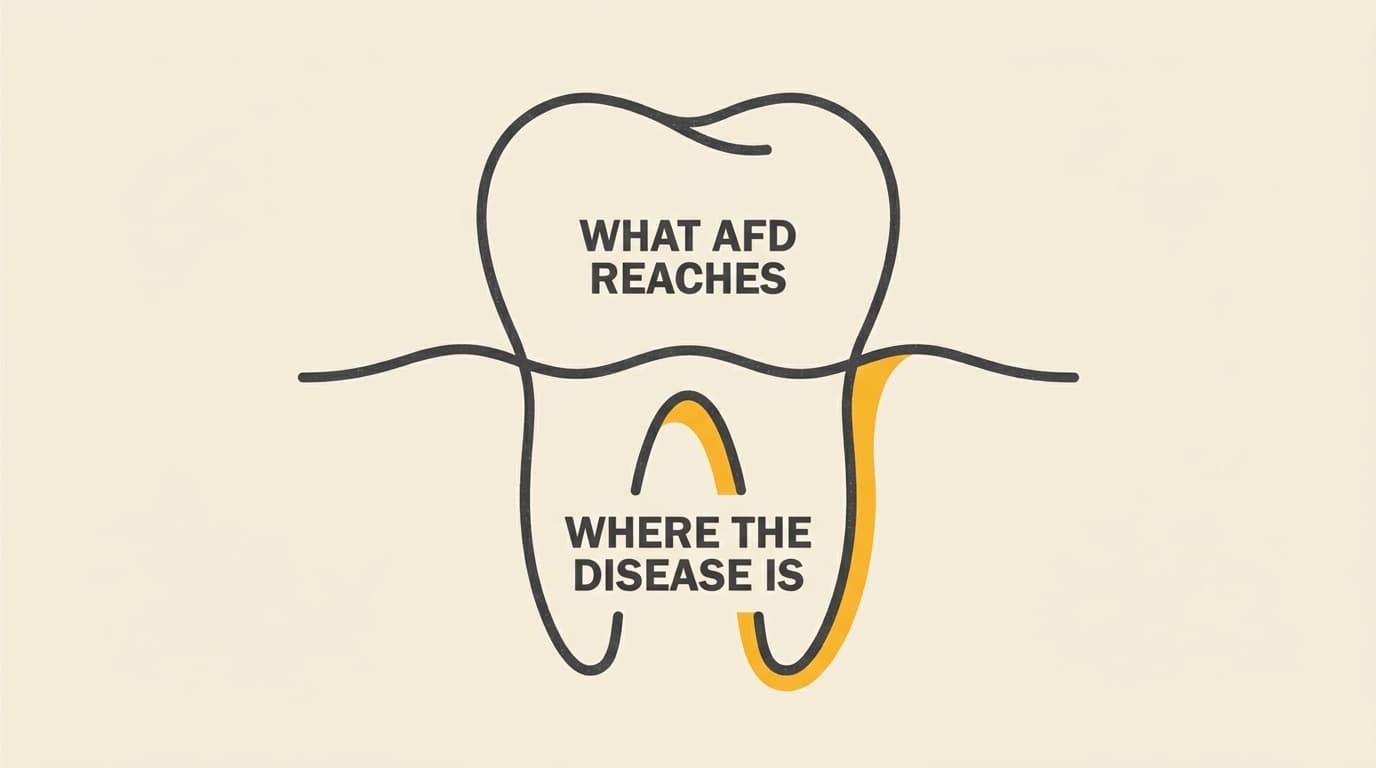
Here's the fact that changes everything, and it's the one the marketing skips. Periodontal disease, the common, painful, tooth-loosening problem that dentals exist to treat, does not live on the shiny visible part of the tooth. It lives below the gum line, in the pocket between the gum and the root, where plaque bacteria burrow down and slowly destroy the attachment holding the tooth in place.
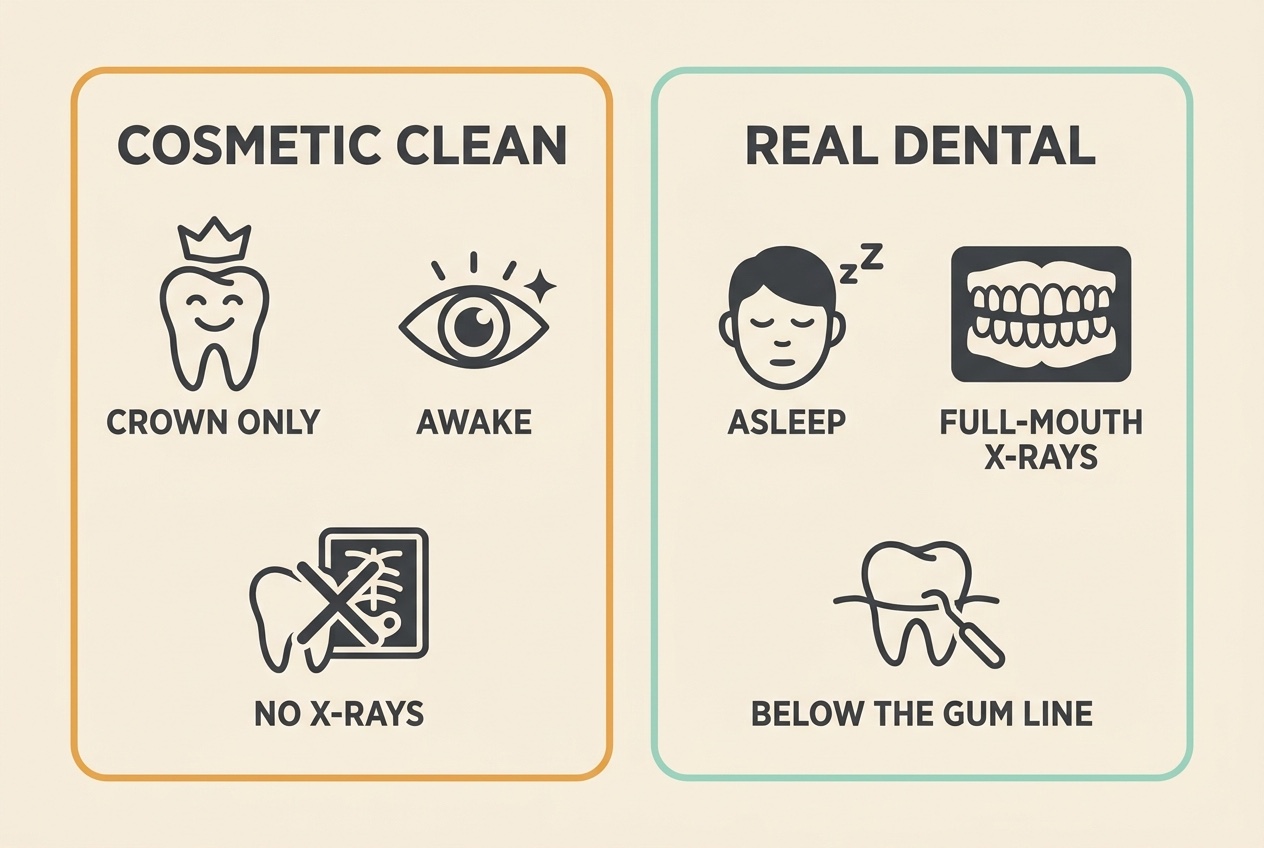
Cleaning that pocket, what vets call sub-gingival scaling, is the part of a dental that matters. It's also uncomfortable, and it needs fine instruments worked carefully under the gum on every surface of every tooth, including the surfaces facing the tongue that you can't even see from the front. A person will sit still for that because we understand what's happening and we've agreed to it. A conscious dog or cat has agreed to nothing. Ask yourself, realistically, whether your pet would hold their mouth open and completely still while a stranger ran a sharp instrument under their gums, tooth by tooth, for twenty minutes. They won't, and no reputable person would try.
So an awake "clean" can only ever reach the visible crown. It polishes the bit you can see and leaves the disease exactly where it was. The American Veterinary Dental College, which has held this position since 2004, puts it plainly: removing tartar from the visible surfaces of the teeth "has little effect on a pet's health, and provides a false sense of accomplishment. The effect is purely cosmetic" (AVDC, 2004).
The trap of a mouth that looks clean
This is the part that genuinely worries vets, more than the wasted money.
When the crowns are scraped shiny, the mouth looks healthy. You see white teeth, you feel reassured, and you reasonably conclude the job is done. Meanwhile the periodontitis under the gum carries on unchecked, and the very thing that would normally prompt you to book a proper dental, the yellow-brown build-up and the smell, has been buffed away. A cosmetic clean can delay the treatment your pet actually needs, sometimes by a year or more, while bone loss and infection quietly progress underneath. By the time it resurfaces, there are often more teeth to lose than there would have been.
That's why "but it looks so much better afterwards" is exactly the wrong reassurance to trust. Looking better and being better are not the same thing in a mouth, and an awake clean is very good at the first and incapable of the second.
What the evidence actually shows
None of this is one vet's opinion. It's the settled position of the professional bodies that write the standards, and there's now direct research behind it.
A 2026 study in the Journal of the American Veterinary Medical Association set out to test whether anaesthesia-free dentistry does anything measurable for periodontal disease in dogs, comparing it against proper dentistry under anaesthetic. The title is the finding: anaesthesia-free dentistry "does not provide any demonstrable medical benefit for the control of periodontal disease in dogs" (Niemiec et al., 2026). Not "less benefit". No demonstrable benefit.
That sits on top of years of guidance saying the same thing. The World Small Animal Veterinary Association's 2020 Global Dental Guidelines discuss the deleterious effects of anaesthesia-free dentistry and describe it as ineffective at best and damaging at worst, with the committee unanimous that anaesthesia is essential for any useful dental procedure (WSAVA, 2020). The European Veterinary Dental College takes the same line, that it is not an acceptable alternative to professional treatment. When the American college, the European college and the global small-animal association all independently reach the same verdict, that's about as close to consensus as veterinary medicine gets.
The stress and injury risk, awake
Set the effectiveness aside for a moment, because there's a welfare cost too.
Scaling instruments are sharp by design. On a patient who can't be asked to hold still, a small head movement at the wrong moment can gouge the gum or the tongue, and a frightened animal may bite the person holding them (AVDC, 2004). To keep a conscious pet still enough to work in, they often have to be firmly restrained, sometimes wrapped or pinned, by people who feel like strangers, doing something that hurts. For an animal that already finds the vet stressful, that's a genuinely distressing experience, and it can make them dread mouth-handling for years afterwards, which undermines the home brushing that actually protects their teeth.
There's an airway risk too. During a real dental, your pet has a cuffed tube in their windpipe that stops water, bacteria and dislodged debris from being breathed down into the lungs. An awake animal has no such protection, so material scraped loose at the back of the mouth can be aspirated (AVDC, 2004). And if a non-vet reaches for a sedative to make an unwilling animal more manageable, that crosses another line entirely, because prescribing or giving sedative drugs without a vet is both dangerous and unlawful.
The RCVS lists the welfare problems directly. Anaesthesia-free procedures, it says, "cannot allow full oral examination to be performed and vitally important diagnoses may be missed or delayed", "do not allow full and effective cleaning of the most important sub-gingival areas", "may actually cause damage to the tissues surrounding the teeth", and "may cause discomfort, pain and/or distress to the animal" (RCVS).
The UK law, plainly
This is the bit almost no owner is told, and in Britain it's the decisive one.
Under the Veterinary Surgeons Act 1966, the practice of veterinary surgery is restricted to registered veterinary surgeons. The RCVS considers that cleaning and assessing the periodontal pocket below the gum line is an act of veterinary surgery. Put those two together and the conclusion is simple: it is illegal for a non-veterinary surgeon to perform sub-gingival scaling, or to extract teeth, and by extension to offer or advertise it as a service (RCVS). A groomer or pet-shop clinic doing this is not offering a cut-price version of what your vet does. They are doing something they are not lawfully allowed to do.
It's worth being precise here, because precision is the point. Polishing only the visible crown, with nothing going under the gum, isn't in itself an act of veterinary surgery. But that purely cosmetic clean is also the one the evidence says is useless, and presenting it as a "dental" or a "dental treatment" can be misleading unless the owner is clearly told how limited and potentially harmful it is. So the fork is this: the part of an awake clean that would actually help is the part that's illegal for a non-vet to do, and the part a non-vet can legally do is the part that doesn't help.
The RCVS position is not out on a limb, either. It's backed by the British Veterinary Dental Association, the European Veterinary Dental College and the European Veterinary Dental Society. Enforcement against non-vets is admittedly limited, the RCVS mainly regulates vets and veterinary nurses rather than pet shops, so the responsibility to know this often falls back to you as the person paying. Now you know it.
Cats: an even worse fit
If awake cleaning is a poor deal for dogs, it's worse for cats, and cats deserve their own paragraph rather than a footnote.
Cats are experts at hiding oral pain, and much of their most important dental disease is invisible from the front of the mouth even to a vet with good light. Tooth resorption, one of the commonest and most painful feline dental problems, often shows itself only on x-ray, as the tooth quietly destroys itself from the inside while the crown still looks intact. No amount of awake scraping will find it, and an x-ray can only be taken safely on a still, anaesthetised patient. A cat is also far less likely than a dog to tolerate having their mouth worked on while conscious, which means either the procedure is abandoned half done or the restraint becomes more forceful and more frightening. Either way, the cat gets the stress and none of the benefit, and a genuinely painful mouth gets signed off as "cleaned".
What a proper dental actually does instead
It helps to see what you're actually paying the extra for, because it isn't the anaesthetic for its own sake. The anaesthetic is what makes everything else possible.
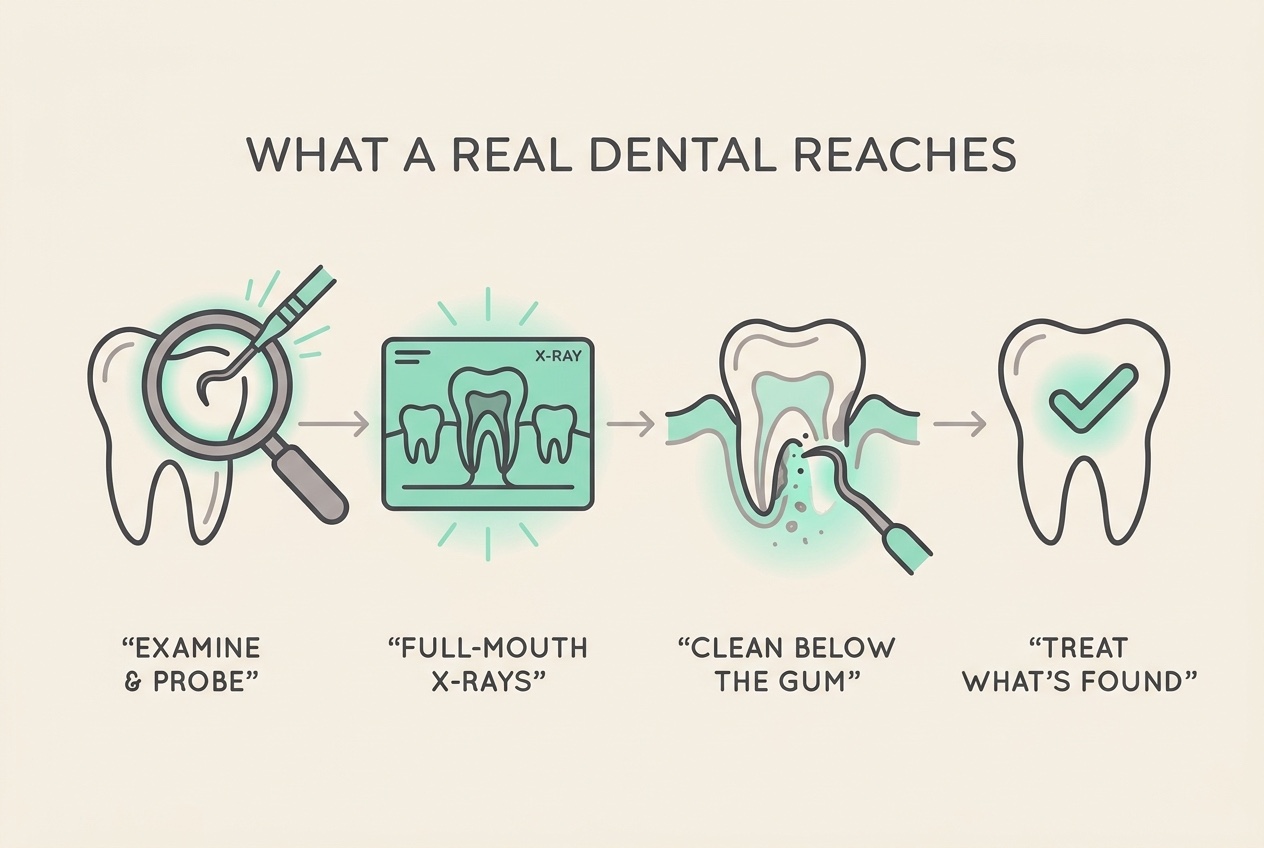
A complete dental under general anaesthetic means a full-mouth examination with every surface of every tooth checked and probed for pockets, full-mouth x-rays to find the disease hiding below the gum line, scaling both above and below the gum where it counts, a polish, and treatment of whatever is found, including extracting teeth that are beyond saving so they stop hurting. Your pet feels none of it, their airway is protected, and they wake up with the actual problem dealt with rather than painted over. That's the difference between a mouth that looks clean and a mouth that is healthy. If you want to see exactly how the day runs, what actually happens during a dental walks through it step by step, and why dental x-rays matter explains the part that catches the disease the eye can't.
And the anaesthetic itself, the thing the whole awake industry is built on avoiding? For a healthy pet it is far safer than most owners fear, and the risk is managed with pre-anaesthetic checks, a drip, and a nurse watching every breath. That fear deserves a proper answer rather than a workaround, which is why we've set out the real anaesthetic risk numbers separately, and why age alone doesn't rule out a dental for an older pet.
What genuinely protects your pet's teeth
If the appeal of awake cleaning was really about doing something regular and low-cost to keep your pet's mouth healthy, the good news is that the thing that works is cheaper still and you can do it at home.
Daily brushing is the single most effective home measure there is, and it's worth building up to slowly and kindly so your pet accepts it. Between brushings, dental chews, diets and additives that carry the Veterinary Oral Health Council seal genuinely help, and which of them actually work is worth reading before you spend anything, because most of the packaging claims aren't evidence of much. What you should never do is take a scaler or your fingernail to your pet's teeth yourself. Scraping tartar at home damages the enamel, misses everything below the gum, and risks hurting your pet or getting bitten, which puts you in the same trap as the awake clean, just without the receipt.
So if you've been eyeing an anaesthesia-free clean, the fair thing to say is that the instinct was right and the option is wrong. Book the mouth check, ask your vet for a real quote and what it includes, and keep the brush by the kettle. That's the version that actually keeps the teeth your pet has.
References
- American Veterinary Dental College (AVDC). Position Statement: Companion Animal Dental Scaling Without Anesthesia. Adopted by the AVDC Board of Directors, 10 April 2004.
- Niemiec BA, et al. Anesthesia-free dentistry does not provide any demonstrable medical benefit for the control of periodontal disease in dogs. Journal of the American Veterinary Medical Association 2026; 264(2). doi:10.2460/javma.25.06.0405
- Niemiec B, Gawor J, Nemec A, et al. World Small Animal Veterinary Association (WSAVA) Global Dental Guidelines. Journal of Small Animal Practice 2020; 61(7): E36–E161. doi:10.1111/jsap.13132
- Royal College of Veterinary Surgeons (RCVS). A statement on 'anaesthesia-free dental procedures' for cats and dogs. RCVS, London.
- European Veterinary Dental College (EVDC) / European Veterinary Dental Society (EVDS). Statement on anaesthesia-free dentistry.
- Veterinary Surgeons Act 1966. UK Public General Acts.
Keep track of how your pet is doing
The owners who cope best are the ones who notice changes early. A simple health log shows you what is working, and what is not, before the next vet visit.
Start tracking, freeYou're not doing this alone
Compare treatment journeys and talk to owners managing teeth & mouth. Free to join.
Join PetsLikeMine