

Why dental x-rays matter: the disease you can't see
Alastair Greenway
BVM&S MRCVS
You booked her in for a clean. Then the estimate came back, and there was a line on it for dental x-rays, and it pushed the price up more than you expected. A fair question forms at that point: why does she need x-rays for a scale and polish? She's having her teeth cleaned, not a hip replacement. It can feel like the sort of extra a garage adds to a service, the thing you're half sure you could decline without much lost.
So let me answer it properly, because it's a good question and it deserves more than "it's just what we do." The short version is this: for most pets, and cats especially, the part of dental disease that actually causes pain lives below the gumline, where no one can see it. The x-ray is not an add-on to the clean. It's the part that tells us whether the mouth is genuinely healthy or just looks that way from the outside. A dental without it is half a job, and I'd rather explain why than have you pay for the half that misses the point.
Why the crown can lie
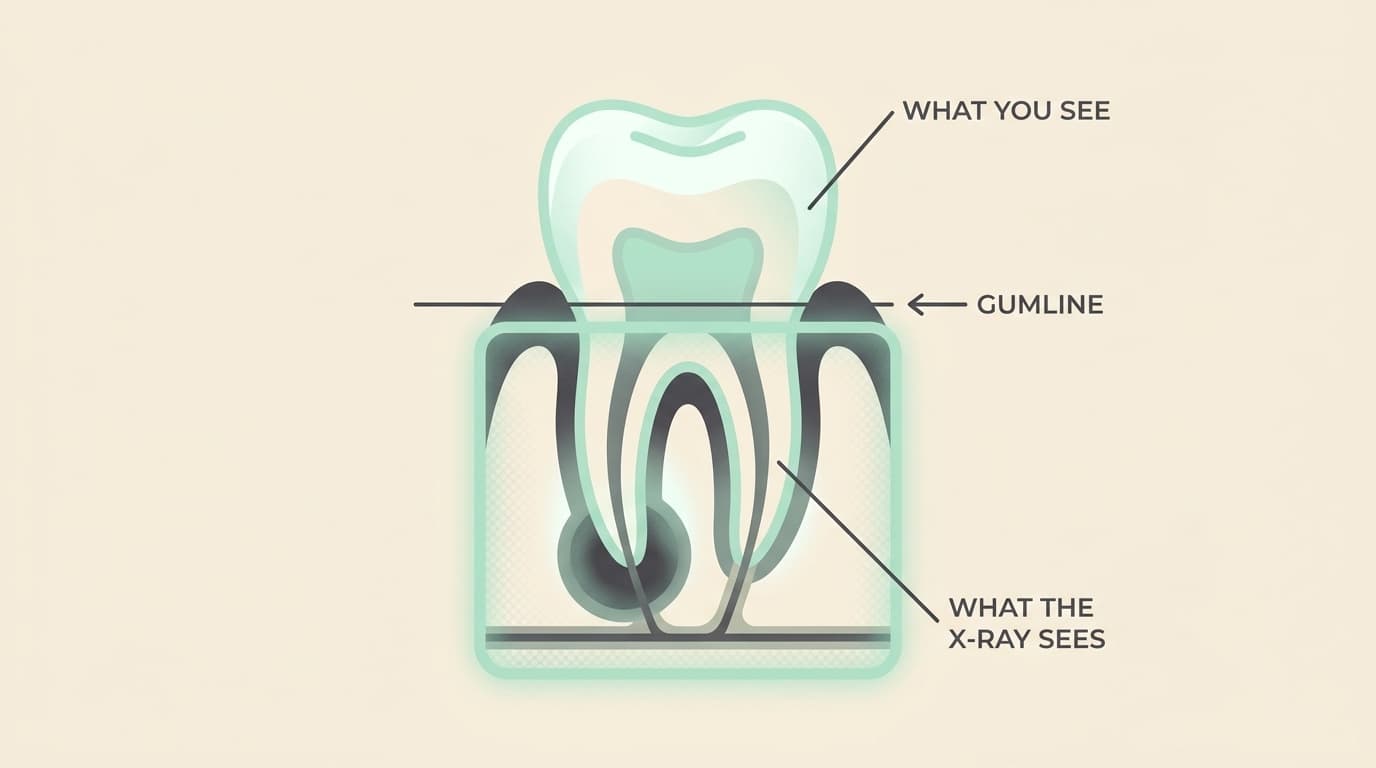
A tooth is mostly hidden. The bit you can see, the white crown, is roughly the top third. The rest is root, and it sits in a socket in the jawbone, wrapped in ligament, completely out of view. When we talk about periodontal disease, the disease that damages the tissues holding a tooth in, we're mostly talking about what's happening down there, at the root and the bone around it.
That's the catch. You can have a mouth where the crowns look reasonable, a bit of tartar maybe, nothing dramatic, while underneath, the bone that anchors those teeth is quietly dissolving away. Or a root that has abscessed and is sitting in a pocket of infection. Or, in cats, a tooth that is being eaten away from the inside by the body's own cells. None of that shows on the crown until it's very advanced, and some of it never shows at all from above. Looking at the crowns and declaring the mouth healthy is a bit like judging a house by its front door. The door can be freshly painted while the foundations are going.
This is why a good vet won't tell you a mouth is "fine" on the strength of a conscious look in the consulting room. We can spot the obvious things awake, the heavy tartar, the wobbly tooth, the angry red gum. We cannot see below the gumline, and below the gumline is where the disease that hurts your pet actually lives.
What the x-ray sees that your eyes can't
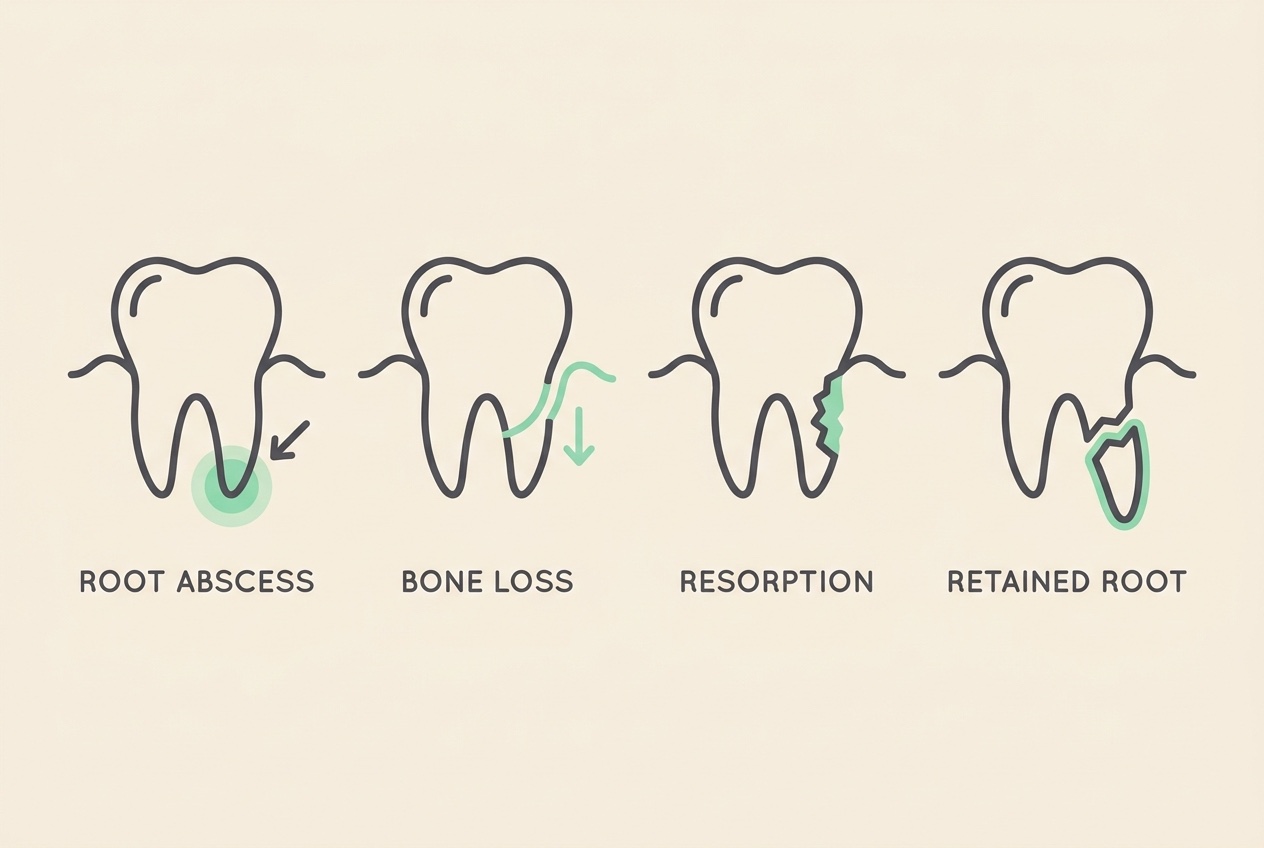
Put a tooth under x-ray and the hidden two-thirds becomes visible. Here is the sort of thing that turns up, none of which can be diagnosed by looking:
- Tooth-root abscesses. Infection at the tip of a root, walled off in the bone. A classic one sits under the big upper cheek tooth (the carnassial) and can burst as a swelling just below the eye, which owners often mistake for a scratch or an insect bite. The crown above it can look almost normal.
- Bone loss around the roots. Periodontal disease is measured by how much of the bone anchoring a tooth has been lost. On an x-ray we can see that bone level directly and decide whether a tooth can be saved or needs to come out. Without the image, we're guessing.
- Tooth resorption. Teeth, cat teeth in particular, that are dissolving from within. Early on there may be nothing to see on the surface at all (more on this below).
- Retained roots. Fragments of root left behind from an old fracture or an extraction elsewhere, often infected, often silently painful.
- Fractured roots and dead teeth. A tooth can look intact at the gumline while the root is broken or the tooth has died and turned into a nidus for infection.
The point that surprises owners most is that a healthy-looking crown is no reassurance. In fact the whole reason we x-ray every tooth, not just the ones that look bad, is that the innocent-looking ones are the ones hiding things.
The numbers, plainly
This isn't a hunch or a way of padding a bill. It has been measured, and the findings are the reason x-rays are now built into the guidelines.
The classic work comes from a pair of studies that x-rayed every tooth in a run of dogs and cats coming in for dental treatment, then asked a simple question: how often did the x-ray reveal something clinically important in a tooth that looked normal to the eye? In dogs, 27.8% of the animals had a clinically important finding hiding in a tooth with no visible problem. In cats it was higher, 41.7% (Verstraete et al., 1998). Read those again. Better than one dog in four, and better than four cats in ten, were walking around with something worth treating that a conscious exam would have missed entirely.
And that's only counting the teeth that looked fine. When those same studies looked at teeth that did have a visible problem, the x-ray still changed or added to the picture the majority of the time, telling the vet the problem was worse, or different, or reached deeper than the surface suggested (Verstraete et al., 1998).
The professional guidelines have taken those numbers to heart. The American Animal Hospital Association rounds them to roughly 28% of dogs and 42% of cats and uses them to argue that full-mouth x-rays belong in every dental, not just the difficult ones (AAHA, 2019). The WSAVA Global Dental Guidelines, the international reference standard for how a dental should be done, put dental radiography squarely inside the standard procedure rather than treating it as an optional extra (Niemiec et al., 2020). This is not one practice's house style. It's the settled position of the bodies that write the rulebook.
Cats, and the disease that hides best
If you have a cat, this all matters more, not less, and I want to give it its own space rather than tucking it on the end.
Cats get a condition called tooth resorption, where the tooth is broken down and destroyed from the inside by the body's own cells. It is common. Depending on the population studied, somewhere between about 28% and 67% of cats are affected (FelineVMA, 2025). It is genuinely painful, even in a cat who is still eating happily, because cats are experts at hiding oral pain. And here is the part that makes x-rays non-negotiable in cats: early resorption can be happening at the root with nothing whatsoever to see on the crown. The tooth looks perfect from above while it's quietly falling apart below.
In the feline study mentioned earlier, resorptive lesions that had been missed on the conscious examination were caught on the x-rays in 8.7% of cats (Verstraete et al., 1998). Those are teeth that would have been left in place, still hurting, if the mouth had only been looked at. The 2025 feline dental guidelines are direct about it: proper care requires, at a minimum, complete intraoral radiography, and early root-surface lesions simply cannot be seen without it (FelineVMA, 2025).
So when a cat is quoted for a "clean" and the x-rays are left off to keep the price down, the single most common painful cat dental problem is exactly the one being skipped over. If you take one thing from this piece for a cat, take that. There's more on the condition itself in our piece on [tooth resorption], including why extraction is the kindness rather than a failure.
Why a "scale and polish" without x-rays is half a job
You'll sometimes see a cheaper quote, or an offer, for a straightforward "scale and polish" with no x-rays. On paper it looks like the same job for less money. It isn't, and it's worth being clear about why.
A scale and polish cleans the crowns. It makes the visible teeth look and smell better, and that's a real thing, not nothing. But it does not, and cannot, tell you what's happening at the roots and in the bone. So the abscess stays. The resorbing tooth stays. The bone loss goes unmeasured. Your pet goes home with a mouth that looks cleaner and a source of pain still sitting in it, and everyone feels reassured because the teeth are shiny. That reassurance is the trap. A clean-looking mouth is not the same as a healthy one.
The other cost is that it often isn't cheaper in the end. A dental is done under general anaesthetic. If the real disease is missed today, it doesn't go away, it progresses, and your pet needs a second anaesthetic and a second procedure down the line to deal with what should have been found the first time. Two anaesthetics, two bills, and months of pain in between, to save the cost of the x-rays once. That's the maths that the cheaper quote quietly hides.
This is also, incidentally, the honest problem with anaesthesia-free "cleaning" offered by non-vets, where a conscious animal has the visible tartar scraped off. It reaches only the crown, it can't touch the disease below the gumline, and by making a diseased mouth look clean it can delay the treatment that would actually help. We cover why that's both ineffective and, done by a non-vet in the UK, unlawful, in a separate piece.
So the plain version, the one I'd want a friend to hear: a dental without x-rays and probing under anaesthetic is not a complete dental. It's a cosmetic clean. It has its uses, but it is not the thing that finds and fixes the disease, and it should never be presented to you as if it were.
What a complete dental actually includes
For the record, so you know what you're comparing, a proper dental done to the guideline standard runs roughly like this (AAHA, 2019; Niemiec et al., 2020):
- A general anaesthetic, because none of the rest is possible, or safe, on a conscious animal.
- Full-mouth x-rays of every tooth.
- Probing and charting around each tooth to measure the gum pockets and check for mobility, the part that maps the disease the x-ray reveals.
- Scaling above and below the gumline, then treatment: extractions or other work where the x-rays and probing show it's needed.
- A polish to leave a smooth surface that plaque struggles to cling to.
The x-rays and the anaesthetic aren't optional trimmings on that list. They're what make it a diagnostic procedure rather than a tidy-up. Everything that actually finds and treats disease depends on both. If a mouth is graded and a treatment plan drawn up, and it later turns out the x-rays reveal more than the surface suggested, that's not a bait-and-switch, it's the x-rays doing exactly the job they're there for. Our guide to [what a grade 2 or 3 actually means] explains why the number you're quoted in the consulting room can shift once we see below the gumline.
The one question to ask when you compare two quotes
If you're weighing up two prices, you don't need to become a dental expert to make a good decision. You need one question: does this include full-mouth x-rays? If one quote does and the other doesn't, you're not comparing the same procedure, and the cheaper one is cheaper because it's leaving out the part that finds the disease.
Ask it plainly, and ask what happens if the x-rays turn something up, so there are no surprises on the day. Any good practice will be glad you asked, because it's the question that shows you understand what you're actually paying for: not shinier teeth, but a mouth we've genuinely looked inside. If you want to understand where the money in a dental goes and why quotes vary so much, our piece on [what a dental costs in the UK] breaks it down.
References
- American Animal Hospital Association (AAHA). 2019 AAHA Dental Care Guidelines for Dogs and Cats. Journal of the American Animal Hospital Association, 2019;55(2):49-69.
- FelineVMA (formerly American Association of Feline Practitioners). 2025 FelineVMA Feline Oral Health and Dental Care Guidelines.
- Niemiec B, Gawor J, Nemec A, et al. World Small Animal Veterinary Association (WSAVA) Global Dental Guidelines. Journal of Small Animal Practice, 2020;61(7):E36-E161.
- Verstraete FJM, Kass PH, Terpak CH. Diagnostic value of full-mouth radiography in cats. American Journal of Veterinary Research, 1998;59(6):692-695.
- Verstraete FJM, Kass PH, Terpak CH. Diagnostic value of full-mouth radiography in dogs. American Journal of Veterinary Research, 1998;59(6):686-691.
Free downloads
Companion worksheets to put what you've read into practice. Free PDFs, print at home.
Keep track of how your pet is doing
The owners who cope best are the ones who notice changes early. A simple health log shows you what is working, and what is not, before the next vet visit.
Start tracking, freeYou're not doing this alone
Compare treatment journeys and talk to owners managing teeth & mouth. Free to join.
Join PetsLikeMine