

Dental chews, diets and water additives: what works and what's marketing
Alastair Greenway
BVM&S MRCVS
Stand in the dental aisle of any big pet shop and you're looking at a wall of promises. "Clinically proven." "Reduces tartar by 80%." "Vet recommended." "Cleans as they chew." There are chews shaped like toothbrushes, powders you sprinkle on food, liquids you tip into the water bowl, special kibble, and a rack of things to gnaw on that range from soft rubber to something that looks like it fell off a stag. Every packet is confident. None of them agrees with the one next to it, and all of them cost money.
I get asked to referee this aisle almost every week. Owners come in genuinely wanting to do the right thing, holding two products, asking me which one works. It's a fair question and it deserves a straight answer, so here it is: some of these products do genuinely help, a lot of them do very little, and the marketing on the front of the box is close to useless for telling the two apart. What you need isn't my opinion on a brand. You need a way to read the shelf yourself.
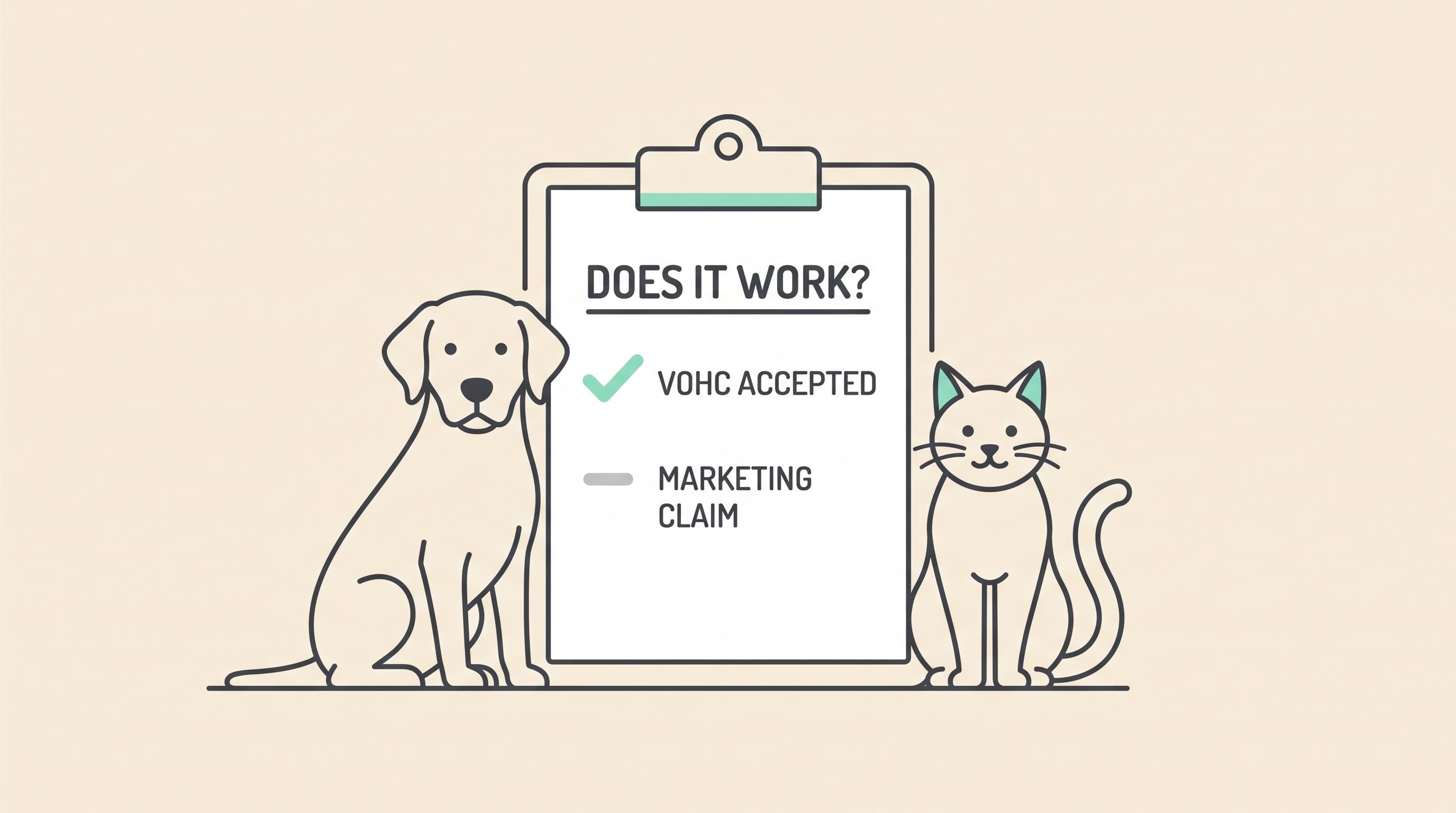
The one filter worth knowing: the VOHC Seal
There is a neutral referee for this whole aisle, and hardly any owner has heard of it. It's the Veterinary Oral Health Council, or VOHC. It was set up in 1997 under the American Veterinary Dental College to do one job: to hold pet dental products to a single, measurable standard and put a seal on the ones that meet it (VOHC).
Here's the part that makes it trustworthy. The VOHC doesn't take money to test products, and it doesn't test them at all. Instead, a company that wants the seal has to run its own clinical trials to a fixed VOHC protocol, then submit the raw results for independent review. To earn the seal, a product has to show a statistically significant reduction in plaque or in tartar (calculus) against an untreated control group, with at least a 15% reduction in each of two separate trials and a mean reduction of at least 20% across them (VOHC). If the data don't clear that bar, no seal. You may see older marketing quote a looser "10%" figure, but the current VOHC standard is the one above.
That's it. That's the whole thing. A product with the VOHC Seal has real, reviewed evidence that it reduces plaque or tartar. A product without it either hasn't been tested to that standard or was tested and didn't pass, and there's no way to tell which from the outside.
A few things the seal does not mean, because they trip people up:
- "Clinically proven" on the box is not the VOHC Seal. A company can run a small, favourable study and print those words legally. The VOHC Seal is a specific logo awarded after independent review. Look for the logo, not the adjective.
- "Vet recommended" means nothing measurable. Any product with one vet somewhere willing to say a kind word can print it.
- The seal comes in two flavours. A product can be accepted for helping control plaque, for helping control tartar, or for both. Plaque is the soft bacterial film that actually causes gum disease. Tartar is the hardened, visible crust. A product that only controls tartar makes the mouth look cleaner without necessarily doing much about the disease process underneath, so it's worth knowing which claim a product actually holds.
- No seal is not proof a product is useless or harmful. It just means there's no independently reviewed evidence it works. Plenty of perfectly nice products have simply never been submitted.
The seal also tells you nothing about how a product does its job, and that matters. Some VOHC-accepted products work mechanically, by physically scraping plaque off as your pet chews. Others work chemically, with an active ingredient that binds minerals in saliva or makes tooth surfaces less sticky for bacteria. Both routes can earn the seal on their results. Neither one reaches below the gumline, which is the single most important limit on everything in this article.
The practical step is simple. The VOHC keeps its accepted-products lists on vohc.org, one for dogs and one for cats, and updates them regularly. Before you spend money, check the current list rather than trusting the packaging. Specific products come and go from it, so I'm going to talk about categories here rather than tell you a brand name that may have changed by the time you read this.
Dental chews and treats: useful, with a ceiling
Dental chews are the most popular category, and the good ones do work, within limits. A well-designed chew reduces plaque and tartar in two ways: the texture forces the tooth through an abrasive material as your dog gnaws, and some carry an active such as sodium hexametaphosphate that helps stop plaque hardening into tartar. Trials on VOHC-accepted chews have shown meaningful reductions, and that's real (VOHC).
Three honest caveats come with them.
First, they only clean what they touch. A chew scrubs the tips and outer surfaces of the big cheek teeth as your dog works at it. It does very little for the small front teeth, the inner surfaces, or the gumline where periodontal disease actually starts. So a chew shifts the visible tartar and freshens breath while leaving the most important real estate untouched.
Second, they only work if given daily, and they're food. A single chew now and then is close to decorative. A daily chew is a daily snack, and many dental chews carry a real calorie load, easily a tenth of a small dog's daily allowance. If you add a daily chew, take the calories off the main meal, or you'll fix the teeth and inflate the waistline.
Third, and this is the Dentastix question everyone actually asks: are the supermarket dental sticks any good? Some variants of the popular sticks do hold the VOHC Seal and some don't, which is exactly why the seal matters more than the brand. The honest position is that an accepted daily stick is a reasonable, convenient adjunct that genuinely reduces plaque a bit, and it is nowhere near as effective as brushing. It is not a con, and it is not a substitute. Check whether the specific product in your hand is on the current VOHC list, then treat it as a useful extra rather than the main event.
Dental diets: real mechanism, same ceiling
Dental diets are a proper, evidence-backed category rather than a gimmick. A therapeutic dental kibble isn't just ordinary food with a claim on the bag. The biscuits are made larger, and with a fibre matrix aligned so that the tooth sinks into the kibble instead of shattering it. That means the tooth is wiped along its surface as it passes through, a bit like a soft brush, rather than the biscuit crumbling on first contact the way normal kibble does. Several dental diets hold the VOHC Seal for plaque and tartar control on the strength of that mechanism (VOHC).
The ceiling is the same as for chews. A dental diet cleans the surfaces the tooth drives through, mostly the cheek teeth, and does little at the gumline or between teeth. It suits a dog or cat who eats dry food anyway and whose owner is realistic about brushing being unlikely. It does not replace a professional dental once disease is established, and it won't undo periodontal disease that's already there. Used from a healthy mouth onward, it's a sensible piece of the puzzle (WSAVA/Niemiec et al., 2020).
Cats are not an afterthought here
Almost every dental-product conversation is framed around dogs, and cats get a token line at the end. That's backwards, because cats are harder to help and the stakes are just as high. Fewer than one in ten cat owners brushes their cat's teeth, and fewer still manage it well, so for a lot of cats the adjunct products carry more of the weight by default (FelineVMA/AAFP, 2025).
The good news is that the VOHC list has a proper feline side. There are accepted dental diets formulated for cats that work on the same larger-kibble, fibre-matrix principle, accepted plaque-control water additives dosed for cats, and dental treats made to a cat's scale. The same rules apply exactly: check the current feline VOHC list, watch the calories on treats (a fat cat is its own problem), and remember that none of it reaches the resorptive lesions and gumline disease that make feline mouths so painful. A cat who has gone off dry food, is drooling, or is chattering the jaw needs a vet and probably dental x-rays, not a new flavour of chew. If your cat will tolerate even a finger-brush a few times a week, that beats any product on the shelf, and it's worth building up to slowly.
Water additives and gels: the weakest tier, honestly
Water additives are the "sprinkle it and forget it" dream, and I understand the appeal completely. You add a capful to the bowl and supposedly the mouth cleans itself. The reality is more sober. This is the weakest-evidence tier of the lot. Some water additives are VOHC-accepted and do produce a modest, measurable drop in plaque; many on the shelf have never been tested to that standard at all, and you can't tell by looking (VOHC).
Even the accepted ones have real limits. An additive may slow the formation of new plaque, but it does nothing to hardened tartar that's already on the tooth, which only a scale under anaesthetic will shift. And there's a practical catch nobody mentions: if your pet dislikes the taste and drinks less as a result, you've traded a tiny dental benefit for the much bigger risk of a dehydrated pet, which matters especially in cats and in any animal with kidney disease. If you use one, use a VOHC-accepted product, keep a plain water bowl available too, and treat it as a minor top-up rather than a strategy.
Sprinkle-on powders sit in the same tier. The best known are based on a specific North Atlantic seaweed (Ascophyllum nodosum), and the idea is that it works systemically through the saliva to make tooth surfaces less sticky, reaching places a chew's texture can't. Some seaweed-based products do hold the VOHC Seal, and the placebo-controlled studies behind them show a modest plaque and tartar reduction rather than a dramatic one. That's a fair adjunct if you want one. It is not a reason to skip brushing.
Do raw bones clean teeth? Partly true, and here's the catch
This is the one that starts arguments, so let me be even-handed. The claim that raw bones clean teeth is not a myth, exactly. It's a half-truth, and the missing half is the dangerous part.
The true half: gnawing on a raw bone really does scrape hard tartar off the crowns of the teeth. In a controlled study of beagles, raw beef bones removed the large majority of existing dental calculus within about two to three weeks (Marx et al., 2016). If you judge "clean teeth" purely by how much visible crust is on the crown, bones do something no chew quite matches.
The missing half is the half that counts. Removing crown tartar is cosmetic. It does nothing for periodontal disease, which lives below the gumline where no bone can reach, and populations of dogs fed whole raw carcasses still show plenty of gum disease alongside their clean-looking crowns. So a bone can give you a tidy-looking mouth that is still quietly diseased where it matters, which is precisely the trap.
And then there's the fracture risk, which is not theoretical. Bones, raw or cooked, are one of the commonest causes of a slab fracture, where the big upper cheek tooth (the carnassial, the fourth upper premolar) splits under the load of chewing something harder than enamel. That fracture usually opens the pulp of the tooth, which is painful and lets infection straight into the root, and it typically needs the tooth extracted or root-treated (WSAVA/Niemiec et al., 2020). I take these teeth out regularly. It's not a rare freak event, it's a Tuesday.
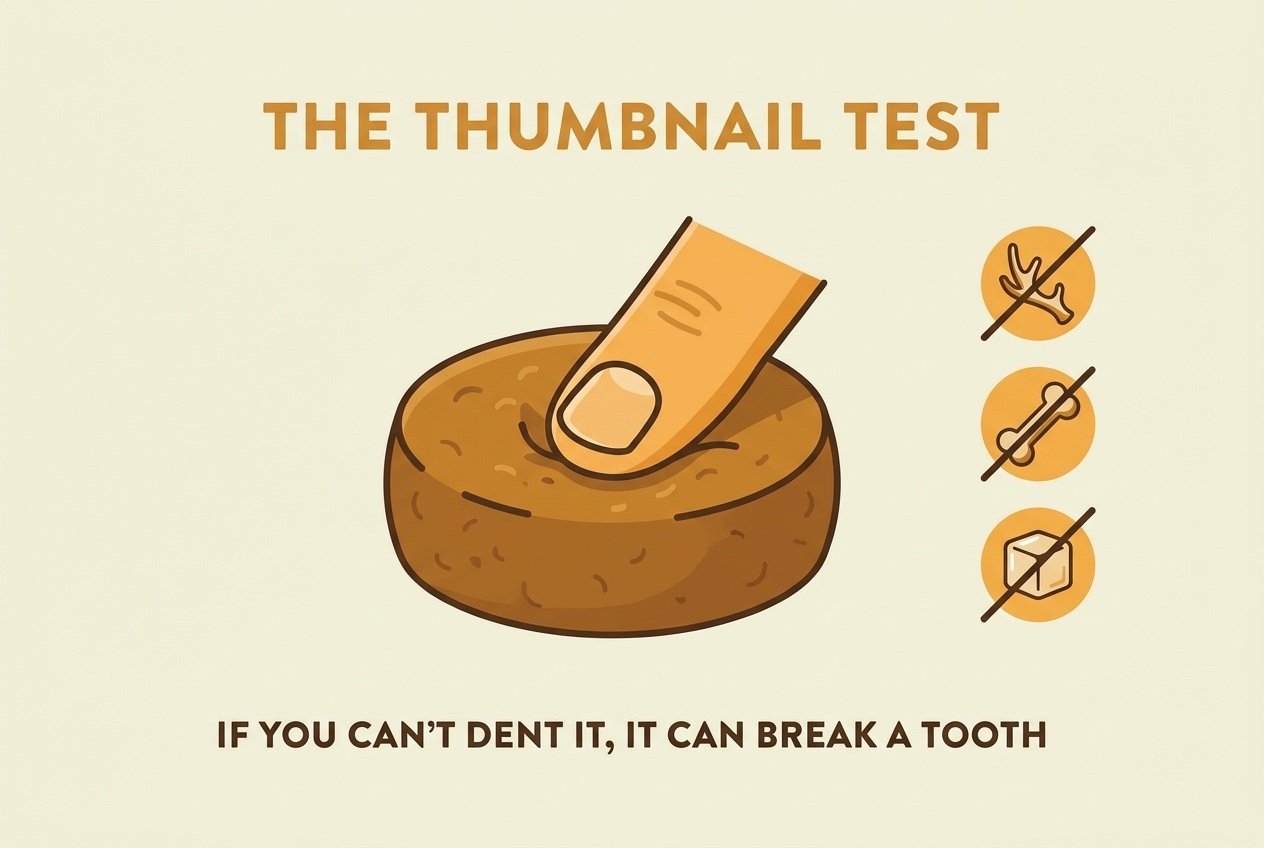
So here's the rule I give every owner, and it covers antlers, hooves, hard nylon bones, cooked and raw bones, and ice cubes too. Do the thumbnail test. Press your thumbnail into it. If it doesn't leave a dent, it's too hard, and it can crack a tooth. A second gut-check: if it would hurt to be hit on the kneecap with it, don't let your dog chew it. Raw bones are not on the VOHC list, and that absence is telling. You can get the tartar off far more safely.
The thing that actually works
After all that, the honest hierarchy is not complicated, and it's a little deflating because the winner is the boring one you already suspected.
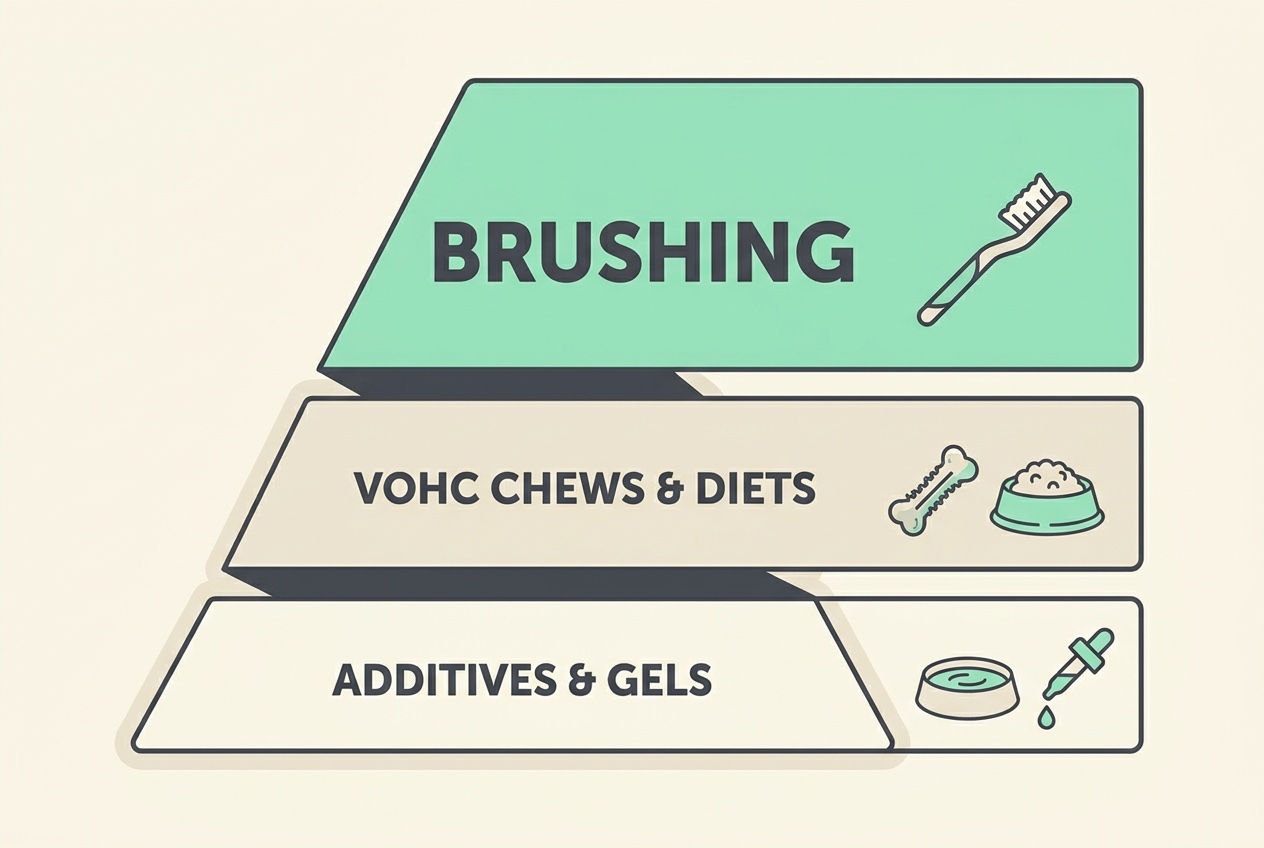
Brushing is the gold standard, and it isn't close. In a direct comparison in dogs, daily toothbrushing produced far lower plaque scores than either a dental diet or a dental chew, with the brushed group scoring around 1.25 against roughly 4 to 4.6 for the diet and the chew (Allan et al., 2019). The reason is simple: a brush is the only home tool that reaches the gumline, all the way round, on every tooth, which is exactly where the disease that matters actually starts. Every other product in this article cleans the bits that show. A brush cleans the bit that counts.
The catch, and the reason this whole aisle exists, is that brushing only works if you actually do it, and most of us don't keep it up. That's not a moral failing, it's just real life. So the sane way to read the shelf is this. Brushing does the heavy lifting. VOHC-accepted chews and dental diets are genuine, worthwhile add-ons, especially for the pet whose owner is never realistically going to brush daily. Water additives and powders are a minor top-up. Hard bones and antlers are a false economy that can cost you a tooth. And none of it, not one product on that wall, replaces a professional dental once disease has taken hold under the gumline (WSAVA/Niemiec et al., 2020; AAHA, 2019).
If you take one thing to the shop tonight, take this: ignore the front of the box, find the VOHC logo, and check the current list on vohc.org for your dog or your cat before you pay. Then pick up a pet toothbrush and some meat-flavoured paste on the way to the till, because the twenty pence a day of enzymatic paste on a soft brush will out-clean everything else in your basket. If you want a hand building the habit so it survives past week two, our Brushing Habit Tracker and the step-by-step guides for brushing a dog's teeth and brushing a cat's teeth are built for exactly that. And for the other half of the shelf, the things to avoid, see dangerous chews and the slab fracture.
References
- Veterinary Oral Health Council (VOHC). About the VOHC, FAQs, and Trial Protocol Requirements. Accepted Products lists for dogs and cats. vohc.org
- Niemiec, B., Gawor, J., Nemec, A., et al. (2020). World Small Animal Veterinary Association Global Dental Guidelines. Journal of Small Animal Practice. WSAVA.
- American Animal Hospital Association (2019). AAHA Dental Care Guidelines for Dogs and Cats.
- Feline Veterinary Medical Association (FelineVMA/AAFP) (2025). Feline Oral Health and Dental Care Guidelines.
- Allan, R.M., Adams, V.J., Johnston, N.W. (2019). Prospective randomised blinded clinical trial assessing effectiveness of three dental plaque control methods in dogs. Journal of Small Animal Practice.
- Marx, F.R., Machado, G.S., Pezzali, J.G., et al. (2016). Raw beef bones as chewing items to reduce dental calculus in Beagle dogs. Australian Veterinary Journal.
Free downloads
Companion worksheets to put what you've read into practice. Free PDFs, print at home.
Keep track of how your pet is doing
The owners who cope best are the ones who notice changes early. A simple health log shows you what is working, and what is not, before the next vet visit.
Start tracking, freeYou're not doing this alone
Compare treatment journeys and talk to owners managing teeth & mouth. Free to join.
Join PetsLikeMine