

Dangerous chews: antlers, bones and the slab fracture
Alastair Greenway
BVM&S MRCVS
You're standing in the pet shop, holding an antler. It's marketed as the sensible choice: natural, long-lasting, no additives, keeps him busy for hours. The packet practically pats you on the back for buying it. Everything about it says "good owner". And that's the problem, because the antler in your hand is one of the commonest ways I see dogs break a tooth.
Or maybe you're not in the shop. Maybe you've just noticed a chipped, greyish back tooth while your dog was yawning, or found a chunk of enamel on the floor next to the antler he's had for a fortnight, and you've come here with a sinking feeling. Either way, this is the article I'd want you to read before you buy the next one. There's a simple test that tells you whether a chew is safe, and once you know it, you'll never look at the hard-chew shelf the same way again.
Why hard things crack teeth
Start with the bit that surprises most owners: a tooth is not as tough as it looks. Enamel, the glassy white outer layer, is the hardest tissue in the body, but in dogs and cats it's also remarkably thin, far thinner than our own. Human enamel runs up to a couple of millimetres deep. A dog's is often well under a millimetre, sometimes as little as a tenth of that (Lewis, 2023). Underneath that thin shell sits softer dentine and, at the core, the living pulp: the nerve and blood supply that keeps the tooth alive and makes it feel pain.
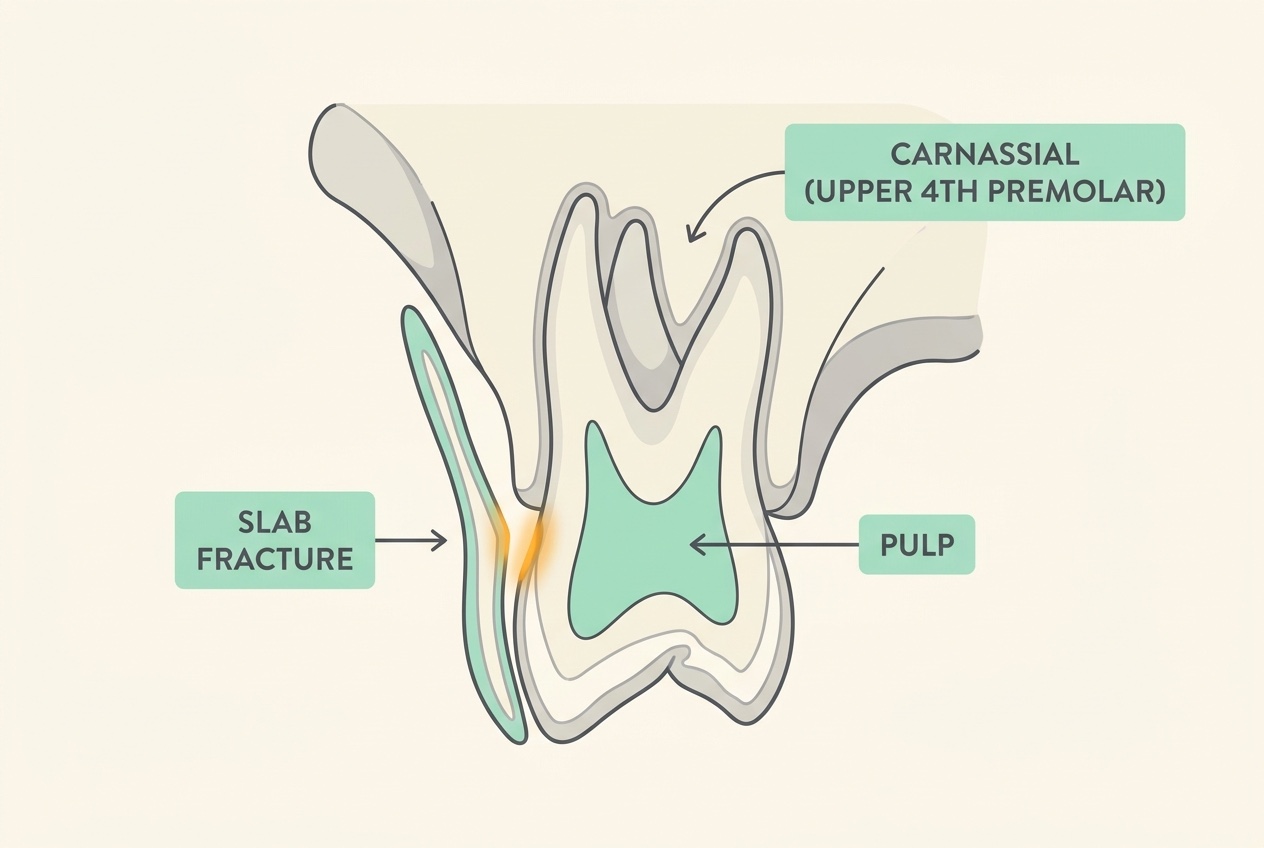
Now think about the physics of a chew. When your dog clamps down on something that gives a little, the pressure spreads out and the object absorbs the force. When he clamps down on something that doesn't give at all, the force has nowhere to go except back into the tooth. Bite down hard enough on an unyielding object at the wrong angle and the enamel doesn't wear, it flakes. A thin plate of tooth, a "slab", splits away from the side of the tooth (Burwood Vet; Best Friends Veterinary Center). That's a slab fracture, and it can happen in a single enthusiastic bite. It isn't gradual damage from a chew that was "a bit too hard for a bit too long". It's a crack that appears in one go, on an object the dog was enjoying, doing exactly what the packet said he would.
The tooth that pays: the carnassial
There's one tooth that takes the hit again and again, and it's worth knowing its name so you can keep an eye on it. It's the upper fourth premolar, the big three-rooted tooth about two-thirds of the way back along the top jaw. Vets call it the carnassial. It's the largest chewing tooth in the mouth and the one your dog instinctively drags a chew round to, because it's his shearing tooth, built to crack and slice. That job is exactly what puts it in the firing line. The classic slab fracture is a flake off the cheek-facing (buccal) surface of the maxillary fourth premolar, and antlers, bones and nylon chews are the usual cause (Lewis, 2023; WSAVA/Niemiec et al., 2020).
The carnassial is also one of the worst teeth to break, because of its plumbing. All three roots share one common pulp chamber, so a slab that opens the pulp on one side has effectively opened the whole tooth (Burwood Vet). That anatomy makes it a difficult tooth to rescue and a common one to end up removing.
Cats aren't exempt, they just break a different tooth. In cats the tooth that fractures most is the canine, the long fang at the front, and while a fair number of feline canine fractures come from falls and road accidents, hard chewing and hard treats do it too (VCA Animal Hospitals; Monroe Veterinary Clinic). A snapped fang with a pink or dark dot at the tip is pulp exposure until proven otherwise, and it's every bit as painful in a cat as in a dog. So this isn't a dog-only warning bolted onto a dog article. If you give your cat hard dental treats or let him gnaw bones, the same rule applies.
What a cracked tooth actually means
Here's where owners go quiet in the consult room, because the word "fracture" sounds dramatic but survivable, and they assume a chipped tooth is cosmetic. Sometimes it is. Vets split tooth fractures into two kinds, and the difference is everything.
An uncomplicated fracture chips the enamel and maybe the dentine but stops short of the pulp. It can still be sore and it still needs a vet to check it, but the living core is sealed. A complicated fracture goes deeper and exposes the pulp (Cornell Riney Canine Health Center). You can sometimes see it as a reddish or black pinpoint in the middle of the broken surface. That pinpoint is an open door. On the day it happens it's genuinely painful, the sort of pain we'd be reaching for strong analgesia over in ourselves. Then, over the following days and weeks, bacteria track down the exposed pulp into the root, the pulp dies, and the tooth becomes a chronic, low-grade abscess sitting in the jaw (Cornell Riney Canine Health Center). A tooth-root abscess on an upper carnassial is the classic cause of a swelling that erupts just below the eye.
Now the part that catches everyone out: through most of that, your dog carries on eating and chewing as if nothing has happened. Pets are hard-wired to hide oral pain, and a dog will happily work a chew on the good side of his mouth while the fractured tooth quietly festers on the other. "He's absolutely fine, still eats like a horse" is not evidence the tooth is fine. It's just evidence he's a dog. Owners are routinely astonished at how much brighter their pet is after a dead tooth comes out, which tells you how much discomfort was being masked.
A complicated crown fracture doesn't heal on its own and it won't settle with a course of antibiotics. It has two real treatments: root canal therapy by a veterinary dentist to save the tooth, or extraction to remove it (Cornell Riney Canine Health Center; VCA Animal Hospitals). On the carnassial, with its shared pulp chamber and three roots, root canal is technically demanding and extraction is often what ends up happening. Both mean a general anaesthetic your dog didn't need to have. That's the true cost of the "natural, long-lasting" antler: not the price on the shelf, but a surgical tooth extraction and the anaesthetic that goes with it.
The usual suspects
If a product is sold as "the toughest chew for power chewers", read that as a warning label, because durability and hardness are the same thing, and hardness is what breaks teeth. The repeat offenders I see behind fractured carnassials are:
- Antlers. The one owners least expect, and one of the commonest culprits veterinary dentists name (Lewis, 2023). Marketed hardest as "natural", they are essentially rock.
- Bones, raw or cooked. Both fracture teeth. Cooked bones also splinter and can pierce the gut; raw bones carry bacterial and choking risks and are not on any list of proven dental products. (We cover the "but bones clean teeth" claim in full in do raw bones clean teeth?.)
- Cow and pig hooves. Hard, hollow and prone to cracking teeth and splitting into sharp shards.
- Hard nylon and hard-plastic "bones". They don't wear down like a real chew because they're built not to, and that's exactly the problem.
- Yak-milk and very hard cheese chews. Sold as gentle and natural; the dried ones are rock-hard.
- Ice cubes, stones, sticks, and the corner of a wall or a crate bar. Not products, but the same physics. Ice in particular gets a free pass from owners on hot days and it shouldn't.
Notice what these have in common. Every one of them is harder than the tooth trying to break it.
Two tests you can do with your own body
You don't need to memorise that list, because two quick tests cover everything, and I give both to every owner who asks.
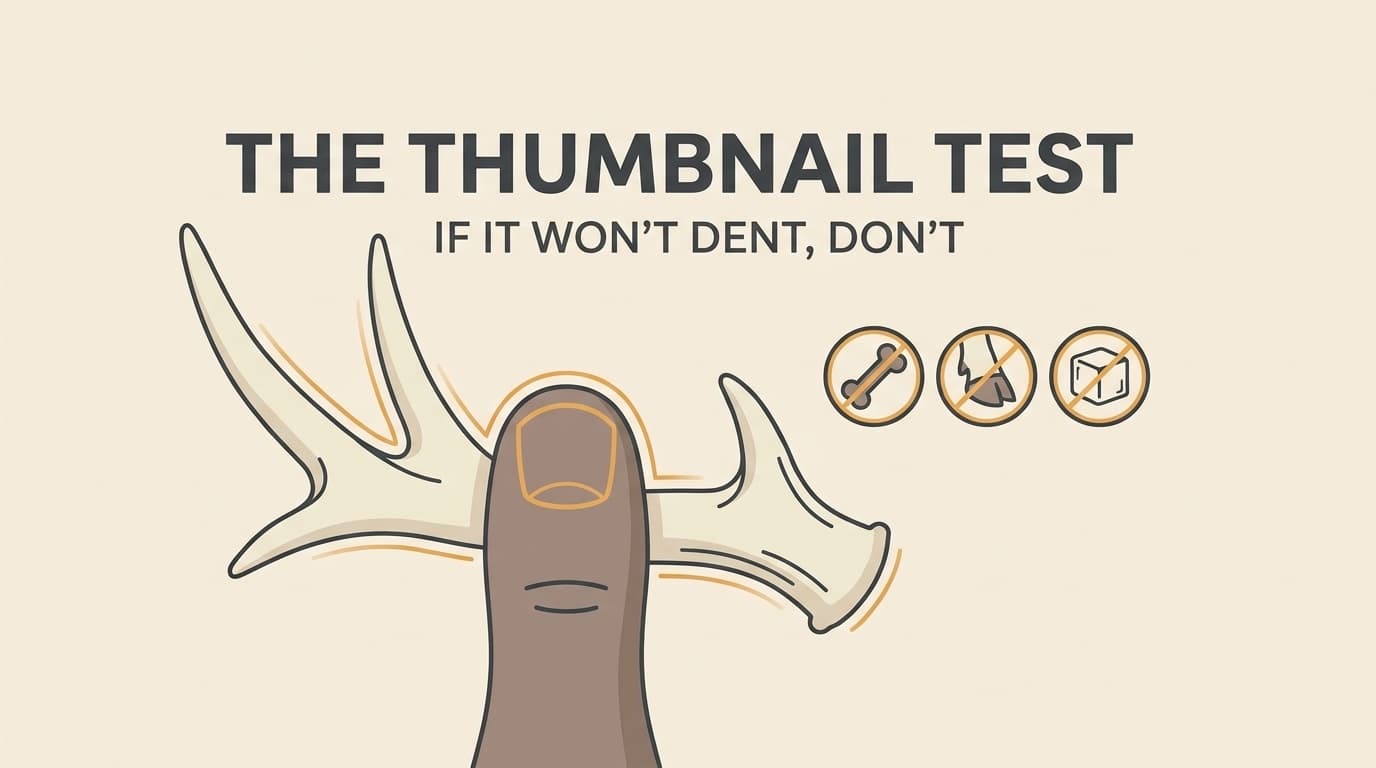
The first is the thumbnail test. Press your thumbnail firmly into the chew. If you can leave a small dent or mark, it has enough give to be reasonably safe. If your nail slides off without marking it, it's harder than your dog's enamel and it can crack a tooth (Veterinary Ireland Journal). That's the whole test. It works on an antler, a nylon bone and a dental treat alike, right there in the shop aisle before you pay.
The second belongs to a veterinary dentist called Dr Fraser Hale, who put it more bluntly and more memorably. It's the knee-cap rule: don't let your dog chew anything you wouldn't be happy to be hit on the kneecap with (Hale, per Kawartha Animal Hospital). If the thought of that object cracking against your own knee makes you wince, it's too hard for a tooth. Between the thumbnail and the kneecap, you have a reliable filter for the entire shelf.
So what can he chew?
None of this means your dog has to give up chewing. Chewing is a real need, it settles anxious dogs and occupies bored ones, and taking it away isn't the answer. The answer is choosing objects with give. As a rule, if a chew flexes, dents or yields under pressure, the force of the bite is absorbed by the chew instead of the tooth (Lewis, 2023). Softer rubber chew toys are the obvious example: durable enough to last, forgiving enough not to fracture teeth. Many can be stuffed with food to keep a dog busy far longer than an antler would.
If your goal is dental benefit rather than just occupation, choose products that have actually been tested to reduce plaque and tartar rather than ones that simply feel tough. The neutral standard for that is the Veterinary Oral Health Council's Accepted Products list, which you can check for free on vohc.org, and a properly designed dental chew is engineered to be firm enough to work yet yielding enough to bend rather than shatter a tooth. We go through the whole "what actually works" question, chews, diets and additives, in chews, dental diets and water additives. Whatever you pick, size it so it can't be swallowed or wedged across the mouth, and supervise. A chew is an activity you do near your dog, not one you leave him alone with for the afternoon.
If you've read this because you've already spotted a chip, a grey or pink-tipped tooth, or a broken fang, don't wait for it to "settle". Book a proper look. Your vet will check whether the pulp is exposed and whether the tooth can be saved or needs to come out, and a fractured tooth is one of the things that can quietly push a mouth up the grades (there's a plain-English guide to those in "Grade 2"? What the vet's dental scale means). And if you're still holding that antler in the shop: do the thumbnail test on it first. I think you already know how it's going to go.
References
- Lewis, J. (2023). Advise clients 'durable' treats are not worth the risk of tooth fractures and tissue injuries. Veterinary Practice News.
- Burwood Veterinary Hospital. Carnassial teeth fractures in dogs. burwoodvet.com
- Best Friends Veterinary Center. Slab fractures. bestfriendsvet.com
- Cornell University College of Veterinary Medicine, Riney Canine Health Center. Risks from a fractured tooth. vet.cornell.edu
- Hale, F. (as cited by Kawartha Animal Hospital, 2018). The knee-cap rule.
- Veterinary Ireland Journal. Exploring tooth-fracture risks in canine patients.
- VCA Animal Hospitals. Fractured teeth in cats and Fractured teeth in dogs. vcahospitals.com
- Monroe Veterinary Clinic. Fractured teeth in cats (2023).
- Niemiec, B., Gawor, J., Nemec, A., et al. (2020). World Small Animal Veterinary Association Global Dental Guidelines. Journal of Small Animal Practice. WSAVA.
- Veterinary Oral Health Council (VOHC). Accepted Products lists for dogs and cats. vohc.org
Keep track of how your pet is doing
The owners who cope best are the ones who notice changes early. A simple health log shows you what is working, and what is not, before the next vet visit.
Start tracking, freeYou're not doing this alone
Compare treatment journeys and talk to owners managing teeth & mouth. Free to join.
Join PetsLikeMine