

Do raw bones clean teeth? The honest answer
Alastair Greenway
BVM&S MRCVS
If you feed raw, you have almost certainly been told that bones are nature's toothbrush. It is one of the most repeated lines in raw feeding, and I understand why it sticks: it makes intuitive sense, it fits the idea of feeding a dog or cat the way its ancestors ate, and there is a visible payoff, because a dog that gnaws bones often does have cleaner-looking teeth than one that doesn't. You are not being gullible for believing it. There is a real grain of truth in there.
I am not writing this to talk you out of raw feeding. That is your decision, and plenty of thoughtful owners make it. I am writing it because "bones clean teeth" is a half-truth, and the missing half is the part that matters most for your pet's mouth, and it comes with some risks that don't get printed on the forum memes. So here is the straight version, the good and the bad, from a vet who pulls the cracked teeth.
The grain of truth: bones really do shift tartar
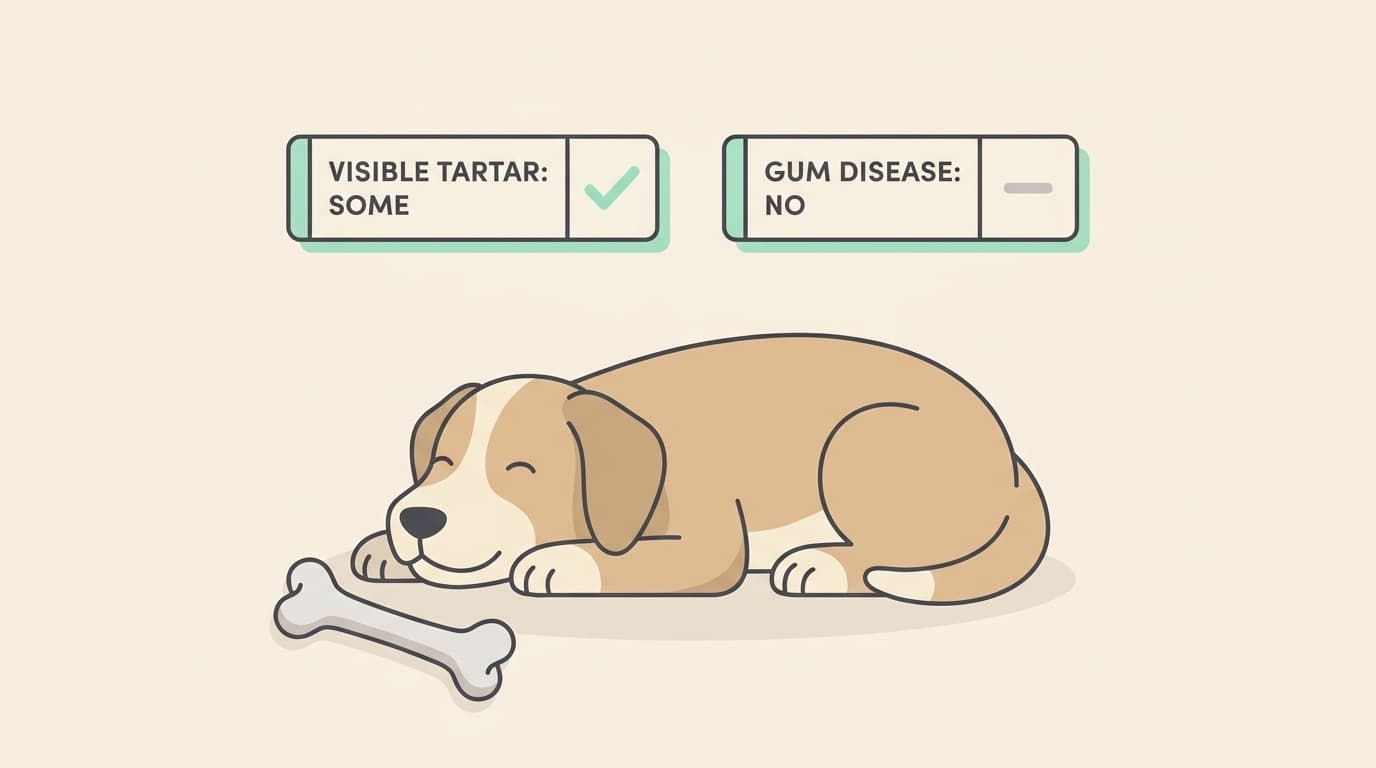
Let's start with what's genuinely true, because it deserves credit. Gnawing on a raw bone is mechanically abrasive, and that scraping action really does remove hard tartar (calculus) from the crowns of the teeth. This isn't folklore. It has been measured.
In a controlled study, Beagle dogs given raw beef bones to chew had the visible calculus on their teeth reduced by around 70% after twelve days with a harder cortical bone, and by nearly 88% after twenty days with a softer spongy bone (Marx et al., 2016). Those are big numbers. If you judge a clean mouth purely by how much brown crust is sitting on the crown, a bone does something that few dental chews can match. So when a raw feeder shows me their dog's gleaming canines, I'm not going to pretend I can't see them. The crowns often are cleaner.
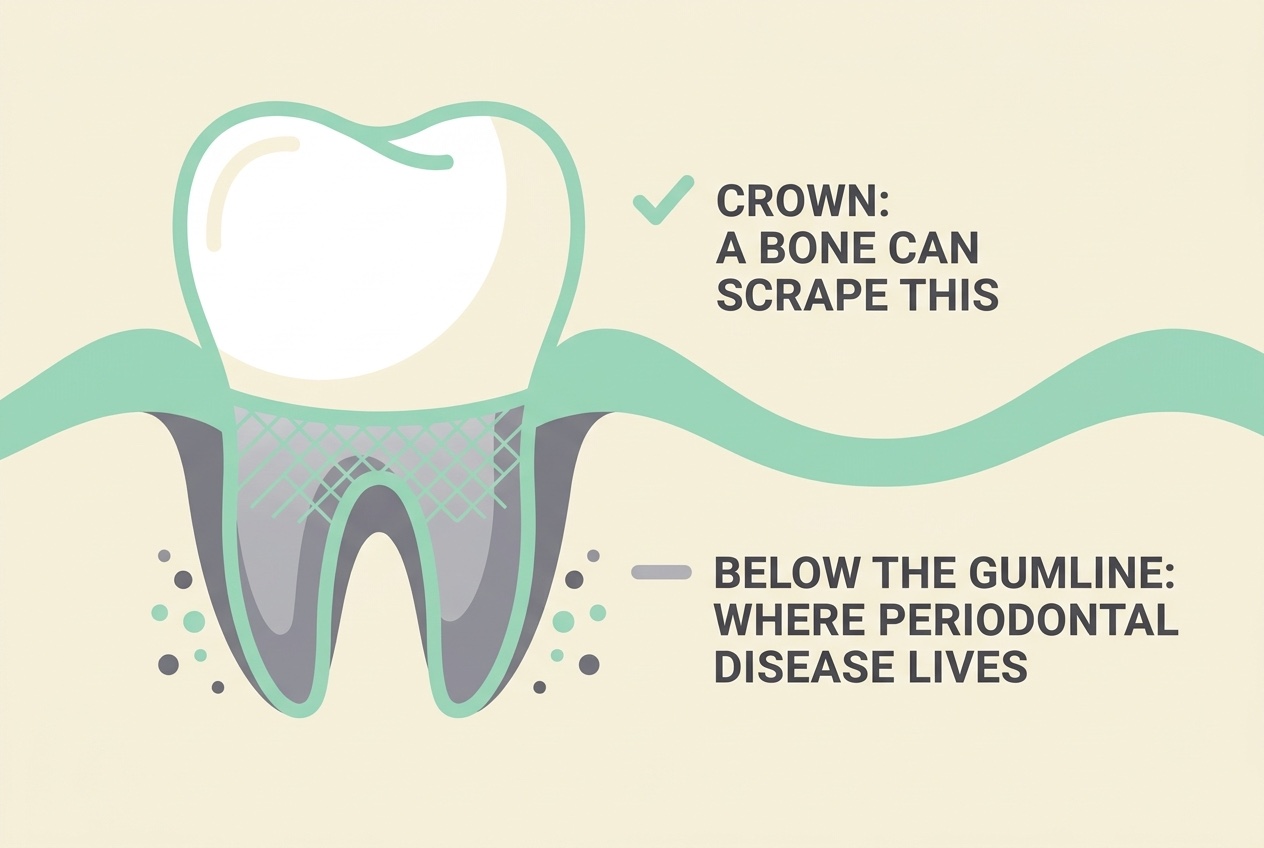
That is the whole of the good news, and it's worth having. But notice exactly what it covers: the visible surface of the tooth, above the gumline, where you can see it. Hold on to that, because it's the hinge the whole question turns on.
The catch: the disease that matters lives where bones can't reach
Here is the part the toothbrush slogan skips. The dental disease that actually costs pets their teeth and causes them pain is not the brown crust on the crown. It is periodontal disease: inflammation and infection below the gumline, in the pocket around the root, where plaque bacteria attack the ligaments and bone that hold the tooth in place (Niemiec et al., 2020). Tartar on the crown is the visible symptom. The disease is underneath, out of sight, and no bone on earth reaches it. A dog can chew its crowns spotless and still be losing bone around the roots.
This is not a theory I'm spinning to defend brushing. It's what we see when we compare animals that eat exactly the diet the slogan is built on.
Take feral cats, which live entirely on the "natural" diet of small mammals, birds and insects, crunching through bone and fur every day. An Australian study compared them with pet cats on tinned and dry food. The feral cats did have significantly less dental calculus, exactly as the theory predicts. But there was no difference in the amount of periodontal disease between the two groups (Clarke and Cameron, 1998). The wild diet cleaned the crowns and did nothing to protect the gums. Wild wolves, eating prey the way the ancestral-diet argument imagines, show plenty of periodontitis too, often worst around the big carnassial teeth they use to crack bone. And packs of working dogs routinely given bones, with no brushing, still turn up with periodontal disease and, as we'll come to, a lot of fractured teeth (Whyte et al., 2021).
So the honest scorecard reads like this. Bones: good at removing visible tartar, useless at preventing the gum disease that actually threatens the tooth. A mouth with clean-looking crowns and quietly diseased roots is arguably more dangerous than an obviously grubby one, because it looks reassuring while the real problem advances unseen.
The risks nobody prints on the meme
If bones only failed to prevent gum disease, they'd be a harmless waste of effort. The trouble is they carry three real risks, and I see all three in the consulting room.
1. Fractured teeth
Bone is hard. Enamel is hard too, but a load-bearing marrow bone or a knuckle bone is often harder, and when a determined dog bites down on something harder than its own tooth, the tooth is what gives. The classic injury is a slab fracture of the upper carnassial, the large fourth premolar near the back of the mouth, where a chunk of the tooth shears clean off (Niemiec et al., 2020). That fracture usually exposes the sensitive pulp inside, which is painful and lets infection straight into the root, and it almost always means the tooth has to be extracted or root-treated.
I'll be even-handed here, because the evidence isn't all one way. The controlled Beagle studies didn't record any fractures over their few weeks, and softer bones caused only minor gum grazes and the odd fragment wedged between teeth (Marx et al., 2016; Pinto et al., 2020). Short trials on chosen bones are gentler than real life. But look at the populations that actually chew bones for years: those Spanish working-dog packs, fed bones and never brushed, had tooth fractures or heavy wear in nearly 69% of dogs (Whyte et al., 2021). Fractured teeth from bones and antlers are one of the commonest dental injuries we treat. It is not a freak event, it's routine.
The simplest safeguard is the thumbnail test. Press your thumbnail into the thing your pet is about to chew. If you can't leave a dent, it is too hard, and it can crack a tooth. Weight-bearing bones (the big femur and knuckle "recreational" bones) fail this test badly. If you feed bones at all, this is the line to hold. There's more on the worst offenders in dangerous chews and the slab fracture.
2. Blockages, perforations and choking
A bone that gets swallowed rather than chewed becomes a problem lower down. Fragments can lodge in the throat and choke, stick in the stomach or intestine as an obstruction, splinter and perforate the gut wall, or pack the colon into painful, constipating cement. The US Food and Drug Administration logged around 68 reports of illness from bone treats over a few years, including gastrointestinal obstruction and around fifteen deaths, some from perforation of the digestive tract (FDA, 2017). Those reports were about processed bone treats rather than raw meaty bones specifically, so I won't overstate them, but the physical hazard is the same one: hard fragments moving through a soft gut. An obstruction can mean emergency surgery, and it can be fatal.
3. What's living on the bone
Raw bone is raw meat, and raw meat carries bacteria. Dogs fed raw meat-based diets shed considerably more Salmonella and Campylobacter in their faeces than dogs on cooked food, and studies keep finding these organisms, sometimes multidrug-resistant strains, in commercial raw products and in the animals eating them (van Bree et al., 2018). Your pet often carries these bugs without looking ill, which is precisely the catch: the risk is as much to you as to them. A dog that has been gnawing a raw bone and then licks a child's face, or a bowl left on the kitchen counter, is a plausible route for a household infection, and the people most vulnerable are young children, the elderly and anyone with a weakened immune system. This is why the FDA, the CDC and the World Small Animal Veterinary Association all advise caution with raw meat in pet diets (Cornell Riney Canine Health Center, n.d.). None of this makes raw feeding indefensible. It does mean the hygiene around bones is not optional.
Cats, bones and the same false comfort
Raw feeding cats is more common than it used to be, and raw chicken necks or wings often get recommended as a "natural" dental. The abrasion argument is the same, and so is its limit. Remember the feral cats: a lifetime of crunching whole prey gave them cleaner crowns and no protection at all from periodontal disease (Clarke and Cameron, 1998). And crucially, bones do nothing whatsoever for the two dental problems that hurt cats most. Tooth resorption, where the tooth dissolves itself from the inside, and feline chronic gingivostomatitis, a fierce immune-driven inflammation of the mouth, are not plaque you can scrape away, and no amount of chewing prevents or treats either. A cat can have beautifully clean-looking teeth and a mouth that is genuinely painful. Cats also tend to bolt small bones rather than grind them, which pushes the choking and obstruction risk up, not down.
So what actually protects the gums?
The deflating truth is that the thing which controls periodontal disease is the boring one: getting under the gumline, mechanically, every day. That means brushing. A toothbrush is the only home tool that reaches the gumline all the way round every tooth, which is exactly where the disease that matters begins, and it remains the gold standard for a reason (Niemiec et al., 2020). Bones clean the part you can see; a brush cleans the part that counts.
And here's the reassuring bit for raw feeders specifically: you do not have to choose. Brushing sits perfectly happily on top of a raw diet. If you want a chewing option too, choose things that pass the thumbnail test, keep a close eye during any bone your pet does get, mind the hygiene, and reach for the products that have actually been measured to reduce plaque, which is what the what actually works guide is for. You can keep feeding the way you believe in and still give your pet's gums the one thing a bone was never going to deliver.
If your dog or cat already has a mouth that smells, bleeds, or has a tooth that's changed colour or shape, that's not a job for a bone or a brush. That's a look under anaesthetic with x-rays, because by then the disease is already below the line where anything you do at home can reach.
References
- Clarke, D.E. and Cameron, A. (1998) Relationship between diet, dental calculus and periodontal disease in domestic and feral cats in Australia. Australian Veterinary Journal, 76(10), pp. 690-693.
- Cornell University College of Veterinary Medicine, Riney Canine Health Center (n.d.) Raw foods for dogs: evidence-based advice.
- FDA (US Food and Drug Administration) (2017) No bones (or bone treats) about it: reasons not to give your dog bones. FDA Consumer Update.
- Marx, F.R., Machado, G.S., Pezzali, J.G., Marcolla, C.S., Kessler, A.M., Ahlstrom, O. and Trevizan, L. (2016) Raw beef bones as chewing items to reduce dental calculus in Beagle dogs. Australian Veterinary Journal, 94(1-2), pp. 18-23.
- Niemiec, B., Gawor, J., Nemec, A., et al. (2020) World Small Animal Veterinary Association Global Dental Guidelines. Journal of Small Animal Practice / WSAVA.
- Pinto, C.F.D., et al. (2020) Evaluation of teeth injuries in Beagle dogs caused by autoclaved beef bones used as a chewing item to remove dental calculus. PLOS ONE.
- van Bree, F.P.J., et al. (2018) Zoonotic bacteria and parasites found in raw meat-based diets for cats and dogs. Veterinary Record.
- Whyte, A., et al. (2021) Periodontal and dental status in packs of Spanish dogs. Animals (Basel).
Keep track of how your pet is doing
The owners who cope best are the ones who notice changes early. A simple health log shows you what is working, and what is not, before the next vet visit.
Start tracking, freeYou're not doing this alone
Compare treatment journeys and talk to owners managing teeth & mouth. Free to join.
Join PetsLikeMine