

Brushing a cat's teeth (yes, really)
Alastair Greenway
BVM&S MRCVS
Let me guess. Your vet mentioned brushing your cat's teeth, you nodded politely, and the whole way home you were thinking one thing: have they actually met my cat? The mental image is a scene of pure chaos. A toothbrush in one hand, a furious cat in the other, and you at the centre of it wearing most of the damage. If that is where you are, you are in good company, because it is the single most common reaction I get in the consult room. "You want me to do what, to that face?"
So I am not going to pretend this is easy, or that every cat will end up serenely offering you their teeth like a spa client. Some won't, and I will be straight with you about that further down. But the flat "impossible with my cat" belief is usually wrong, and it is wrong for a specific reason. Almost everyone who has tried and failed did the one thing that guarantees failure: they started with the toothbrush. The trick with a cat is that you don't start with the toothbrush at all. You start with a finger, a tiny taste of something nice, and a couple of unhurried weeks. Do it in that order and a surprising number of deeply sceptical cats come round.
What brushing actually does (and what it can't)
Before you commit a fortnight of your life to this, it is fair to ask what you are buying. The answer is genuinely worth it, but I want to be precise about it rather than sell you the whole moon.
Brushing removes plaque. Plaque is the soft, sticky film of bacteria that builds up on the tooth every single day, and left alone it inflames the gum (gingivitis) and, over time, drives the destruction of the tissues holding the tooth in (periodontitis). The reason brushing beats almost everything else is timing. Plaque starts reforming within about 24 hours of being cleaned off, so daily disruption is what keeps the gum healthy (WSAVA, 2020). Daily brushing can prevent most forms of dental disease, which is why the feline dental guidelines and Cornell's feline specialists both call it the gold standard of home care (FelineVMA, 2025; Cornell Feline Health Center). Nothing else you can do at home comes close.
Here is the honest limit, though, and it matters because it saves you from blaming yourself later. Brushing works against periodontal (gum) disease, because that is a plaque-driven problem. It does not prevent the two conditions cat owners most dread. Tooth resorption, where the tooth quietly destroys itself from the inside, has no known cause and no known prevention, so no amount of brushing will stop it (FelineVMA, 2025). Feline chronic gingivostomatitis (FCGS), that savage whole-mouth inflammation, is an immune over-reaction, not a hygiene failure. If your cat develops either, it is not because you skipped a night. Brushing is a powerful tool aimed at one specific target: the everyday plaque that causes gum disease. Aim it there, expect it to do that job, and don't expect it to do jobs it was never built for. (There is more on both in our pieces on tooth resorption and feline chronic gingivostomatitis.)
Get the kit right first (and never, ever human toothpaste)
You need surprisingly little. A tube of pet toothpaste, and something soft to put it on: a rubber finger brush that slips over your fingertip, a very soft small toothbrush (a baby one works), or simply a bit of gauze wrapped round your finger (VCA Hospitals). For a cat, small and soft beats anything designed for a human mouth.
The toothpaste part is not optional and it is not fussiness, so please read this bit twice. Never use human toothpaste on a cat. Human paste is formulated on the assumption that you will spit it out. Your cat cannot spit. It will swallow every scrap. Human toothpaste typically contains fluoride at levels meant for adult humans, foaming detergents that upset the stomach, and sometimes xylitol, a sweetener that is a known toxin to dogs and simply has no business anywhere near a pet's food (VCA Hospitals). Pet toothpaste is the opposite by design: it is made to be swallowed safely, it skips the foaming agents, and, the part that actually matters for your sanity, it comes in flavours cats might tolerate or even like, usually fish, poultry or malt. That flavour is not a gimmick. It is the whole reason the training below works, because it turns the paste from an ordeal into a treat.
The finger-first ramp
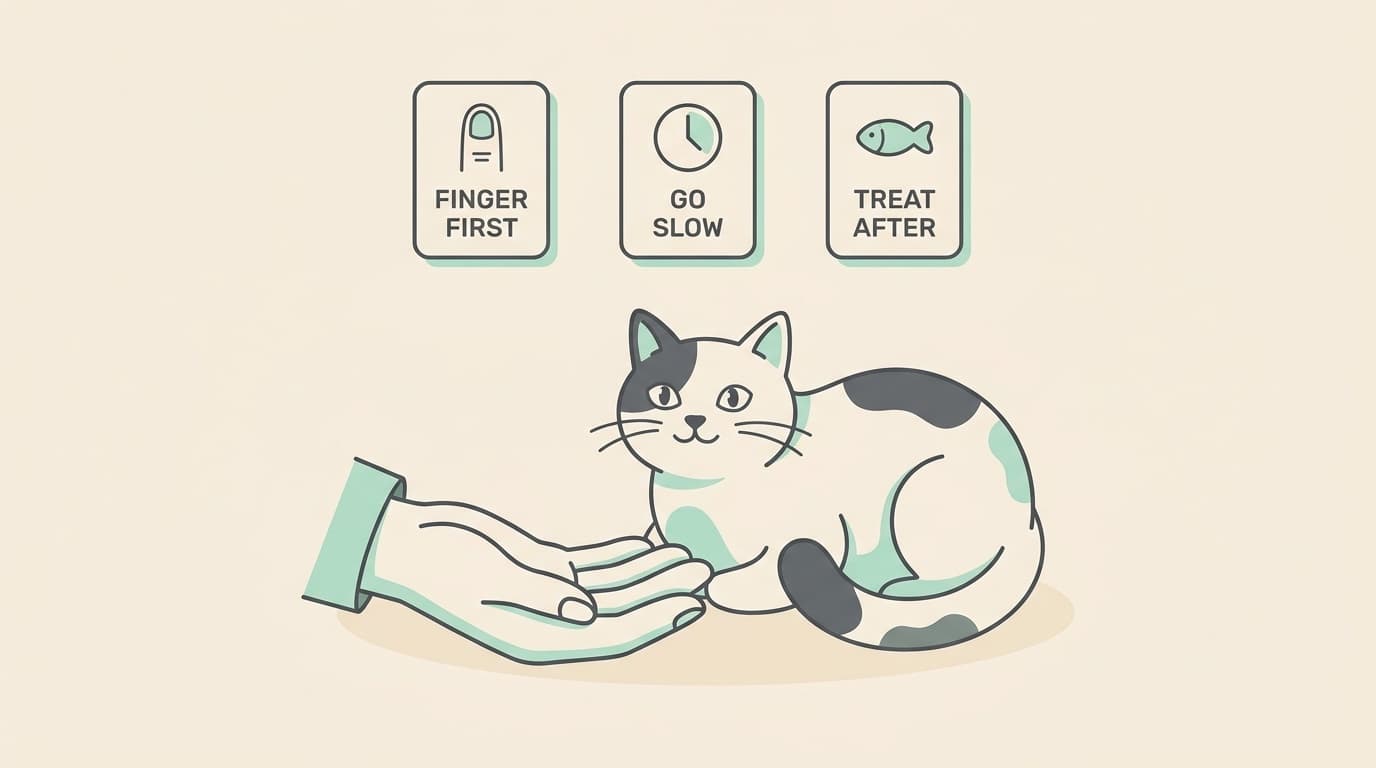
This is the part people skip, and it is the part that decides everything. You are not trying to brush your cat's teeth this week. You are trying to convince your cat, one tiny step at a time, that fingers near the mouth mean good things happen. Behaviourists call it desensitisation. You can call it bribery. It works out the same.
Do each stage once a day, keep every session under a minute, and always finish with something your cat loves, a treat or a bit of fuss, so the last memory is a good one. Only move up a stage when your cat is relaxed and happy at the one you are on. If a stage goes badly, you have not failed, you have simply found this week's edge. Drop back a stage and stay there longer. Expect the whole ramp to take anywhere from one week to six, depending on your cat's temperament and history (VCA Hospitals). A confident kitten might romp through it in days. A wary rescue might need a month. Both are completely normal.
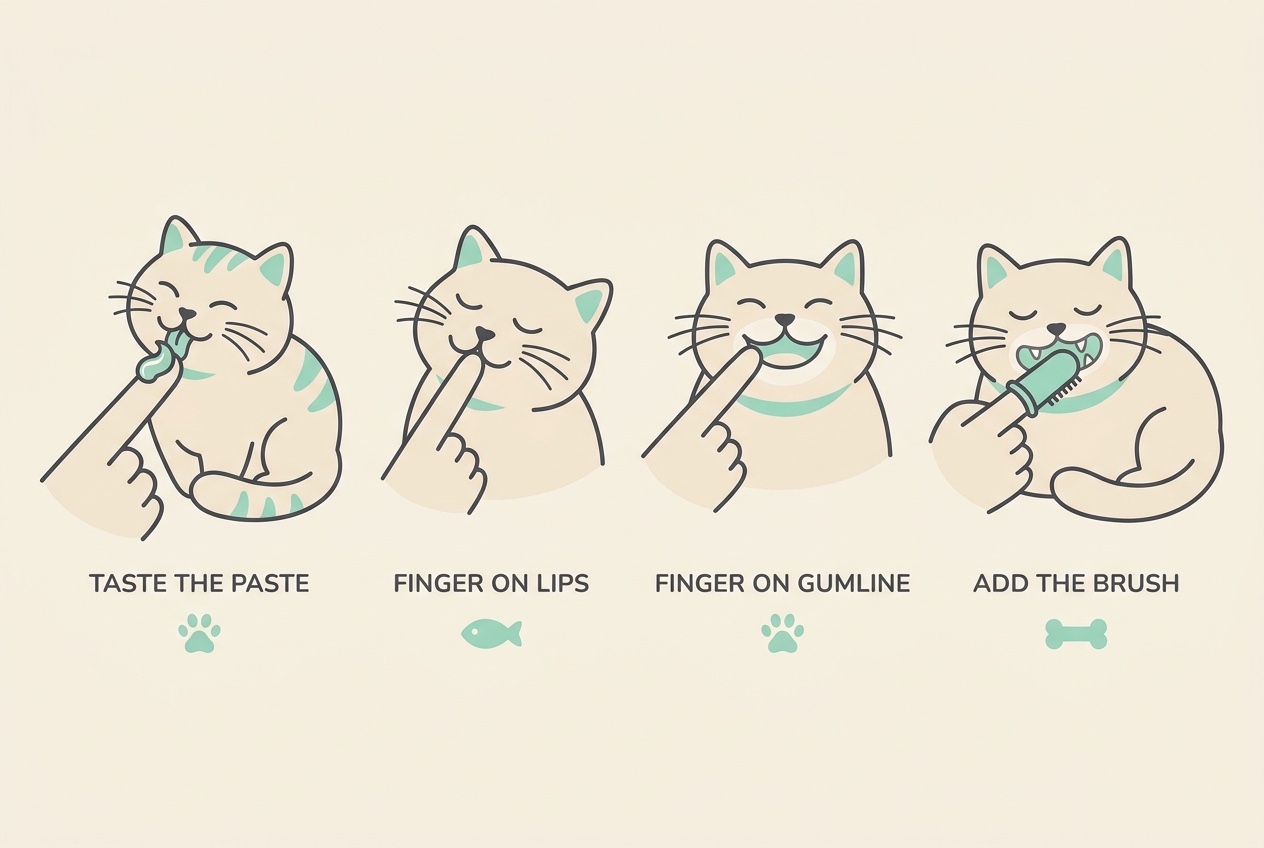
- Days 1 to 3. Just the taste. Put a smear of pet toothpaste on your finger and let your cat lick it off. That is the entire task. Do not go near the mouth, do not lift a lip, just let them decide the paste is delicious. You are building the single most useful association there is: this stuff is a treat.
- Days 3 to 6. A finger on the lips. With a little paste on your fingertip, gently touch the outside of the lips and the front of the muzzle while your cat licks. A second or two is plenty. You are teaching them that your hand arriving at their face is nothing to flinch about.
- Days 6 to 10. A finger along the gumline. Slip your finger just under the lip and rub it briefly along the outside of the teeth and gums, where the tooth meets the gum. A couple of teeth, one or two seconds, then out and reward. Aim for the big cheek teeth and the canines at the sides; those outer surfaces are where plaque gathers and where brushing does most of its work (WSAVA, 2020). You never need to prise the jaws open or reach the inner surfaces. The tongue keeps the inside reasonably clean; it is the outside that needs you.
- Days 10 to 14 and beyond. Introduce the brush. Now, and only now, swap your finger for the finger brush or a soft brush with paste on it. Keep the mouth gently closed, tilt the head to about 45 degrees, and run the brush along the outside of just a few teeth in small circles, the same spots your finger already knows (VCA Hospitals). Build up over further sessions until you can do most of the outer surfaces in under a minute. Then hold there. That is the finished routine. You are done climbing.
The golden rule threaded through all of it: quit while you are ahead. The instinct is to push for one more tooth, one more second, because you are finally getting somewhere. Don't. A cat you stop on a good note comes back tomorrow willing. A cat you push into a struggle remembers the struggle, and you can undo a fortnight of goodwill in ten forced seconds.
Once you are there: keep it small and keep it up
The whole ball game is consistency, and consistency is a fight against week two, when the novelty wears off and life gets busy. Aim for once a day, because daily is what actually holds gum disease off (Cornell Feline Health Center). If daily is genuinely not going to happen in your house, three times a week is the sensible floor, still enough to make a real difference to plaque (VCA Hospitals). What matters far more than any single perfect session is that the sessions keep coming, week after week, month after month. A pretty good brush most days beats a heroic brush that you abandon by the school holidays.
Because that steady rhythm is the hard part, we built the Brushing Habit Tracker to take the remembering off your hands: it logs each brush, nudges you when you drift, and shows the streak building so the habit sticks past that week-two wobble. [TRACKER TOOL: placeholder link, wire real route at integration]
When you shouldn't brush right now
One important caveat before you start, because enthusiasm can do harm here. If your cat's mouth is already sore, brushing will hurt, and hurting your cat is the fastest way to lose their trust for good. Do not start (or keep going) if you see an angry red gumline, bleeding, obvious pain, or the fierce inflammation of gingivostomatitis. Brushing a mouth like that is painful and can make things worse, so the right move is a vet check first (Cornell Feline Health Center). Get the mouth diagnosed and comfortable, and start or restart the brushing once it has healed. A young cat with red, sore gums deserves the same pause and the same look; see our piece on sore gums in a young cat. Brushing is preventive maintenance for a healthy or treated mouth, not a treatment for a diseased one.
If your cat simply says no
Now the promise I made at the top. Some cats will not accept this, ever, no matter how patient and clever you are, and I need you to hear that this is not a mark against you or your cat. Most cats can be trained with a gentle enough ramp, but not all, and a cat who genuinely cannot bear having their mouth handled is telling you something you should respect (Cornell Feline Health Center). Forcing it is worse than useless. It is stressful for the cat, risky for your fingers, and it poisons the very trust you would need to get anywhere.
So if you have honestly worked the ramp and hit a wall, brushing is not the only card in the deck. It is the best card, but a mouth kept reasonably clean by other means is far better than a mouth left to marketing and hope. The sensible alternatives:
- VOHC-accepted dental products. The Veterinary Oral Health Council seal is the one neutral marker that a chew, dental diet, water additive or gel has actually met a plaque or tartar reduction standard in trials, rather than just claiming it on the box. For a non-brushing cat, a VOHC-accepted product is the honest plan B. We sort the ones that work from the ones that don't in chews, dental diets and water additives: what actually works.
- Brushless gels. Some oral hygiene gels are designed to be smeared on or added without any brushing at all, which suits a cat who will tolerate a finger but not a brush, or one with tender gums (Cornell Feline Health Center). Check for the VOHC seal and ask your vet what fits your cat.
- More frequent professional dentals. A cat who accepts no home care at all will lean harder on professional cleaning under anaesthetic, which may mean your vet recommends them a little more often. That is a reasonable trade, not a failure.
None of these replaces brushing when brushing is possible, and none of them replaces a proper dental once disease has set in. But they are real, and they mean the door is never fully shut on caring for your cat's mouth.
So here is your actual first step tonight, and notice how small it is. Do not buy a toothbrush. Buy a tube of pet toothpaste, put a smear on your finger, and let your cat lick it off. That is the whole job for today. If they come back for more tomorrow, you have already started, and you have started in exactly the right place.
References
- World Small Animal Veterinary Association (WSAVA). Global Dental Guidelines. WSAVA, 2020.
- Feline Veterinary Medical Association (FelineVMA). 2025 FelineVMA feline oral health and dental care guidelines. Journal of Feline Medicine and Surgery, 2025.
- Cornell Feline Health Center. Feline Dental Disease. Cornell University College of Veterinary Medicine.
- VCA Animal Hospitals. Brushing Your Cat's Teeth.
- American Animal Hospital Association (AAHA). Dental Care Guidelines for Dogs and Cats. AAHA, 2019.
- Veterinary Oral Health Council (VOHC). VOHC Accepted Products.
Free downloads
Companion worksheets to put what you've read into practice. Free PDFs, print at home.
Keep track of how your pet is doing
The owners who cope best are the ones who notice changes early. A simple health log shows you what is working, and what is not, before the next vet visit.
Start tracking, freeYou're not doing this alone
Compare treatment journeys and talk to owners managing teeth & mouth. Free to join.
Join PetsLikeMine