

Sore gums in a young cat: juvenile gingivitis and early FCGS
Alastair Greenway
BVM&S MRCVS
You lifted your kitten's lip, maybe to check a wobbly baby tooth or because her breath had turned, and the gum line stopped you. A bright, angry red rim running along the teeth, puffy in places, perhaps a smear of blood where it met the tooth. She is barely a year old. She should have a perfect, pristine mouth, and instead it looks inflamed and sore. So you did what any of us would do, you searched it, and somewhere in the results was the phrase "feline chronic gingivostomatitis", a lifelong, painful, teeth-out disease. Now you are frightened that this is where your young cat is heading.
Let me set your mind at ease on the biggest fear first, before we get into the detail. Red gums in a cat this young are common, they usually are not FCGS, and most of the time they settle. What you are almost certainly looking at is something with its own name, juvenile gingivitis, and it behaves very differently from the condition you read about. That said, I am not going to tell you to ignore it, because a smaller group of these young cats does need prompt help to stop the gums turning into something that damages the teeth for good. The trick is knowing which is which, and the good news is that the two most useful things you can do, a vet check and starting gentle home care now, are the same whichever way it goes.
What juvenile gingivitis actually is
As the adult teeth come through, roughly between six and ten months of age, a lot of young cats develop a striking band of inflammation along the gum line (FelineVMA, 2025). The gums go red, sometimes swollen and slightly overgrown, they bleed easily, and the breath can turn. The thing that catches vets' attention, and yours, is that the redness looks far worse than it should for the tiny amount of plaque actually on the teeth. A grubby mouth you could understand. This is a young, fairly clean mouth reacting as if it were filthy.
That mismatch is the clue to what is going on underneath. Juvenile gingivitis is not thought to be simple dirt-and-plaque gum disease. The best current understanding is that some young cats' immune systems over-respond to the ordinary bacteria that live in every mouth, mounting an inflammatory reaction out of all proportion to the trigger (FelineVMA, 2025). Exactly why some cats do this and others do not is not known. There is a clear genetic thread, because certain breeds turn up far more often than chance would predict, including Maine Coons, Siamese, Abyssinians, Somalis and Ragdolls (FelineVMA, 2025). If your kitten is one of those, it is worth having this on your radar from around six months rather than waiting for a problem.
None of this is your fault, and I want to be firm about that because owners of young cats blame themselves hardest of all. You did not cause it by feeding the wrong food or by missing brushing. It is a quirk of how that individual cat's mouth reacts, present before you had any say in the matter.
Why this is not the FCGS you were dreading
The condition that scared you, feline chronic gingivostomatitis, is defined by where the inflammation goes. In FCGS the raw, ulcerated tissue spreads well beyond the gums, past the point where gum meets cheek (the mucogingival junction), and reaches back to the folds at the very rear of the mouth and the throat (FelineVMA, 2025). It is that back-of-mouth involvement, the caudal mucosa, that makes FCGS what it is. It is also, in the great majority of cats, an adult disease, most often showing up in middle age rather than kittenhood (Soltero-Rivera et al., 2023).
Juvenile gingivitis, by contrast, stays put. The inflammation sits on the attached gum around the teeth and does not march to the back of the mouth (FelineVMA, 2025). So when you look inside and the redness is a rim along the gum line only, with the back of the mouth looking normal, that pattern is reassuring. It points towards the juvenile problem that tends to settle, not towards the chronic one that does not.
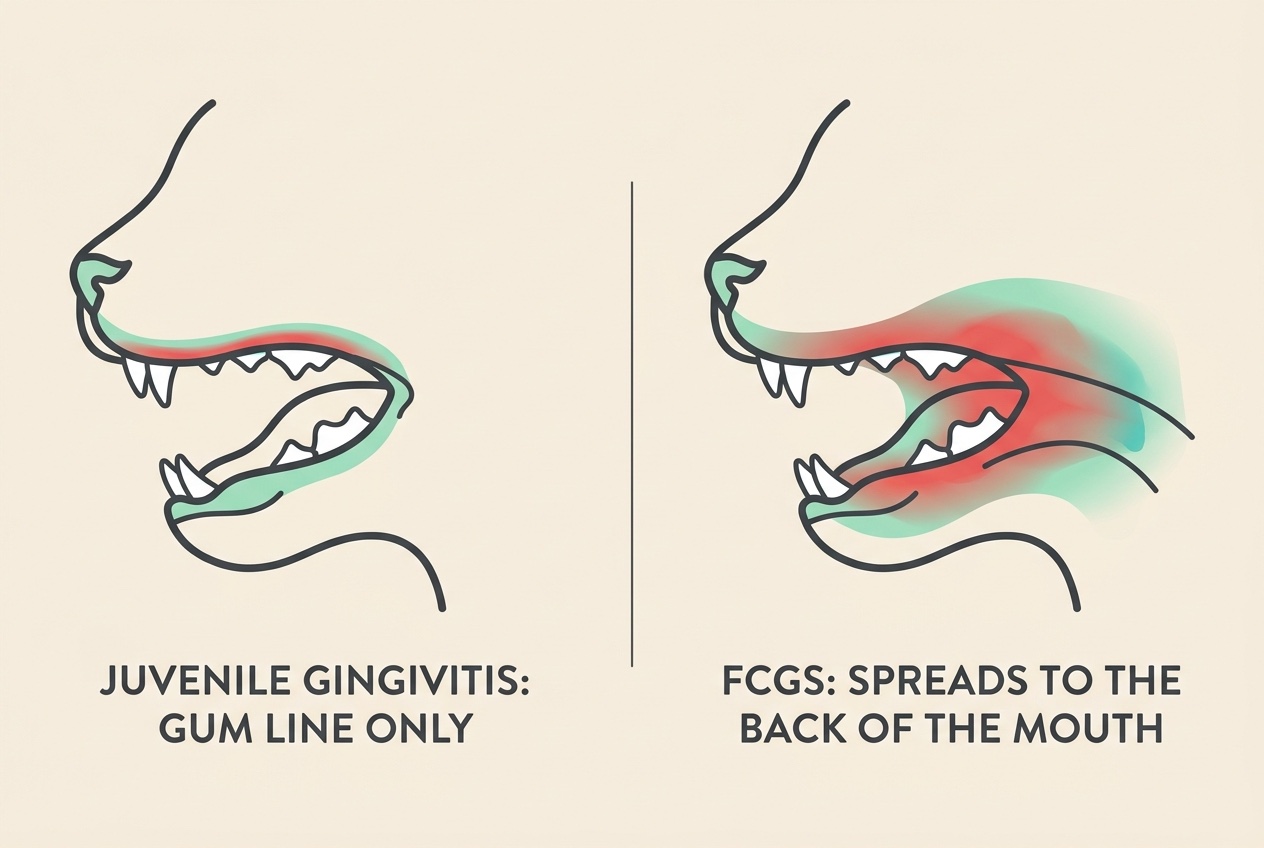
I will be straight with you about the overlap, because you will find it if you keep reading online. A small number of cats who start with juvenile gum disease do go on to develop FCGS-like changes later, and researchers are still untangling how, or whether, the two are linked (FelineVMA, 2025). It is real, but it is the exception, not the expected path. The everyday version of your kitten's red gums is far more likely to be the settling kind.
The honest catch: when it does not just settle
Here is the part I would be doing you a disservice to skip. "Usually settles" is not "always settles", and juvenile gingivitis has a more serious cousin called juvenile-onset periodontitis. In this version the inflammation does not stay skin-deep. It starts eating into the bone and the fibres that hold the teeth in place, and it can do so in a cat barely out of kittenhood, sometimes loosening or losing teeth before the second birthday (FelineVMA, 2025).
The genuinely important thing about this is that you cannot see it from the outside. The gum line can look like straightforward gingivitis while, below it, bone is already being lost. In young cats with moderate to severe gum inflammation, the majority turn out to have real periodontal disease on x-ray that was invisible on an awake look in the consult room (FelineVMA, 2025). This is exactly why a vet will not just glance in and send you home. The only way to know whether those red gums are the harmless settling kind or the bone-losing kind is to look properly, and looking properly means dental x-rays and gentle probing under a general anaesthetic.
I know a general anaesthetic on a young cat sounds like a big step for "just sore gums". Weigh it against what it buys you, which is certainty at the one age when catching this early changes everything. A tooth's supporting bone, once it is gone, does not grow back. Finding trouble at eight months and acting on it is a completely different prospect from finding it at three years with teeth already lost.
What the vet will actually do
If your vet is concerned enough to recommend a proper assessment, here is roughly what that involves and why (FelineVMA, 2025). Under anaesthetic they will chart every tooth, take full-mouth x-rays to read the bone below the gum, and clean the teeth thoroughly both above and, importantly, below the gum line where the disease lives. Where the gum has overgrown into puffy folds, they may trim it back so it can heal flat and clean. Any baby teeth that have stubbornly failed to fall out get removed, because a retained deciduous tooth crowds its neighbour and traps plaque exactly where you least want it. If the x-rays show teeth that are already losing significant bone, extracting those few is far kinder than leaving them to cause pain and further loss.
For most young cats caught early, that is the extent of it, a clean-up, not a mouthful of extractions. It is worlds away from the near-full-mouth surgery that FCGS often needs. Your vet will then usually want to recheck the mouth every few months through the rest of the first couple of years, because this is an active phase and staying ahead of it is what protects the teeth (FelineVMA, 2025).
The lever that is genuinely in your hands: home care now
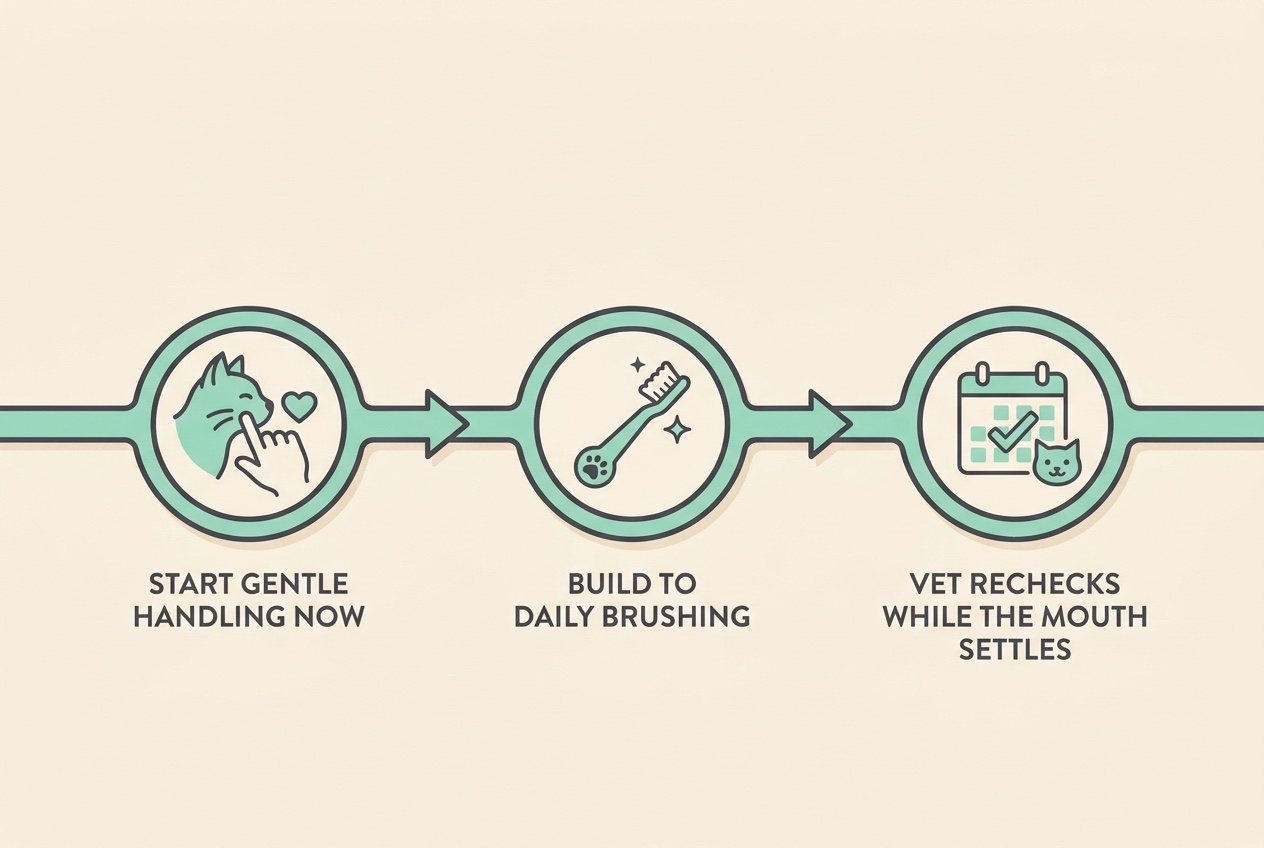
This is where you have more power than you might think, and it is the reason I would rather you read this than lie awake worrying. Daily plaque control is the single most effective thing that keeps a young inflamed mouth from tipping into the bone-losing kind, and you are starting at the best possible age for it (FelineVMA, 2025). A kitten who learns that having her mouth handled is normal, even pleasant, becomes an adult cat you can actually brush, and brushing is the gold standard by a distance.
Do not expect to be scrubbing molars by the weekend. The way it works with cats is a slow ramp, finger first, over weeks, letting her set the pace. We walk through exactly how to build that habit without a fight in our guide to brushing a cat's teeth, and with a young cat you have a real head start because the routine can grow up alongside her. Where brushing is genuinely not tolerated yet, dental products carrying the VOHC seal (the independent mark for things actually shown to reduce plaque) are a reasonable bridge, though they are a supplement to brushing rather than a replacement for it.
One firm no while we are here. Please do not try to scrape the redness or any tartar off yourself, however tempting the idea or the online videos are. You cannot reach the part that matters, below the gum, and you can hurt her gums and put her off letting you near her mouth for life. Home care is gentle brushing and vet-verified products, and nothing sharper than that.
When to stop watching and pick up the phone
Most young red gums can wait for a routine appointment rather than an emergency one, but some signs mean sooner rather than later. Book a check, and mention it is the mouth, if you see gums that bleed readily or look overgrown and lumpy, breath that has genuinely turned, or your cat starting to drop food, chew on one side, or paw at her face. A predisposed breed with obvious gum inflammation is worth an early look on principle rather than a wait-and-see.
The signs that push me towards worrying about the more serious end, and towards a prompt appointment, are redness that is clearly spreading back towards the throat rather than sitting on the gum line, any ulcers or raw patches on the cheeks or back of the mouth, and a cat who is going off her food, losing weight, or crying when she eats. Those are the features that separate simple juvenile gingivitis from something heading in the direction of FCGS, and they are covered more fully in our pieces on the hidden signs of dental pain and feline chronic gingivostomatitis if you want to read further. And if your cat stops eating altogether, do not sit on it. A cat that will not eat needs a same-day call, whatever the cause.
The practical next step from here is small and doable. Book a mouth check with your vet in the next week or two so someone can tell you which kind of red gums you are dealing with, and this evening, start letting your kitten get used to your finger near her mouth. You are catching this at the age when it is most fixable, and that is a genuinely good place to be starting from.
References
- FelineVMA (Lobprise, H., St Denis, K., Anderson, J. G., Hoyer, N., Fiani, N., & Yaroslav, J.) (2025). 2025 FelineVMA feline oral health and dental care guidelines. Journal of Feline Medicine and Surgery.
- Soltero-Rivera, M., Goldschmidt, S., & Arzi, B. (2023). Feline chronic gingivostomatitis: current concepts in clinical management. Journal of Feline Medicine and Surgery, 25(9).
Keep track of how your pet is doing
The owners who cope best are the ones who notice changes early. A simple health log shows you what is working, and what is not, before the next vet visit.
Start tracking, freeYou're not doing this alone
Compare treatment journeys and talk to owners managing teeth & mouth. Free to join.
Join PetsLikeMine