

Brushing a dog's teeth (and actually keeping it up)
Alastair Greenway
BVM&S MRCVS
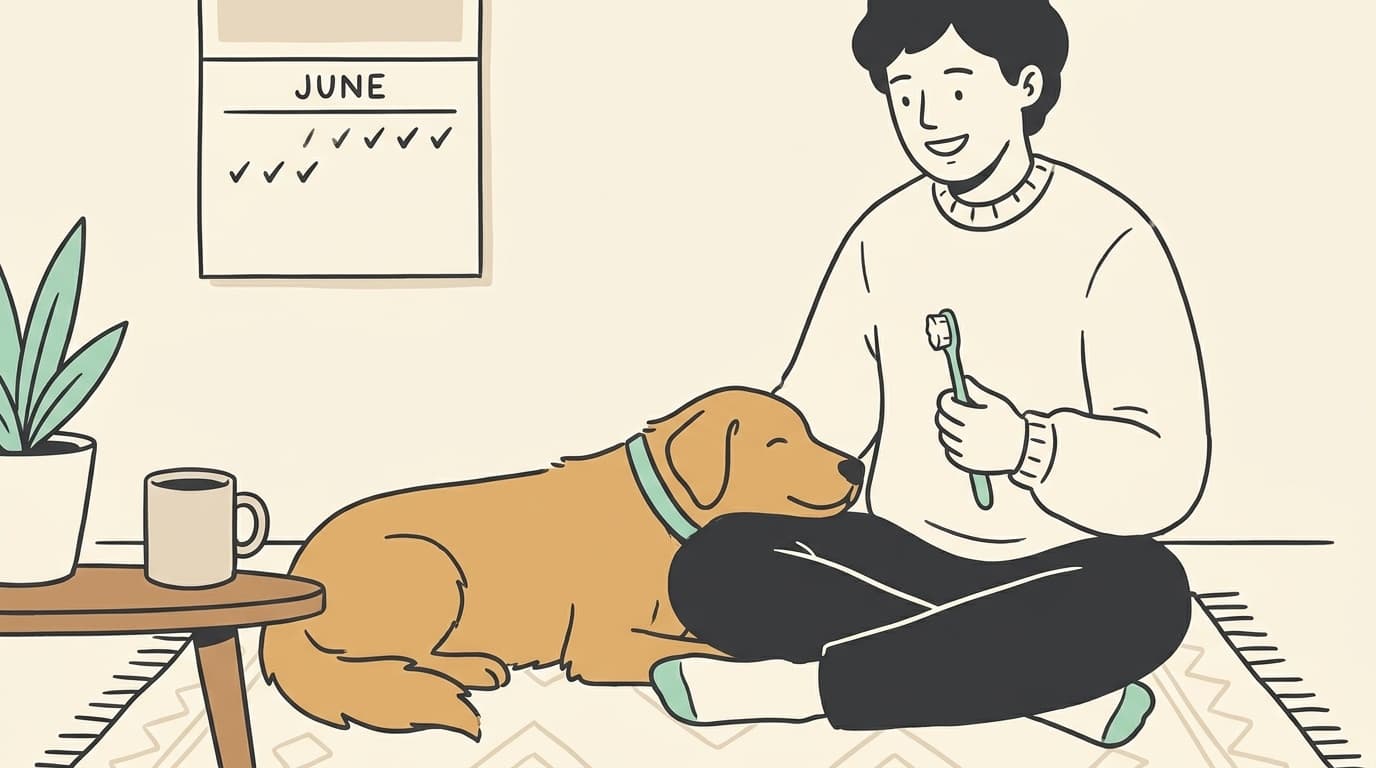
You've just picked your dog up from a dental. The mouth that smelled like a drain last week is clean and pink, she's brighter than she's been in months, and the vet has said the thing every vet says at discharge: "the best way to keep it like this is to brush her teeth." You mean it this time. On the way home you buy a toothbrush and a tube of meat-flavoured paste, and for about five days you're brilliant. Then one night you're tired, you skip it, and skipping it once turns out to be much easier than doing it. By week two the brush is at the back of a drawer with the good intentions.
I see this cycle constantly, and I want to be clear at the start: it is not a discipline problem, and you are not lazy. Almost everyone starts brushing and almost everyone stops, usually inside a fortnight. The reason is never "I couldn't be bothered." It's that they were sold a task (brush the teeth) instead of a habit, they went too fast for the dog, and the whole thing became a two-person wrestling match that nobody wanted to repeat. This article is about doing it the other way: slowly enough that your dog tolerates it, and built into your day tightly enough that it survives past week two.
Why brushing is the one that actually works
Before the how, a quick word on why it's worth the bother, because that's the thing that gets you through the hard fortnight. Brushing is the gold standard for home dental care, and it isn't a close-run thing (WSAVA/Niemiec et al., 2020). In a direct head-to-head trial in dogs, daily toothbrushing produced far lower plaque scores than either a dental diet or a dental chew, with the brushed dogs scoring around 1.25 against roughly 4 to 4.6 for the diet and the chew (Allan et al., 2019). Nothing else you can do at home comes close.
The reason is mechanical and simple. Gum disease starts at the gumline, in the narrow gap where the tooth meets the gum, and a brush is the only home tool that actually reaches there, all the way round, on every tooth. Chews and dental diets scrub the tips and outer faces of the big cheek teeth and do very little at the gumline where the trouble is. A brush cleans the bit that counts.
There's a clock ticking, too, which is why frequency matters more than technique. The film of bacteria called plaque starts forming on a clean tooth within about 24 hours. Left alone, it begins to harden into cement-like calculus (tartar) in roughly three days, and once it's calculus you cannot brush it off, only a scale under anaesthetic will shift it. So the entire game of home brushing is to disturb the plaque regularly enough that it never gets the chance to set. That's it. You're not scrubbing teeth clean like a surgeon, you're just wiping the day's plaque off before it turns to stone.
One honest caveat before we go on. Brushing keeps a healthy or freshly cleaned mouth healthy. It does not undo periodontal disease that's already established, and it won't remove calculus that's already there. If your dog hasn't had that dental yet and her mouth is already sore or crusted, brushing a painful mouth will only teach her to hate it. Get the professional clean done first, let the mouth heal (usually a couple of weeks if there were extractions), and start brushing on a comfortable mouth. If you're not sure where your dog is, our guide to checking your dog's mouth at home will help you read it.
The toothpaste rule that isn't optional: never human paste
This is the one hard safety line in the whole article, so I'll be blunt about it. Never use human toothpaste on your dog. Ever.
Two reasons. First, many human toothpastes contain xylitol, an artificial sweetener that is severely toxic to dogs. It triggers a rapid, dangerous crash in blood sugar within as little as 10 to 60 minutes and can cause liver failure. Second, human toothpaste is loaded with fluoride and foaming detergents that are made to be spat out. Your dog can't spit, she swallows the lot, and swallowed fluoride and detergent cause stomach upset and worse. Human paste is formulated for a creature that rinses and spits. Your dog does neither.
Use a toothpaste made for dogs. The good ones are enzymatic, meaning they carry enzymes such as glucose oxidase and lactoperoxidase that help break down plaque bacteria chemically as well as physically, and they're made to be swallowed safely. They also come in flavours dogs actually want (poultry, beef, malt), which matters far more than you'd think, because the flavour is what turns the paste from a chore into a treat your dog looks forward to. That single fact does more for your chances of keeping this up than any brushing technique. Buy the flavour your dog loves.
The ramp: go slower than feels necessary
Here is where most people fail, and it's entirely fixable. They come home fired up and try to brush every tooth on day one. The dog, who has never had a plastic stick pushed into her mouth, quite reasonably objects, and now brushing means restraint and stress for both of you. You have to earn the brush, over days, by making every step so easy and so rewarded that your dog is almost pleased to see you coming. Vets call this desensitisation. You're breaking the job into tiny steps and pairing each one with something nice (VCA, 2023).
Do not rush the ramp. For an easy-going dog it might take a week. For a suspicious one it can take a month, and that's fine. You are not behind. Each stage should feel boringly easy before you move to the next, and if a stage goes badly you drop back to the one before.
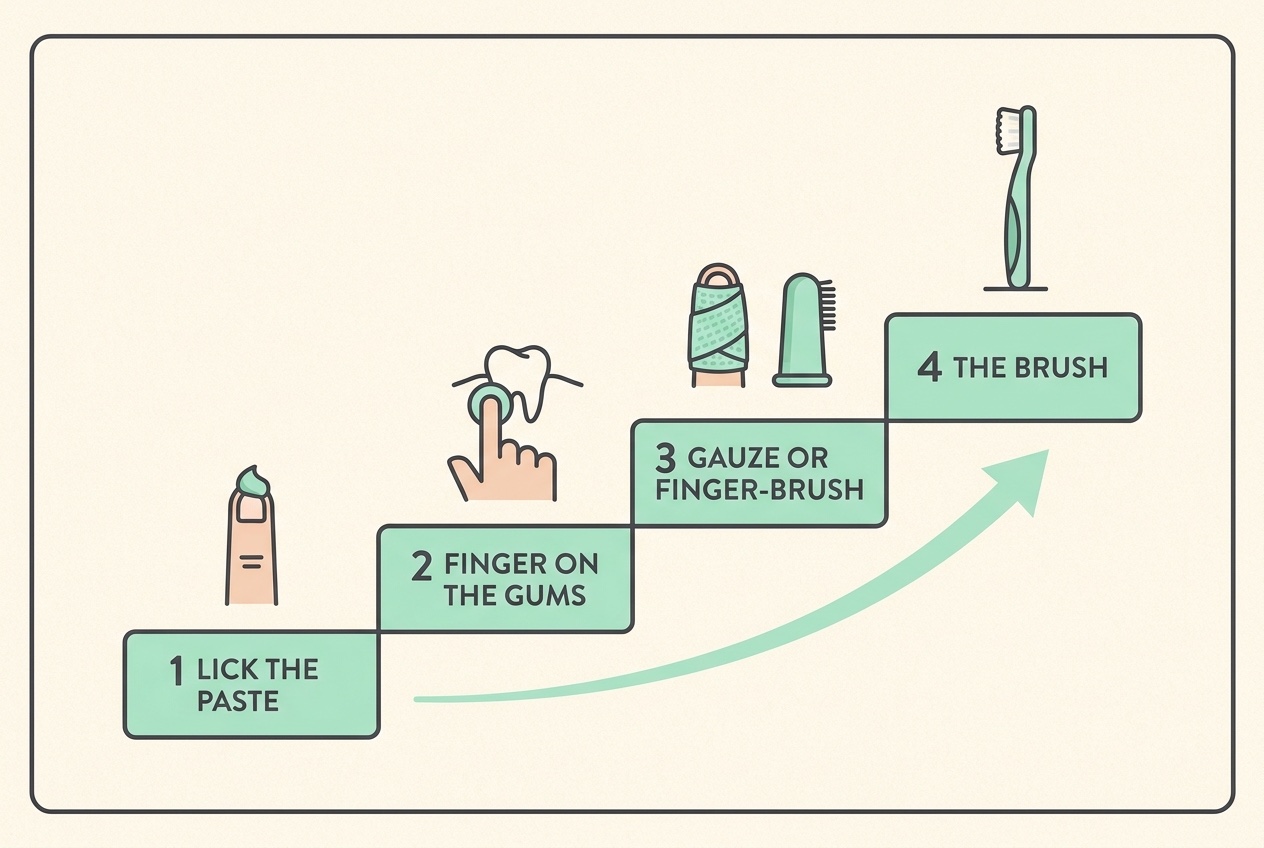
Step one: the paste is a treat. For the first few days, don't go near a brush. Just let your dog lick a smear of the dog toothpaste off your finger, twice a day, and make a fuss of her. That's the entire task. You're teaching her that this flavour and this moment mean good things.
Step two: your finger on the gums. Once she's happily licking the paste, put a little on your finger and gently rub it along the outer surfaces of her teeth and gums for a few seconds, then stop and praise her. Lift the lip at the big cheek teeth toward the back, because that's where tartar lands first. You don't need to open her mouth or reach the inside surfaces, the tongue keeps those reasonably clean on its own. Build from a couple of seconds up to fifteen or so over several days.
Step three: gauze or a finger-brush. Wrap a little gauze around your finger, or slip on a rubber finger-brush, add paste, and repeat the same gentle rub. The slightly rough texture starts doing real cleaning while still feeling far less intrusive than bristles. Plenty of dogs are perfectly happy to stay at this stage forever, and that's a genuine win, not a failure. A finger-brush used daily beats a proper brush used never.
Step four: the brush. When the finger-brush is a non-event, introduce a soft pet toothbrush. Touch it to just a few teeth for five or ten seconds the first time, with plenty of paste and praise, and grow the coverage over days. Hold the brush at a slight angle so the bristles reach into the gumline, and use gentle little circles or back-and-forth strokes along the outer surfaces. Aim for the outsides of the cheek teeth and canines. If you never manage the tiny front teeth or the inner surfaces, you're still winning the war.
Throughout, watch your dog, not the clock. If she pulls away hard, growls, or gets frightened, you've gone too fast: back up a step and slow down. This should end with a treat and a happy dog, every single time. A dog who enjoys the routine is a dog whose teeth still get brushed next year.
How often, honestly
The target is daily, and I'll tell you why rather than just insisting on it. In a controlled study comparing brushing frequencies in dogs, daily brushing and every-other-day brushing both produced significantly better results than brushing weekly or fortnightly, for plaque, calculus and existing gingivitis alike (Harvey et al., 2015). Daily is the gold standard because it never lets the plaque clock reach the three-day point where plaque turns to calculus.
But here's the realistic bit, because I would rather you brushed imperfectly forever than perfectly for a fortnight. Every other day is nearly as good as daily in that same study, so if daily genuinely won't fit your life, every second day is a strong, sustainable target and not a consolation prize. Below that, the benefit drops off: once you're down to weekly, work in racing greyhounds found that weekly brushing still reduced calculus but was not enough to reduce gum inflammation, whereas daily brushing reduced both. So a few times a week comfortably beats nothing, and daily beats a few times a week. Pick the most frequent slot you can actually keep, and keep it.
Why it falls apart, and how to make it stick
The technique is the easy part. The habit is the whole game, and it's worth understanding why habits form so you can rig the odds. When researchers followed people forming a new daily habit, the average time for it to become automatic (the point where you do it without deciding to) was about 66 days, with a big spread from 18 days to more than 200 (Lally et al., 2010). So the fortnight where it feels like effort is not you failing, it's just the middle of the tunnel. It gets automatic if you get to the far end, and the trick is designing the run so you reach it.
Three things make the difference between a habit that lands and one that dies in a drawer.
Attach it to something you already do without thinking. This is the single most powerful tactic, and it has a name: habit-stacking. Don't resolve to "brush the dog's teeth." Bolt it onto an existing anchor so the anchor becomes the reminder. Brush her teeth right after her evening meal, or every night while the kettle boils, or the moment before her last toilet trip. You already do those without a second thought, and the new habit rides along on their coat-tails. A free-floating good intention gets forgotten. One glued to your kettle does not.
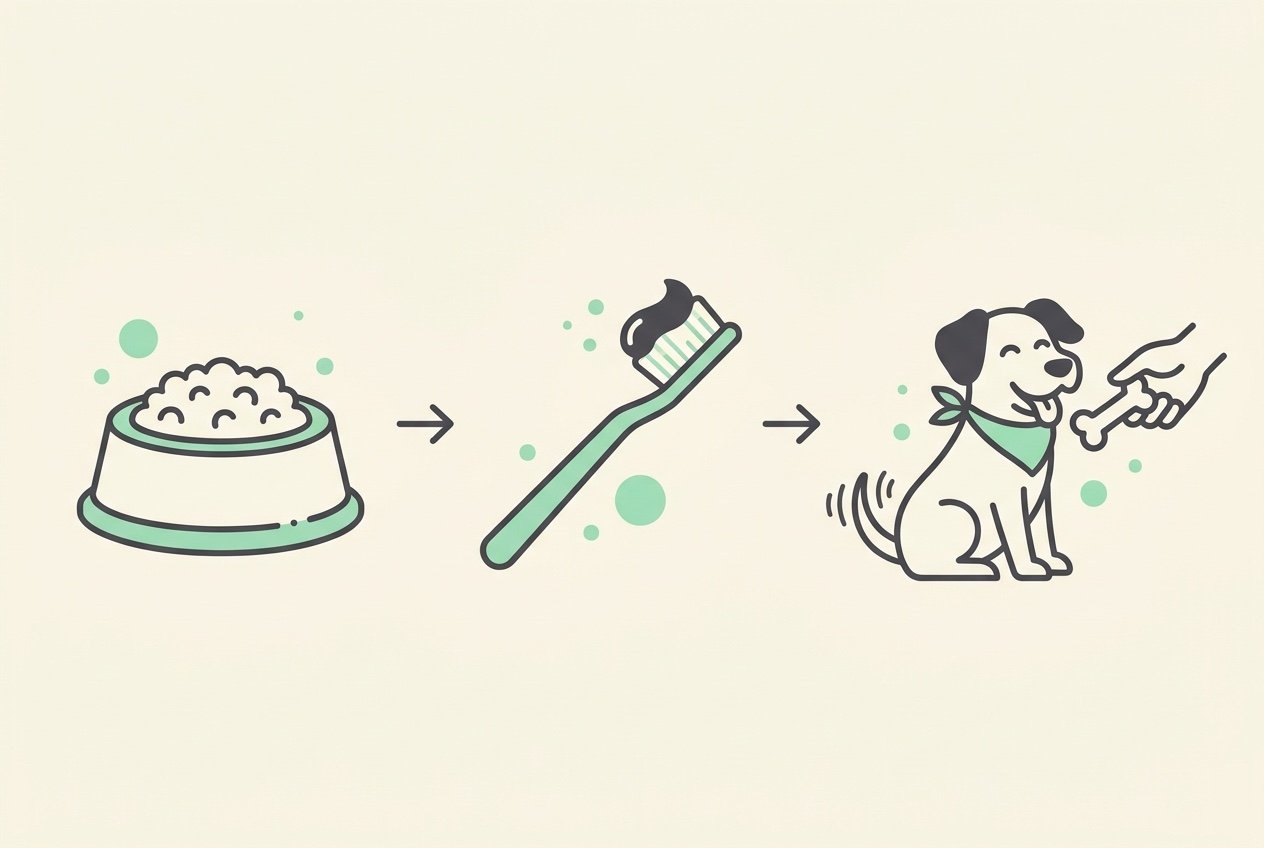
Keep the kit where the trigger is. If the toothbrush lives in the bathroom cupboard but you've decided to brush after her dinner in the kitchen, you've built in a reason to skip. Keep the brush and paste next to the anchor: by the food bowl, by the kettle, wherever the moment happens. Friction is what kills habits. Remove it.
Forgive the missed day immediately. In that same habit research, missing a single day did not meaningfully derail the process, but the belief that "I've blown it now" absolutely does (Lally et al., 2010). One skipped night is nothing. Two skipped nights that turn into a fortnight because you decided you'd failed is how the drawer wins. Missed last night? Just do tonight. Never let one gap become the reason to quit.
And use the scaffolding. Ticking off a run of days is genuinely motivating in the fragile early weeks, which is exactly why our Brushing Habit Tracker exists, to give you the little chain of ticks that keeps you going until the habit runs itself. Pair the brushing with the VOHC-accepted chews and diets that actually help if you want a belt-and-braces routine, and remember none of them replaces the brush.
So, tonight, don't try to brush her teeth. Just get the dog paste out, put a smear on your finger, and let her lick it off while you tell her she's wonderful. That's step one done, that's the whole job for today, and it's the small, boring, doable thing that a real routine is actually built from. Leave the tube next to whatever you do every evening, and do the same again tomorrow.
References
- Niemiec, B., Gawor, J., Nemec, A., et al. (2020). World Small Animal Veterinary Association Global Dental Guidelines. Journal of Small Animal Practice, 61(7). WSAVA. (Toothbrushing as gold-standard home care; daily home care as plaque accumulates within 24 hours.)
- Harvey, C., Serfilippi, L., Barnvos, D. (2015). Effect of Frequency of Brushing Teeth on Plaque and Calculus Accumulation, and Gingivitis in Dogs. Journal of Veterinary Dentistry, 32(1):16-21. (Daily and every-other-day brushing significantly outperform weekly/fortnightly.)
- Allan, R.M., Adams, V.J., Johnston, N.W. (2019). Prospective randomised blinded clinical trial assessing effectiveness of three dental plaque control methods in dogs. Journal of Small Animal Practice. (Brushing ~1.25 vs ~4-4.6 for dental diet and chew.)
- Lally, P., van Jaarsveld, C.H.M., Potts, H.W.W., Wardle, J. (2010). How are habits formed: Modelling habit formation in the real world. European Journal of Social Psychology, 40(6):998-1009. (Mean 66 days to automaticity, range 18-254; one missed day does not derail formation.)
- VCA Animal Hospitals (2023). Successful Toothbrushing Training for Happy Dental Care. (Desensitisation and counter-conditioning ramp: finger/paste to gauze to brush.)
- Xylitol and fluoride toxicity in dogs from human toothpaste: pin to a citable veterinary toxicology source (e.g. VPIS / Merck Veterinary Manual) at integration. Fact is not in doubt.
Free downloads
Companion worksheets to put what you've read into practice. Free PDFs, print at home.
Keep track of how your pet is doing
The owners who cope best are the ones who notice changes early. A simple health log shows you what is working, and what is not, before the next vet visit.
Start tracking, freeYou're not doing this alone
Compare treatment journeys and talk to owners managing teeth & mouth. Free to join.
Join PetsLikeMine