

How to check your pet's mouth at home
Alastair Greenway
BVM&S MRCVS
You've decided to look. Maybe the breath has been getting worse, or you read that most dogs and cats have some gum disease by middle age and thought, right, I'll actually check tonight. Then you lifted the lip an inch, met a wall of teeth you don't really know how to read, and stopped. What am I even looking for? What if I hurt her? What if she bites?
That hesitation is completely reasonable, and this piece is written to get you past it. A home mouth check is one of the most useful two minutes you can spend on your pet's health, and you don't need to be a vet to do it well. You're not trying to diagnose anything or treat anything. You're learning what your own pet's normal mouth looks like, so that when something changes you notice it early, while it's still cheap and simple to fix. Let's walk through it slowly, dogs and cats both, and I'll show you exactly what healthy looks like and what should send you to the phone.
Why two minutes is worth it
Gum disease is sneaky because it's painless at the start and then quietly gets worse. It begins as gingivitis, which is just inflammation of the gum where it meets the tooth, and at that stage it's fully reversible with a clean and good home care (Niemiec et al., 2020). Left alone, that inflammation can progress to periodontitis, where the bone and ligament holding the tooth in place start to break down, and that damage does not grow back (Niemiec et al., 2020). The whole point of looking regularly is to catch the reversible stage rather than the irreversible one. A red gumline you spot this month is a very different problem from a loose, painful tooth you find next year.
There's a quieter benefit too. A pet who is used to having their lips lifted and their mouth touched is a pet you can eventually brush, which is the single best thing you can do at home for their teeth. Every calm little session you do now is you laying the groundwork for that. So even the checks where you find nothing wrong are doing a job.
A fortnightly look is plenty for most pets. You're not inspecting every surface with a torch. You're doing a quick, friendly once-over and comparing it to last time.
How to look without a fight
The mouth check that works is the one your pet barely notices. Forcing a struggling animal's jaws open teaches them to dread the whole thing and gets you a nip for your trouble, so the golden rule is: gentle, brief, and stop while you're still ahead.
Pick your moment. A dog who's just had a walk and is flopped and content on the sofa is a far better subject than one who's bouncing off the walls. Sit with them, make a fuss of them, and get them relaxed before you go anywhere near their face.
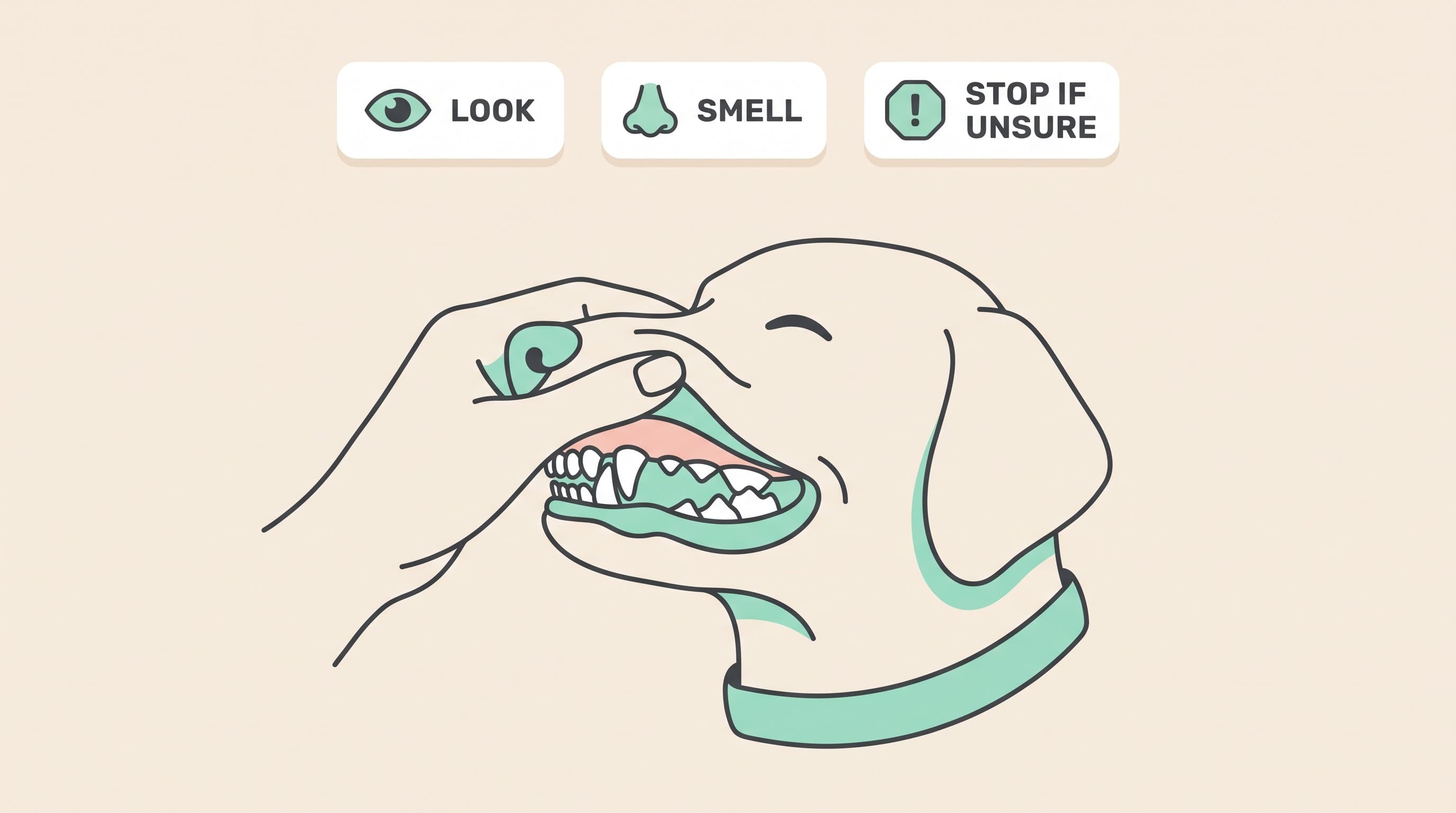
Here's the actual technique for a dog:
- With your pet facing away from you or beside you, rest one hand gently over the top of the muzzle.
- Use your thumb or a finger to lift the upper lip upward and back, exposing the gums and the big teeth along the side. You don't need to open the mouth at all. Lips closed, jaw shut, you're just peeling back the curtain.
- Look along the gumline where the gum meets the tooth. Then work back toward the large cheek teeth, because that's where trouble tends to show first.
- Have a quick sniff while you're there. Breath tells you a lot.
- Praise, treat, done. Two minutes, tops.
Why the back teeth? Because tartar, that hard brown or yellow crust, tends to build up first on the outer surface of the big upper cheek teeth, near where the salivary glands empty into the mouth (Niemiec et al., 2020). The little front teeth can look almost clean while the carnassials at the back are caked, so if you only glance at the front you'll miss the earliest signs. You also don't need to see the inner surfaces or the tongue side at home. Looking at the outside of the teeth is enough for a home check, and it's far less of an imposition on your pet.
Doing it with a cat
Cats are not small dogs about this, and pretending otherwise is how people get scratched. Most cats will not tolerate having their mouth opened, and they've a very low ceiling for being messed about with, so the whole approach is shorter and gentler and you quit before they've had enough, not after (Lobprise et al., 2025).
Start where they already like being touched, behind the ears or under the chin, then slide a finger to the side of the mouth for half a second and go straight back to the nice scratch. Over several days you build up to gently lifting the upper lip with one finger while your other hand keeps up the fussing. You are aiming for a one-second peek at the gumline and the cheek teeth, then instant reward. If your cat clamps down, turns away, flattens their ears or starts to wriggle, you've reached the end of that session. Let them go, try again tomorrow. A cat who learns that lip-lifts predict a treat and freedom is a cat you can keep checking for years. A cat you pinned down once is a cat who'll see you coming.
If your cat simply won't allow it, don't force the issue and don't feel you've failed. Plenty of feline dental disease is picked up by your vet at a routine check, and cats especially need a proper look under anaesthetic to assess fully anyway (Lobprise et al., 2025). Your job at home is to notice the outward signs, dribbling, a bloody fleck on their toy, eating on one side, pawing at the face, and flag them.
What a healthy mouth looks like
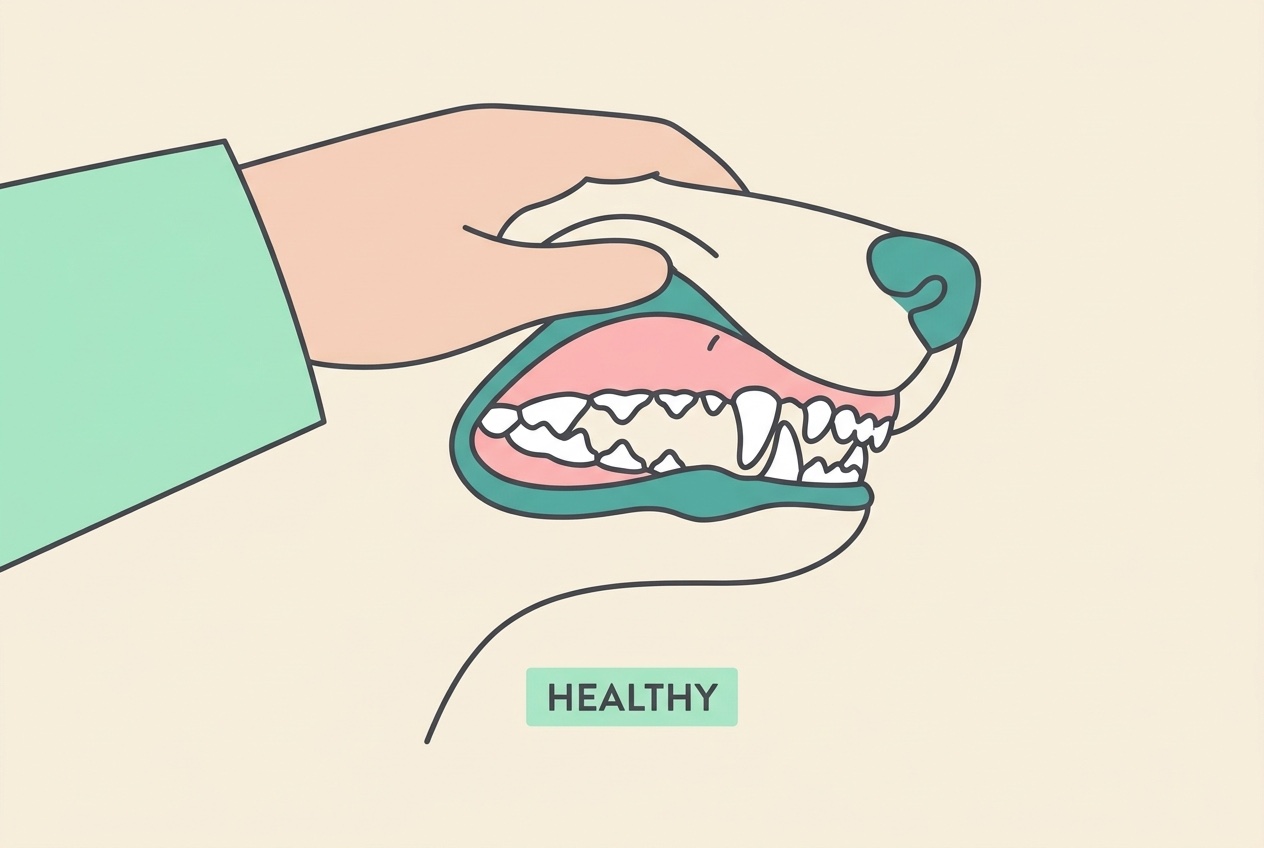
Healthy gums are pink. Think a clean salmon or bubblegum pink, moist and smooth, sitting neatly against the tooth with no angry red border. Some dogs and cats have naturally black-pigmented gums or patches of pigment, and that's completely normal, so you're looking at the texture and the margin as much as the colour: a healthy gum edge is a crisp, calm line, not a swollen, inflamed rim.
The teeth themselves should be white to cream, with a smooth surface and no obvious brown build-up, especially along that gumline where plaque likes to sit. And a healthy mouth doesn't really smell of much. Neutral, a bit of a doggy or catty odour, fine. What you're learning here is your pet's personal baseline, because the most valuable thing a home check gives you isn't a diagnosis, it's the ability to say "that's different from last month."
One quick aside on colour, because people worry. If your pet's gums ever look starkly white, blue, brick-red or yellow-tinged, that's a whole-body warning about circulation, oxygen or the liver, not a dental thing, and it means a same-day call to your vet. Everyday dental checking is about that thin red line at the gum, not the overall colour.
What "get it checked" looks like
Here's what should make you book an appointment. None of these are emergencies on their own, but all of them mean the mouth needs a professional look.
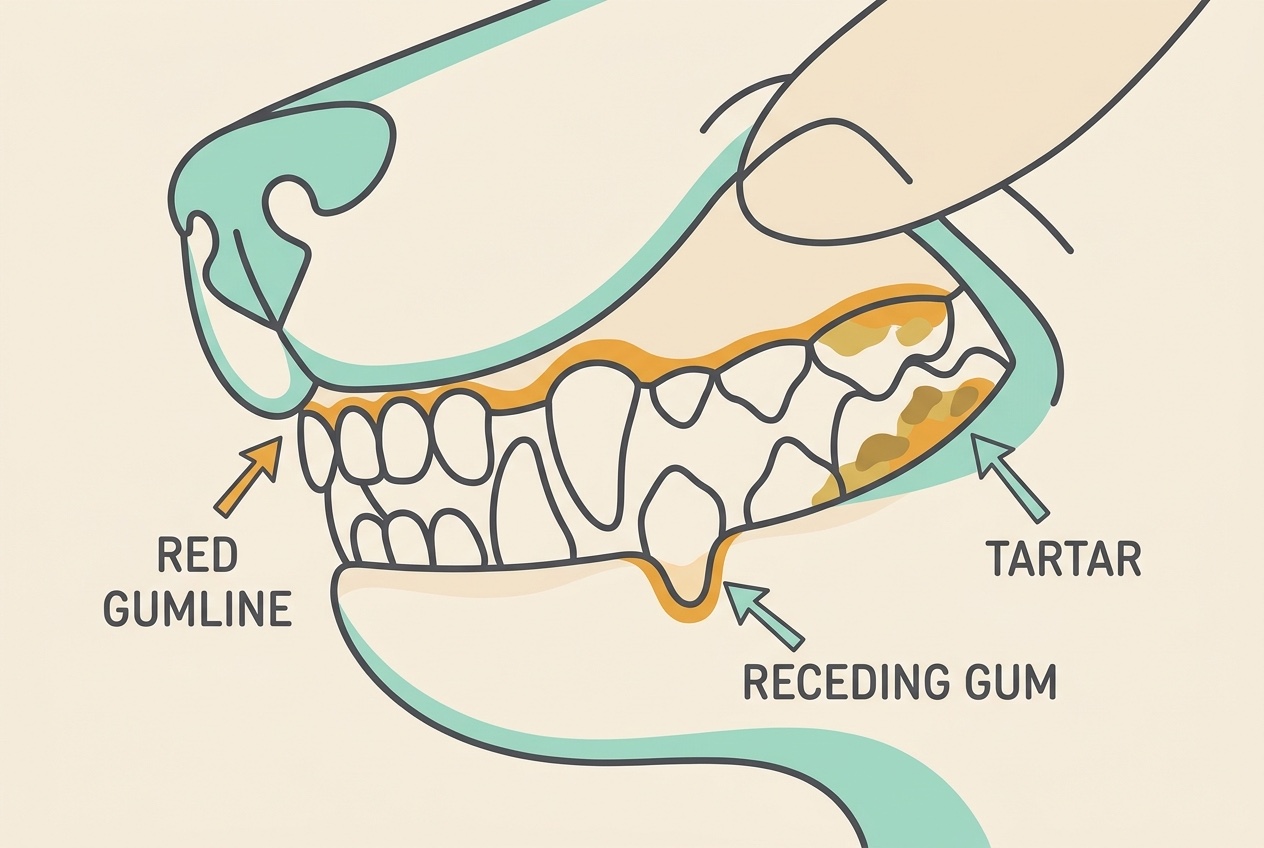
- A red or swollen rim along the gumline. That thin line of redness where gum meets tooth is gingivitis, the early, reversible stage. It's the single most useful thing you can spot, because it's the moment intervention works best.
- Brown or yellow crust on the teeth. That's tartar (calculus), and once it's hard it doesn't brush off. It usually means there's disease sitting under it.
- Gums that bleed easily, or that are pulling back from the teeth. A gum that bleeds at the lightest touch, or has receded to expose more of the tooth or a root, has moved past the early stage.
- A broken or discoloured tooth. A tooth that's chipped with a dark or pink spot in the middle, or one that's gone grey, purple or brown compared with its neighbours, may have an exposed or dying pulp. These are painful and shouldn't be left, and a "wait and see" approach isn't advised for them (Niemiec et al., 2020).
- An angry red, cobblestoned area at the very back of the mouth, especially in a cat. Inflammation that spreads beyond the gums into the tissue at the back of the mouth can be a sign of feline chronic gingivostomatitis, a genuinely painful condition that needs veterinary care (Lobprise et al., 2025).
If your check turns up a facial swelling below the eye, a mouth that's actively bleeding, or a pet who suddenly won't eat at all, don't wait for a routine slot. Ring your vet and get seen promptly.
What you can't see, and why this is triage
Here's the honest limit of a home look, and it matters. Most of the disease that actually causes pain and tooth loss happens below the gumline, out of sight, in the roots and the bone. You cannot see it by lifting a lip, and neither can your vet in the consulting room, which is exactly why a proper dental needs x-rays and probing while your pet is under anaesthetic (Niemiec et al., 2020; Bellows et al., 2019). A mouth can look reasonably tidy on the surface and still hide an abscess or bone loss underneath, and this is especially true in cats.
So please read your home check for what it is: triage, not diagnosis. A clean-looking mouth at home is reassuring, but it isn't a guarantee that all is well beneath the surface, and it's no substitute for a proper examination. What the home check does brilliantly is catch the obvious, visible warning signs early and tell you when it's time to get a professional involved. If you want a more structured read on what you're seeing, our "Does my pet need a dental?" checker walks you through the same signs and helps you decide how urgently to act. And if you'd like to understand why the x-rays matter so much, Why dental x-rays matter explains what a look-only clean can miss.
Please don't scrape it yourself
There's a trend, fuelled by videos online, of owners buying a metal scaler and chipping the tartar off their pet's teeth themselves. Please don't. It's one of the few home "dental care" ideas that does real harm.
Scraping doesn't work and it isn't safe. The tartar you can see is bonded hard to the enamel, and dragging a sharp tool across it scratches the tooth surface, which actually gives new plaque more to cling to. A metal instrument near the gum of an awake, wriggling animal cuts gums and can push bacteria into inflamed tissue. And crucially, you can only ever reach the visible crown, never the disease under the gumline that's the whole problem, so you end up with a tooth that looks cleaner and a mouth that's no healthier, which is worse, because it hides the very thing that needed treating. Removing tartar properly, above and below the gum, is done with the right instruments under anaesthetic, and it's worth doing properly. Your job at home is looking and, in time, brushing. Leave the scaling to the professionals.
What to do tonight
Go and have your two-minute look while your pet's relaxed, and just learn what their normal is. If everything's pink and clean and unremarkable, brilliant, note it and check again in a fortnight. If you spotted a red gumline, some brown build-up, a bleeding or receding gum, a dodgy-looking tooth or redness at the back of the mouth, run the dental checker for a structured read or book a check with your vet. And if you found a facial swelling, active bleeding or a pet who's stopped eating, make that call today. Whatever you find, you've done the thing most owners never do, and your pet's mouth is better off for it.
References
- Bellows, J., Berg, M. L., Dennis, S., Harvey, R., Lobprise, H. B., Snyder, C. J., Stone, A. E. S., & Van de Wetering, A. G. (2019). 2019 AAHA Dental Care Guidelines for Dogs and Cats. Journal of the American Animal Hospital Association, 55(2), 49-69.
- Lobprise, H. B., St Denis, K., Anderson, J. G., Hoyer, N., Fiani, N., & Yaroslav, J. (2025). 2025 FelineVMA feline oral health and dental care guidelines. Journal of Feline Medicine and Surgery, 27.
- Niemiec, B., Gawor, J., Nemec, A., Clarke, D., McLeod, K., Tutt, C., Gioso, M., Steagall, P. V., Chandler, M., Morgenegg, G., & Jouppi, R. (2020). World Small Animal Veterinary Association Global Dental Guidelines. Journal of Small Animal Practice, 61(7), E36-E161.
Free downloads
Companion worksheets to put what you've read into practice. Free PDFs, print at home.
Brushing: A Week-by-Week Desensitisation Plan
PDF · 247 KBThe gentle, gradual way to teach a dog or cat to accept toothbrushing: finger and paste-taste first, then a finger on the gums, then gauze or a finger-brush, then the brush. A tick-off week-by-week plan with the two safety rules (never human toothpaste, never a sore mouth) and the habit tricks that get you past the fortnight where most owners give up.
The At-Home Mouth Check
PDF · 223 KBA calm two-minute guide to lifting the lip and reading your pet's mouth: how to look without a fight (dogs and cats), what healthy pink gums and clean teeth look like, and a green, amber and red list of what to book a check for versus what needs a same-day call. A home look is triage, not diagnosis, because most disease hides below the gumline.
Keep track of how your pet is doing
The owners who cope best are the ones who notice changes early. A simple health log shows you what is working, and what is not, before the next vet visit.
Start tracking, freeYou're not doing this alone
Compare treatment journeys and talk to owners managing teeth & mouth. Free to join.
Join PetsLikeMine