

Managing constipation: fibre, lactulose, prokinetics, hydration and the litter-tray truth
Alastair Greenway
BVM&S MRCVS
Most of the work of keeping a constipation-prone pet comfortable happens at home, in the everyday choices about food, water and where the litter tray sits. This is the practical toolkit: what works, in what order, and when to stop.
What constipation looks like and where it can lead is the job of the companion guide, the cat who cannot poo. One thing from there saves lives and is worth repeating: if your cat is straining right now and you are not certain it is passing a normal volume of urine, treat it as an emergency and ring your vet, because a blocked bladder looks almost identical and can be fatal within a day or two.
Start with water, not supplements
One idea runs underneath everything that follows: hard faeces are, almost by definition, dehydrated faeces. The colon's job is to reabsorb water, so when transit slows or a pet is under-hydrated, faeces sit longer, lose water and harden, which slows transit further: a self-reinforcing loop (Washabau & Holt, 1999; Merck Veterinary Manual). Nearly every lever below pulls on that one mechanism, which is why getting hydration right is the most effective, lowest-risk thing you can do, and the thing the internet skips on its way to pumpkin.
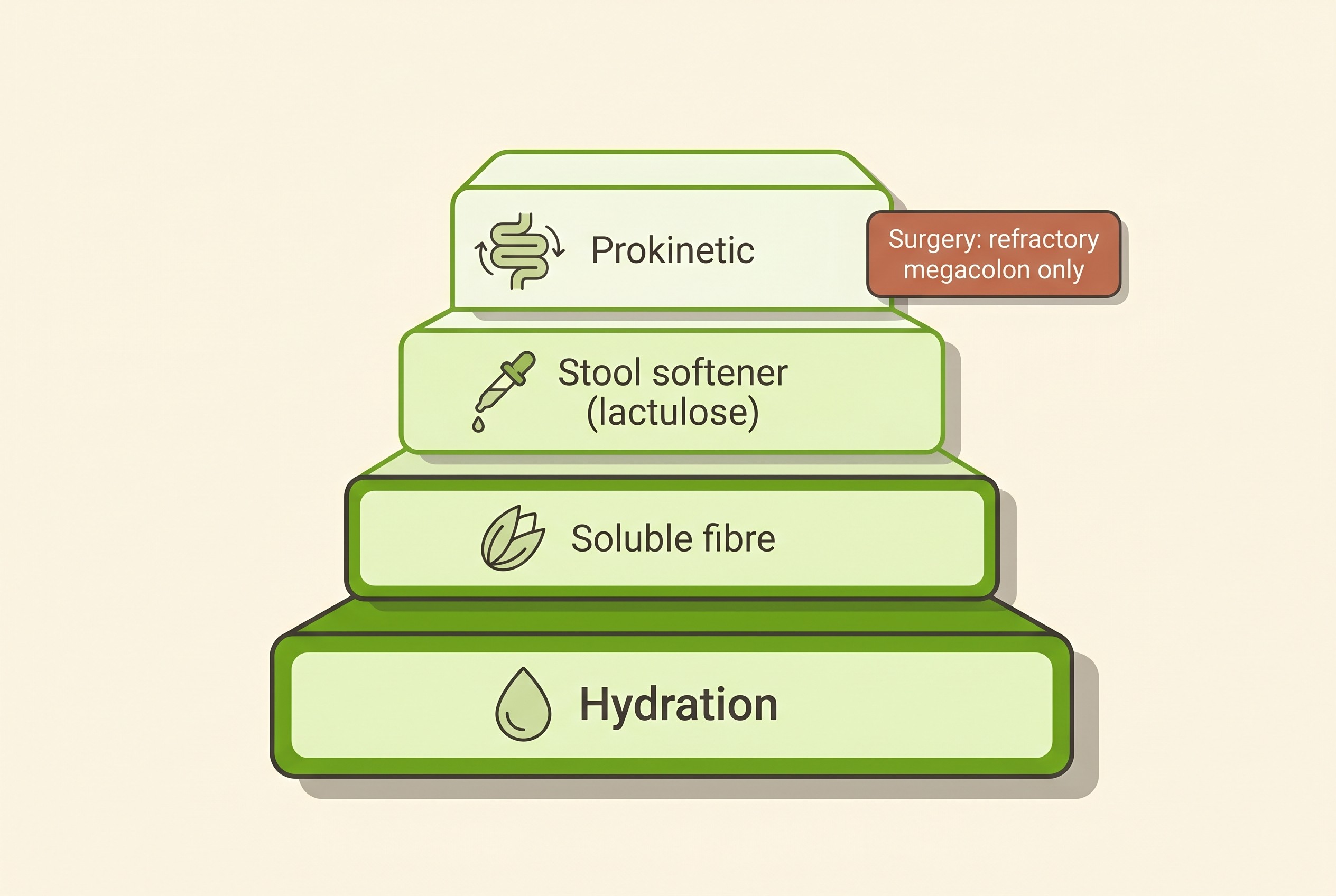
For cats especially, the single most useful change is moving moisture into the diet, because they are desert-adapted with a low thirst drive and easily kept quietly under-hydrated on dry food alone. Shifting to wet or tinned food, adding water to meals, offering a fountain (many prefer moving water), and placing several wide bowls around the house away from the food are all sensible, mechanism-backed measures, and worth getting right before you reach for anything in a bottle (Washabau & Holt, 1999; Merck Veterinary Manual).
One hidden driver is chronic kidney disease, common in older cats and hard on hydration. In a survey of defecation habits, only 58% of cats with kidney disease passed a motion at least once a day against 85% of healthy cats, and poor hydration is one of the likely contributors (Jones et al., 2022). So a constipation-prone cat deserves a kidney and hydration check, and if kidney disease is present, the water matters even more. That kidney picture belongs to our Kidney and Urinary space.
Fibre, the realities
Two things matter about fibre: type counts for more than amount, and more is not always better. Soluble or fermentable fibres, such as psyllium husk, hold water in the stool and ferment to short-chain fatty acids that nourish the colon lining and nudge motility, softening faeces and easing their passage. Insoluble or bulking fibres, such as wheat bran and cellulose, distend the colon to stimulate it, but only work if the colon can still contract (Freiche et al., 2011; Merck Veterinary Manual). For the typical constipation-prone but not end-stage pet, soluble psyllium is the sensible workhorse, with real cat-specific evidence: in 66 constipated cats fed a psyllium-enriched dry diet, faecal consistency improved significantly (P less than 0.001) and most were better by two months (93% and 82% across the two trials), though it was uncontrolled, so read it as strongly supportive rather than the last word (Freiche et al., 2011).
Pumpkin, because every owner asks, is a palatable source of mostly soluble fibre and a little moisture, a reasonable gentle addition at roughly one to four tablespoons per meal, but not magic: there is no good evidence it outperforms a dedicated psyllium supplement, so treat it as a low-dose home option, not a treatment (Merck Veterinary Manual).
Now the bit most pages leave out. In a cat with established megacolon, where the colon is permanently widened and can no longer contract well, adding insoluble bulking fibre asks a worn-out muscle to do more and can pile up stool and worsen the distension; those cats go the other way, onto a low-residue, highly-digestible diet to minimise stool volume, plus a prokinetic (Washabau & Holt, 1999; Merck Veterinary Manual). Either way, hydrate before you load fibre, because bulking the stool in an already dehydrated colon can make an impaction worse: water first, fibre second (Merck Veterinary Manual).
Lactulose and stool softeners
When diet and hydration are not quite enough, lactulose is the workhorse osmotic softener. This non-absorbable sugar draws and holds water in the bowel to soften faeces, and its fermentation produces organic acids that stimulate the colon to secrete fluid and push (Merck Veterinary Manual; Washabau & Holt, 1999).
Doses are your vet's call and vary between animals. The skill is titration: start low, increase gradually until the stool is soft and easily passed, then hold there, and back off if it tips into watery diarrhoea. You are aiming for soft-but-formed, not loose. Watching that output is exactly what the Faecal Score Tracker is for: logging the score, frequency and appetite turns titration into a readable line, so you and your vet can see whether the plan is holding or slipping back towards hard or absent stools. (How to score a stool is its own short guide, describing symptoms to your vet.)
Other softeners are second-string adjuncts: docusate, a stool-wetting agent, and lubricants such as liquid paraffin (mineral oil). Mineral oil must never be syringed into the mouth, because it is tasteless, so the swallow reflex is not triggered, it is easily inhaled, and aspiration causes a serious pneumonia (Merck Veterinary Manual).
And one hard line that saves lives: never give a cat an over-the-counter human phosphate enema (the sodium-phosphate, Fleet-type ones), because they cause life-threatening derangements of phosphate, calcium and sodium and can be fatal in cats (Merck Veterinary Manual). Emptying a badly blocked cat is a veterinary procedure done with fluids and sedation, not a bathroom job, and that obstipation picture is the sibling article's.
When the colon needs help contracting
If a colon still has working muscle but is sluggish, a prokinetic can help it push, and in cats the one of choice is cisapride, which stimulates colonic muscle to contract, used alongside diet, fibre and a softener (Washabau & Holt, 1999; Merck Veterinary Manual). Timing is everything: it works best on a colon that still has some pump left, so a cat with long-standing obstipation or end-stage megacolon is unlikely to improve, because by then the muscle cannot contract whatever you give it (Washabau & Holt, 1999; Merck Veterinary Manual).
It is also worth knowing how you will actually get hold of it. Cisapride was withdrawn from the human market around 2000 over rare but serious heart-rhythm problems in combination with certain other drugs, and it is no longer conventionally licensed in the UK and much of the EU. It is effective and widely used in cats, but it comes from your vet, not the pet shop, specially imported on a named-patient basis or compounded where permitted (Washabau & Holt, 1999; Merck Veterinary Manual).
The litter-tray truth, for cats
For a cat, the litter tray is not a detail, it is a clinical variable. A cat that finds its tray unpleasant, hard to reach or contested holds on, and a cat that holds on makes harder, drier faeces, so before blaming the colon, get the tray right. The AAFP and ISFM guidance gives concrete specifics that are easy to act on (Carney et al., 2014):
- Number: at least one more tray than you have cats, the "n plus 1" rule, in separate, low-traffic spots.
- Size: big. Aim for roughly one and a half times your cat's body length from nose to tail base.
- Substrate and depth: most cats prefer a fine, sand-like, unscented litter (ideally clumping) at around three centimetres or more. Skip the scented litters and deodorisers, which are for you, not the cat.
- Cleanliness: scoop at least once a day and wash the tray periodically, because a soiled tray is a tray a cat avoids.
- Covered or open: preference is roughly split, so offer a choice; open trays are easier to keep clean and trap less odour.
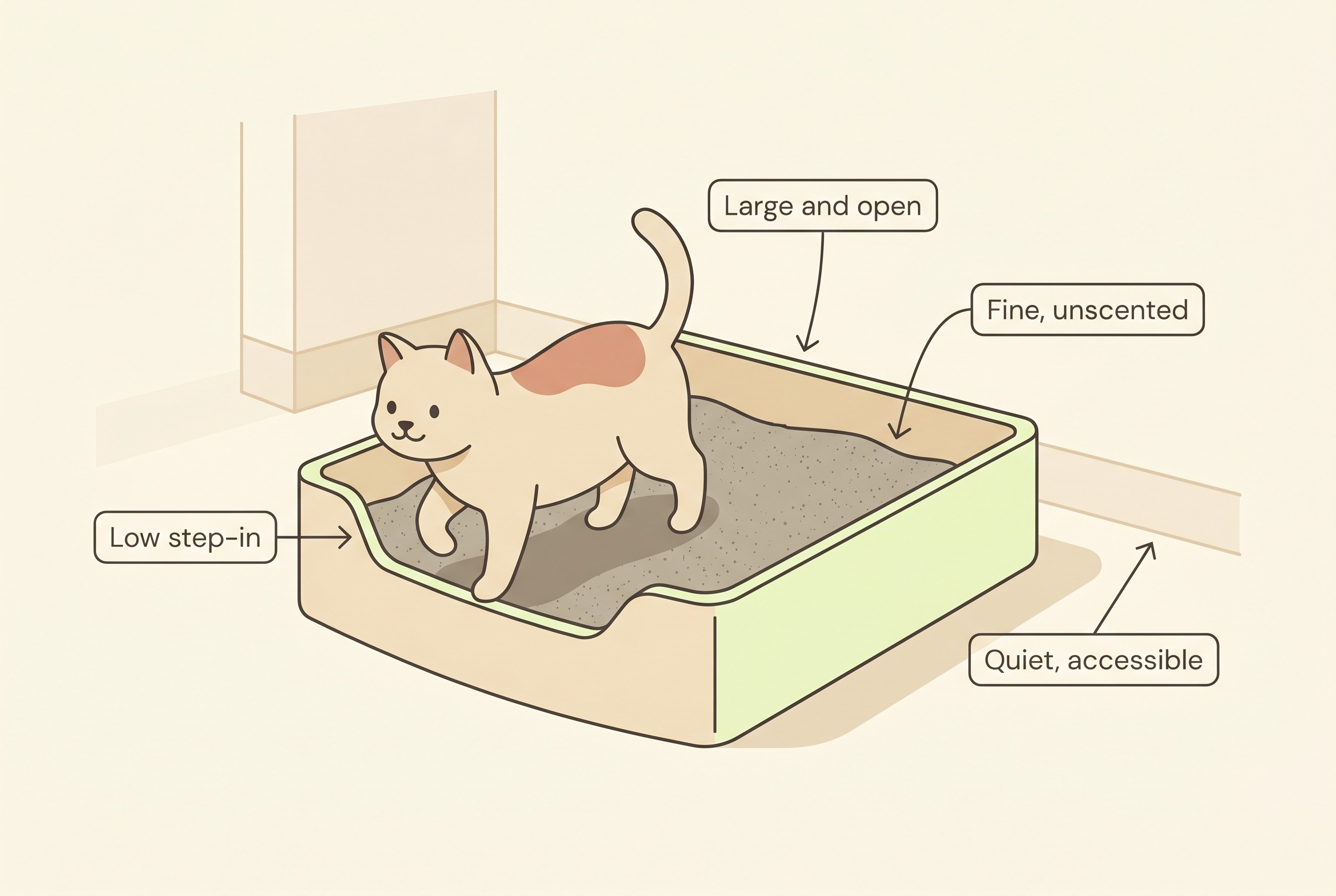
Access is where this links to arthritis. Older and arthritic cats struggle to climb into high-sided or awkwardly placed trays, so they go less often and constipation follows (Carney et al., 2014; Ellis et al., 2013; Taylor et al., 2024). The fixes are practical: at least one tray with a very low step-in side, and a tray on every floor the cat uses and near its resting places (managing the arthritis itself belongs to our mobility space). Stress matters too, and meeting a cat's environmental needs of safety, choice and predictability reduces the avoidance that suppresses regular toileting (Ellis et al., 2013).
Knowing when home care has run out
Two background levers help: obesity and inactivity are both associated with constipation, so a sensible body condition and gentle daily activity are worth the effort (Washabau & Holt, 1999). And beyond every medical layer sits surgery (subtotal colectomy), the backstop for genuinely medicine-resistant megacolon (Washabau & Holt, 1999; Merck Veterinary Manual); that surgical end is the sibling article's, named here only so you know the ladder has a top rung, and a good one for the right cat.
For dogs the same toolkit applies, with one important difference: constipation is far less often simple plumbing and far more often a clue to something else, from an enlarged prostate to a pelvic problem, so do not just keep adding fibre to a dog who needs investigating. That different canine differential has its own guide, constipation in dogs.
The limit of all this is that the toolkit is for the stable, comfortable, eating pet, not one straining unproductively, painful, off its food, vomiting, flat, or that has passed nothing for a worrying stretch. That pet needs seeing that day (Washabau & Holt, 1999; Merck Veterinary Manual). If you are unsure how urgent the signs are, our Vomiting and Diarrhoea Triage can help you decide, and the wider picture lives in digestive emergencies and, for the blocked-up cat, in the cat who cannot poo. Short of that line, most constipation-prone pets watched with the Faecal Score Tracker stay comfortable for years, with the next drift caught long before it becomes a crisis.
References
- Carney, H. C., Sadek, T. P., Curtis, T. M., Halls, V., Heath, S., Hutchison, P., Mundschenk, K., & Westropp, J. L. (2014). AAFP and ISFM guidelines for diagnosing and solving house-soiling behavior in cats. Journal of Feline Medicine and Surgery, 16(7), 579-598.
- Ellis, S. L. H., Rodan, I., Carney, H. C., Heath, S., Rochlitz, I., Shearburn, L. D., Sundahl, E., & Westropp, J. L. (2013). AAFP and ISFM feline environmental needs guidelines. Journal of Feline Medicine and Surgery, 15(3), 219-230.
- Freiche, V., Houston, D., Weese, H., Evason, M., Deswarte, G., Ettinger, G., Soulard, Y., Biourge, V., & German, A. J. (2011). Uncontrolled study assessing the impact of a psyllium-enriched extruded dry diet on faecal consistency in cats with constipation. Journal of Feline Medicine and Surgery, 13(12), 903-911.
- Jones, S. E., Quimby, J. M., Summers, S. C., Adams, S. M., Caney, S. M. A., & Rudinsky, A. J. (2022). Survey of defecation habits in apparently healthy and chronic kidney disease cats. Journal of Feline Medicine and Surgery, 24(2), 131-141.
- Merck Veterinary Manual. (n.d.). Constipation, obstipation, and megacolon in small animals.
- Taylor, S., Gruen, M., KuKanich, K., Lascelles, B. D. X., Monteiro, B. P., Real Sampietro, L., Robertson, S., & Steagall, P. V. (2024). 2024 ISFM and AAFP consensus guidelines on the long-term use of NSAIDs in cats. Journal of Feline Medicine and Surgery, 26(4), 1098612X241241951.
- Washabau, R. J., & Holt, D. E. (1999). Pathogenesis, diagnosis, and therapy of feline idiopathic megacolon. Veterinary Clinics of North America: Small Animal Practice, 29(2), 589-603.
Keep track of how your pet is doing
The owners who cope best are the ones who notice changes early. A simple health log shows you what is working, and what is not, before the next vet visit.
Start tracking, freeYou're not doing this alone
Compare treatment journeys and talk to owners managing digestive health. Free to join.
Join PetsLikeMine