

Constipation in dogs: diet, dehydration, and the causes worth ruling out
Alastair Greenway
BVM&S MRCVS
A few worrying days of your dog hunching in the garden and producing little or nothing sends most owners to the same advice you would read for a constipated person: add fibre, add a spoon of pumpkin, add water, job done. For a dog that advice is not just incomplete. It can occasionally be the wrong move altogether.
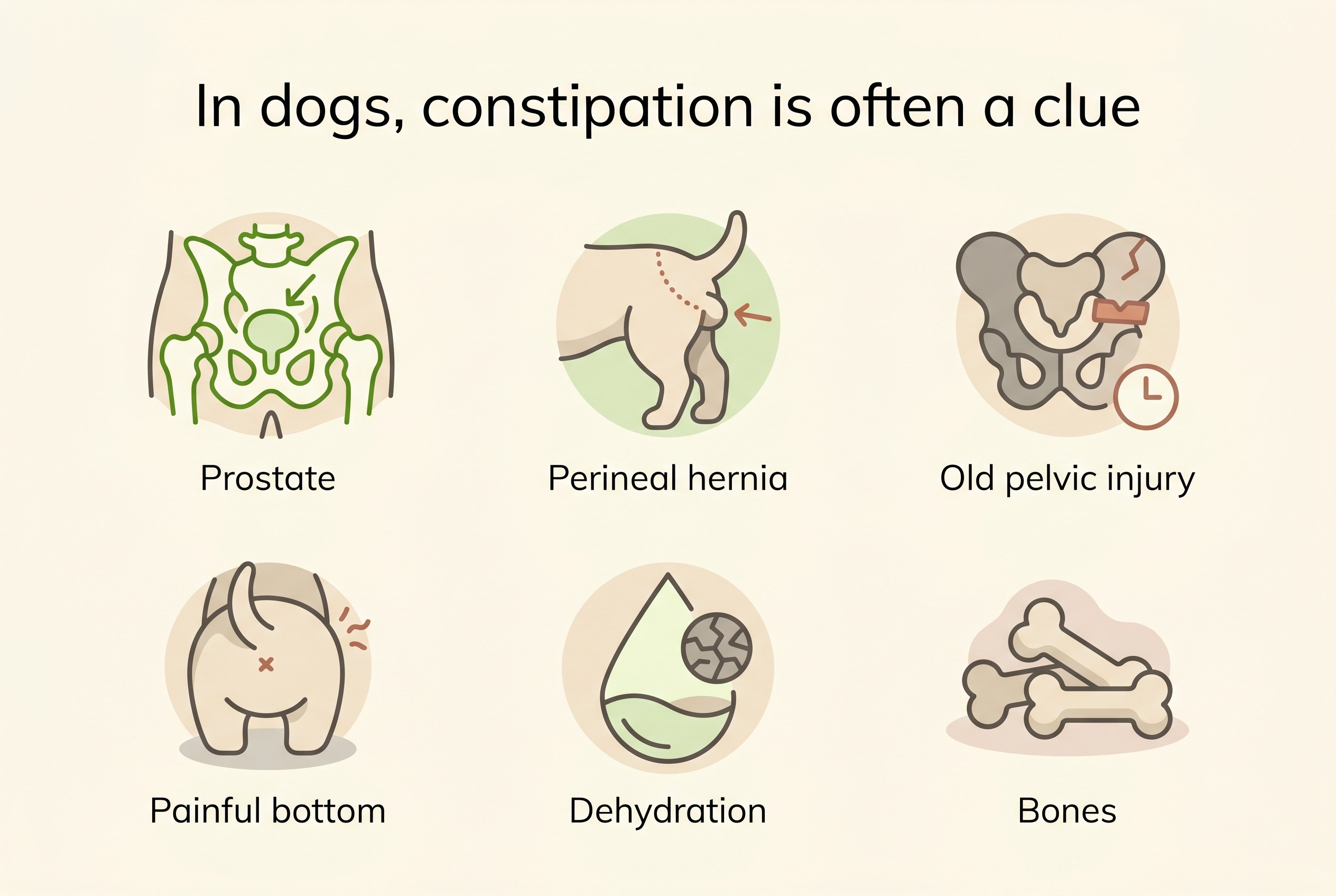
Constipation in dogs is genuinely uncommon, and that fact changes everything. When a dog truly struggles to pass faeces, far more often than not it is a clue pointing at something else. The high-value question is not "what shall I add to soften the stool", it is "why is this dog struggling at all". The answers include things owners rarely think of: an enlarged prostate in an entire male, a weak pelvic floor, an old pelvic fracture that healed narrow, a painful bottom, a neurological problem, or a metabolic upset such as a high blood calcium. This is the inverse of the cat story, where a permanently sluggish colon dominates, so if you have a cat this is not your article, and I would send you to the feline guide.
Three words owners tend to blur
It helps to be precise, because owners and even some websites run three different things together. Constipation means difficult, reduced or painful passing of faeces, and it is a clinical sign rather than a diagnosis (Merck Veterinary Manual, n.d.; Redfern, 2019). When it becomes intractable, so the dog cannot evacuate at all and the colon packs with hard, dry faeces, we call it obstipation, the severe end of the spectrum. A permanently dilated, sluggish colon is megacolon, and here is the load-bearing contrast for dog owners: megacolon is common in cats and rare in dogs, and in cats it is most often idiopathic, with no underlying cause found in roughly two-thirds (Washabau & Holt, 1999; Merck Veterinary Manual, n.d.). In dogs it is almost always the consequence of something mechanical, such as a narrowed pelvis, which is why the dog story is a hunt for a cause rather than a label to apply.
There is a more useful distinction your vet will be making, again in three words (Redfern, 2019). Dyschezia means painful defecation, and points at the anorectal region: a sore bottom, painful anal sacs, perianal disease. Tenesmus means straining, usually ineffective, and points at the large bowel or an obstruction to outflow: colitis, a mass, a stricture, a prostate pressing down. Plain constipation means the faeces themselves are hard and slow. This matters because a dog that strains and produces little is not necessarily "blocked up": it may have colitis, or a painful bottom, and an almost empty colon, where adding fibre does nothing useful. Telling these apart is exactly why a vet's examination, very often a rectal one, is the single highest-value step in a straining dog (Redfern, 2019; Hall et al., 2020).
When water and movement really do help
Plenty of one-off constipation in an otherwise bright, well dog is exactly as innocent as it looks. The engine of hard, dry faeces is dehydration: reduced water intake, hot weather, fluid lost through illness, or a switch from moist food to dry all draw water back out of the stool in the colon and leave it firm (Merck Veterinary Manual, n.d.). This is the single most modifiable factor. Inactivity is the next culprit: a dog that has been laid up, hospitalised, recovering from surgery or knocked off its routine will often slow down at both ends, sometimes compounded by a reluctance to posture because something hurts (Merck Veterinary Manual, n.d.). And then there is diet, which brings me to a myth worth puncturing.
The bone myth
Bones are marketed as natural, wholesome and good for a dog. For the colon they are anything but. Bone fragments, from cooked bones or large quantities of raw bone, become incorporated into the faecal mass and turn it hard, dry, sharp and genuinely painful to pass, sometimes needing an enema or manual evacuation under anaesthetic to clear (WikiVet, n.d.; Merck Veterinary Manual, n.d.). The pale, crumbly, bone-laden stool is one of the more recognisable presentations of canine constipation, and it is wholly avoidable. The more serious risks, perforation and true obstruction, belong with the digestive emergencies guide, but the everyday lesson is simple: a bone-heavy diet is a real and preventable cause of a constipated dog.
Where the pumpkin actually fits
So where does that leave the pumpkin? For a bright, well dog with a genuine one-off, improving water intake, adding moisture or wet food, getting some gentle movement back in, and a modest fibre adjustment alongside plenty of water are all sensible first steps (Moreno et al., 2022; Merck Veterinary Manual, n.d.). Fibre is not a single thing: soluble, fermentable fibres such as psyllium hold water in the stool and normalise transit, while insoluble fibre adds bulk (Moreno et al., 2022).
There is a caveat almost no competitor page states plainly. Fibre works by drawing water into the bowel, so in a dog that is dehydrated, or actually obstructed rather than merely sluggish, more fibre can make things worse, not better (Moreno et al., 2022). It is no substitute for water. The detailed toolkit, where lactulose, stool softeners and prokinetics fit, lives in our companion guide, managing constipation, so I will not put doses here.
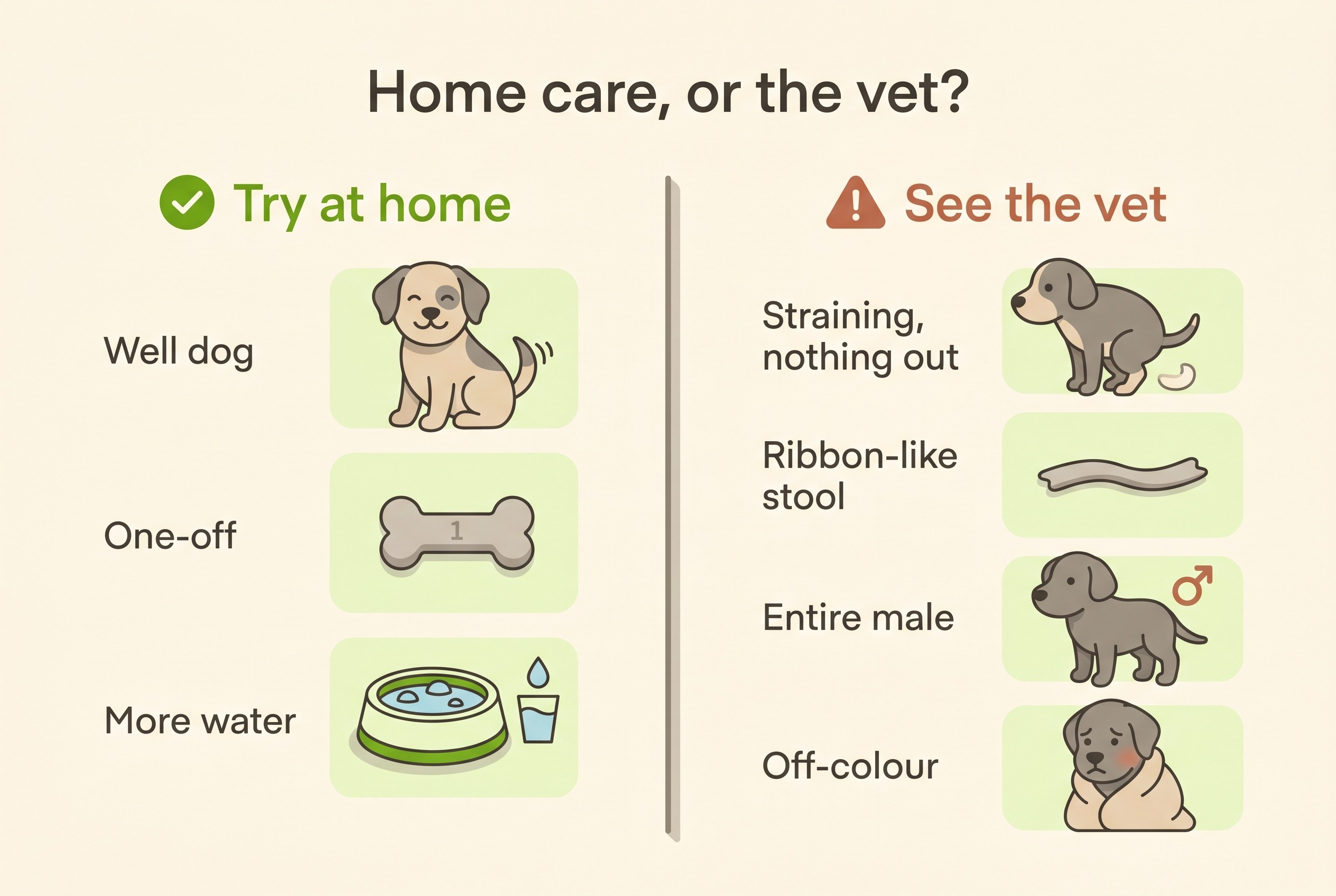
Where the line falls between home care and a vet visit is worth committing to memory. See your vet for constipation that recurs; for straining that produces little or nothing (which may be obstruction or colitis, not impaction); for any entire male dog with ribbon-like stools; for a past pelvic fracture; for pain on defecation, scooting or excessive licking; for blood; and for any dog that is also lethargic, off its food, vomiting, or has a distended or painful belly. The vet's first move is usually history plus a physical and rectal examination, often the single most informative test here, with bloods and imaging as the picture demands (Redfern, 2019; Hall et al., 2020). It helps to arrive prepared: our Faecal Score Tracker lets you log stool consistency, frequency and straining over a few days, so the vet sees the pattern, and a hydration-and-fibre trial in a benign case can be judged on data, not guesswork.
When it is urgent
A small number of these dogs are not "constipation at home" cases at all. A dog that is straining and also unwell, repeatedly vomiting, retching unproductively, collapsing, or with a tense, painful, distended abdomen, or where a swallowed foreign object might be obstructing the gut, needs a vet now, not a watch-and-wait. If that is your dog, our digestive emergencies guide covers it, and if you are unsure whether straining plus an off-colour dog has tipped over the line, our Vomiting and Diarrhoea Triage will help you decide. It is the point we started with: a dog that looks "blocked up" may be obstructed or seriously ill rather than merely constipated, which is the best argument against treating blind.
So a single bout in a well dog usually settles with more water, a little movement and patience. But where it keeps coming back, or the stool comes out ribbon-like, or your dog is an entire male, the most useful thing you can do is not reach for the fibre tub. It is to let your vet feel for the answer, because in a dog the cause is so often the cure. Once it has been found and addressed, the day-to-day plan to keep things moving comfortably lives in managing constipation.
References
- ACVS (American College of Veterinary Surgeons). (n.d.). Perineal hernias.
- Åhlberg, T. M., Jokinen, T. S., Salonen, H. M., Laitinen-Vapaavuori, O. M., & Mölsä, S. H. (2022). Exploring the association between canine perineal hernia and neurological, orthopedic, and gastrointestinal diseases. Acta Veterinaria Scandinavica, 64, 39.
- Hall, E. J., Williams, D. A., & Kathrani, A. (Eds.). (2020). BSAVA Manual of Canine and Feline Gastroenterology (3rd ed.). British Small Animal Veterinary Association.
- Merck Veterinary Manual. (n.d.). Constipation, obstipation, and megacolon in small animals.
- Merck Veterinary Manual. (n.d.). Benign prostatic hyperplasia in dogs.
- Moreno, A. A., Parker, V. J., Winston, J. A., & Rudinsky, A. J. (2022). Dietary fiber aids in the management of canine and feline gastrointestinal disease. Journal of the American Veterinary Medical Association, 260(S3), S33-S45.
- Niżański, W., Ochota, M., Fontaine, C., & Pasikowska, J. (2020). Comparison of clinical effectiveness of deslorelin acetate and osaterone acetate in dogs with benign prostatic hyperplasia. Animals, 10(10), 1936.
- Redfern, A. (2019). Dyschezia and tenesmus. In J. Mott & J. A. Morrison (Eds.), Blackwell's Five-Minute Veterinary Consult Clinical Companion: Small Animal Gastrointestinal Diseases (Ch. 6). Wiley-Blackwell.
- Suzuki, R., Shimada, M., Fukuda, H., Munakata, S., Kamijo, K., Yamaguchi, S., & Hara, Y. (2024). Pelvic osteotomy for pelvic canal stenosis after malunion pelvic fractures in cats. Journal of Feline Medicine and Surgery, 26(10), 1098612X241276393.
- Washabau, R. J., & Holt, D. E. (1999). Pathogenesis, diagnosis, and therapy of feline idiopathic megacolon. Veterinary Clinics of North America: Small Animal Practice, 29(2), 589-603.
- White, R. N. (2002). Surgical management of constipation. Journal of Feline Medicine and Surgery, 4(3), 129-138.
- WikiVet. (n.d.). Colonic impaction - dog and cat.
Keep track of how your pet is doing
The owners who cope best are the ones who notice changes early. A simple health log shows you what is working, and what is not, before the next vet visit.
Start tracking, freeYou're not doing this alone
Compare treatment journeys and talk to owners managing digestive health. Free to join.
Join PetsLikeMine