

The cat who cannot poo: constipation, megacolon and when it is an emergency
Alastair Greenway
BVM&S MRCVS
A cat owner often arrives with their phone already open on a photo of the litter tray. The cat keeps going in and out, crouching, straining, and either nothing comes or a few hard little pellets do. Most of the time this is constipation, which is common, treatable and usually not dangerous. But there is one look-alike that genuinely is dangerous, and a point at which constipation itself stops being a watch-and-wait problem, so it is worth knowing where those lines are.
This article is the recognition piece: how to tell what you are looking at, why cats in particular get bunged up, where it can lead, and the signs that mean today rather than tomorrow. The hands-on toolkit for keeping a constipation-prone cat regular lives in the companion guide, managing constipation.
First, the look-alike that matters most
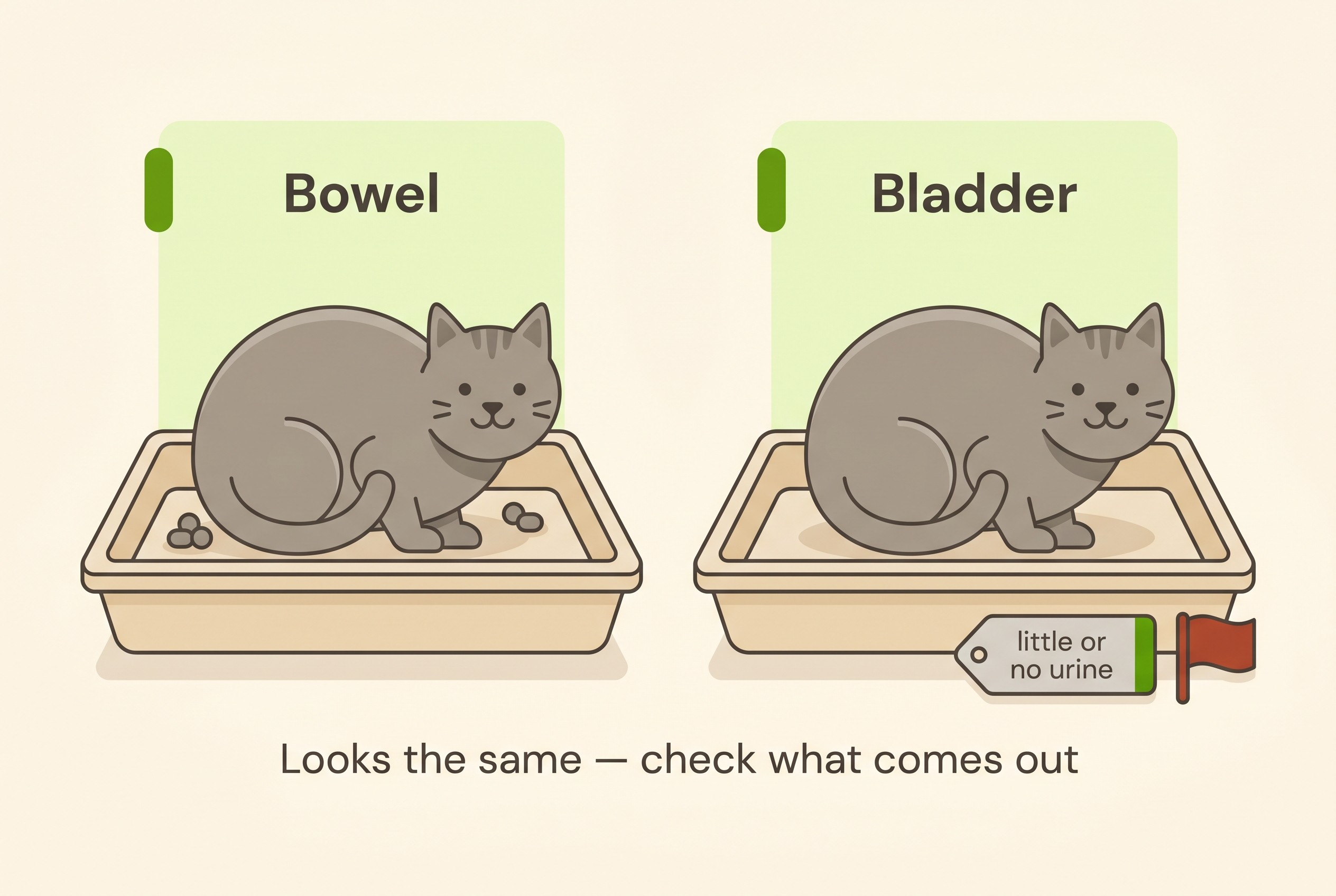
In a cat, straining in the litter tray is not always about the bowel. The very same posture, crouched, tense, repeatedly visiting the tray, is the classic sign of a blocked bladder (a urethral obstruction), and that is a true emergency that can be fatal within roughly 24 to 48 hours, especially in male cats (iCatCare, 2025). From across the room the two look almost identical.
What comes out is the practical way to tell them apart. A constipated cat strains to pass faeces and produces small hard pellets, or nothing. A blocked cat strains to pass urine and produces little or none, often cries, and may have a tense belly with a firm bladder felt low down. If your cat is straining and you cannot confirm it is passing a normal volume of urine, do not sit and watch: treat it as a urinary emergency and ring your vet now. The blocked cat's work-up belongs to our Urinary Health space, but the message to leave with is simple: a straining cat is innocent until proven passing urine.
What constipation actually looks like
Assuming the bladder is accounted for, here is the bowel picture. A constipated cat makes repeated, often unproductive trips to the tray, posturing and straining, and what appears is small, very hard, dry faeces, sometimes with a little mucus or a streak of blood squeezed around an impacted mass, or nothing at all (Washabau & Holt, 1999; Merck Veterinary Manual). As things progress the cat often goes quiet: off its food, hiding, dull, and once really backed up it may start to vomit (Merck Veterinary Manual). Some owners can feel a firm, sausage-shaped mass through the belly wall: the colon packed with hard faeces.
It helps your vet enormously if you arrive with specifics rather than just "she's constipated": how many trips, what came out (if anything), what it looked like, and whether she is eating and bright or flat. The Faecal Score Tracker is built for this, a daily note of trips to the tray, consistency on the 1 to 7 scale and appetite, so a slow drift towards drier, less frequent, more effortful motions shows up as a line and you catch the creep before it becomes a crisis. (Scoring a stool and what to photograph is covered in describing symptoms to your vet.)
Three words, in order: constipation, obstipation, megacolon
These signs sit on a spectrum, and understanding it explains why acting early matters.
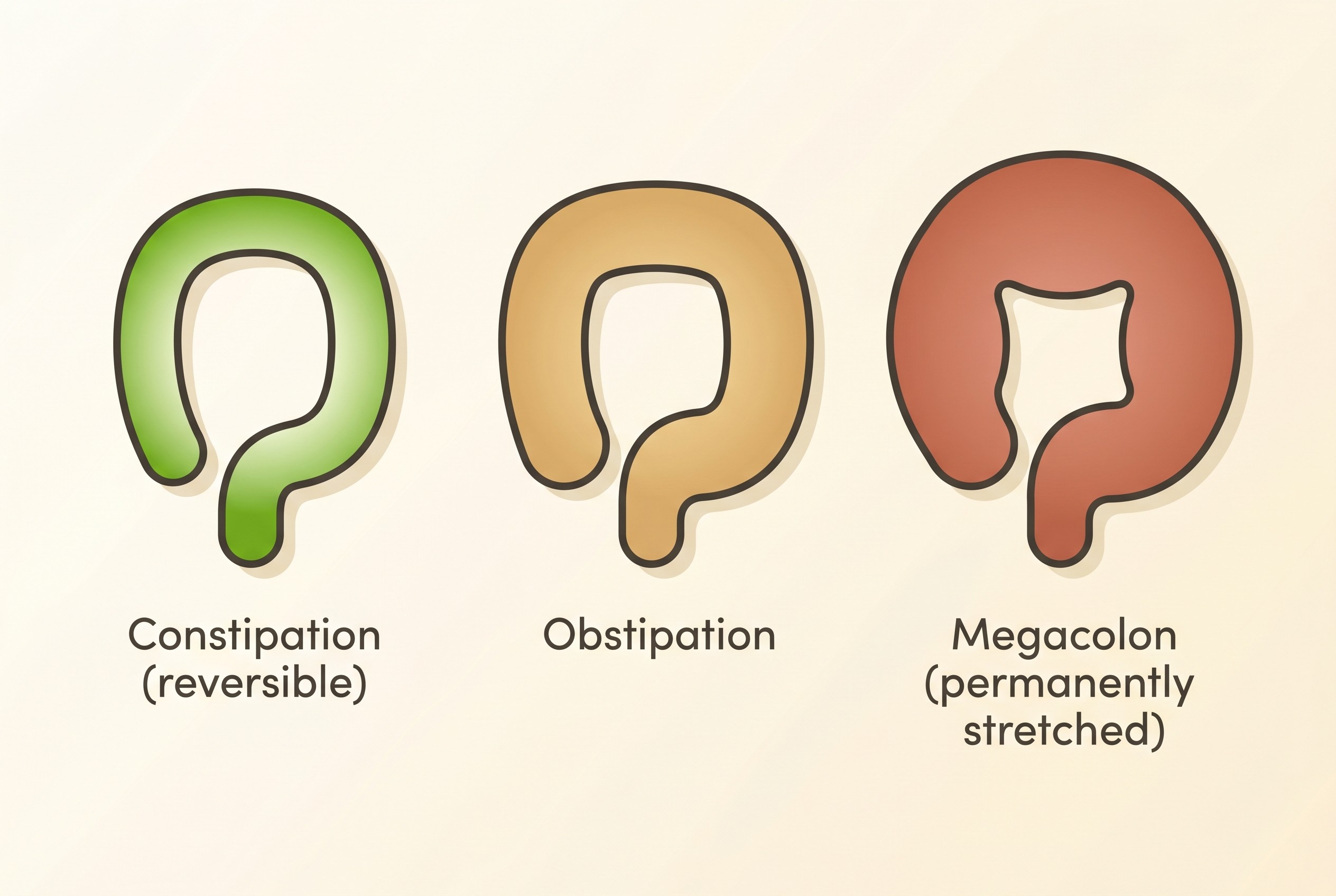
Constipation is the infrequent or difficult passage of hard, dry faeces. It is a clinical sign rather than a diagnosis, and it is usually reversible (Washabau & Holt, 1999; Merck Veterinary Manual). Obstipation is constipation that has become intractable: the cat is so backed up that it can no longer empty the colon at all and no longer responds to ordinary management, the point at which it usually needs a vet to physically empty the bowel (Washabau & Holt, 1999). Megacolon is the end of the road: a colon that has become permanently and abnormally dilated and lost its ability to contract and push, so faeces accumulate and the problem turns chronic. Once a colon is genuinely megacolonic that change is generally permanent; it does not bounce back (Washabau & Stalis, 1996; Washabau & Holt, 1999).
Both directions deserve a clear word. Most constipated cats never progress to megacolon, so a single missed day in the tray is not a sentence. But neglected or repeatedly recurring constipation can slide along this spectrum until the colon passes a point of no return, which is why "let's keep an eye on it for a few more weeks" is the wrong instinct in a cat who keeps getting blocked.
What fails in idiopathic megacolon is the colon's muscle, not its nerves: muscle from affected cats contracts far less than normal to every stimulus tested, while the nerves and muscle cells look essentially normal down the microscope (Washabau & Stalis, 1996). The pump is worn out, not the wiring, which is why a drug that prompts a partly-working colon to squeeze can help an early case but cannot rescue one that has already failed. ("Idiopathic" just means we do not know the trigger.)
Why cats are so prone to it
A handful of reasons keep recurring.
Dehydration is the engine. Cats are desert-adapted with a low thirst drive, so they are easy to keep quietly under-hydrated, especially on dry food, in older age, or with kidney disease. When water is short the colon reabsorbs more of it, the faeces harden, transit slows, and a vicious circle starts (Merck Veterinary Manual). Almost everything in management pulls on this one lever.
Kidney disease often travels alongside. Chronic kidney disease is very common in older cats, and there is a genuine link: in a survey of defecation habits, only 58% of cats with kidney disease passed a motion at least daily against 85% of healthy cats (Jones et al., 2022). The nuance is that excluding cats with a prior history of constipation largely erased the difference, so the connection is probably driven by the dehydration, low potassium and medication of kidney disease rather than the disease alone (Jones et al., 2022). It is fair to ask whether the kidneys have been looked at, without assuming one caused the other.
Pain and arthritis matter more than most owners expect. Degenerative joint disease is extraordinarily common in cats: in one study, 61% of cats aged six and over had radiographic osteoarthritis in at least one limb joint (Slingerland et al., 2011). A sore hip, stifle or spine makes squatting to pass a motion, or climbing into a high-sided tray, uncomfortable, so the cat holds on, the faeces dry out, and constipation follows. The arthritis itself belongs to our mobility and arthritis space; the point here is that a stiff, older cat is a constipation-prone cat.
Stress and litter-tray aversion. Cats are private and fussy about toileting, and a dirty, cramped, exposed or hard-to-reach tray, or a tense multi-cat household, can make a cat hold on. Feline environmental-needs guidance treats a low-stress toileting site as one of the core pillars of a cat's environment (Ellis et al., 2013), and the practical fixes are the companion guide's territory.
Mechanical and nerve causes. There are structural drivers too. In the largest classification of feline obstipation, 96% of cases came down to four causes: idiopathic megacolon (62%), a narrowed pelvic canal usually after an old, badly-healed fracture (23%), nerve injury to the colon (6%), and the congenital spinal defect seen in tailless Manx cats (5%) (Washabau & Holt, 1999). Those with idiopathic megacolon are most often middle-aged, male and domestic shorthairs, though any cat can be affected (Abdelbaset-Ismail et al., 2022).
When it is an emergency
A cat that cannot pass faeces and is also painful, off its food, dull, dehydrated or repeatedly vomiting needs to be seen the same day, not watched at home: obstipation in a systemically unwell cat is not a "give it another day" problem (Washabau & Holt, 1999; Merck Veterinary Manual). If you are weighing up how urgent the signs are, our Vomiting and Diarrhoea Triage can help, and the wider picture of when any digestive sign is urgent lives in digestive emergencies.
One home remedy needs a specific warning, because it can kill. Do not give your cat a human over-the-counter enema. The hypertonic sodium-phosphate type (the Fleet-style ones) are dangerous in cats: in a study of ten healthy cats given the product, every one developed clinical or biochemical abnormalities (high sodium, high phosphate, low calcium, acidosis), and at the higher dose one died (Atkins et al., 1985). A badly blocked cat is not a bathroom job, and the temptation to keep trying things at home is exactly what delays the help it needs.
What your vet will do, and why it is not a lost cause
Diagnosis is usually straightforward: a history of long-standing constipation, a firm faeces-filled colon felt on examination, and a plain X-ray showing a distended colon, which vets can even measure against the spine to confirm megacolon objectively (Trevail et al., 2011; Merck Veterinary Manual). Just as importantly, your vet will hunt for the cause, checking for dehydration, kidney disease, low potassium, an old pelvic fracture, nerve problems and pain, because treating the cause is what stops it coming back.
For a cat that is truly backed up, the first job is de-obstipation: physically emptying the colon, a controlled veterinary procedure done under sedation or anaesthetic, with intravenous fluids first to correct dehydration and electrolytes, then gentle warm-water enemas and careful manual breakdown of the impacted mass (Merck Veterinary Manual; Washabau & Holt, 1999).
For a colon that still has some function, ongoing management rests on hydration, a stool softener such as lactulose (an osmotic laxative titrated to a soft but not loose motion), dietary change, and a prokinetic, cisapride, which prompts the colon to contract (Washabau & Holt, 1999). Cisapride was withdrawn from the human market in 2000 over rare heart-rhythm problems and is no longer conventionally licensed, so for cats it is supplied as a special import or compounded preparation, including in the UK, though those cardiac effects have not been a problem in cats at the doses used (AVMA, 2000; Washabau & Holt, 1999). It helps a partly-working colon but is unlikely to rescue a cat with long-standing obstipation or established megacolon (Washabau & Holt, 1999). The doses and fibre choices are the companion guide's job: see managing constipation.
When a cat has true, recurrent, medicine-resistant megacolon, there is a definitive option, and I want to dispel the dread around it. Surgery to remove most of the colon (subtotal colectomy) is not a grim last resort: in the largest outcome study it was associated with long survival times and high owner satisfaction, with the refinement that preserving the ileocolic junction where possible gives better results (Grossman et al., 2021). Older reports put long-term success around 75 to 90%, with a spell of soft stools afterwards that settles (Washabau & Holt, 1999). For the right cat, a colectomy often hands a chronically miserable animal a normal life back. The timing lesson is real: cats whose signs have dragged on tend not to respond to medicine and do better with surgery, whereas shorter-duration cases more often settle on medicine (Abdelbaset-Ismail et al., 2022).
So do not let a recurrently blocked cat grind on for months hoping it sorts itself out, because the colon can reach a point from which it will not recover. If your cat has been here before, start logging the trips and faecal scores in the Faecal Score Tracker now, so you and your vet can see the next slide coming and step in while medicine still has something to work with. (Dogs get constipated too, but the causes differ enough to deserve their own guide: see constipation in dogs.)
References
- Abdelbaset-Ismail, A., Ibrahim, N., Sobh, M. S., et al. (2022). Use of radiographic and histologic scores to evaluate cats with idiopathic megacolon grouped based on the duration of their clinical signs. Frontiers in Veterinary Science, 9, 1033090.
- Atkins, C. E., Tyler, R., & Greenlee, P. (1985). Clinical, biochemical, acid-base, and electrolyte abnormalities in cats after hypertonic sodium phosphate enema administration. American Journal of Veterinary Research, 46(4), 980-988.
- AVMA. (2000, July 1). Efforts to keep cisapride available meet dead end. JAVMA News.
- Ellis, S. L. H., Rodan, I., Carney, H. C., Heath, S., Rochlitz, I., Shearburn, L. D., Sundahl, E., & Westropp, J. L. (2013). AAFP and ISFM feline environmental needs guidelines. Journal of Feline Medicine and Surgery, 15(3), 219-230.
- Grossman, R. M., Sumner, J. P., Lopez, D. J., et al. (2021). Evaluation of outcomes following subtotal colectomy for the treatment of idiopathic megacolon in cats. Journal of the American Veterinary Medical Association, 259(11), 1292-1299.
- iCatCare. (2025). ISFM consensus guidelines on the diagnosis and management of feline lower urinary tract disease. International Cat Care / International Society of Feline Medicine.
- Jones, S. E., Quimby, J. M., Summers, S. C., Adams, S. M., Caney, S. M. A., & Rudinsky, A. J. (2022). Survey of defecation habits in apparently healthy and chronic kidney disease cats. Journal of Feline Medicine and Surgery, 24(2), 131-141.
- Merck Veterinary Manual. (n.d.). Constipation, obstipation, and megacolon in small animals.
- Slingerland, L. I., Hazewinkel, H. A. W., Meij, B. P., Picavet, P., & Voorhout, G. (2011). Cross-sectional study of the prevalence and clinical features of osteoarthritis in 100 cats. The Veterinary Journal, 187(3), 304-309.
- Trevail, T., Gunn-Moore, D., Carrera, I., Courcier, E., & Sullivan, M. (2011). Radiographic diameter of the colon in normal and constipated cats and in cats with megacolon. Veterinary Radiology & Ultrasound, 52(5), 516-520.
- Washabau, R. J., & Holt, D. E. (1999). Pathogenesis, diagnosis, and therapy of feline idiopathic megacolon. Veterinary Clinics of North America: Small Animal Practice, 29(2), 589-603.
- Washabau, R. J., & Stalis, I. H. (1996). Alterations in colonic smooth muscle function in cats with idiopathic megacolon. American Journal of Veterinary Research, 57(4), 580-587.
Keep track of how your pet is doing
The owners who cope best are the ones who notice changes early. A simple health log shows you what is working, and what is not, before the next vet visit.
Start tracking, freeYou're not doing this alone
Compare treatment journeys and talk to owners managing digestive health. Free to join.
Join PetsLikeMine