

Which Dogs Get It? Breed, Weight, Neutering and Conformation
Alastair Greenway
BVM&S MRCVS
"Why mine?" is the question that surfaces within a day of a cruciate rupture, and it arrives wrapped in guilt: the muddy field, the ball you threw, the jump off the sofa, the extra couple of kilos you'd been meaning to address. I hear it in the consult room more than almost any other, and I want to answer it as straight as I can, because the real answer is kinder and more useful than the guilt people usually walk in with.
Here's the foundation, kept brief because another article tells the full story. Cruciate disease in dogs is overwhelmingly a degenerative process, not a one-off sporting injury. The fibres of the ligament break down over months or years, and eventually the weakened ligament gives way under load a healthy one would have shrugged off (Comerford et al., 2011). The jump off the sofa is the moment it finished, not the reason it failed. If you want that story in full, with the reassurance that goes with it, Why It's Degeneration, Not an Injury is the piece to read next. What I want to answer here is the other half of the question. If it's degeneration, why does it happen to some dogs and not others?
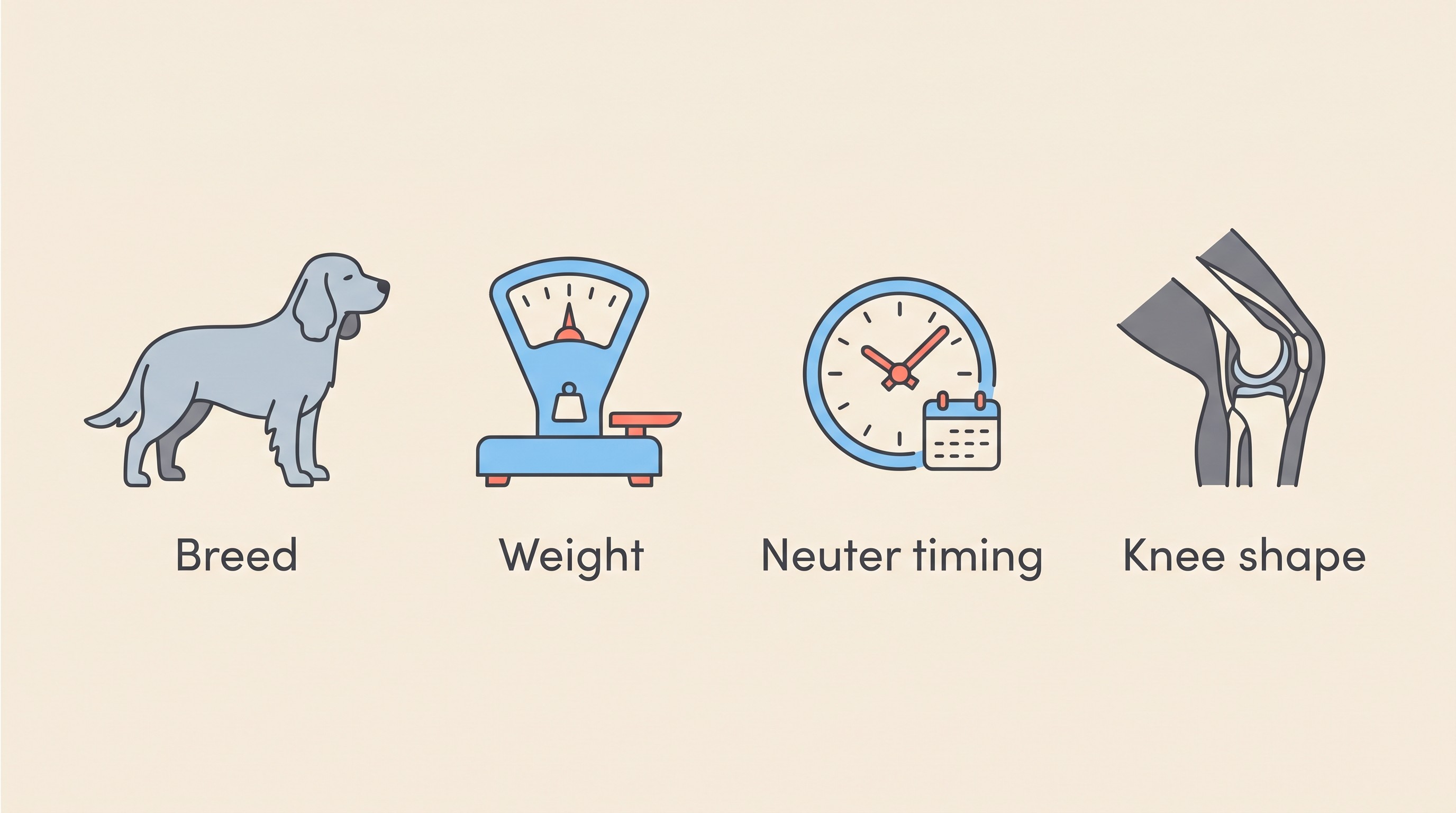
Several things stack the odds at once. Breed and genetics, size and bodyweight, neuter status and timing, age, and the shape of the knee itself each nudge the risk upward. No single one is destiny. A high-risk breed is a flag, not a sentence. And while some of these factors are fixed, others are genuinely within your hands.
Breed and size
Let me start with the data that matters most to a UK reader, because it's drawn from UK first-opinion practices rather than a referral hospital on another continent. In a large primary-care study, certain breeds carried clearly higher odds of cruciate disease than crossbreeds: the Rottweiler stood out at more than three and a half times the odds (OR 3.66), followed by the Bichon Frise (OR 2.09), West Highland White Terrier (OR 1.80), Golden Retriever (OR 1.69), Yorkshire Terrier (OR 1.53) and Jack Russell Terrier (OR 1.43) (Pegram et al., 2023). An earlier UK study of more than 171,000 dogs put the one-year prevalence of a cruciate diagnosis at 0.56%, roughly one dog in 180 seen each year, and flagged a similar cast at increased risk, adding the Staffordshire Bull Terrier (Taylor-Brown et al., 2015).
Now look at those lists again, because there's a detail the lazy "large-breed disease" headline gets wrong. The Bichon Frise, the Westie, the Yorkie, the Jack Russell. None of those is a big dog. Several small breeds are genuinely over-represented, which tells you size alone isn't the whole story. It cuts both ways too. Several breeds carry reduced odds compared with crossbreeds, the Cockapoo, Chihuahua and Shih-Tzu among them (Pegram et al., 2023). If you've got a breed on the lower-risk list, that's reassuring, though it isn't a guarantee. Think of risk as a dial rather than a switch.
For context rather than a UK benchmark, a very large North American database names Newfoundlands, Rottweilers and Labrador Retrievers among the most affected, with reported prevalence ranging from roughly 0.56% to 2.55% depending on the population (Witsberger et al., 2008).
Why should breed matter at all? Because there's a real, heritable component. In a cohort of Newfoundlands the pattern of inheritance fitted a recessive model with around 51% penetrance and a heritability estimate of 0.27 (Wilke et al., 2006). That's not a number to memorise, but it makes the point: a meaningful share of the risk is written into the dog's genes. This is why responsible breeding matters, and why none of it is your fault as an owner. You didn't cause a tendency your dog was born carrying.
Weight
If breed is the factor you can't change, weight is the one you can, and it's the single biggest lever you hold. In that same UK study of over 171,000 dogs, those in the heaviest third of bodyweight were 3.4 times more likely to be diagnosed with cruciate disease than the lightest (Taylor-Brown et al., 2015). That is a large effect, and it's worth pausing on.
Two plausible reasons sit behind it. The obvious one is mechanical: a heavier dog drives more load through a knee already relying on a degenerating ligament. The less obvious one is biochemical. Fat is not inert padding, it is metabolically active and releases inflammatory signals, and chronic low-grade inflammation is plausibly unhelpful for a ligament that's quietly breaking down. Between the load and the inflammation, extra weight stacks the odds in a way lighter dogs don't face.
The practical how-to of weight management, body condition scoring, muscle and the lifelong plan belongs to Weight, Muscle and the Long Game and to our wider osteoarthritis library. The take-away here is simpler: of everything on this list, your dog's weight is the factor most worth acting on, before any sign of trouble and at every stage afterwards. It helps the at-risk knee, and if one knee has already gone it helps protect the other.
Neutering and timing
Most owner-facing pages skirt this part, and I'd rather meet it head on, because the questions it raises are real and the framing has to be careful.
There is a clear association between neutering and cruciate disease. In the large North American dataset, spayed females had more than double the odds (OR 2.35) and castrated males raised odds too (OR 1.68) compared with entire dogs (Witsberger et al., 2008). UK data echoes the direction, with neutered females (OR 1.46) and neutered males (OR 1.42) carrying higher odds than entire females (Pegram et al., 2023). So neuter status is consistently associated with risk.
The more nuanced, and more useful, finding is about timing, and it's strongly breed-specific. In a study following Labradors and Golden Retrievers, neutering before six months of age roughly doubled the incidence of one or more joint disorders in Labradors, and raised it four to five-fold in Golden Retrievers, with cranial cruciate tear one of the disorders raised in the early-neutered group (Hart et al., 2014). That's a striking signal, but read the breed names carefully. The effect was not uniform across breeds, and you cannot lift a Golden Retriever finding onto every dog in the country. There's even a plausible mechanism. Dogs with an excessively steep tibial plateau angle were three times as likely to have been neutered before six months, suggesting early removal of the sex hormones may alter how the long bones grow and subtly reshape the knee (Duerr et al., 2007).
So how should you hold all this? Not as "never neuter". Neutering carries genuine benefits, behavioural, reproductive and for preventing other diseases, and for most dogs it remains the right call. The fair take-away is narrower: in certain larger breeds, the timing of neutering may matter for joint health, so it's a conversation worth having with your own vet who knows your dog and your breed, rather than a blanket rule. If you've got a puppy of an at-risk breed, that's exactly the discussion a good vet will welcome.
Knee conformation
The last factor is the shape of the knee itself. The top of the shin bone slopes backwards at an angle called the tibial plateau angle. The steeper that slope, the more the shin bone wants to slide forward when the dog bears weight, and the harder the cruciate has to work to stop it. In one study, the mean tibial plateau angle was around 5.7 degrees greater in stifles that had ruptured than in normal ones (Morris and Lipowitz, 2001). Later work has been mixed, so I'd frame a steep plateau as a contributing predisposition rather than a sole cause, but the principle is sound: some knees are simply built to ask more of their cruciate.
There's a separate wrinkle for small breeds, and it ties back to those terriers on the high-risk list. A luxating patella, the kneecap that slips out of its groove, is common in small dogs and turns out to be a cruciate risk factor in its own right over time. Among dogs with patellar luxation, 41% had a concurrent cruciate rupture, and those with both were considerably older (mean 7.8 years) than those with a luxating patella alone (mean 3.0 years), with higher-grade luxation carrying more cruciate rupture (Campbell et al., 2010). Years of a knee tracking abnormally seem to wear on the cruciate, so a "trick knee" in a young small dog is worth watching as it ages. You can't reshape your dog's tibia, but knowing the knee is predisposed helps you stay alert and act early if a hint of lameness appears.
What you can change, and what you can't
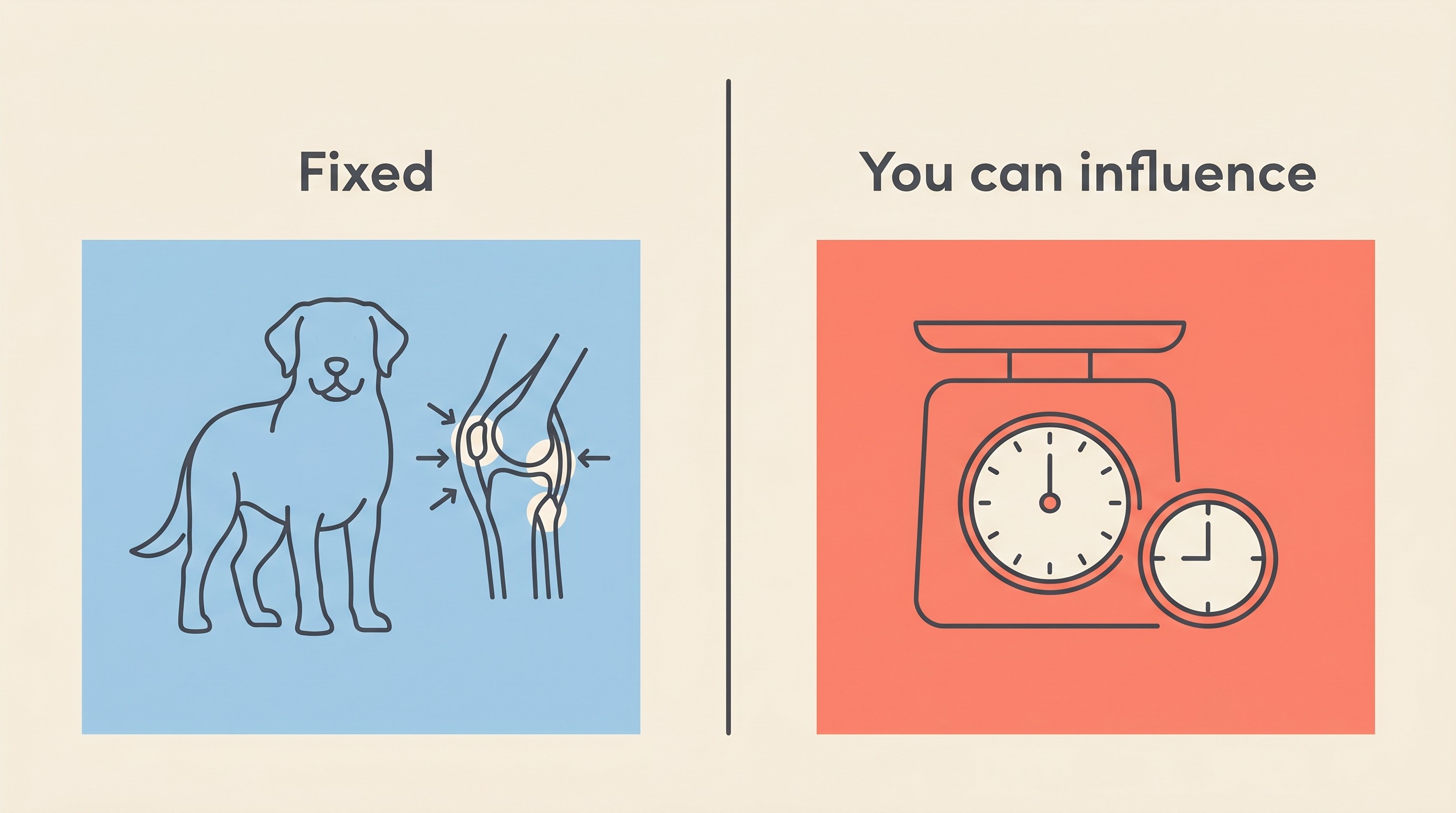
Step back and the picture sorts into two columns. On one side sit the things you cannot change: your dog's breed, the genes it was born with, and the shape of its knee. These stack the odds, but there's no guilt to be had in them. They were never yours to control.
On the other side sit the things genuinely within your influence. Bodyweight is the big one, the lever most worth pulling and the one that keeps paying off for the rest of your dog's life. An informed, breed-appropriate neutering decision, made with your vet rather than by default, is another. And awareness handles the rest: knowing your dog is predisposed means you notice the first subtle limp, keep the weight in check, and don't lose a fortnight wondering whether it's nothing.
One last thing to carry forward. Because the tendency lives in the dog rather than in bad luck in one joint, dogs who rupture one cruciate have a real chance of the other going too, with the second knee commonly affected within months to a year or so in a substantial share of cases (Doverspike et al., 1993). A smaller group, around one in ten (10.6% in one Labrador series), already have both knees affected at the point of diagnosis (Buote et al., 2009). That's not a reason to panic, and it deserves a proper discussion rather than a frightening one-liner. The full picture of that risk, and what it means for how you plan, belongs to Will the Other Leg Go Too? The Bilateral Risk, which is written for exactly that worry.
If you've landed here in the thick of a fresh diagnosis and want the whole arc in one place, what the disease is, how it's treated, and what recovery asks of you, start with the complete guide to cruciate disease. One small reassurance, since people sometimes ask: this is very much a dog's disease. Cats do occasionally rupture a cruciate, but it's uncommon and usually follows a genuine accident, which only underlines how different the canine story is. For your dog, the answer to "why mine?" is rarely something you did. It's breed, anatomy and a slow degeneration you couldn't see. What happens next, the weight, the watchfulness, the sensible decisions, is where you come in, and that part you can do well.
References
- Buote, N., Fusco, J., Radasch, R. (2009). Age, tibial plateau angle, sex, and weight as risk factors for contralateral rupture of the cranial cruciate ligament in Labradors. Veterinary Surgery, 38(4), 481-489.
- Campbell, C.A., Horstman, C.L., Mason, D.R., Evans, R.B. (2010). Severity of patellar luxation and frequency of concomitant cranial cruciate ligament rupture in dogs: 162 cases (2004-2007). Journal of the American Veterinary Medical Association, 236(8), 887-891.
- Comerford, E.J., Smith, K., Hayashi, K. (2011). Update on the aetiopathogenesis of canine cranial cruciate ligament disease. Veterinary and Comparative Orthopaedics and Traumatology, 24(2), 91-98.
- Doverspike, M., Vasseur, P.B., Harb, M.F., Walls, C.M. (1993). Contralateral cranial cruciate ligament rupture: incidence in 114 dogs. Journal of the American Animal Hospital Association, 29, 167-170.
- Duerr, F.M., Duncan, C.G., Savicky, R.S., Park, R.D., Egger, E.L., Palmer, R.H. (2007). Risk factors for excessive tibial plateau angle in large-breed dogs with cranial cruciate ligament disease. Journal of the American Veterinary Medical Association, 231(11), 1688-1691.
- Hart, B.L., Hart, L.A., Thigpen, A.P., Willits, N.H. (2014). Long-term health effects of neutering dogs: comparison of Labrador Retrievers with Golden Retrievers. PLoS ONE, 9(7), e102241.
- Morris, E., Lipowitz, A.J. (2001). Comparison of tibial plateau angles in dogs with and without cranial cruciate ligament injuries. Journal of the American Veterinary Medical Association, 218(3), 363-366.
- Pegram, C., Brodbelt, D.C., Diaz-Ordaz, K., Chang, Y., Frykfors von Hekkel, A., Church, D.B., O'Neill, D.G. (2023). Risk factors for cranial cruciate ligament rupture in dogs under primary veterinary care in the UK. The Veterinary Journal, 292, 105952.
- Taylor-Brown, F.E., Meeson, R.L., Brodbelt, D.C., Church, D.B., McGreevy, P.D., Thomson, P.C., O'Neill, D.G. (2015). Epidemiology of cranial cruciate ligament disease diagnosis in dogs attending primary-care veterinary practices in England. Veterinary Surgery, 44(6), 777-783.
- Wilke, V.L., Conzemius, M.G., Kinghorn, B.P., Macrossan, P.E., Cai, W., Rothschild, M.F. (2006). Inheritance of rupture of the cranial cruciate ligament in Newfoundlands. Journal of the American Veterinary Medical Association, 228(1), 61-64.
- Witsberger, T.H., Villamil, J.A., Schultz, L.G., Hahn, A.W., Cook, J.L. (2008). Prevalence of and risk factors for hip dysplasia and cranial cruciate ligament deficiency in dogs. Journal of the American Veterinary Medical Association, 232(12), 1818-1824.
Sister tool · Sightline
Track whether treatment is working
Sightline, a separate ConciergeVet tool, runs a short weekly check-in built on validated pain and mobility instruments, turns it into a single Sightline Score you can watch trend over weeks rather than judge on one bad day, and produces a report you can bring to your vet.
A written log, or our printable trackers, does much the same job.
See how Sightline tracks treatmentKeep track of how your pet is doing
The owners who cope best are the ones who notice changes early. A simple health log shows you what is working, and what is not, before the next vet visit.
Start tracking, freeYou're not doing this alone
Compare treatment journeys and talk to owners managing cruciate ligament disease. Free to join.
Join PetsLikeMine