

When Age Becomes Illness: Understanding Decline in a Senior Pet
Alastair Greenway
BVM&S MRCVS
Some worries never get a diagnosis attached to them. No one has said anything frightening at the vet's. There is no scan, no result, no word like "terminal". There is just a creeping sense, building over weeks or months, that the dog who used to meet you at the door now lifts his head from the bed instead, or that the cat who ruled the windowsill now sleeps a little too much and seems a little less herself. Underneath sits a question you may not have put into words: is this just old age, or is something actually wrong? You are frightened of two opposite mistakes at once, of fussing over the simple passage of time, and of missing something you could have helped.
That is one of the wisest worries an owner can have, and the answer is more reassuring than the fear, though not in the way you might expect. The reassurance isn't "don't worry, it's just his age." It's more useful than that: a great deal of what looks like "just old age" is treatable, and the kindest thing you can do for an ageing pet is to stay curious rather than resigned. This piece is about telling the slow, normal greying of a life apart from the conditions that hide inside it, and recognising the gentle slide toward the end when it begins. It hands the decision itself, when it comes, to how will I know when it is time, and the detail of comfort and nursing to its own guides. Here I just want to help you read what you are seeing.
Ageing is not a disease, but "just old age" is a costly label
Old age is not, in itself, an illness to be cured. The American Veterinary Medical Association says it plainly to owners: "it's important to remember that age is not a disease," while noting that senior pets are more likely to develop health problems (AVMA, Caring for senior cats and dogs), and the profession's most recent senior-care guidelines are built on exactly that, "the understanding that aging is not a disease" (AAHA, 2023). (Senior, for the record, arrives sooner than most owners expect: the PDSA reckons dogs are generally senior from around seven and cats from around eleven, with larger dogs ageing faster, and seniors make up around 44% of the pet population (PDSA; AAHA, 2023).)
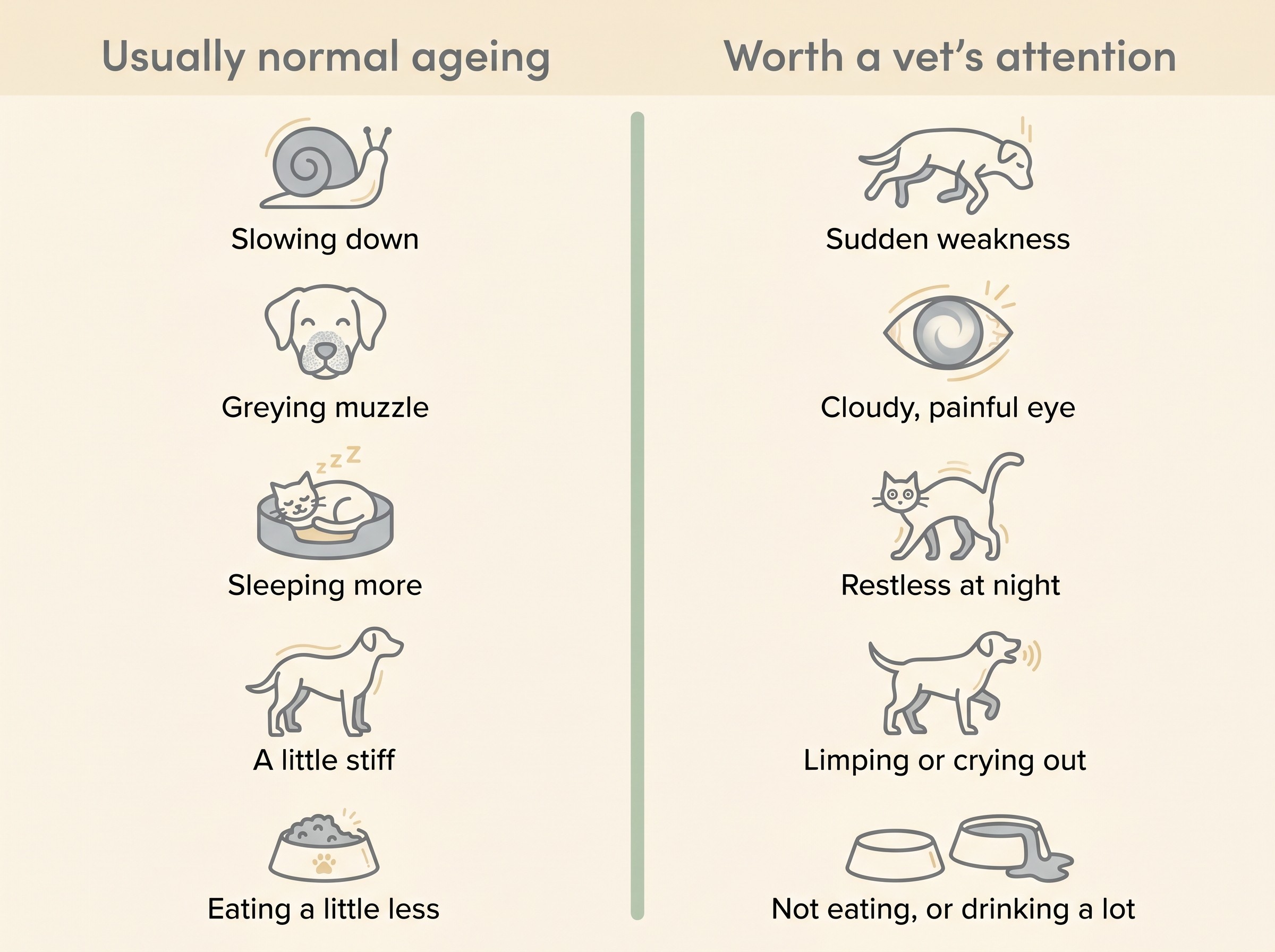
So why does old age feel like an illness? Because it quietly changes the ground that disease grows in. The AVMA describes it as "a gradual decline in the body's ability to repair itself, maintain normal body functions, and adapt to the stresses and changes in the environment," with immune function compromised over time (AVMA, Caring for senior cats and dogs). An older body has less in reserve and fewer defences against illnesses that were always lurking. The greying muzzle and the longer naps are the ageing itself. The conditions it lets in are something else, and many can be treated.
And the research keeps finding the same thing: the single commonest reason a treatable problem goes unspotted in an old pet is that the owner, kindly and understandably, files the signs under "normal ageing". A UK study set out to understand how owners think about their ageing dogs, and the title alone tells the story: "'Just old age'" (Wallis et al., 2023). It found that age-related changes "were mostly perceived as 'just old age' by dog owners", that many senior dogs no longer attended check-ups "unless owners identified a problem", and concluded that "opportunities to educate owners on which clinical signs represent healthy or pathological ageing are being missed" (Wallis et al., 2023). The lead researchers put it bluntly: owners may mistake signs "like increased sleep" for normal ageing rather than "potential indicators of treatable conditions", and the study found "significant gaps in veterinary professional and dog owner communication... requiring urgent intervention" (Wallis et al., 2023, via University of Liverpool).
None of that is a charge of negligence. Mislabelling illness as old age is exactly what the body invites you to do, because illness in an old animal so often arrives wearing the costume of ageing: a little slower, a little quieter, a little off. The fix is not guilt. It is simply knowing that "he's just getting old" is a hypothesis, not a diagnosis, and the difference is worth a vet's eyes. And it matters, because illness is genuinely common and genuinely hidden in pets who look perfectly well. When researchers screened a hundred apparently healthy senior and geriatric dogs, abnormalities were the rule rather than the exception: raised blood pressure in 53, raised kidney values in 32, a heart murmur in 22, with new diagnoses including chronic kidney disease, an underactive thyroid, mast cell tumours and bladder infections (Willems et al., 2017). "Physical and laboratory abnormalities are common in apparently healthy elderly dogs," they concluded, and screening helps with "early disease detection" and "early therapeutic intervention" (Willems et al., 2017). That is not a reason to fear your pet is secretly riddled with disease. It is a reason to let a vet look properly rather than assume the answer in advance.
When trouble comes, it rarely comes alone
When something does turn out to be wrong, a second truth about old animals changes how you should think about it: in a frail, ageing pet, illnesses rarely arrive politely, one at a time. They come in packs.
The common late-life conditions are a familiar list to any vet: chronic kidney disease, heart disease, arthritis, cognitive decline, cancer, and the hormonal diseases (an overactive thyroid in cats; Cushing's, an underactive thyroid, or diabetes in dogs). What owners are rarely told is how often several coexist in the same animal at once. In a large study of more than 26,000 dogs, 71.6% carried three or more concurrent conditions, and the tangle grew denser with age, reaching its most complex in the senior group (Bras et al., 2024). Some of the classic pairings map straight onto the rest of this site: high blood pressure alongside kidney disease, and diabetes alongside cataracts and blindness (Bras et al., 2024). Cats are no different. Senior cats frequently carry kidney disease, an overactive thyroid, arthritis, high blood pressure and cognitive decline together, and these conditions "are sometimes at odds with each other", because treating one can complicate another (dvm360, managing comorbidities in senior cats).
The practical upshot is this. A single new sign in an old pet, the weight loss, the extra thirst, the reluctance on the stairs, may be the visible tip of more than one problem, and one condition can easily mask or mimic another. This is why a good vet examines the whole animal rather than chasing the symptom you walked in about, why "let's just check a few things while he's here" is rarely overkill in a senior pet, and why this is not something to sort out by guesswork at home.
"He's just stiff" and "she's gone senile": two disguises worth naming
Two conditions deserve singling out, because they hide behind the words we reach for when a pet gets old, and because both, once recognised, can frequently be helped.
The first is arthritis, staggeringly under-recognised, especially in cats. When researchers x-rayed a hundred elderly cats, around 90% of those over twelve years old showed evidence of degenerative joint disease, most of it never suspected, and it "may be an overlooked cause of clinical disease" (Hardie et al., 2002). Most arthritic old cats, in other words, are quietly sore and no one knows, because cats do not limp the obvious way dogs do. They simply stop jumping onto the windowsill, sleep somewhere more accessible, groom less, get a touch grumpier, and we say "she's just getting old and set in her ways." The same is true of plenty of stoic old dogs. The detail of spotting that hidden pain belongs to spotting pain in a pet who hides it, and I would point any owner of a slowing senior straight to it, because pain is one of the most fixable things on this whole page.
The second disguise is dementia, and here I have to hold two ideas that pull in opposite directions. Cognitive decline in old pets is real, common and hugely under-diagnosed. In dogs the signs are often summarised by the acronym DISHA: Disorientation, altered Interactions, Sleep and wake cycle disturbance, House-soiling, and Activity changes, with anxiety frequently added (WSAVA, 2019). It rises steeply with age, affecting around one in four dogs by eleven or twelve and over two-thirds by fifteen or sixteen (Neilson et al., 2001), yet most is never picked up: one survey found signs in around 14% of older dogs but only about 2% diagnosed by a vet, because "most cases go undiagnosed until signs become sufficiently problematic" (Salvin et al., 2010). Cats are no different: roughly 28% of those aged eleven to fourteen and 50% of those over fifteen show such changes (Landsberg et al., 2010), and in one survey 75% of owners reported signs when asked but only 12% had volunteered them unprompted (reported in MacQuiddy et al., 2022).
So the night-pacing, the staring at walls, the soiling indoors, the howling at three in the morning are real, and worth taking to your vet rather than enduring in silence. But here is the part that pulls the other way: dementia is a diagnosis of exclusion. "With the identification of any behavioural signs of CDS, a diagnosis is made by exclusion of all possible medical causes of the signs" (WSAVA, 2019). Almost every classic dementia sign can also be caused by something else, and often something treatable. Before reaching for the diagnosis in a cat, "it is necessary to first rule out other underlying medical conditions (ie, osteoarthritis, hypertension, hyperthyroidism, etc)" (MacQuiddy et al., 2022). The cat howling at night may be senile, or she may have high blood pressure, an overactive thyroid, failing sight or pain, all of which can be helped. The dog soiling indoors may be losing his mind, or he may have a bladder infection or sore joints that make getting out in time too hard. Arthritic pain in cats in particular can mimic the very signs of cognitive dysfunction, and these often improve with pain management (Landsberg et al., 2010). So please do not quietly conclude "she's just gone senile" and stop there. That label, reached too early, hides a list of things you could fix.
"Too old to do anything about it" is a myth worth demolishing
One belief does real harm in old age, and I want to take it apart gently: that "he's too old, there's no point putting him through tests, just let him be." It sounds like kindness. Often it delays help for something genuinely treatable. The veterinary consensus runs the opposite way: regular screening of older pets supports "early disease detection" and "early therapeutic intervention" (Willems et al., 2017), and the profession built its senior-care guidelines around enhancing, and potentially extending, quality of life in what it calls a vulnerable life stage (AAHA, 2023). Age is a factor to weigh, not an automatic veto on finding out what is wrong, and what gets found is frequently very manageable: arthritis pain, an overactive thyroid, kidney support, even the signs of cognitive decline can all be treated or slowed. A diagnosis at thirteen is not the same as a diagnosis being pointless. Very often it is the difference between a comfortable last chapter and an uncomfortable one.
And yet the truth lives in the tension, so hold the other half too. Not every test or treatment is kind in a very frail animal; the opposite failure is over-treating, putting a fragile old pet through burdensome investigations that buy little time and cost real comfort. Both mistakes are made out of love. The way through is not a rule but a question to ask your vet together: what would this actually change for him, what will it cost him in stress or discomfort, and is the likely benefit worth it to the pet, not just to me? Sometimes the answer is to investigate and treat. Sometimes it is that comfort-focused care, easing what can be eased without chasing a cure, is the kinder path, and that is not giving up; it has its own guide in pet hospice and comfort care at home, with the patient's own quality of life as the goal the profession names directly (AAHA, 2023). And on the harder calls, when you genuinely cannot tell whether more medicine is a kindness or a burden, hold onto this: no one can make this decision for you, but you do not have to make it alone, and your vet will help you weigh it.
How decline actually tends to look: plateaus, then step-downs
Owners often expect old age to be a smooth, steady downhill slope, then feel blindsided when it isn't, so the shape vets and owners actually tend to see is worth describing.
Decline in a frail old animal usually does not slide gently. It tends to come in long, stable plateaus, weeks or months where your pet has settled into a slightly diminished but contented normal, interrupted by sudden step-downs. The step-down is often triggered by something specific: an illness, a bad night, a fall, a flare of pain, a tummy upset. Sometimes there is a partial recovery afterwards, but to a slightly lower baseline, and then another plateau begins. Knock by knock, each tends to take a little more than the last.
There is a real mechanism behind this. Ageing brings a loss of "robustness", the ability to maintain an optimal state of physiologic functioning, and of "resilience", the ability to return to that state after stressors, with frailty defined as "diminished resistance to stressors, and increased risk of disease, disability, and death" alongside an "increased need for acute or chronic medical care" (McKenzie et al., 2022). In plain terms: a young animal shrugs off a bad night because it has reserve to spare; a frail old one has spent that reserve, so the same knock can drop it to a new, lower level it never fully climbs back from. That is the engine under the step-downs, and it is why a setback that would be trivial in a young animal deserves real attention in an old one rather than a wait-and-see shrug.

Which leads to the cruel paradox of loving an old animal, worth naming because it lifts a weight of guilt: the person closest to the pet is the one least able to see it declining. Because the change is gradual and you are with it constantly, the slow slide hides inside the daily sameness. It is the visitor who hasn't seen your dog in six months who walks in and goes quiet, comparing him to a memory while you compare him only to yesterday, and it is exactly why the research keeps finding that owners miss treatable change (Wallis et al., 2023). It is not a failing of love; it is how proximity works. So compare across time instead of trusting your daily impression: dig out a video from a year ago, ask someone who sees your pet rarely, and above all keep a simple record, so that "is he worse than he was?" becomes a visible line rather than an anxious guess in the dark.
That first step asks nothing clinical of you. Our Quality of Life Check is a short in-app snapshot, built on the everyday markers vets use, designed not to judge a single bad day but to reveal the trend across many of them.
Sightline (sightline.vet), a separate ConciergeVet tool, runs a short adaptive weekly assessment with a quality-of-life focus mode built around exactly these frameworks, tracks a single composite score over time so you can see the trend rather than judge a single bad day, and produces a Sightline Report PDF you can bring to your vet. A written log, or our printable QoL sheet, does much the same job.
The detail of how to read that trend, and what to do as it falls, belongs to how will I know when it is time. Here, the only thing to take is the habit: notice, compare, write it down.
Carrying all of this forward
Growing old is not the same as being ill, and the most loving thing you can do with an ageing dog or cat is to refuse the easy comfort of "it's just his age" and stay curious instead, so that what can be eased is eased, and what genuinely cannot be is met with comfort and clear eyes rather than guesswork and regret.
Three things hide so well behind age that they deserve a vet's eyes more than most: a change in pain, which masquerades as stiffness, grumpiness and lost habits (spotting pain in a pet who hides it); the question of comfort over cure in a frail patient, which is a loving path rather than a defeat (pet hospice and comfort care at home); and the slow slide toward the end, when it comes, which deserves its own guide rather than a paragraph here (how will I know when it is time).
And if, somewhere in the reading, you have brushed up against the harder feeling, the dread of watching this happen, the fear that you cannot bear it, I would say only this. That fear is the ordinary cost of loving an animal who has grown old, not a sign that anything is wrong with you, and you do not have to sit with the heaviest version of it alone; if it ever tips into feeling you genuinely cannot go on, the Samaritans are there day and night, free, on 116 123, and pet worry is a real and recognised reason to reach out. For now, though, you are not at the end of anything. You are at the beginning of paying close, kind attention, and an old pet whose owner is watching with clear eyes rather than wishful ones is a pet in very good hands.
References
- American Veterinary Medical Association. (n.d.). Caring for senior cats and dogs.
- Bras, D., et al. / Dog Aging Project. (2024). Constructing the first comorbidity networks in companion dogs in the Dog Aging Project. bioRxiv / PMC11702704.
- Dhaliwal, R., Boynton, E., Carrera-Justiz, S., Cruise, N., Gardner, M., Huntingford, J., Lobprise, H., & Rozanski, E. (2023). 2023 AAHA Senior Care Guidelines for Dogs and Cats. Journal of the American Animal Hospital Association, 59(1), 1-21.
- dvm360. (2023). Managing comorbidities in senior cats.
- Hardie, E. M., Roe, S. C., & Martin, F. R. (2002). Radiographic evidence of degenerative joint disease in geriatric cats: 100 cases (1994-1997). Journal of the American Veterinary Medical Association, 220(5), 628-632.
- Landsberg, G. M., Denenberg, S., & Araujo, J. A. (2010). Cognitive dysfunction in cats: a syndrome we used to dismiss as 'old age'. Journal of Feline Medicine and Surgery, 12(11), 837-848.
- MacQuiddy, B., Moreno, J. A., Frank, J., & McGrath, S. (2022). Survey of risk factors and frequency of clinical signs observed with feline cognitive dysfunction syndrome. Journal of Feline Medicine and Surgery, 24(12), e335-e346.
- McKenzie, B. A., Chen, F. L., Gruen, M. E., & Olby, N. J. (2022). Canine Geriatric Syndrome: A Framework for Advancing Research in Veterinary Geroscience. Frontiers in Veterinary Science, 9, 853743.
- Neilson, J. C., Hart, B. L., Cliff, K. D., & Ruehl, W. W. (2001). Prevalence of behavioral changes associated with age-related cognitive impairment in dogs. Journal of the American Veterinary Medical Association, 218(11), 1787-1791.
- PDSA. (n.d.). A guide to senior pet food and feeding your ageing pet.
- Salvin, H. E., McGreevy, P. D., Sachdev, P. S., & Valenzuela, M. J. (2010). Under diagnosis of canine cognitive dysfunction: A cross-sectional survey of older companion dogs. The Veterinary Journal, 184(3), 277-281.
- Wallis, L. J., Radford, A. D., Belshaw, Z., Jackson, J., Kubinyi, E., German, A. J., & Westgarth, C. (2023). 'Just old age': a qualitative investigation of owner and veterinary professional experiences of and attitudes to ageing in dogs in the UK. Journal of Small Animal Practice, 64(7), 425-433.
- Wallis, L. J., et al. / University of Liverpool. (2023). 'Just old age' or is your dog experiencing a serious clinical issue? (research press release). University of Liverpool News.
- Willems, A., Paepe, D., Marynissen, S., Smets, P., Van de Maele, I., Picavet, P., Duchateau, L., & Daminet, S. (2017). Results of Screening of Apparently Healthy Senior and Geriatric Dogs. Journal of Veterinary Internal Medicine, 31(1), 81-92.
- World Small Animal Veterinary Association (Landsberg, G.). (2019). The Science of Canine Cognitive Decline and Dysfunction: Prevalence, Diagnosis and Clinical Signs. WSAVA 2019 Congress Proceedings (VIN).