
Stomatitis "cures" online (Mutian/Mutoral): what the evidence says
Alastair Greenway
BVM&S MRCVS
It usually happens late at night. Your cat has stomatitis, you have read everything, the vet has said the word "extraction", and you cannot quite make peace with it. So you find the Facebook group, and there, in the small hours, is exactly what you have been aching to hear: a photo of somebody's cat, bright and eating again, and a caption saying a product they bought online cured her without a single tooth coming out. Someone posts a link. Others chime in. It sounds like the answer.
I want to be clear before anything else: wanting that to be true does not make you gullible, and reaching for it does not make you a bad owner. You are watching an animal you love be in pain, and you are being offered a way out that skips the part that frightens you. Anyone would look. What I would like to do here is stand next to you and go through what these products actually are, what the evidence does and does not show, and why the treatment that sounds so drastic is still the one with the track record. Not to talk you out of hope. To make sure the hope you act on is pointed at something real.
What these products actually are
The names that come up most often are Mutian and Mutoral. Mutian is a Chinese company that first became known in cat circles for selling unlicensed antiviral products for feline infectious peritonitis (FIP), sold directly to owners over the internet. More recently the same company has marketed a product aimed at stomatitis, branded Mutoral (also referred to by a code, MT-2073). The company describes it as a small-molecule drug that dampens part of the immune signalling involved in feline stomatitis (a so-called JAK inhibitor) (Mutian, 2026).
On paper, that mechanism is not absurd. FCGS really is an immune-driven disease, and calming an overactive immune response really is one legitimate direction of travel (Soltero-Rivera et al., 2023). Reputable pharmaceutical research is genuinely exploring immune-modulating and antiviral drugs for exactly this condition. So the pitch is not obviously ridiculous, and that is part of why it is persuasive. The problem is not the idea. The problem is the gap between the idea and the proof.
The honest evidence position
Here is the part that matters most, and I will give it to you straight rather than dressed up.
There is, at the time of writing, no robust, independent, peer-reviewed evidence that Mutoral cures or reliably controls feline chronic gingivostomatitis. The company points to its own clinical study of the product, but that is not the same as independent evidence: a manufacturer reporting that its own product met its own targets, in a trial you cannot read in full or scrutinise, is a very different thing from a study run by researchers with no stake in the result and published where other vets can pull it apart (Mutian, 2026). When you search the veterinary literature for these products, what you find is company material and owner anecdotes, not the kind of controlled evidence that sits behind the treatments your vet offers.
I want to be careful and fair about what that means, because it is easy to overstate. Absence of good evidence is not the same as proof that something does nothing. It is entirely possible that a future, properly run trial shows a benefit. But "we don't yet have evidence that it works" is exactly the position you should treat with caution when your cat is in pain and the alternative is a proven treatment. The anecdotes are real, and the cats in the photos may genuinely be brighter. What an anecdote cannot tell you is why: whether it was the product, or a flare that was always going to settle, or steroids given at the same time, or simply an owner desperate to see improvement. That is the entire reason controlled trials exist. Without one, a hundred hopeful posts still cannot tell you whether the thing in the packet is the thing that helped.
The problem of what's actually in the packet
There is a second issue that has nothing to do with whether the mechanism could work, and it is worth understanding because it is specific and it is documented.
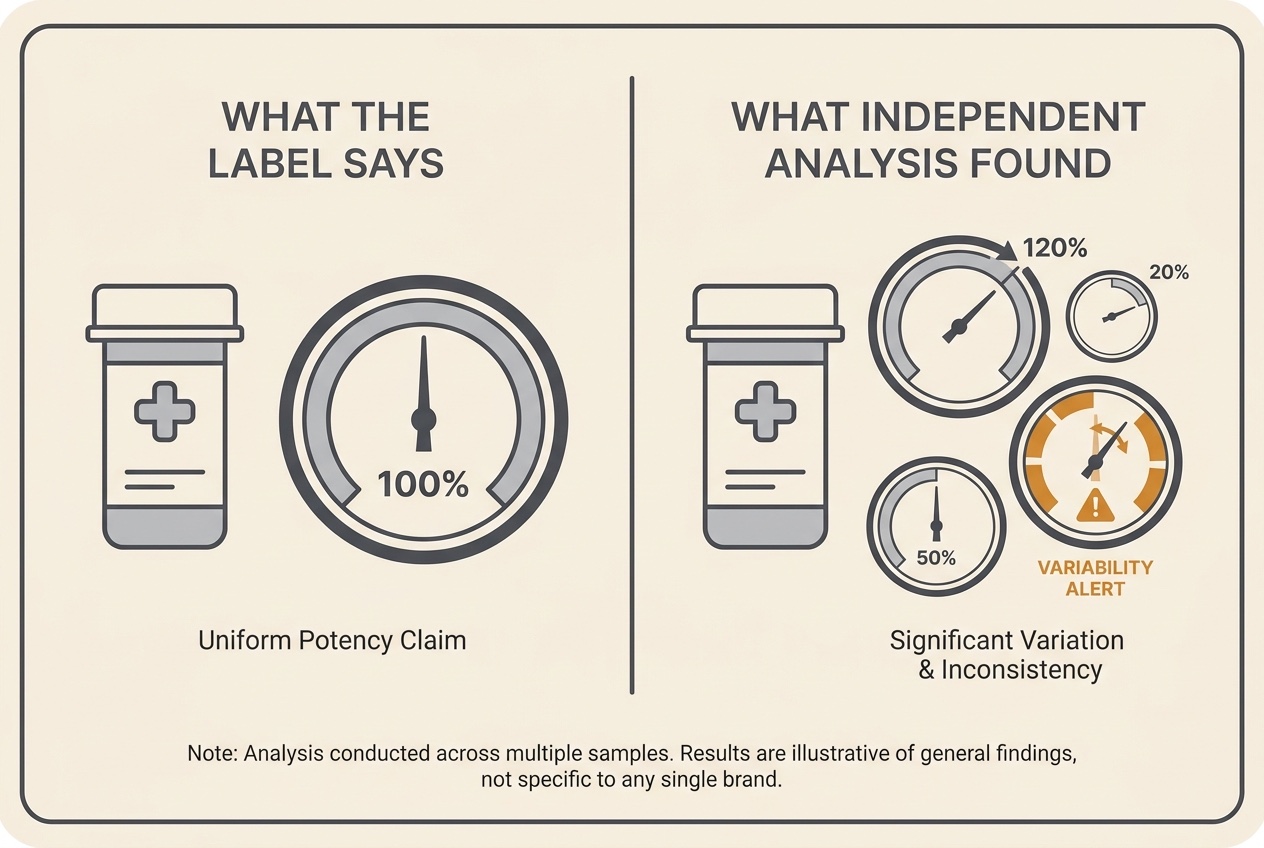
When independent researchers got hold of the same company's better-known FIP antiviral products and analysed them in a laboratory, what they found was not reassuring. In a study of 127 samples from 30 unlicensed brands (Mutian among them), the actual drug content bore little relation to what the labels claimed. Some oral products contained far more active drug than advertised, in the company's case ranging from roughly 90% to over 300% of the stated amount. A handful of samples contained a different drug altogether (remdesivir) that was not declared at all (Kent et al., 2024). The researchers were blunt about the underlying problem: with an unregulated product bought this way, you genuinely do not know what you are giving.
I want to be precise, because precision is the whole point of a piece like this. That laboratory analysis was of the FIP antivirals, not of the stomatitis product specifically, and it would not be fair to claim the two are identical. But it is the closest hard evidence we have about how reliably this maker's unlicensed, direct-to-owner products match their own labels, and the answer was: not reliably at all. When a product is sold outside any medicines regulator, nobody is independently checking the dose, the purity, or even the identity of what is inside. That is not a flaw in one bad batch. It is the built-in consequence of buying medicine from outside the system that exists to check it.
There is a legal dimension too, and it is not a small one. In the UK these products are not authorised veterinary medicines, and importing an unauthorised medicine yourself is a criminal offence, not merely frowned upon (VMD, 2022). I mention that not to frighten you or add guilt to an already hard situation, but because owners are almost never told it before they click "buy", and it is the sort of thing you would want to know.
Why the proven route still exists
If you set the online products to one side for a moment, the reason your vet keeps coming back to extraction is not stubbornness or a lack of imagination. It is that, across everything that has been tried for FCGS, surgical extraction has the best-documented outcomes by a wide margin.
Removing the teeth (either all of them, or all of those behind the canines) takes away the plaque-covered surfaces the immune system keeps over-reacting to. In one study of 95 cats, 28% had their stomatitis resolve completely after extraction and a further 39% improved substantially, so roughly two in three did well (Jennings et al., 2015). A systematic review of the whole literature reached the same conclusion: extraction is the most effective treatment we have, and medical management alone rarely controls the disease (Winer et al., 2016). This is why the 2025 feline dental guidelines still name it first-line (FelineVMA, 2025). It is not the exciting answer. It is the answer that has been measured, repeated, and stood up.
That does not mean extraction is a magic switch, and I would not insult you by pretending it is. Some cats need pain relief and medication for a while afterwards as the mouth settles, and a minority (very roughly one in ten) stay difficult and need ongoing specialist management (Soltero-Rivera et al., 2023). But those cats are managed with treatments that are also studied and prescribed by a vet who can watch for side effects, not bought unlabelled from overseas. Our piece on feline chronic gingivostomatitis, explained walks through why the surgery works, and living with stomatitis covers the day-to-day of managing pain, food and flares once you are through it.
How to weigh a claim you see online
You do not need a science degree to sort the promising from the dubious. A few plain questions do most of the work, and they are the same ones I would ask of any product, including the ones I do recommend.
- Is it a licensed veterinary medicine where you live? A licence means a regulator has seen the data and checked the manufacturing. No licence means nobody independent has.
- Is there evidence, and is it independent? A company reporting on its own product is not the same as a study run by people with nothing to gain, published where other vets can challenge it. One cured-cat photo is a story, not evidence.
- Do you actually know what is in it? If the ingredients or the dose cannot be independently verified, you are trusting a seller's word about a medicine going into your cat.
- Who benefits from you believing it? A support group is full of kind people, but the person who originally posts a purchase link is not always one of them.
- What does it ask you to skip? Any "cure" that works by talking you out of the treatment with the evidence behind it deserves your deepest suspicion.
The same instinct that makes you weigh a chew or a dental diet against a neutral standard belongs here too. If you have read our verdict on chews, dental diets and water additives, you already know the move: ask what has actually been measured, and treat "clinically proven" on a sales page as marketing until an independent source backs it.
What to do with the hope
None of this means you have to swallow the extraction decision without question or feel silly for having looked. Take the post that gave you hope to your own vet and ask them about it directly. A good vet will not roll their eyes. They will tell you what is known, what is not, and whether anything genuinely promising is on the horizon for your particular cat, because there is real research happening into antiviral and immune-based options, done the slow, careful, checkable way (FelineVMA, 2025). Hope is not the problem here. Hope is the reason you are still fighting for her. The only thing worth guarding against is spending that hope, and your money, and precious weeks of your cat's comfort, on something sold to you outside the system built to tell you whether it works.
And if she has stopped eating altogether while you weigh all this up, do not wait on any of it. A cat that will not eat can go downhill fast, and that is a same-day call to your vet, not a watch-and-see.
References
- FelineVMA (Lobprise, H., St Denis, K., Anderson, J. G., Hoyer, N., Fiani, N., & Yaroslav, J.) (2025). 2025 FelineVMA feline oral health and dental care guidelines. Journal of Feline Medicine and Surgery.
- Jennings, M. W., Lewis, J. R., Soltero-Rivera, M. M., Brown, D. C., & Reiter, A. M. (2015). Effect of tooth extraction on stomatitis in cats: 95 cases (2000-2013). Journal of the American Veterinary Medical Association, 246(6), 654-660.
- Kent, A. M., Guan, S., Jacque, N., Novicoff, W., & Evans, S. J. M. (2024). Unlicensed antiviral products used for the at-home treatment of feline infectious peritonitis contain GS-441524 at significantly different amounts than advertised. Journal of the American Veterinary Medical Association, 262(4), 489-497.
- Mutian (2026). Mutoral (MT-2073) product and FCGS clinical information. Manufacturer materials,
- Soltero-Rivera, M., Goldschmidt, S., & Arzi, B. (2023). Feline chronic gingivostomatitis: current concepts in clinical management. Journal of Feline Medicine and Surgery, 25(9).
- VMD (Veterinary Medicines Directorate) (2022). Importing unauthorised veterinary medicines is criminal.
- Winer, J. N., Arzi, B., & Verstraete, F. J. M. (2016). Therapeutic management of feline chronic gingivostomatitis: a systematic review of the literature. Frontiers in Veterinary Science, 3, 54.
Keep track of how your pet is doing
The owners who cope best are the ones who notice changes early. A simple health log shows you what is working, and what is not, before the next vet visit.
Start tracking, freeYou're not doing this alone
Compare treatment journeys and talk to owners managing teeth & mouth. Free to join.
Join PetsLikeMine