

Living with stomatitis: managing pain, food and the SDAI diary
Alastair Greenway
BVM&S MRCVS
By now you know the word better than you ever wanted to. Stomatitis. Maybe she's a few weeks past her extractions and you're watching every mouthful, willing her to eat. Maybe she's on medication and having a run of good days, and you're braced for the next bad one. Either way, you've stopped being the frightened owner in the consulting room and become something harder: the person who manages this, day after day, at home, with no one watching over your shoulder to tell you whether you're getting it right.
So let me tell you first, plainly: you're doing well. Living with a cat who has feline chronic gingivostomatitis (FCGS) is a marathon, not a single dramatic rescue, and the fact that you're reading this, thinking about her food and her comfort and how to tell a flare from a wobble, means she has exactly the person she needs. This piece is about the long game. What to feed a sore mouth, how pain relief actually fits in, how to track whether she's genuinely improving or quietly slipping, and when a bad day tips into a same-day phone call. If you haven't yet read what FCGS actually is and why extraction is the treatment, start there. This is the piece for after that, when the question changes from "what is this?" to "how do we live with it well?"
Feeding a mouth that hurts
Food is where most of the daily worry lives, because it's the thing you can see. A cat who won't eat frightens you in a way almost nothing else does, and with FCGS the fear is doubled: she's hungry, she wants the food, and her own mouth won't let her have it comfortably. So this is usually the first practical problem to solve.
A quick, important caveat before the tips: there isn't a large body of trial evidence on exactly what to feed a stomatitis cat, so what follows is practical experience rather than something you'll find with a peer-reviewed number attached. Treat it as a starting point to adapt to your own cat, not a prescription.
The general aim is to reduce how much work her mouth has to do. Soft, wet food usually goes down more easily than dry while the mouth is sore, so a smooth pate-style texture tends to beat anything chunky or jelly-set. Warming food gently to around body temperature (a few seconds, stirred and tested on your wrist so it's warm and never hot) lifts the smell, which matters a great deal to a cat whose appetite is being fought by pain. Thinning food into a soup or loose slurry she can lap rather than bite helps some cats, and small, frequent servings often beat one big bowl she stares at and gives up on.
Here's the reassurance that surprises people, though. If your cat has had full-mouth or near-full-mouth extractions, the long-term news on food is genuinely good. Cats eat perfectly well without teeth, dry food included if that's her preference, because a cat's teeth were built for catching and tearing rather than chewing, and her tongue and gums handle ordinary eating without them (FelineVMA, 2025). Many owners keep offering soft food out of habit and worry long after their cat would happily crunch biscuits again. Once she's healed, let her show you what she can manage. The soft-food phase is for the sore mouth, not forever. If you're in the early post-surgery window and every meal feels like a battle, our piece on eating after extractions walks through that specific fortnight in more detail.
Where pain relief fits, and what it can and can't do
FCGS hurts. That's the single most important fact to keep hold of, because a cat hides pain by instinct and it's easy to under-treat something you can't see her complaining about. Managing that pain is not spoiling her or over-medicating; it's the difference between a cat who can eat and groom and one who slowly shuts down.
I'm not going to give you doses here, because pain relief in a cat has to be chosen and monitored by your own vet, who knows her kidneys, her other conditions and her weight. But it helps to understand the shape of it. Two families of drug do most of the work. Opioid-type pain relief such as buprenorphine is often reached for around procedures and flares because it's effective and reliable in cats, and studies in stomatitis cats specifically found it produced a good, consistent analgesic effect (Soltero-Rivera et al., 2023). Anti-inflammatory pain relief (the NSAID group, which includes drugs like meloxicam and robenacoxib) tackles the inflammation itself, and there's reasonable evidence these can be used over longer stretches in cats whose kidneys are stable and monitored (Soltero-Rivera et al., 2023). Which of these, at what dose, and for how long is a conversation with your vet, not a decision to make from an internet article or, please, from another owner's leftover medication.
The pattern to expect after extraction is worth naming so it doesn't alarm you. Most cats who go on to do well still need a course of medication (pain relief, sometimes anti-inflammatories or antibiotics) for a finite period after the first couple of weeks while the mouth settles. In one large series, close to seven in ten of the cats who improved needed that kind of support for a limited time (Soltero-Rivera et al., 2023). That's a normal part of healing, not a sign the surgery failed. The goal is a tapering course you eventually come off, not a lifelong prop.
One drug I'll be firm about: steroids on their own are not a treatment for FCGS. They can blunt the pain for a while and feel like they're helping, but used alone they produce a real, lasting improvement in only around a quarter of cats, and long-term steroids in cats carry their own serious cost, including a meaningful risk of tipping a cat into diabetes (Soltero-Rivera et al., 2023). They have a place in the right cat, alongside proper treatment and with a vet watching closely. They are not a way to avoid fixing the mouth, and a cat parked on steroids for years is usually a cat still in pain who is now brewing a second illness.
Tracking flares: the SDAI home score
The cruel thing about a mouth condition is that you can't see inside it, and your cat is wired to hide exactly the signals you most need. So how do you know, week to week, whether she's genuinely getting better, holding steady, or sliding into a flare? Guesswork and dread aren't a plan, and "I think she seems a bit brighter?" is impossible to act on.
This is what the Stomatitis Disease Activity Index, or SDAI, is for. It was devised by the veterinary dentist Dr Jamie Anderson, and it has two halves that fit together (Soltero-Rivera et al., 2023). One half is your vet's: a structured look at the redness, ulceration and swelling in her mouth at each check-up. The other half is yours, and it carries real weight. At home you score four everyday things, each on a simple 0 to 3 scale: her appetite, her activity, her grooming, and her oral comfort (Soltero-Rivera et al., 2023). Those four are precisely the things that shift first when a cat feels better or worse, and you see them across whole days and weeks in a way no ten-minute consult ever can.
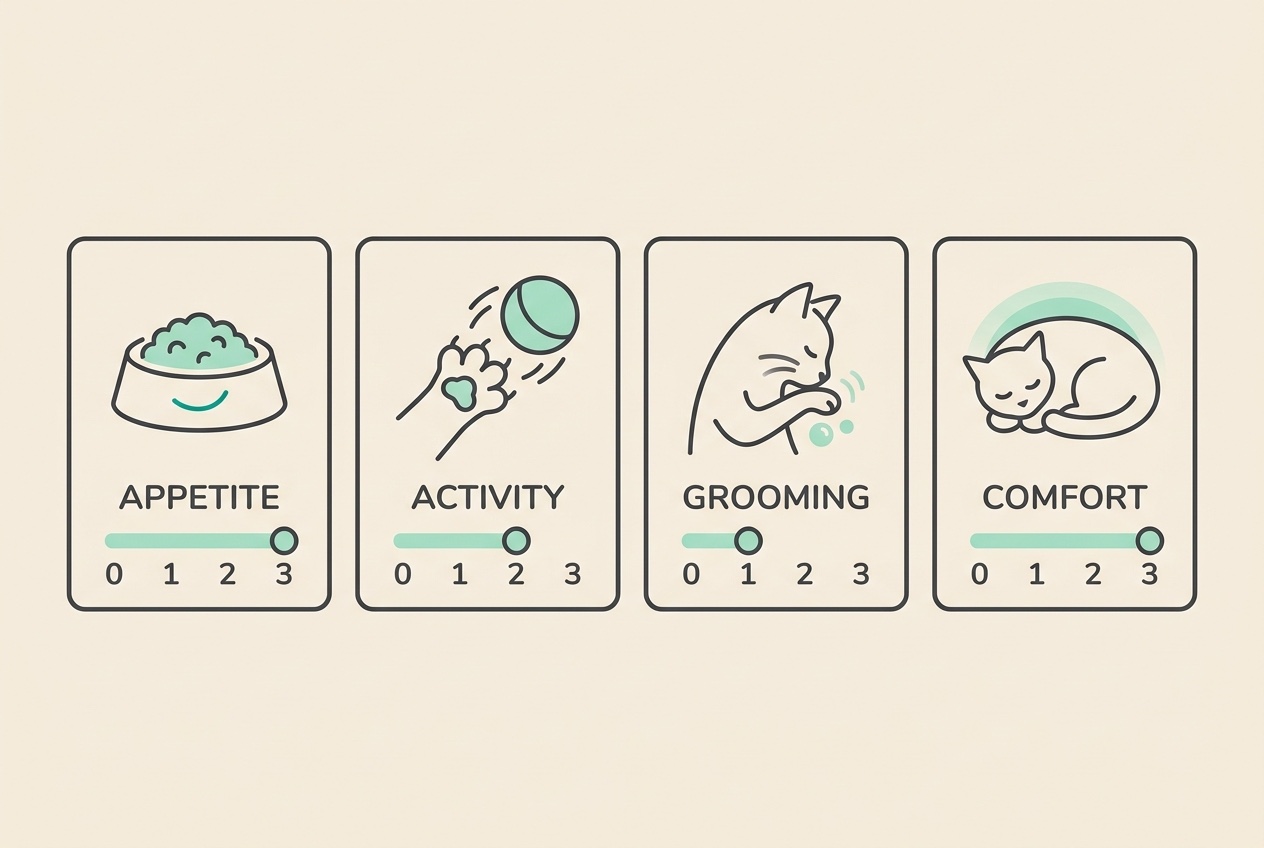
Two things make this genuinely useful rather than just another form. First, the vet's view and the owner's view don't always agree, and the gap between them is information in itself; a cat whose mouth still looks inflamed but who is eating and grooming happily is a different clinical picture from one whose mouth looks calmer but who has gone quiet (Soltero-Rivera et al., 2023). Capturing both is the whole point. Second, a number you wrote down last month is something you can compare against, which turns a vague impression into a trend you and your vet can actually read.
Our SDAI diary tool is built around exactly this. You log the four home scores between visits, it keeps the history, and you bring a clear picture to each appointment instead of trying to reconstruct six weeks of good and bad days from memory. One honest note on the science: the SDAI is a practical monitoring tool, and it hasn't yet been through formal studies of how consistently different people score it, which is why it works best when the same person tracks the same cat over time, so you're comparing like with like (Soltero-Rivera et al., 2023). For a home diary that's a strength, not a flaw. You are the most consistent observer she has.
What a flare looks like, and what improvement looks like
Once you're scoring, the patterns start to speak. It helps to know in advance what you're watching for, because a flare and a good stretch each announce themselves in the small things long before anything dramatic happens.
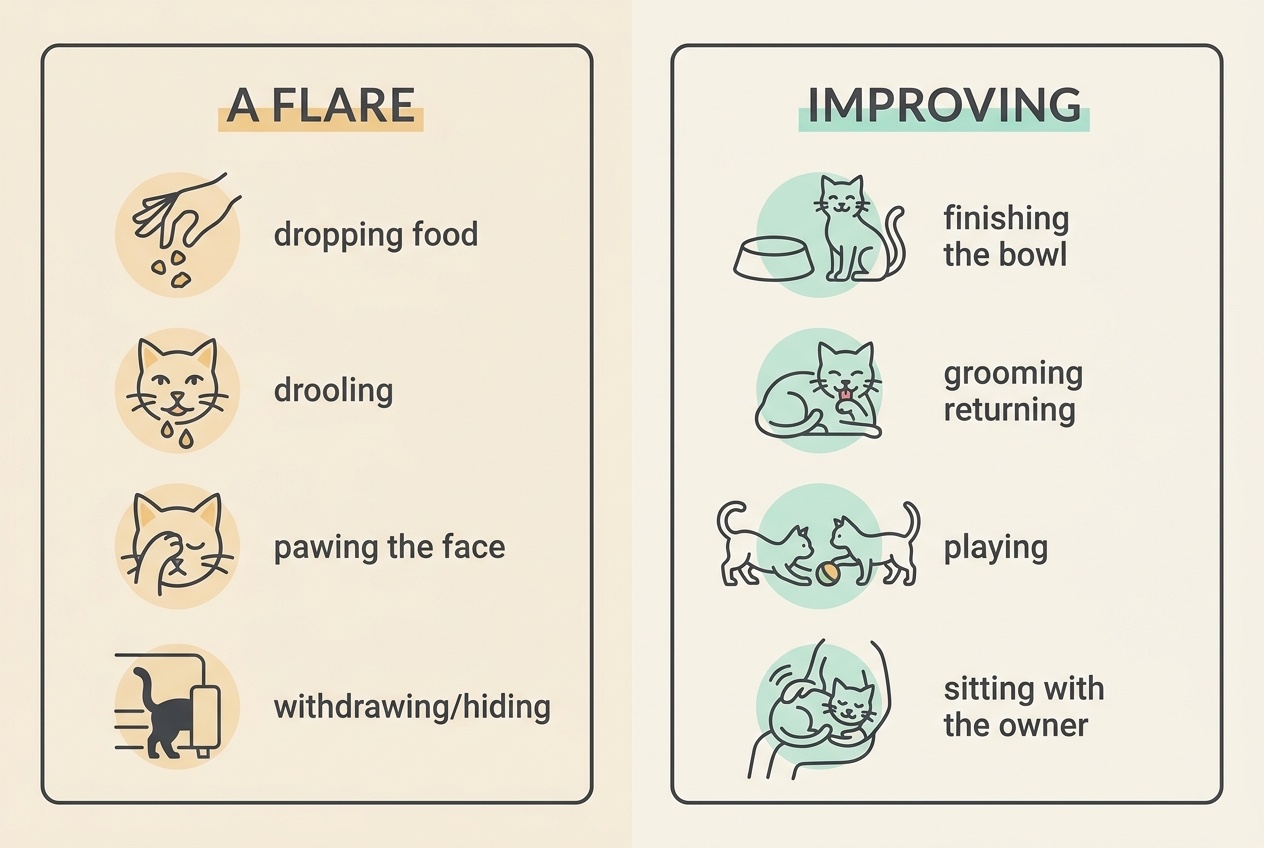
A flare usually shows up as her scores drifting the wrong way together. Appetite drops, or she approaches the bowl keen and then backs off. She starts drooling more, sometimes tinged pink, or pawing at her face and turning her head from your hand. The grooming falls away, so her coat looks less kept and maybe a little matted, and she withdraws, sleeping more, hiding, less interested in the things she likes. A sudden crash in mood or a swipe when you go near her head is pain talking, not temper.
Improvement is quieter and slower, and it's easy to miss because you're braced for the next bad day. It looks like her creeping back to the bowl and finishing more of it. It looks like grooming returning, so she starts washing her face and flanks again and the coat tidies up. It looks like her coming back out into the room, sitting with you, playing in small bursts, holding her head normally when you stroke her. Owners routinely tell us the moment they realised the treatment had worked wasn't a dramatic one; it was noticing, weeks in, that she'd jumped onto the sofa to sit with them and they hadn't seen her do that in months.
The reason to write these down rather than just feel them is that FCGS moves slowly, and slow change is exactly what human memory is worst at. A diary catches a flare early, while there's time to adjust her pain relief before she stops eating, and it catches real progress on the days your nerve is failing and you're sure nothing is working.
The honest bit: the cats who need more
I'm not going to tell you extraction fixes every cat, because that wouldn't be fair to you or true to the evidence, and if your cat is in the harder group you deserve to hear it straight rather than feel like the odd one out.
Here's the honest shape of it. Most cats do well after extraction: roughly two in three are cured or substantially improved (Soltero-Rivera et al., 2023). Of those, as we've said, many need a finite course of medication while they heal, and then come off it. That's the common path, and it's a good one. But a real minority of cats stay refractory, meaning the inflammation persists despite full-mouth extraction and the mouth won't fully settle. Depending on how you count it, somewhere up to about a third of cats don't respond completely to extraction alone, and a smaller core, very roughly one in ten, remain genuinely refractory and need ongoing, sometimes lifelong, medical management (Soltero-Rivera et al., 2023). This is the group whose care is a true marathon, and if that's your cat, none of it is a failure on your part or your vet's.
For these cats the aim shifts from "cure" to "control", and it usually means immune-modulating medication under closer or specialist supervision, because the problem is an immune system stuck in the "on" position. Ciclosporin, a drug that dampens that over-reaction, is the mainstay here; in a controlled trial it helped close to four in five refractory cats improve, with the best responses in cats whose blood levels of the drug were kept high enough (Soltero-Rivera et al., 2023). Recombinant feline interferon and, at referral centres, stem-cell therapy are other options being used and studied (Soltero-Rivera et al., 2023). I'm deliberately not giving doses or telling you which is right, because refractory FCGS is a case for your vet and often a specialist, working from her bloods and her monitoring. A refractory diagnosis is not the end of the road. It's a different, longer road, with real tools on it.
It's also, I'll say gently, the point at which the internet gets most dangerous. Refractory FCGS is precisely when an exhausted owner is offered an unlicensed "cure" in a Facebook group, and it's precisely when a false promise does the most harm by delaying treatment that would genuinely help. Before you spend money or change course on anything you've read online, our piece on the stomatitis "cures" you'll see online walks through the specific products and what the evidence actually says.
When a bad day becomes a phone call
Most flares are managed with a diary note and a conversation at the next check, or a call to adjust her pain relief. A few things, though, don't wait.
If your cat has stopped eating altogether, that's a same-day call to your vet, not a watch-and-see. A cat that isn't eating can become seriously unwell surprisingly fast, and a mouth too sore to eat needs its pain relief looked at now, not next week. Persistent bleeding from the mouth, a facial swelling, a cat who is hiding and won't be coaxed out, or one whose comfort score has fallen off a cliff over a day or two, all earn a phone call rather than a wait. You will not be wasting anyone's time. The people looking after her would far rather hear from you early, while a flare is still a flare, than late, when it's become a crisis.
Keep the diary going even on the good stretches, because the good stretches are the baseline that makes the next bad day legible. The version of you that has three months of scores written down is the version who catches the next flare on day one. That's not a small thing. Over a condition measured in years, it's most of the battle.
References
- Soltero-Rivera, M., Goldschmidt, S., & Arzi, B. (2023). Feline chronic gingivostomatitis: current concepts in clinical management. Journal of Feline Medicine and Surgery, 25(9).
- FelineVMA (Lobprise, H., St Denis, K., Anderson, J. G., Hoyer, N., Fiani, N., & Yaroslav, J.) (2025). 2025 FelineVMA feline oral health and dental care guidelines. Journal of Feline Medicine and Surgery.
- Anderson, J. G. (Stomatitis Disease Activity Index, SDAI).
Keep track of how your pet is doing
The owners who cope best are the ones who notice changes early. A simple health log shows you what is working, and what is not, before the next vet visit.
Start tracking, freeYou're not doing this alone
Compare treatment journeys and talk to owners managing teeth & mouth. Free to join.
Join PetsLikeMine