


Pulmonary Fibrosis ("Westie Lung"): An Honest Guide for the Hard Diagnosis
Alastair Greenway
BVM&S MRCVS
Pulmonary fibrosis is a phrase most owners first hear in a consulting room, often about a little white terrier who has been part of the family for years. It sounds frightening, and you've come to understand what it means. So I'm going to be straight with you, gently but properly, because I think that's what you've come for.
I won't pretend this is a hopeful treatment piece. It isn't one. Canine idiopathic pulmonary fibrosis is a serious, incurable condition, and you are allowed to grieve it even while your dog is still pottering about beside you. What I can offer instead is clarity and a plan: what this disease is, how long dogs tend to have, and how you give yours the best run of good days from here. That last part matters most, and there is genuinely a great deal you can do.

What pulmonary fibrosis actually is
Start with one distinction and most of the rest falls into place: scarring is not fluid, and neither is infection. That difference explains almost everything about this disease, including the hard parts.
Canine idiopathic pulmonary fibrosis, usually shortened to CIPF and nicknamed "Westie lung", is a chronic, progressive disease in which the lung tissue slowly scars and stiffens (Clercx, Fastrès & Roels, 2018; Cohn, 2006). "Idiopathic" means we don't yet know what starts it; "fibrosis" is the important word. Healthy lung is soft and springy, expanding with each breath so oxygen can pass into the blood. In CIPF, that delicate tissue is gradually replaced by stiff scar, so the lungs can't expand properly and can't take up oxygen efficiently (Clercx et al., 2018; Cohn, 2006).
This is not heart failure, where fluid floods the lungs, and it isn't pneumonia, where infection inflames them. Both of those can often be cleared. Fibrosis is different, and here is the hard truth at the centre of this disease: scar tissue is permanent. It doesn't melt away with antibiotics or diuretics or time. That is precisely why "treatment" here means keeping your dog comfortable rather than reversing the disease, and I'd rather you heard that from me plainly.
You probably already know this is overwhelmingly the West Highland White Terrier's disease. CIPF is so strongly concentrated in this one breed that a genetic predisposition is suspected, although the exact gene hasn't been pinned down (Clercx et al., 2018; AKC Canine Health Foundation, n.d.). Other terriers and the odd dog of another breed turn up now and then, but if you picture this condition, you picture a Westie (Clercx et al., 2018; Corcoran, 2021). It is a disease of later life, with the typical age of onset around nine years (Cohn, 2006; Clercx et al., 2018), which is part of why a diagnosis lands so heavily: these are often dogs who have been family for the better part of a decade.
What you've been seeing at home
The signs of CIPF come on slowly, which is one reason it's often mistaken at first for something else, including heart disease or a chest infection (AKC Canine Health Foundation, n.d.; Cohn, 2006). Looking back, most owners realise the changes had been creeping in for months.
The earliest and most consistent sign is exercise intolerance: your dog tires more quickly, lags on walks they used to enjoy, needs to stop and catch their breath (Clercx et al., 2018; Cohn, 2006). Alongside it comes fast, shallow, effortful breathing, the lungs working hard but unable to take a satisfying deep breath because the stiff tissue won't allow it (vets call this restrictive breathing), and many dogs also cough (Clercx et al., 2018). One finding is so characteristic it often points your vet straight at the diagnosis: a loud, coarse crackling throughout the chest on the stethoscope, a little like Velcro being pulled apart (Clercx et al., 2018; Cohn, 2006). As the disease advances, you may see a bluish tinge to the gums on exertion (cyanosis, meaning the blood isn't carrying enough oxygen), or even fainting after effort (Corcoran, 2021; Cohn, 2006).
Because that picture overlaps so closely with heart disease, ruling the heart out properly is a genuinely important early step, not a box-ticking exercise. I've left the full heart-versus-lungs detective work to the piece that owns it, cough: heart or lungs?; the short version is that the two can look almost identical from the sofa, and telling them apart changes what helps.
Reaching a diagnosis
There is no single blood test that says "this is CIPF", which surprises a lot of owners. The diagnosis is built from the clinical picture plus pictures of the chest (Clercx et al., 2018; Cohn, 2006). Plain X-rays usually show a diffuse, hazy pattern, but the key test is a high-resolution CT scan, which shows the scarring far more clearly, with a characteristic ground-glass haze and net-like pattern (Clercx et al., 2018; Lilja-Maula et al., 2014). An echocardiogram (an ultrasound of the heart) is done to exclude heart disease, exactly because the signs overlap (Cohn, 2006). A truly definitive answer needs a tissue sample under the microscope, but in a living patient the diagnosis is usually made confidently from the signs and imaging (Clercx et al., 2018).
One simple, kind test deserves a mention, because you'll likely meet it. The six-minute walk test measures how far a dog can walk in six minutes. Affected Westies covered a shorter distance, a median of 398 metres (ranging from 273 to 519), against around 492 metres in healthy dogs (Lilja-Maula et al., 2014). Its real value is tracking your own dog over time, watching for the slow drift that tells you the disease is progressing.
The hard part: prognosis
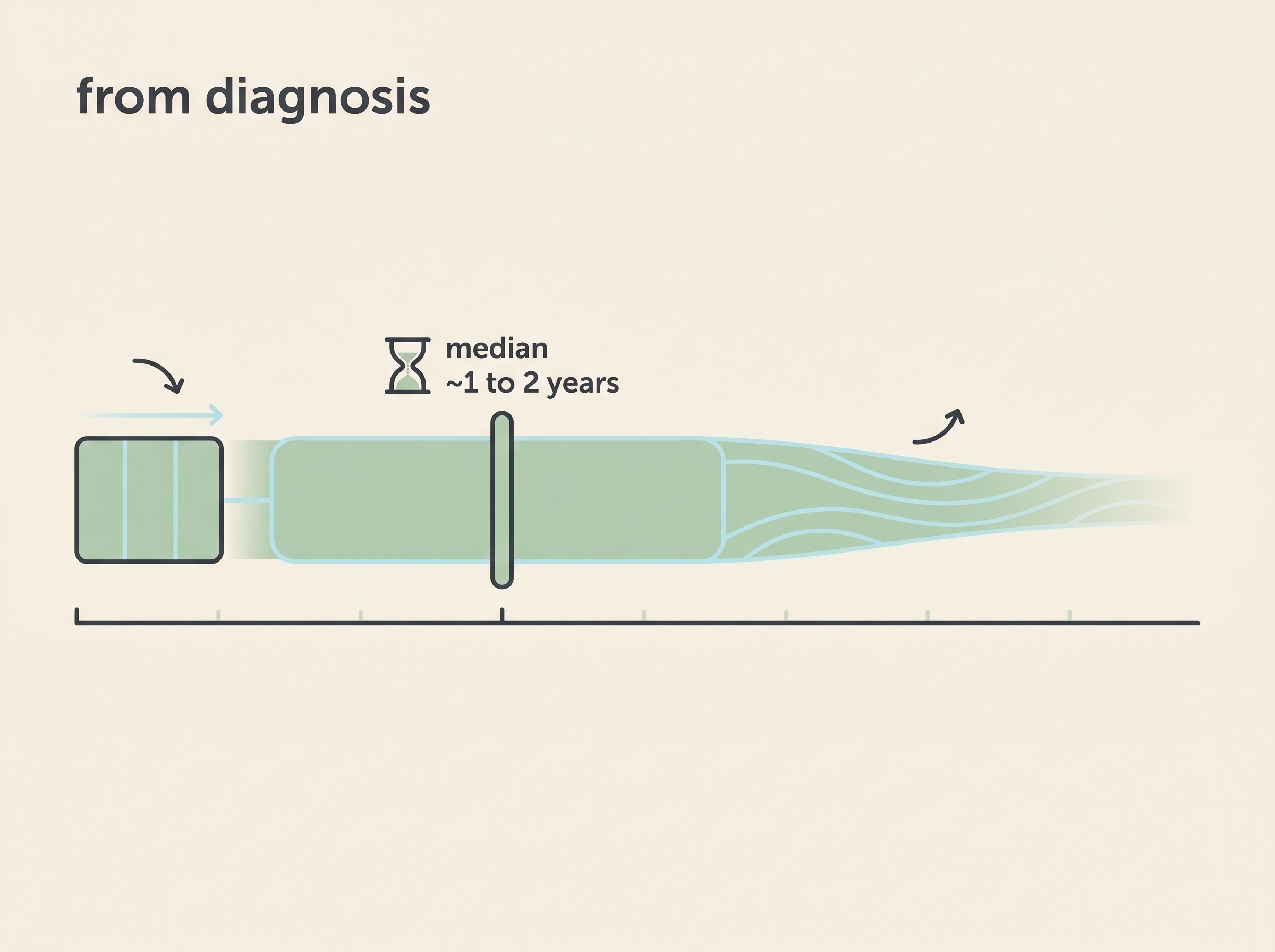
This is the section you may have scrolled to find, and I'm not going to dodge it. CIPF is progressive and not curable, because the scarring is irreversible (Clercx et al., 2018; Cohn, 2006). What I can do is be straight about how much time that tends to mean, and how uncertain that figure is. Survival varies a great deal from dog to dog, and the published numbers reflect that:
- In a group of 25 Westies, the median survival from the point of diagnosis was about 557 days, with an enormous range from 40 days to 1,538 days (Roels et al., 2021).
- Measured instead from the onset of clinical signs, median survival in a smaller study was around 32 months, ranging from 2 to 51 (Lilja-Maula et al., 2014).
- One clinician's summary puts it as "most dogs die within 18 months of initial clinical signs" (Cohn, 2006); another good resource gives "average survival following diagnosis is about a year, although some dogs live much longer" (AKC Canine Health Foundation, n.d.).
So the realistic synthesis, the thing I'd say across the consulting table, is this: often roughly a year to two, but genuinely variable, and a meaningful minority of dogs live considerably longer. Hold it as a range, not a countdown. No one can give you a precise date, and that isn't evasiveness: a study that looked specifically for factors predicting survival couldn't reliably identify any, so the unpredictability is real and built into the disease (Lilja-Maula et al., 2014). One modest pointer does exist, worth knowing because it's a small piece of better news: dogs whose CT changes are milder at diagnosis tend to live longer than those whose lungs are already badly affected (AKC Canine Health Foundation, n.d.). It is not a precise forecast, but it is a reason the scan is worth doing rather than guessing. All of that leaves real room for your dog to be one of the ones who beats the average.
A complication worth naming: pulmonary hypertension
One complication is worth understanding by name, because it often drives the symptoms you find hardest to watch. As the lung tissue scars, the blood vessels running through it get squeezed, and the pressure inside them climbs. This is pulmonary hypertension, and it's common: moderate-to-severe pulmonary hypertension was found in around 60% of Westies with CIPF, against only about 5% of healthy dogs (Roels et al., 2021; Clercx et al., 2018). It's a major contributor to the exercise intolerance and the fainting. There is a nuance worth knowing, though: in that same study, how severe the pressure was did not statistically predict shorter survival, with moderate-to-severe cases living a median of 689 days against 733 days for those without (Roels et al., 2021). So think of it as a big driver of symptoms we can try to ease, rather than a clock counting down. That distinction matters, because easing it can genuinely improve how your dog feels.
What treatment can and can't do
Let me be straight, because this is where false hope does real harm. No drug reverses the scarring, and none reliably stops it spreading (Clercx et al., 2018; Cohn, 2006). What treatment can do, and it's not nothing, is ease symptoms and lift quality of life. These are the levers your vet may reach for:
- Sildenafil, for significant pulmonary hypertension. It relaxes and opens the lung's blood vessels, and can improve exercise tolerance and reduce those frightening fainting episodes (Cohn, 2006; Roels et al., 2021; Johnson et al., 2020). It treats the high pressure, not the fibrosis, which is exactly why it can still help your dog feel better.
- Corticosteroids such as prednisolone are sometimes tried and can occasionally settle things for a while, but they don't touch the scarring, the benefit is inconsistent, and the side effects are real (Cohn, 2006; Corcoran, 2021).
- Cough suppressants (such as butorphanol) and bronchodilators (such as theophylline) can take the edge off a troublesome cough and ease the work of breathing in some dogs (Cohn, 2006).
You may have read about antifibrotic drugs, pirfenidone and nintedanib. They are the most promising research direction, and are established treatments for the human version of this disease, where trials show they slow the decline in lung function (Aravena et al., 2015). But the evidence in dogs is very limited, and they are not a standard or readily available treatment for dogs in the UK (Clercx et al., 2018; Corcoran, 2021). I mention them so you know the science is moving, not so you ask for a prescription tomorrow. It would be unkind to dangle them as a current answer when they aren't one yet.
I'll add one framing your vet may share. Some specialists now think Westie lung may sit a little closer to a related human condition called NSIP than to classic human IPF, and a few are trialling steroid-based regimens on that basis (Corcoran, 2021). It's an active area, not a settled answer, and the sober truth is that treatment to date aims to stretch out the good time rather than to stop the disease (Corcoran, 2021). I tell you that not to dishearten you, but so that whatever your own vet suggests, you can hear it clearly and ask the questions that matter to you and your dog.
Giving your dog the best days from here
This is the part I most want you to take away, because it's where you have real power. When a disease can't be cured, the goal shifts to good days for as long as possible, and the small daily things add up: keep your dog lean, walk a harness, never a collar, and above all manage exertion and heat, keeping the home calm and cool and letting your dog set the pace rather than pushing through. Get any treatable extra, such as a chest infection on top of the fibrosis, promptly seen, since it helps comfort even though it won't change the underlying disease (Corcoran, 2021). The full day-to-day playbook lives in living with a breathing condition, so I'll keep it to that here.
The single most useful habit you can build is counting your dog's resting respiratory rate. Count the breaths while they sleep: normal is under about 30 breaths a minute at rest, 30 or more is worth watching, especially if it's climbing over days, and 40 or more needs a call to the vet. Healthy dogs actually sit well below that ceiling, often in the mid-teens to low twenties, so "under 30" is a generous line rather than the normal figure (Porciello et al., 2016). In truth this threshold was validated in heart disease, where stable dogs almost never cross 30 at rest, and we borrow it here as a general "the lungs are struggling" signal (Porciello et al., 2016; Tufts HeartSmart, n.d.). It's an imperfect fit for fibrosis, but it's a sensitive early-warning number all the same, and it catches a slow decline before your dog is in obvious distress. Log it with the breathing rate tracker, and use the airway diary to note how far and how comfortably your dog walks, your own gentle version of that six-minute walk test.
You also need a clear line for what counts as an emergency, because respiratory distress is suffering and shouldn't be ridden out. Severe effort to breathe, gums turning blue or grey, or a dog who simply cannot settle means a vet now, not in the morning (Cohn, 2006). An out-of-hours plan ready, the number saved and the route known, takes one source of panic out of a frightening moment. There will come a point, too, where the loving question is about quality of life rather than treatment, and I won't write that whole conversation here because it deserves its own gentle space: when breathing gets harder is written for exactly that. For today, you just have to know it's there when you need it.
You're not on your own with this
It can feel terribly lonely, partly because CIPF is uncommon and few people you know will have heard of it. But there is a small, good-hearted community behind this disease. The University of Edinburgh's "Westie Lung Disease" programme has long been a centre for UK research and owner information, and the Westie Foundation of America keeps free, non-commercial resources, including an owner e-book and an active owner support group, for affected families (Corcoran, 2021; Westie Foundation of America, n.d.). They are good places to feel less alone and to watch where the science is heading.
You can't undo the scarring, and I won't tell you that you can. But you can do an enormous amount to keep your dog's days easy: lean, cool and calm, walked in a harness, the pulmonary hypertension eased with your vet's help, those sleeping breaths counted so you catch any change early, and a clear plan for the moment breathing becomes distress. Start the resting-rate habit tonight, save the out-of-hours number, and take the next quiet walk at your dog's pace.
References
- Aravena, C., Labarca, G., Venegas, C., Arenas, A., & Rada, G. (2015). Pirfenidone for idiopathic pulmonary fibrosis: A systematic review and meta-analysis. PLoS ONE, 10(8), e0136160.
- AKC Canine Health Foundation. (n.d.). Canine pulmonary fibrosis (E. Rozanski, Tufts University).
- Clercx, C., Fastrès, A., & Roels, E. (2018). Idiopathic pulmonary fibrosis in West Highland white terriers: An update. The Veterinary Journal, 242, 53–58.
- Cohn, L. A. (2006). Idiopathic pulmonary fibrosis: Profile, diagnosis, treatment. Clinician's Brief.
- Corcoran, B. M. (2021). Canine pulmonary fibrosis ("Westie Lung Disease"). University of Edinburgh.
- Johnson, L. R., & Stern, J. A. (2020). Clinical features and outcome in 25 dogs with respiratory-associated pulmonary hypertension treated with sildenafil. Journal of Veterinary Internal Medicine, 34(1), 65–73.
- Lilja-Maula, L. I. O., Laurila, H. P., Syrjä, P., Lappalainen, A. K., Krafft, E., Clercx, C., & Rajamäki, M. M. (2014). Long-term outcome and use of 6-minute walk test in West Highland White Terriers with idiopathic pulmonary fibrosis. Journal of Veterinary Internal Medicine, 28(2), 379–385.
- Porciello, F., Rishniw, M., Ljungvall, I., Ferasin, L., Häggström, J., & Ohad, D. G. (2016). Sleeping and resting respiratory rates in dogs and cats with medically-controlled left-sided congestive heart failure. The Veterinary Journal, 207, 164–168.
- Roels, E., Fastrès, A., Merveille, A.-C., Bolen, G., Teske, E., Clercx, C., & Mc Entee, K. (2021). The prevalence of pulmonary hypertension assessed using the pulmonary vein-to-right pulmonary artery ratio and its association with survival in West Highland white terriers with canine idiopathic pulmonary fibrosis. BMC Veterinary Research, 17, 171.
- Tufts HeartSmart. (n.d.). Monitoring heart disease treatment at home. Cummings School of Veterinary Medicine, Tufts University.
- Westie Foundation of America. (n.d.). Idiopathic pulmonary fibrosis – "Westie Lung Disease".
Keep track of how your pet is doing
The owners who cope best are the ones who notice changes early. A simple health log shows you what is working, and what is not, before the next vet visit.
Start tracking, freeYou're not doing this alone
Compare treatment journeys and talk to owners managing breathing & airways. Free to join.
Join PetsLikeMine