

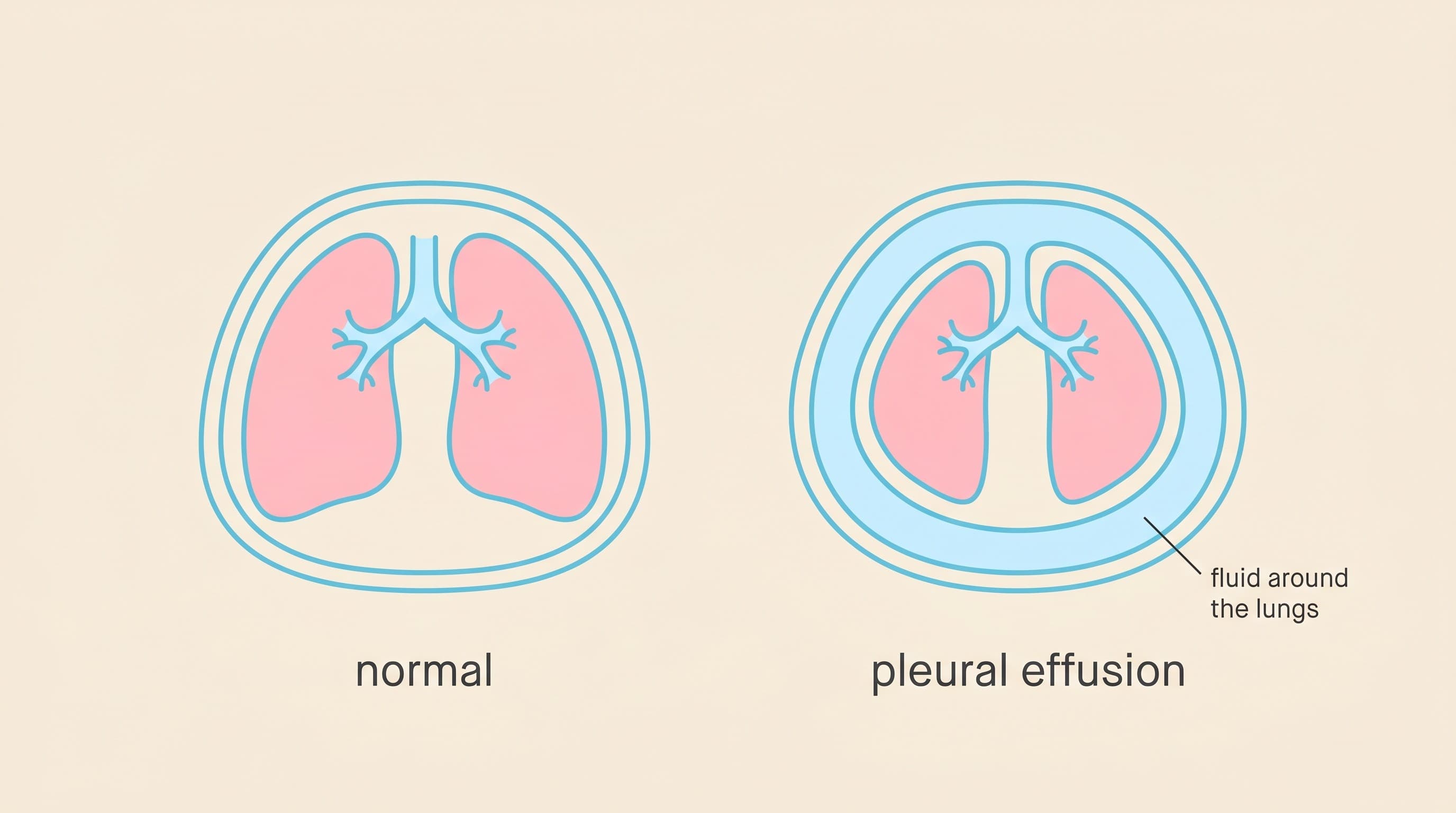
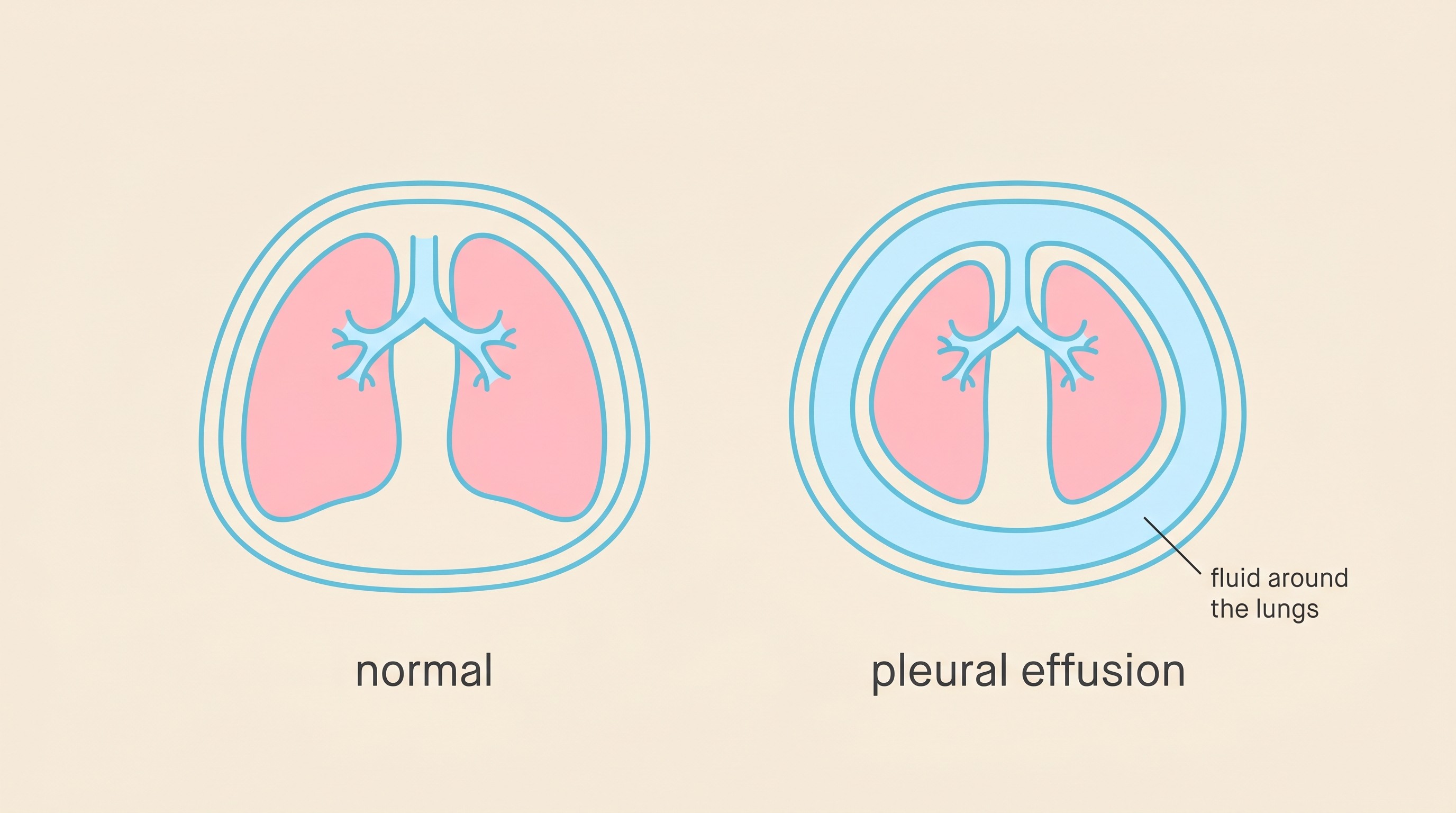
Belly Breathing in a Cat: The Fluid-Around-the-Lungs Emergency
Alastair Greenway
BVM&S MRCVS
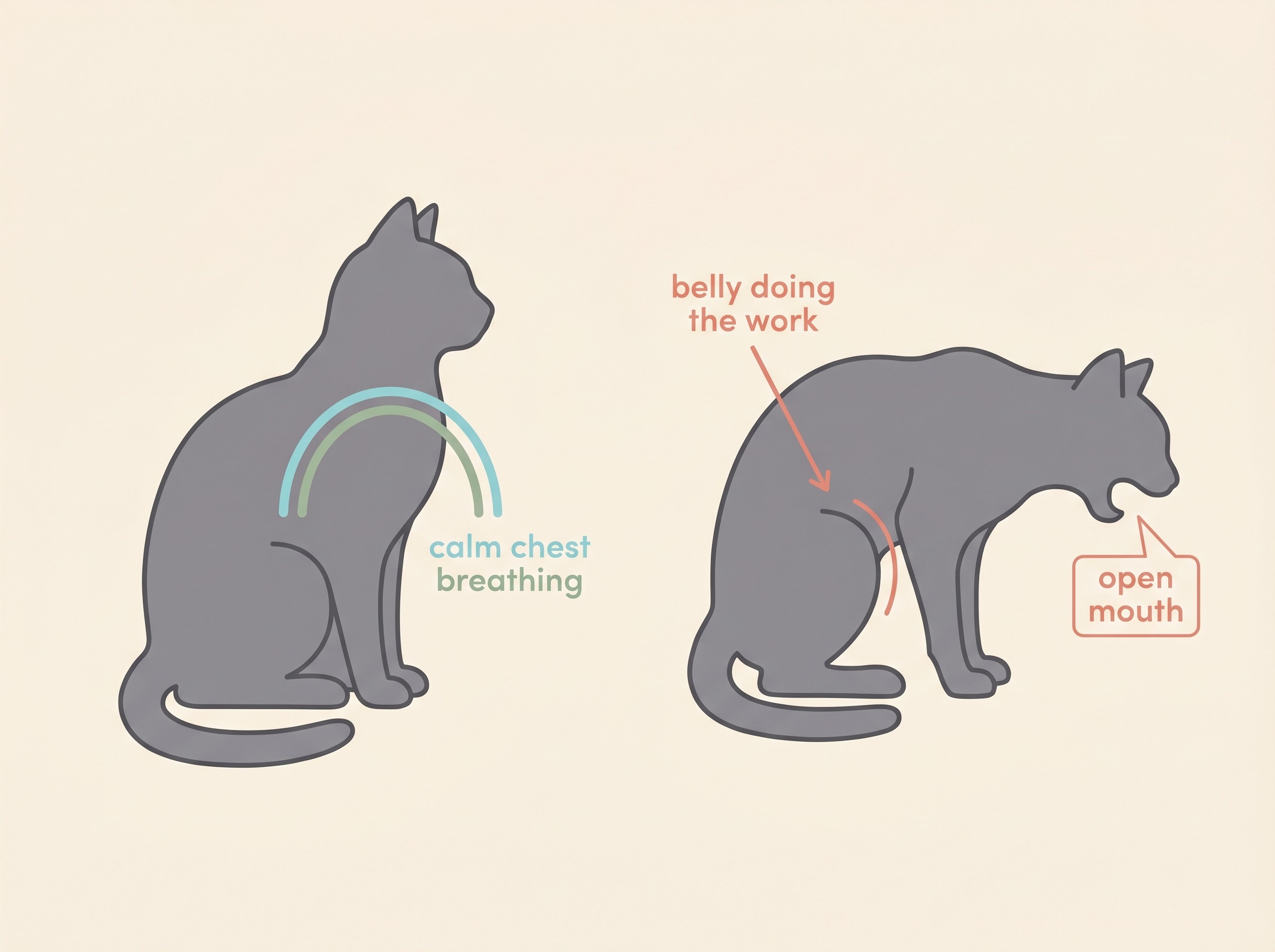
A cat breathing fast and shallow right now, with the belly doing the work on every breath, and especially with its mouth open, is the situation this opening is for. Don't read to the end of this page first. That picture in a cat is an emergency, and the single most useful thing you can do is phone your vet, say "my cat is struggling to breathe", and go. A cat almost never breathes through an open mouth unless it is in real trouble, so open-mouth breathing in a cat is never normal and is always an emergency (Johnson, 2018). The explanation can wait. Your cat probably can't.
If you've come here more calmly, perhaps watching a cat that has gone quiet, off its food and is breathing oddly, the rest of this page will help you recognise one particular and dangerous pattern. It's the one we call belly breathing, and in a cat it very often means fluid has collected around the lungs. The proper name for that fluid is pleural effusion, and it is one of the three commonest causes of breathing difficulty in cats, alongside asthma and heart failure (Cornell Feline Health Center, n.d.). This is a recognition-and-go piece, not a treatment guide: my aim is to help you see what your cat is showing you and act fast, because with this problem, time matters most.
What "belly breathing" actually is
When a cat breathes normally, the chest does most of the visible work: quiet, easy movement you'd struggle to count from across the room. When fluid fills the space around the lungs, they can no longer expand fully, so the cat recruits its abdominal muscles to drag air in. The belly heaves with each breath, often moving out of sync with the chest, and the breaths turn rapid and shallow. Cats with pleural effusion show exactly this: a restrictive, rapid, shallow respiratory pattern with increased effort on the in-breath (Beatty and Barrs, 2010).
That out-of-sync, abdomen-led effort has a name in the clinic, paradoxical or inverse breathing, and it is one of the most useful pointers we have. In one prospective study of dogs and cats in respiratory distress, an asynchronous pattern together with quiet lung sounds was strongly associated with pleural space disease, and the combination was very sensitive (around 99%), though, to be clear about its limits, not very specific, so it points hard towards chest fluid without proving it on its own (Sigrist et al., 2011). A larger French study of nearly 400 dyspnoeic dogs and cats put real numbers on it for cats specifically: of the cats showing this paradoxical breathing, about two thirds (66%) turned out to have pleural disease, against only about one in eight (13%) of the cats without it, making chest fluid roughly fourteen times more likely when a cat breathes this way (Le Boedec et al., 2012). That is why a vet who sees a cat breathing from its belly treats fluid around the lungs as the prime suspect until proven otherwise.
Two things often travel with it. A struggling cat will frequently sit hunched with its head and neck stretched forward, reluctant to lie down because lying flat lets the fluid press on more of the lung, and it may pant with an open mouth or look as though it's gagging (Cornell Feline Health Center, n.d.; Beatty and Barrs, 2010). And cats are stoical to the point of being dangerous to themselves. The onset is often insidious: owners commonly notice their cat going off food and turning lethargic before the breathing looks obviously wrong, and by then the cat has almost no reserve left (Beatty and Barrs, 2010). A cat can look "a bit quiet" right up until it suddenly can't breathe.
Why this is a genuine emergency
I use the word emergency deliberately. The lungs physically cannot inflate against a chest full of fluid, so the cat is heading towards respiratory failure, and fear and struggling make it worse by sharply raising a cat's demand for oxygen, the one thing a compromised cat can least supply (Beatty and Barrs, 2010; Johnson, 2018). The numbers are sobering, and I'd rather you had them than a vague "it's serious". In the largest published series of cats with pleural effusion, 380 in all, nearly a quarter (22.9%) died or were put to sleep before they ever went home (Domínguez Ruiz et al., 2018). Cornell put it as plainly as I've seen anywhere: any cat showing signs of breathing difficulty, whatever the cause, is at high risk of dying if the problem is not treated promptly (Cornell Feline Health Center, n.d.). That is the whole case for not waiting. A cat breathing hard from the belly, with its mouth open, or with gums that look blue, grey or muddy rather than pink, needs a vet now. Don't wait for morning, don't wait to see if it settles, and please don't stop to film it.
Where the fluid comes from
You don't need to diagnose the cause to act, but it helps to know that "fluid around the lungs" is a description, not a single disease. A small number of conditions account for the large majority, on the order of nine in ten, of feline pleural effusions: congestive heart failure, cancer, pyothorax (a build-up of infected fluid, essentially pus, around the lungs) and feline infectious peritonitis, or FIP, with a leak of lymph fluid called chylothorax making up most of the remainder (Beatty and Barrs, 2010).
Heart disease comes out on top. In the 380-cat series, congestive heart failure was commonest at 40.8%, followed by cancer at 25.8%, then pyothorax, chylothorax, trauma and FIP (Domínguez Ruiz et al., 2018). A separate study of 148 cats, median age nearly ten years, found the same order in slightly different proportions, with heart failure at 53.4% and cancer at 20.3% (Hung et al., 2022). The exact figures vary between studies, but heart disease and cancer consistently lead, and in older cats especially.
Age shifts the odds in a way worth knowing. Trauma and FIP tend to strike much younger cats, whereas heart failure and cancer skew older (Hung et al., 2022; Beatty and Barrs, 2010). FIP is an important cause of chest and belly fluid in cats under about two, classically a young cat from a multi-cat household or cattery that has recently been stressed by something like rehoming or surgery, and its effusive or "wet" form produces pleural fluid that "may be accompanied by tachypnea, dyspnea, cyanotic mucous membranes, or muffled heart sounds" (Merck Veterinary Manual, n.d.-b; dvm360, n.d.). So a young cat with chest fluid raises FIP or an accident, while an older cat points more towards the heart or a tumour. The heart side belongs to our Heart Health home, and if your cat has also been coughing, is the cough from the heart or the lungs helps you tell, so I'll hand you there rather than write a cardiology lesson into an emergency page.
I don't want to leave this section uniformly bleak, because one cause carries real hope. Pyothorax is serious but genuinely treatable, with broad-spectrum antibiotics plus draining and flushing the chest through a chest tube. The first couple of days are the dangerous ones, but cats that get through them tend to do well: in one series of 47 cats, around three quarters survived the early period, roughly two thirds were still doing well in the longer term, and the condition came back in only about one in twenty, leading the authors to call the outlook for cats that reach discharge "excellent" (Krämer et al., 2021). So while the picture demands urgency, the cause found at the end of it is not always a grim one.
Getting to the vet without making it worse
Because struggling and handling make a cat with chest fluid worse, the guiding principle on the way in is calm and minimal. Move your cat gently, lifting the whole carrier rather than chasing, grabbing or scruffing a cat that's fighting for breath (Beatty and Barrs, 2010; Johnson, 2018). Keep it cool and quiet, and don't give anything from the medicine cupboard: human medicines and even some pet ones can do real harm, and none of them will shift fluid from the chest. Phone ahead so the practice has oxygen and a quiet space ready when you arrive.
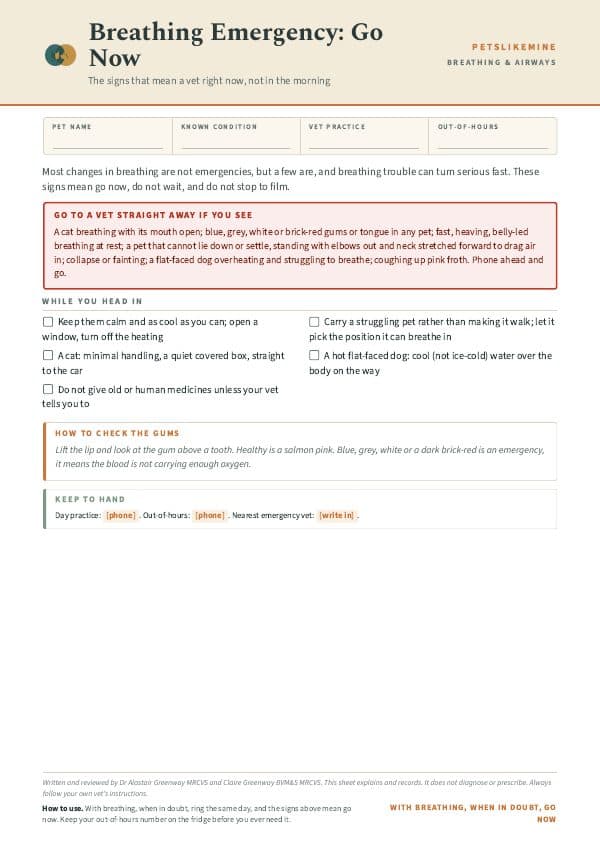
You'll notice I'm not asking you to count breaths. Counting a sleeping cat's resting rate is a brilliant monitoring habit between crises, and our breathing rate tool makes it easy, but it belongs to the calm days, not this one. In a cat already breathing hard or open-mouthed, the message is not "measure it", it's "go". If you're ever unsure which situation you're in, our respiratory distress and cough triage sorts an emergency from something you can book, and the breathing emergency red flags is a one-page reminder for the fridge. For how to tell a now-emergency from a wait-and-see across all the breathing problems, is my pet's breathing an emergency is the hub to read on a calmer day.
One quick word to head off a common mix-up. Feline asthma can look frighteningly similar from the outside, but it's a problem inside the airways, which narrow and spasm, whereas pleural effusion is fluid sitting outside the lungs and pressing them flat. Your vet tells these apart quickly, and crucially both need a vet straight away, so you don't have to work it out before you go.
What "now" actually buys your cat
It helps to know what you're rushing towards. The first thing a vet does is usually oxygen, by a cage or gently held flow-by, often with a mild, short-acting sedative if the cat is panicking, all with as little restraint as possible (Ayoob-Wagner, 2024). Then comes the step that can change everything in minutes. Thoracocentesis, a chest tap, is a needle passed carefully into the chest to draw the fluid off, and it is both the treatment and the test in one: it often relieves the breathing dramatically while giving a sample that helps pin down the cause (Ayoob-Wagner, 2024; Merck Veterinary Manual, n.d.-a). In a cat that is severely distressed, with muffled chest sounds pointing to fluid, that tap can come before any x-rays, because relieving the breathing is what keeps the cat alive and the risk of the procedure is low (Merck Veterinary Manual, n.d.-a; Beatty and Barrs, 2010).
This is what makes the problem strangely hopeful in the immediate term. Because the trouble is fluid outside the lungs rather than damage inside them, taking it off lets the lungs spring back open and the cat breathe again. As VCA put it, the lungs are essentially floating in a chest full of fluid, and removing that fluid lets a cat breathe more readily (VCA Hospitals, n.d.). That doesn't undo the underlying cause. Once the cat is stable, the vet works out why the fluid was there, with chest x-rays, an ultrasound of the heart (specifically worth doing in cats because heart disease is such a frequent culprit), and analysis of the fluid itself (Merck Veterinary Manual, n.d.-a; Hung et al., 2022).
And that's the real shape of this condition. Whatever the cause, the immediate urgency is identical: the fluid has to come off so your cat can breathe. What differs is the road afterwards, which ranges widely, a drainable pyothorax can do very well, while heart failure and cancer carry a more guarded outlook (Beatty and Barrs, 2010; Domínguez Ruiz et al., 2018). You can't know which road you're on from the sofa, and you don't need to. The most powerful thing you will ever do for a cat breathing from its belly is the simplest: recognise it for what it is, and get to the vet while there's still reserve to work with.
References
- Ayoob-Wagner, A. L. (2024). Stabilization of Patients With Pleural Effusion Prior to Referral. Clinician's Brief. Retrieved from
- Beatty, J., and Barrs, V. (2010). Pleural effusion in the cat: A practical approach to determining aetiology. Journal of Feline Medicine and Surgery, 12(9), 693–707.
- Cornell Feline Health Center. (n.d.). Dyspnea (Difficulty Breathing). Retrieved from
- Domínguez Ruiz, M., Vessières, F., Ragetly, G. R., and Hernandez, J. L. (2018). Characterization of and factors associated with causes of pleural effusion in cats. Journal of the American Veterinary Medical Association, 253(2), 181–187.
- dvm360. (n.d.). Feline infectious peritonitis: Strategies for diagnosing and treating this deadly disease in young cats. Retrieved from
- Hung, L., Hopper, B. J., and Lenard, Z. (2022). Retrospective analysis of radiographic signs in feline pleural effusions to predict disease aetiology. BMC Veterinary Research, 18, 118.
- Johnson, L. R. (2018). A Practical Approach to Cats with Respiratory Distress. World Small Animal Veterinary Association (WSAVA) Congress Proceedings. Retrieved from
- Krämer, F., Rainer, J., and Bali, M. S. (2021). Short- and long-term outcome in cats diagnosed with pyothorax: 47 cases (2009–2018). Journal of Small Animal Practice, 62(8), 669–676.
- Le Boedec, K., Arnaud, C., Chetboul, V., Trehiou-Sechi, E., Pouchelon, J.-L., Gouni, V., and Reynolds, B. S. (2012). Relationship between paradoxical breathing and pleural diseases in dyspneic dogs and cats: 389 cases (2001–2009). Journal of the American Veterinary Medical Association, 240(9), 1095–1099.
- Merck Veterinary Manual. (n.d.-a). Diagnostic Techniques for Respiratory Disease in Animals. Retrieved from
- Merck Veterinary Manual. (n.d.-b). Feline Infectious Peritonitis. Retrieved from
- Sigrist, N. E., Adamik, K. N., Doherr, M. G., and Spreng, D. E. (2011). Evaluation of respiratory parameters at presentation as clinical indicators of the respiratory localization in dogs and cats with respiratory distress. Journal of Veterinary Emergency and Critical Care, 21(1), 13–23.
- VCA Hospitals. (n.d.). Pleural Effusion in Cats. Retrieved from
Free downloads
Companion worksheets to put what you've read into practice. Free PDFs, print at home.
Keep track of how your pet is doing
The owners who cope best are the ones who notice changes early. A simple health log shows you what is working, and what is not, before the next vet visit.
Start tracking, freeYou're not doing this alone
Compare treatment journeys and talk to owners managing breathing & airways. Free to join.
Join PetsLikeMine