

How Pets Breathe: What's Normal, and When to Worry
Alastair Greenway
BVM&S MRCVS
Breathing is the one thing a healthy pet does thousands of times a day without you ever noticing. Then one evening you glance across the room and something looks off: the chest moving a little faster than usual, a sound you haven't heard before, or a cat sitting hunched in a way that makes your stomach drop. Now you're watching every breath, with no clear idea what a normal one is even supposed to look like.
Before we get into emergencies or any particular illness, it helps to understand the ordinary machinery: how breathing actually works, what easy breathing looks like, and the small handful of changes that turn "fine" into "ring the vet". Once you can picture normal, the worrying things stop hiding in plain sight. And there's one simple habit, counting the breaths while your pet sleeps, that is genuinely the most useful thing most owners can learn to do.
The machinery, in plain terms
Breathing is mostly a pulling job, not a pushing one, and that surprises people. Air travels in through the nose (or mouth), down past the throat and the voice box, into the windpipe, then branches into smaller and smaller airways until it reaches the tiny air sacs of the lungs, where oxygen crosses into the blood and carbon dioxide is handed back to be breathed out (MSD Veterinary Manual, n.d.-b). That's the route. The engine driving it is the diaphragm, the dome of muscle slung underneath the lungs. When it contracts and flattens, helped by the muscles between the ribs, it makes the chest bigger and drops the pressure inside, so air is drawn in rather than blown in. Breathing out asks for hardly any effort at all: the muscles relax, the naturally elastic lungs spring back, and the air flows out on its own.
The reason that matters to you is that quiet, easy breathing is supposed to look almost lazy. A relaxed pet does the work with the chest, in a smooth rhythm, with nothing visibly straining. So when you start to see effort, the belly pumping, the whole body recruited into each breath, you're watching a system that has stopped coasting and started working. We'll come to exactly what that looks like.
Panting is cooling, not struggling
Here's a place owners tie themselves in knots, so let's settle it. A dog panting on a warm day is not struggling to breathe. It's running its cooling system.
Dogs have very few working sweat glands, so they can't sweat off heat the way we do. Their main way to cool down is evaporation through panting, which is the major route by which a dog sheds heat: fast, shallow, open-mouthed breathing that moves air quickly over the wet surfaces of the tongue, mouth and upper airway, so moisture evaporates and carries heat away with it (Goldberg et al., 1981). Physiologically, panting is "a controlled increase in respiratory frequency accompanied by a decrease in tidal volume", and the clever part is that it's designed to ventilate the upper airway and shed heat while still keeping normal gas exchange ticking over deep in the lungs (Robertshaw, 2006). In other words, a happily panting dog is doing exactly what it's built to do, and it's getting plenty of oxygen while it does it.
This is precisely why you never try to count a resting breathing rate on a panting dog: you'd be timing the air conditioning, not the breathing. The skill, with dogs, is learning to tell relaxed cooling-down panting (loose, rhythmic, the dog otherwise comfortable) from genuine laboured breathing (effortful, distressed, the dog not settling, sometimes with the gums changing colour). The two can look superficially similar for a second.
In a cat, an open mouth is a warning
Cats are a different story. Unlike dogs, cats almost never pant to cool down. A cat breathing with its mouth open, panting like a dog, or breathing hard is not normal, and it is very often an emergency (Tufts University HeartSmart, n.d.-a). It usually means real respiratory distress, with the three commonest culprits being asthma, fluid building up around the lungs, and heart disease (Cornell Feline Health Center, n.d.).
So I'll say it as plainly as I can. If your cat is breathing with its mouth open, if the gums or tongue look blue, grey or very pale, or if it's breathing hard from the belly, that is a vet visit right now. Don't wait to see if it passes. Don't stop to film it. A healthy cat takes somewhere around 20 to 30 breaths a minute and its breathing should never look like a struggle, so when it does, the situation can turn life-threatening quickly and needs help as soon as possible (Vets Now, n.d.). This is the one feline rule I would tattoo on every owner if I could, because cats hide illness so well that by the time the breathing looks wrong, things are already serious.
What normal resting breathing looks like
Now the baseline you're really here to learn. At rest or asleep, healthy breathing is quiet, smooth, easy and led by a gentle rise and fall of the chest. There's no visible effort, no noise, no open mouth in a cat, and the rhythm is steady. If you sat and watched, you'd almost be bored.
Put a number on it, and a normal resting or sleeping breathing rate is under about 30 breaths a minute, in both dogs and cats, where one breath means one full in-and-out, one complete rise and fall of the chest (VCA Animal Hospitals, n.d.). That figure isn't plucked from the air. When researchers measured dogs and cats with well-controlled, stable heart disease at home, the sleeping rate clustered around a median of 20 a minute, and only 1 of 51 dogs and 1 of 22 cats ever crept above 30 while asleep (Porciello et al., 2016). Settled, healthy animals sit comfortably under that line.
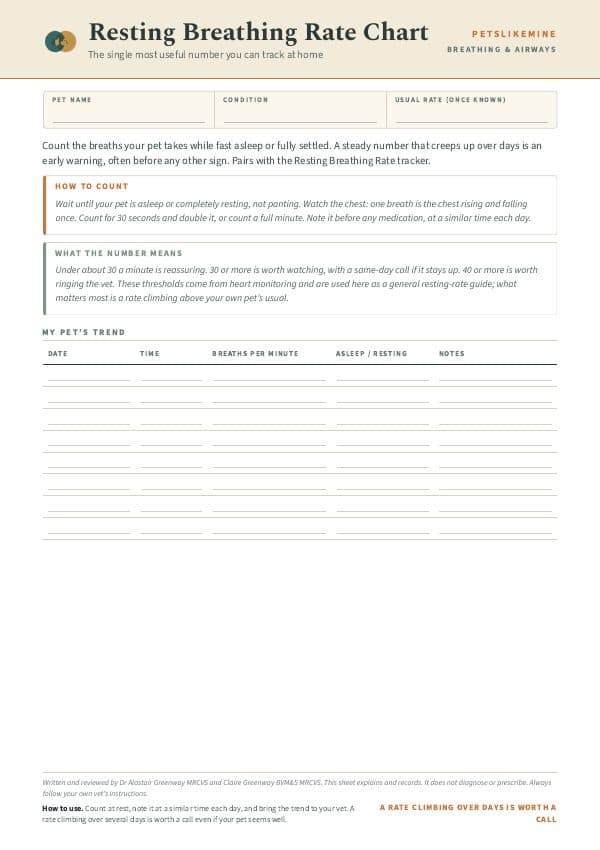
So the rule of thumb worth memorising is this: normal is under about 30 breaths a minute at rest; 30 or more is worth watching, and 40 or more needs a call to the vet. It's worth being clear about where that line comes from, though, because the distinction is the point. The "under about 30 is normal, and a rate sitting at 30 or more deserves a vet's attention" half is on very solid ground, validated through years of home heart-disease monitoring and repeated to owners by veterinary hospitals on both sides of the Atlantic (Porciello et al., 2016; VCA Animal Hospitals, n.d.). The specific 40-a-minute "urgent" mark is a sensible practical escalation rather than a separately proven trial figure: think of 30-and-climbing as the evidence-based line to start watching, and 40 as clearly too fast, ring now. The number was first worked out for heart disease, and we're borrowing it here as a general "the breathing is faster than it should be" signal, which is exactly how you should hold it.
The changes that turn normal into worrying
This is the list to keep in your back pocket. Any one of these means normal breathing has tipped into something that needs looking at, and several of them mean it needs looking at today.
- Faster at rest. A resting or sleeping rate that's higher than your pet's usual, especially one that's climbing day on day rather than sitting steady (VCA Animal Hospitals, n.d.).
- Visible effort. You can see the work going into each breath. The clearest version of this is more motion of the belly or chest wall on every breath than there should be (Tufts University HeartSmart, n.d.-a).
- Belly breathing. The tummy heaves visibly with each breath instead of an easy chest rise. This means your pet is recruiting extra muscles to shift air, and it's a classic cue for fluid or air building up around the lungs (Tufts University HeartSmart, n.d.-a).
- Any new noise. Snoring or snorting, a raspy in-breath, a honking cough, a wheeze. Noise is simply the sound of the airway working harder than it should have to.
- An open mouth in a cat. As above: rarely anything but an emergency (Tufts University HeartSmart, n.d.-a).
- A colour change in the gums to grey, pale, brick-red or blue. Blue gums (cyanosis) mean dangerously low oxygen and are an emergency (MSD Veterinary Manual, n.d.-a).
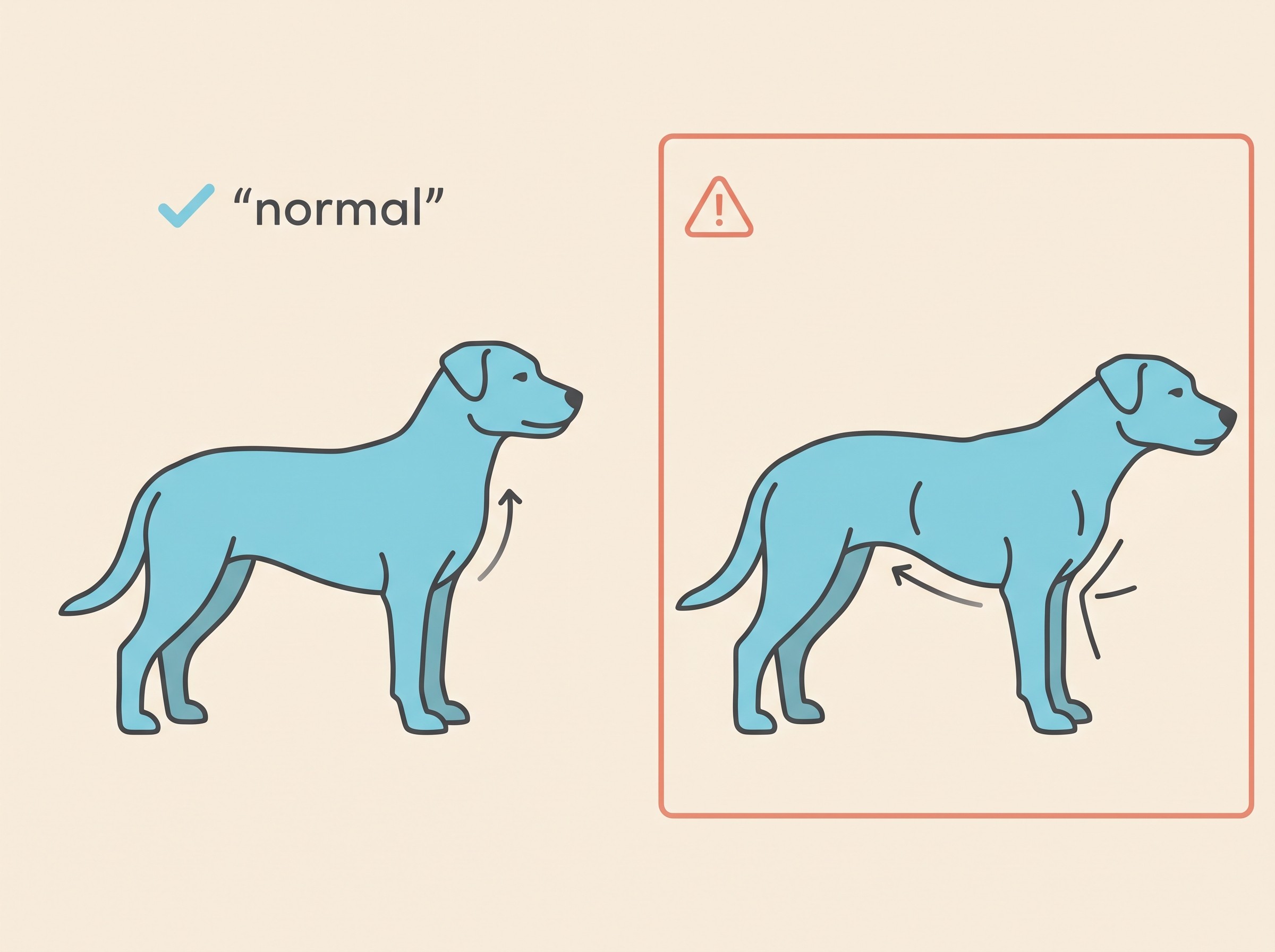
There are postures that go with real distress, too, and they're worth recognising because pets adopt them instinctively when air is hard to come by. A struggling dog often stands with its elbows pushed out from its body, neck and head stretched forward, and flatly refuses to lie down on its side, because lying flat makes breathing harder still (Tufts University HeartSmart, n.d.-a; MSD Veterinary Manual, n.d.-a). A struggling cat tends to crouch low with its chest lifted, elbows out and neck extended, often with its head held low and pushed forward (Cornell Feline Health Center, n.d.; MSD Veterinary Manual, n.d.-a). Any of these, and above all a gum-colour change or belly breathing, is urgent.
I'm deliberately not going to sort these signs into "emergency now" versus "book an appointment" here, because that triage deserves its own careful walkthrough. If your pet is showing any of these right now and you need to know how fast to move, go straight to is my pet's breathing an emergency?, which lays out the dispositions and what to do while you get to the vet. This page is the foundation: it names the warning signs, and hands the "how worried, how fast" decision over to the piece built for it.
Cats and dogs hide it differently
Two species, two completely different ways of going wrong, and knowing which animal you've got changes what you watch for.
Cats are masters at hiding illness, and it is thought to be a survival instinct: in the wild, an animal that looks weak is a target, so a cat that feels unwell tends to go quiet and still rather than make a fuss (Eckman, n.d.). They often show almost nothing until they're genuinely very unwell, so the subtle signs carry enormous weight: a sleeping breathing rate that's crept up, more hiding than usual, a hunched posture, or simply a cat that seems "off" can be the only warning before a crisis. With a cat, small changes in resting breathing are a big deal, and they deserve to be taken seriously rather than watched for another few days.
Dogs are more obvious about feeling rough, which helps, but they muddy the water with all that normal panting. So the work with a dog is the opposite: learning to tell genuinely happy, cooling-down panting from the real effort of laboured breathing, and not being lulled by the fact that some open-mouthed breathing is completely fine in a dog when it would be an alarm bell in a cat.
If the change you're noticing is a cough rather than the breathing itself, that's a slightly different fork in the road, and it's worth knowing that a cough can come from the heart or from the airways, which need different help. I won't unpack that here, because is it the heart or the lungs? is written for exactly that question and walks through how to tell them apart. The resting breathing rate, as it happens, is the key tell in that piece too, which brings us neatly to the one habit worth building.
The single best habit you can build
The resting or sleeping breathing rate is the most useful number an owner can collect at home, and it's worth understanding why it punches so far above its weight.
The magic is that it's objective and trackable. A breathing rate counted when your pet is calm, settled or asleep reflects the heart and lungs themselves, not excitement, not exercise, not the doorbell going (Tufts University HeartSmart, n.d.-b). That makes it a clean signal. And a rate that's climbing over days, or sitting at 30 or more, is a sensitive early warning that fluid is starting to build on the lungs. It's best validated as an early sign of left-sided congestive heart failure, where dogs in the run-up to failure still keep their sleeping rate comfortably under 30, so a climb above that line is a meaningful early change worth catching (Ohad et al., 2013). Catching that rise early genuinely helps, because it buys time to act before a crisis (Porciello et al., 2016; Tufts University HeartSmart, n.d.-b). Even well outside heart disease, it remains the simplest instrument you have for answering "is the breathing getting worse?"
The method is forgiving. Wait until your pet is asleep or fully relaxed, then count one full breath (chest in and out once) at a time, for 30 seconds and double it, or for a full minute (VCA Animal Hospitals, n.d.). Skip a dog that's panting and a cat that's purring, since both throw the count off, and try not to count during active dreaming, when paws twitch and the rate naturally speeds up (PDSA, n.d.). A handful of counts over a week or two gives you your pet's personal baseline, and once you know that, a change stands out a mile.
You don't have to do the arithmetic in your head or remember last week's number, either. The breathing rate tracker lets you tap along with each breath and keeps the history for you, and if counting a wriggling patient feels hopeless, the Breath Camera will count the breaths from a short phone clip. There's also a printable resting respiratory rate chart if you'd rather keep a record on the fridge. I'll leave the step-by-step of those to the tools themselves, because they're built to make the counting effortless.
None of this is about turning you into an anxious breath-watcher. It's the opposite. Knowing what easy breathing looks like, and having a baseline number you trust, is what lets you relax on the ordinary evenings and act quickly on the rare one that matters. Spend a fortnight quietly getting to know your pet's normal, and you'll have given yourself the best early-warning system there is.
References
- Cornell Feline Health Center, Cornell University College of Veterinary Medicine. (n.d.). Dyspnea (Difficulty Breathing). Retrieved June 2026 from
- Eckman, S. (n.d.). When is your cat hiding illness or injury? [Pet Talk]. Texas A&M University School of Veterinary Medicine & Biomedical Sciences. Retrieved June 2026 from
- Goldberg, M. B., Langman, V. A., & Taylor, C. R. (1981). Panting in dogs: paths of air flow in response to heat and exercise. Respiration Physiology, 43(3), 327–338.
- MSD Veterinary Manual. (n.d.-a). Clinical Signs of Respiratory Disease in Animals. Retrieved June 2026 from
- MSD Veterinary Manual. (n.d.-b). The Respiratory System in Animals. Retrieved June 2026 from
- Ohad, D. G., Rishniw, M., Ljungvall, I., Porciello, F., & Häggström, J. (2013). Sleeping and resting respiratory rates in dogs with subclinical heart disease. Journal of the American Veterinary Medical Association, 243(6), 839–843.
- PDSA (People's Dispensary for Sick Animals). (n.d.). How to: record a resting respiratory rate. Retrieved June 2026 from
- Porciello, F., Rishniw, M., Ljungvall, I., Ferasin, L., Häggström, J., & Ohad, D. G. (2016). Sleeping and resting respiratory rates in dogs and cats with medically-controlled left-sided congestive heart failure. The Veterinary Journal, 207, 164–168.
- Robertshaw, D. (2006). Mechanisms for the control of respiratory evaporative heat loss in panting animals. Journal of Applied Physiology, 101(2), 664–668.
- Tufts University, Cummings School of Veterinary Medicine — HeartSmart. (n.d.-a). Difficulty Breathing (Dyspnea). Retrieved June 2026 from
- Tufts University, Cummings School of Veterinary Medicine — HeartSmart. (n.d.-b). Monitoring Heart Disease Treatment at Home. Retrieved June 2026 from
- VCA Animal Hospitals. (n.d.). Home Breathing Rate Evaluation. Retrieved June 2026 from
- Vets Now. (n.d.). Breathing difficulties in cats: why is my cat struggling to breathe? Retrieved June 2026 from
Free downloads
Companion worksheets to put what you've read into practice. Free PDFs, print at home.
Keep track of how your pet is doing
The owners who cope best are the ones who notice changes early. A simple health log shows you what is working, and what is not, before the next vet visit.
Start tracking, freeYou're not doing this alone
Compare treatment journeys and talk to owners managing breathing & airways. Free to join.
Join PetsLikeMine