

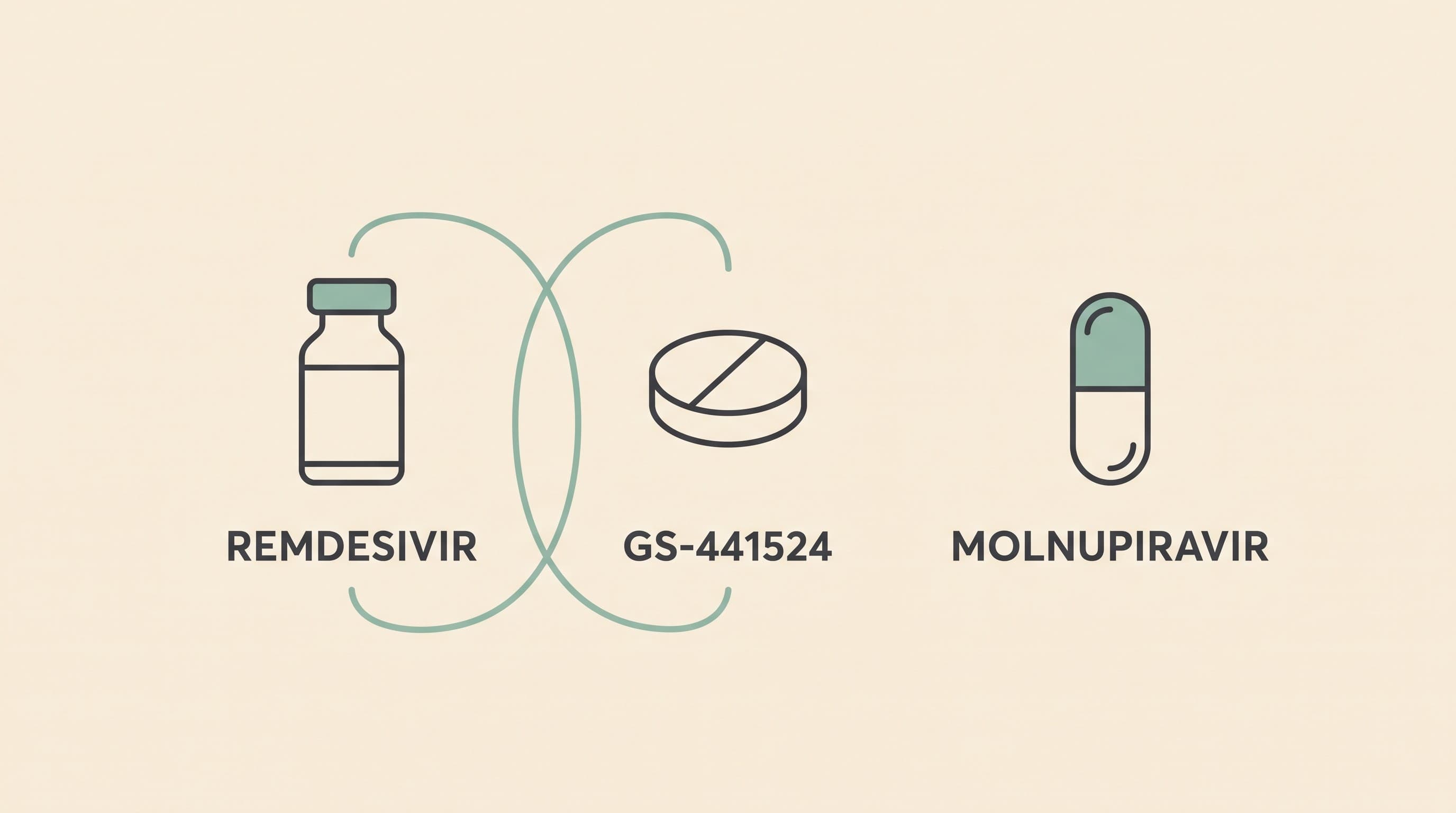
GS-441524, remdesivir and molnupiravir explained
Alastair Greenway
BVM&S MRCVS
If you have spent any time reading about FIP online, you have probably met three drug names by now, and they have probably left you more confused than when you started. GS-441524. Remdesivir. Molnupiravir. People use them almost interchangeably in forums, then in the next breath argue about which one is "real" or "better", and somewhere in the middle of all that your own vet has offered you something with yet another name on the label. It is a lot to hold when you are frightened and just want to know your cat is getting the right thing.
So let's slow all the way down and take them one at a time. None of this is a decision you have to make on your own, and none of it changes the single most important fact: FIP is treatable now, your vet can prescribe treatment legally here in the UK, and the differences between these drugs are far smaller than the internet makes them sound.
They are all antivirals, and two of them are practically the same molecule
Here is the part that clears up most of the confusion in one go. GS-441524 and remdesivir are not rivals. They are two forms of the same thing.
Remdesivir is what pharmacists call a prodrug. That means it is an inactive form that the body converts into the active drug once it is inside the cells. And the active drug it turns into is GS-441524 (Taylor et al., 2023). So when your cat receives remdesivir, the medicine that actually goes to work against the virus is GS-441524. They share the same active ingredient, they work in exactly the same way, and a large systematic review of FIP treatment treats them as a single therapeutic approach for good reason (GS-441524 systematic review, 2018-2024).
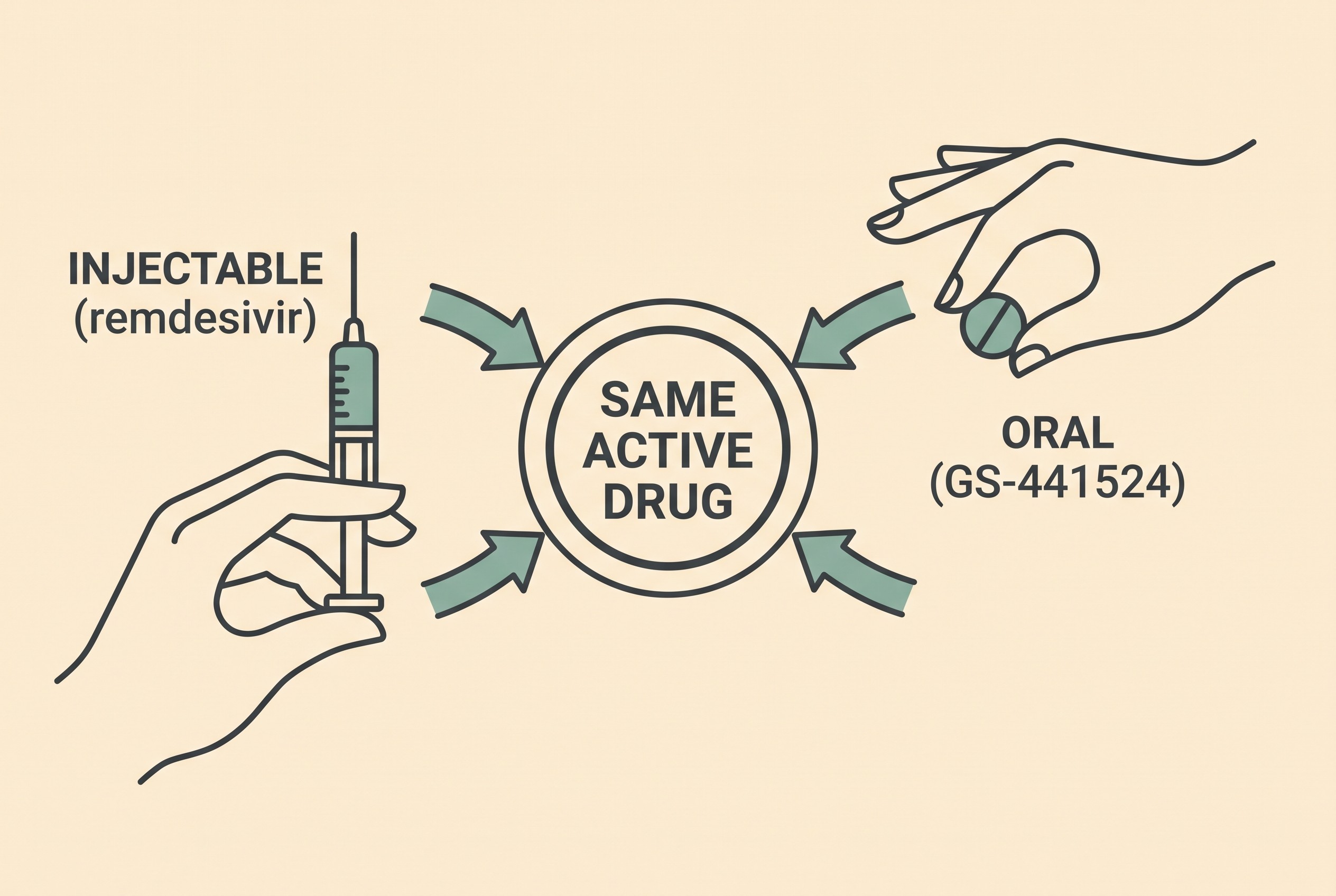
The reason both names exist at all comes down to how the drug is given. Remdesivir dissolves well in liquid, so it is the form used for injections. GS-441524 is more stable as a tablet, so it is the form used for pills. Same medicine, two doorways into the body.
Molnupiravir is the genuine outsider of the three. It is a different antiviral, from a different family, that happens to work on the same kind of virus. We will come back to it, because it has a specific job in FIP treatment and it is not the first thing most cats are given.
How GS-441524 actually stops FIP
You do not need a pharmacology degree to follow this, and understanding it tends to make the daily routine feel less like a leap of faith.
Nearly all cats carry a common, usually harmless feline coronavirus in their gut. In a small number of cats that virus mutates inside the body and starts spreading through tissues in a way that causes FIP (Thayer et al., 2022). Like all coronaviruses, it survives by copying itself over and over, building new strands of viral genetic material.
GS-441524 is a nucleoside analogue. That is a fancy way of saying it is a decoy building block. It looks enough like one of the real building blocks the virus needs that the virus grabs it by mistake and tries to build it into a new copy of itself. Once it does, the chain cannot continue. The copy is cut short and the virus cannot finish replicating (Taylor et al., 2023). Starve the virus of working copies of itself for long enough, day after day, and the immune system gets the upper hand. That is the whole logic of the 84-day course: not a single knockout blow, but steady daily pressure until the infection is genuinely cleared.
Oral or injectable: the same medicine, a real practical difference
Because remdesivir (injectable) and GS-441524 (oral) are the same active drug, the choice between them is not a choice between a strong option and a weak one. It is a practical choice your vet makes with you, and it usually comes down to how poorly your cat is and how the treatment is tolerated.
Historically, and in the early UK cases, many cats started on injectable remdesivir. It gets the drug in reliably when a cat is very unwell, off its food, or being sick, which is exactly when swallowing a tablet is hardest. The catch is that the injections can sting. In the large UK study of 307 treated cats, injection-site pain was the most common side effect, reported in 47.8% of cats given subcutaneous remdesivir, thought to be linked to the acidity of the solution (Taylor et al., 2023). That is a big part of why many cats now move onto oral tablets as soon as they are well enough to take them, and why some start on tablets from day one.
Does the route affect the odds? The honest answer from the evidence is reassuring. In the systematic review, oral treatment showed a slightly higher success rate than the subcutaneous route (roughly 87% versus 77%), but the authors were careful to warn that the two groups were very different in size and were not matched by disease type, so that gap should not be read as "tablets are better" (GS-441524 systematic review, 2018-2024). What matters far more than the doorway is getting enough drug in, every single day, for the whole course, and adjusting the dose as your cat grows. More on that in weigh weekly, re-dose weekly.
One thing worth knowing so it does not throw you: because tablets are absorbed less completely than an injection, oral doses generally run higher than injectable doses for the same effect. This is normal and expected. It is also exactly why you must never try to convert a dose yourself or copy a number from one form to another. The dose is your vet's to set for the form your cat is actually on.
Roughly what your vet may prescribe, and why the numbers vary
We will never print a "here is your dose" calculation, because dosing is your vet's job and getting it wrong is genuinely dangerous. But it helps to understand the shape of what your vet is working from, so the numbers on your cat's prescription do not look arbitrary.
The current UK guidance most vets follow is the ISFM update on treating FIP with antiviral drugs, which is a living document revised most years (ISFM/Taylor et al., 2024). Broadly, and always as ranges rather than one fixed figure, it describes oral GS-441524 in the region of around 15 mg/kg once daily for the wet (effusive) and dry (non-effusive) forms, rising towards about 20 mg/kg a day, often split into two smaller doses twelve hours apart, for cats with eye or neurological involvement. The higher doses for the eye and brain forms exist because the drug has to cross the blood-eye and blood-brain barriers to reach the virus there, which is harder to do (ISFM/Taylor et al., 2024). Injectable remdesivir is dosed differently again.
Please read those figures as background, not as instructions. They are ranges from a guideline that changes, they differ by the form of the drug and the form of the disease, and your own vet will set the exact amount for your cat's current weight. If a number on a website ever contradicts your prescription, your prescription wins, and the thing to do is ask your vet, not adjust the dose.
Where molnupiravir fits in
Molnupiravir is the third name, and it earns its place as a second-line option rather than a starting point for most cats.
It is a different antiviral that also interferes with how the coronavirus copies itself, but by a different mechanism. It tends to come into the conversation in specific situations: a cat that is not responding well enough to GS-441524, or one whose FIP has come back, or cases where the eye and brain forms are proving stubborn and an extra tool is wanted. A 2024 study found molnupiravir and GS-441524 gave broadly similar outcomes in cats with FIP, which is genuinely encouraging, because it means there is a credible option to reach for if the first drug is not doing the job (Cook et al., 2024).
There are reasons it is not simply used first for everyone. It is newer in this setting, the long-term safety picture in cats is less complete, and vets generally reach for the best-established option first and keep others in reserve. If your vet raises molnupiravir, it is not a sign things have gone badly wrong. It is a sign you have a vet thinking carefully about the whole toolkit.
What about the drug names you are seeing in Facebook groups?
If the names attached to the drugs you have seen online are not "remdesivir" or "GS-441524" but something that looks more like a product code or a brand, you have wandered into the unlicensed market that grew up before treatment was legal. Those "brands" are an artefact of that era, not different medicines, and we do not describe or source from that route.
The reason is simple and it is about your cat's safety, not red tape. With a vet prescription through the proper UK supply chain, you know exactly what is in the vial or the tablet and at what strength, and you have a vet monitoring the response. That is worth a great deal when the dose has to be right to the milligram. The legal route, how it works, and why it is genuinely legal here now are all covered in FIP is treatable now: the legal UK route, and the black-market question is answered squarely in its own article.
The one thing to take from all of this
Three names, far fewer real differences. Remdesivir and GS-441524 are the same active drug in an injectable and a tablet form. Molnupiravir is a separate antiviral held in reserve for the harder cases. Whichever your cat is on, the treatment works the same way underneath: a decoy building block that stops the virus copying itself, given every day until the infection is cleared and the observation window confirms it.
If you are not sure which your cat has been prescribed or why, that is a good and fair question to put to your vet, and a good sign you are paying the kind of attention that gets cats through this. When you are ready, the next practical step is the daily dosing routine, which walks you through actually giving it.
References
- Thayer V, Gogolski S, Felten S, et al. 2022 AAFP/EveryCat Feline Infectious Peritonitis Diagnosis Guidelines. Journal of Feline Medicine and Surgery 2022;24(9):905-933.
- Taylor S, Coggins S, Barker EN, et al. Retrospective study and outcome of 307 cats with feline infectious peritonitis treated with legally sourced veterinary compounded preparations of remdesivir and GS-441524 (2020-2022). Journal of Feline Medicine and Surgery 2023;25(9).
- Taylor S, Tasker S, Barker EN, Gunn-Moore D, et al. An update on treatment of FIP using antiviral drugs (ISFM/UK living document, 2024 edition).
- Efficacy of GS-441524 for Feline Infectious Peritonitis: A Systematic Review (2018-2024).
Keep track of how your pet is doing
The owners who cope best are the ones who notice changes early. A simple health log shows you what is working, and what is not, before the next vet visit.
Start tracking, freeYou're not doing this alone
Compare treatment journeys and talk to owners managing feline infectious peritonitis (fip). Free to join.
Join PetsLikeMine