

Feeding Tubes for Fatty Liver: The 6-7 Weeks That Save Cats
Alastair Greenway
BVM&S MRCVS
Your cat has been diagnosed with hepatic lipidosis, fatty liver, and somewhere in the conversation your vet said the words "feeding tube". If your stomach dropped a little at that, you are in good company. Almost every owner I have had this conversation with has the same first reaction: a tube sounds drastic, distressing, a step too far. Some people quietly wonder whether it means their cat is beyond hope, or whether they are being asked to put their cat through something cruel.
I want to reassure you on both counts, because the truth is close to the opposite. A feeding tube is not a sign that things are hopeless. It is very often the single thing that turns hepatic lipidosis around, and it is one of the gentler, kinder tools in the whole toolkit. Cats who would otherwise be fought with a syringe several times a day, growing more stressed and eating less each time, instead get complete nutrition calmly and reliably, and get better. This piece is here to demystify the tube: why your cat needs one, what it actually is, what living with it for those crucial weeks really looks like, and why it is worth it.
Why feeding is the whole treatment
To understand why a tube, you have to understand why food is the medicine here. There is a fuller explanation in Your cat has stopped eating: a liver emergency, but the short version is this. Hepatic lipidosis happens when a cat stops eating and fat floods into the liver faster than the liver can process it, clogging it up. The way you reverse that is to get proper, complete nutrition back into the cat. Once the body has food coming in, it stops mobilising fat, and the liver can start clearing the backlog and recovering.
So the treatment is, quite literally, feeding. And that is the problem, because these cats will not eat. That is the definition of the disease. They are nauseous, they feel unwell, and they have often developed a genuine aversion to food. You cannot coax, tempt, or negotiate enough calories into a cat with fatty liver, no matter how patient or devoted you are. And you cannot get there with a syringe either, at least not reliably, not for the weeks it takes, and not without a great deal of stress and risk for both of you.
That is what the tube solves. It takes the eating out of the equation. Your cat does not have to want food, taste it, or cooperate. The nutrition simply arrives, in full, every day, calmly, for as long as the liver needs. That is why it works when nothing else does.
What a feeding tube actually is
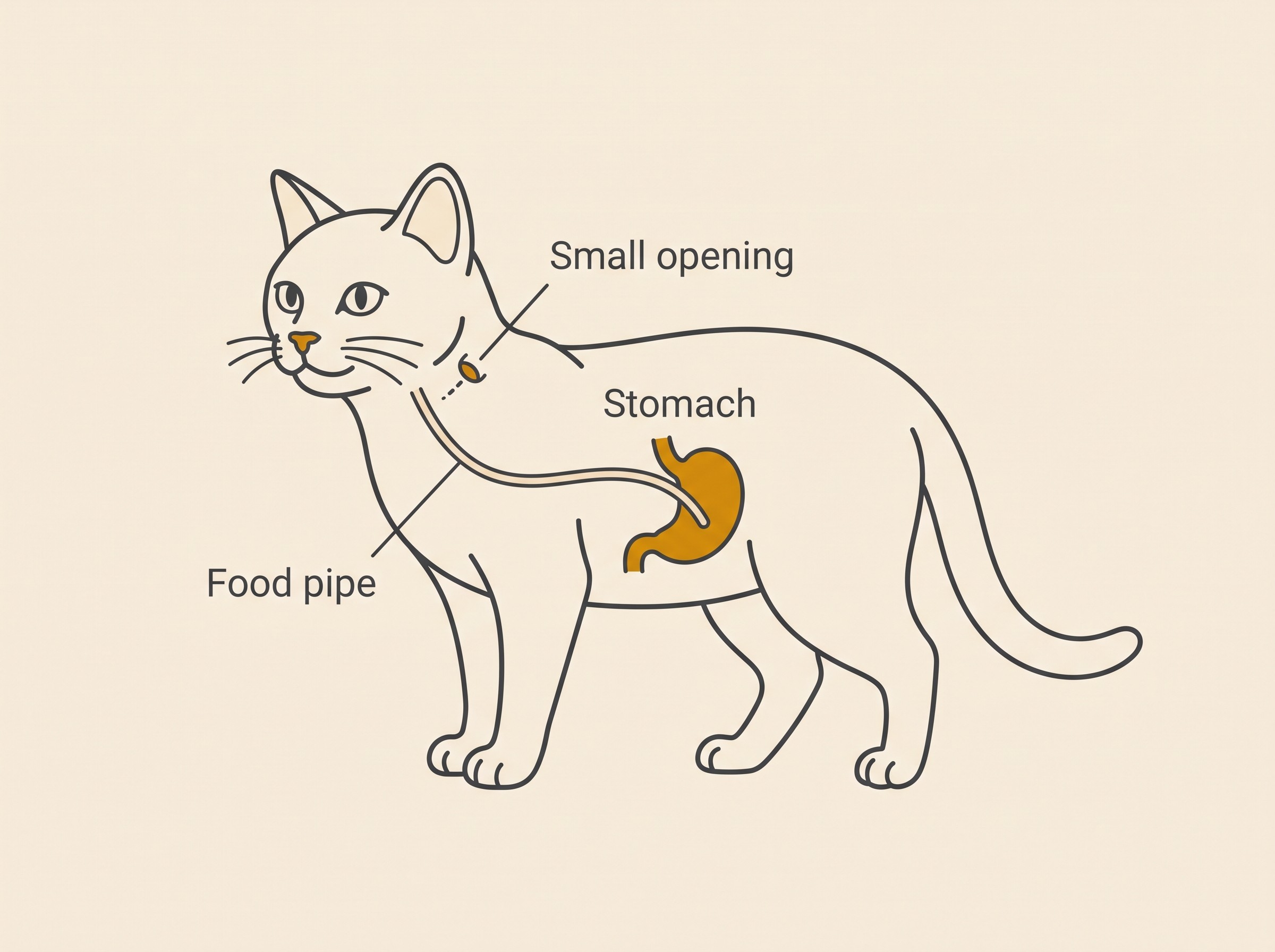
The most commonly used tube for hepatic lipidosis is an oesophagostomy tube, usually shortened to O-tube. Here is what that means in plain terms.
Under a short general anaesthetic, your vet places a soft, narrow tube through a small opening on the side of the neck, so that it runs into the oesophagus (the food pipe) and stops just short of the stomach. The outside end is secured with a light dressing or a soft neck wrap, and it sits neatly against the neck when not in use. Food, water and medicines go in through that outside end, so they travel straight down to where they need to be, bypassing the mouth entirely.
A few things usually surprise people, in a good way. The opening is small and heals well. Cats generally tolerate the tube far better than owners expect, often within a day or two acting largely like themselves with a tube in place. The tube does not stop a cat drinking, grooming a little, moving around, or, crucially, eating on their own if and when their appetite returns. In fact one of the quiet advantages of the tube is that you can keep offering food by mouth throughout, and top up whatever they do not manage, without any pressure. There is no force, no fight, no cat learning to dread mealtimes.
Your vet may occasionally use a different type of tube depending on the individual cat, but the O-tube is the workhorse for this condition, and it is designed precisely for a job that lasts weeks rather than days.
The 6-7 weeks: what living with a tube really looks like
The part owners most want to know is what the day-to-day is actually like, and how long it goes on. Let me be honest and practical.
How long. Hepatic lipidosis is not a quick fix. The liver needs sustained nutrition to recover, and the tube typically stays in for around six to seven weeks, sometimes a bit less, sometimes a bit more, guided by how your cat is doing and, importantly, by when they start eating enough on their own again. It is a marathon, not a sprint, and knowing that up front helps. People who expect a few days and then face weeks find it much harder than people who plan for the full stretch from the start.
The daily routine. Feeding through the tube is done several times a day. Your vet or nurse will show you exactly how: how to warm the food to body temperature, how to draw it up, how to check the tube is in the right place before each feed, how to feed slowly, and how to flush the tube with a little water afterwards so it stays clear. The amount is worked out for your cat and usually built up gradually over the first days rather than going in at full volume immediately, to let the gut adjust. Feeds take a few minutes each. Most owners find that after the first few nervous attempts it becomes a calm, almost meditative part of the day, and their cat sits quietly for it.
Keeping the site clean. The little opening on the neck needs the dressing kept clean and dry and checked regularly for any redness or discharge, which your vet will show you how to manage.
Medicines made easy. A hidden bonus of the tube is that any medicines your cat needs, and cats with fatty liver often need anti-nausea medication and treatment for the underlying cause, can go straight down the tube. No pilling, no fighting, no spat-out tablets. For many owners this alone transforms the experience.
Water too. Cats with fatty liver are often mildly dehydrated and reluctant to drink, and the tube lets you give water as well as food, which keeps your cat comfortable and takes one more worry off your plate. Small, frequent flushes of water between feeds also keep the tube itself clear and working.
I will not pretend it is nothing. It is a commitment of time and nerve, especially at first. But the great majority of owners settle into it, and a striking number tell us afterwards that the tube was far less of an ordeal than they feared, and that watching their cat come back to life made every feed worth it.
Weaning off, and coming home
The tube does not come out the moment your cat perks up. The goal is for your cat to be eating enough on their own, voluntarily, to maintain themselves before the tube is removed. So as recovery progresses, you keep offering food by mouth and track how much your cat eats without help. As their own intake climbs, the tube feeds are reduced to top-ups. Only once your cat is reliably eating enough by themselves does the tube come out, which is a quick and simple procedure, and the little opening heals over quickly. Removing it too early risks the cat sliding straight back, which is exactly what you have spent weeks preventing, so a little patience at the end pays off.
Why it is worth it
Here is the figure that puts the whole thing in perspective. With committed assisted feeding, most commonly via a tube, survival from hepatic lipidosis is in the region of 80 to 90 per cent. Without adequate nutritional support, the same condition is frequently fatal. The tube is, quite simply, the mechanism that delivers the treatment that makes that difference. When you find yourself two weeks in, tired and wondering whether it is all necessary, that contrast is worth remembering: this is not an optional extra, it is the thing that works.
It also helps to hold on to the fact that hepatic lipidosis, unlike some liver diseases, is genuinely recoverable. A liver clogged with fat can clear and go back to normal function, provided it is fed through the crisis. You are not managing a permanent decline. You are getting your cat across a defined, difficult bridge of a few weeks, at the far end of which most cats return to being entirely themselves.
A realistic word before you start
Support the whole cat, not just the tube. Keep every recheck appointment, because your vet is monitoring the liver values, adjusting the plan, and treating the underlying cause that started all this. Ring your vet promptly if the tube looks blocked, if the neck site becomes red, sore or smelly, if your cat vomits repeatedly around feeds, or if they seem to be going backwards rather than forwards. And be kind to yourself through the six or seven weeks. It is a lot to take on, and you took it on for your cat.
When you are ready, read Cholangitis and triaditis: the liver-gut-pancreas triangle if that is what triggered your cat's illness, and keep Jaundice in cats: what the yellow actually means to hand so you know what a setback would look like. The tube is the hard part you were dreading. For most cats and their people, it turns out to be the part that saves them.
References
- Cornell Feline Health Center. Hepatic lipidosis in cats: assisted feeding, oesophagostomy tube use and duration.
- University of Illinois College of Veterinary Medicine. Feline hepatic lipidosis: enteral nutrition via feeding tube, home care and prognosis.
- Oesophagostomy tube as the standard route for medium-term enteral nutrition in feline hepatic lipidosis.
- Typical feeding-tube duration of approximately 6-7 weeks in hepatic lipidosis recovery.
- Survival approximately 80-90% with aggressive assisted (tube) feeding; frequently fatal without adequate nutritional support.
- Home tube-feeding protocol: warming, tube-position checking, slow feeding, flushing, and stoma-site care.
- Tube removal criteria based on adequate voluntary intake.
Keep track of how your pet is doing
The owners who cope best are the ones who notice changes early. A simple health log shows you what is working, and what is not, before the next vet visit.
Start tracking, freeYou're not doing this alone
Compare treatment journeys and talk to owners managing liver & gallbladder. Free to join.
Join PetsLikeMine