

Bad breath: when it's more than "doggy breath"
Alastair Greenway
BVM&S MRCVS
You leaned in for a cuddle, she yawned in your face, and you recoiled. Or the smell reached you from the other end of the sofa and you found yourself typing "why does my dog's breath smell" into your phone, already half-expecting the answer to be a shrug and a "that's just dogs". It's such an ordinary complaint that we've built a whole excuse around it. Doggy breath. Cat breath. Something you put up with, like muddy paws and hair on your jumper.
I want to gently talk you out of that excuse, because it's one of the most useful things I can do for your pet in a single article. Bad breath is not a personality trait. It's not what dogs and cats are supposed to smell like. Far more often than not, that smell is the first thing your pet can tell you about a mouth that has quietly started to hurt. And on the rarer occasions when it isn't the teeth at all, it can be pointing at something in the body that matters just as much.
"Doggy breath" and "cat breath" aren't real things
Let's start by retiring the phrase. A healthy dog's mouth, and a healthy cat's mouth, does not smell bad. It might smell faintly of whatever they last ate, and a cat who's just finished a pouch of fish will smell of fish for a while. That's normal and it passes. What isn't normal is a persistent, offensive smell that's there whether or not they've just eaten, the sort that makes you turn your head away when they come close.
That smell has a cause, and the cause is almost always bacterial. When we say a pet has "bad breath", nine times out of ten we're describing the smell of periodontal (gum) disease, and it's worth understanding exactly what you're smelling, because once you know, you can't un-know it.
What you're actually smelling
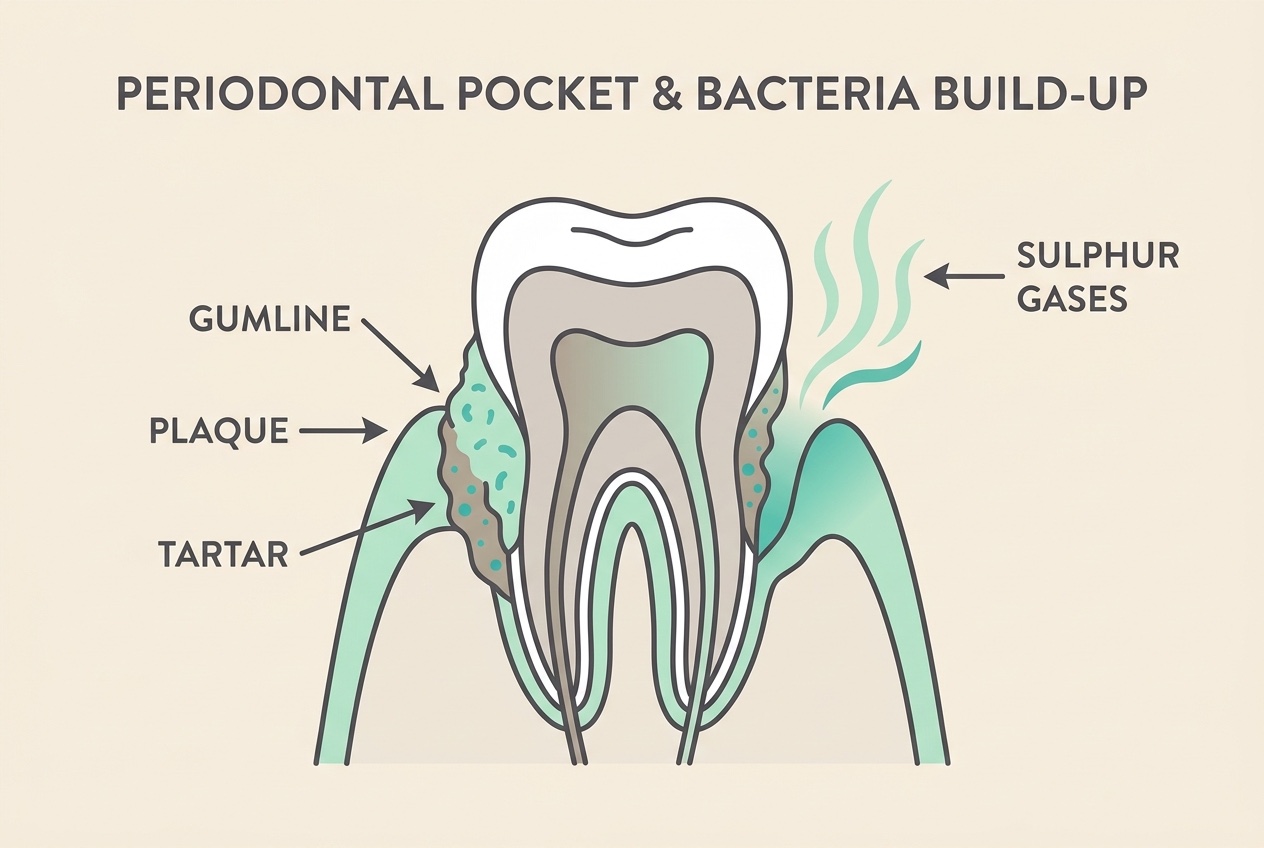
Plaque is a soft, sticky film of bacteria that builds up on teeth within hours of a clean. Left alone, it thickens, hardens into the brown-yellow crust we call calculus or tartar, and creeps down under the gumline. As it matures, the mix of bacteria shifts towards anaerobes, the kind that thrive in the low-oxygen pocket between tooth and gum. These bacteria feed on proteins in the mouth and give off waste gases, and it's those gases you can smell.
The main culprits are volatile sulphur compounds, chiefly hydrogen sulphide (the rotten-egg smell) and methyl mercaptan. As one study of the bacteria living in dogs' mouths put it, "volatile sulphur compounds are the main cause of halitosis in humans and dogs with periodontal disease" (Ito et al., 2023). The uncomfortable twist is that these same gases aren't just smelly, they're toxic to the gum tissue itself, contributing to the destruction of the very structures holding the teeth in (Ito et al., 2023). So the smell isn't a harmless by-product. It's the exhaust fumes of an active, damaging process happening below the gumline, in a part of the mouth you can't see just by lifting the lip.
That's the bit worth sitting with. By the time you can smell it across the room, there's usually established disease under there, not a passing whiff.
Why it's the most ignored early warning there is
Here's the frustrating thing about bad breath as a symptom. It's the sign owners notice first, and the sign they dismiss fastest. In a large survey of dog owners, almost half reported that their dog had bad breath to some degree (Enlund et al., 2020), yet very few of them treated it as a reason to do anything. It gets filed under "just how she is" and forgotten.
That's a shame, because it's often the earliest warning you'll ever get. Periodontal disease is not some rare misfortune. It's the single most commonly diagnosed problem in dogs seen by first-opinion vets in the UK, affecting around one in eight dogs in any given year (O'Neill et al., 2021). Look across a whole lifetime and it's close to universal: the WSAVA Global Dental Guidelines report that by just two years of age, roughly 80% of dogs and 70% of cats already have some degree of periodontal disease (Niemiec et al., 2020). If your pet is past their second birthday and their breath has turned, the odds are simply that the disease has arrived. The smell is your invitation to catch it early, while it's still a scale-and-polish rather than a mouthful of extractions.
Bad breath rarely travels alone, either. If you've noticed the smell, it's worth looking for the company it keeps: drooling, chewing on one side, going quiet on hard food, pawing at the face, or a general sense that your pet has become a slightly smaller, grumpier version of themselves. I've written about those quieter clues in the signs your pet's mouth hurts, and the smell is often the loudest member of that quiet crowd.
Cats get it too, and with cats it matters even more
It's tempting to think of bad breath as a dog problem, because dogs breathe in our faces and cats mostly don't. But cats get periodontal disease at nearly the same rates as dogs, and they carry two extra conditions that dogs don't: tooth resorption, where the tooth destroys itself from the inside, and feline chronic gingivostomatitis, a fierce immune-driven inflammation of the whole mouth. Both are painful, and both can announce themselves as a smell before anything else.
What makes the feline version more serious is that cats are extraordinarily good at hiding pain. The 2025 FelineVMA feline dental guidelines are blunt about it, noting that cats have "retained a strong survival instinct to conceal illness and pain", and that "a normal appetite does not always equate with a healthy mouth" (Lobprise et al., 2025). A cat won't limp on a sore mouth or whimper at the bowl. She'll carry on eating and grooming and greeting you as though nothing's wrong, right up until she can't. In that silence, breath becomes one of the few signals that gets through. A cat whose breath has turned genuinely foul, especially with a bit of drooling or a reluctance to be touched around the face, is a cat whose mouth deserves a proper look, not a mint and a shrug.
So please don't discount it in cats because they're not breathing on you. If you find yourself noticing the smell when your cat washes near you or yawns on your lap, that's worth acting on.
When the smell isn't the teeth at all
Most of the time, bad breath is a dental story. But not always, and this is the part that turns "just bad breath" into something you genuinely shouldn't wave away. A handful of conditions elsewhere in the body change the smell of the breath, and a few of them are serious. You don't need to become a diagnostician, but it helps to know the shapes of them so you can tell your vet what you're noticing.
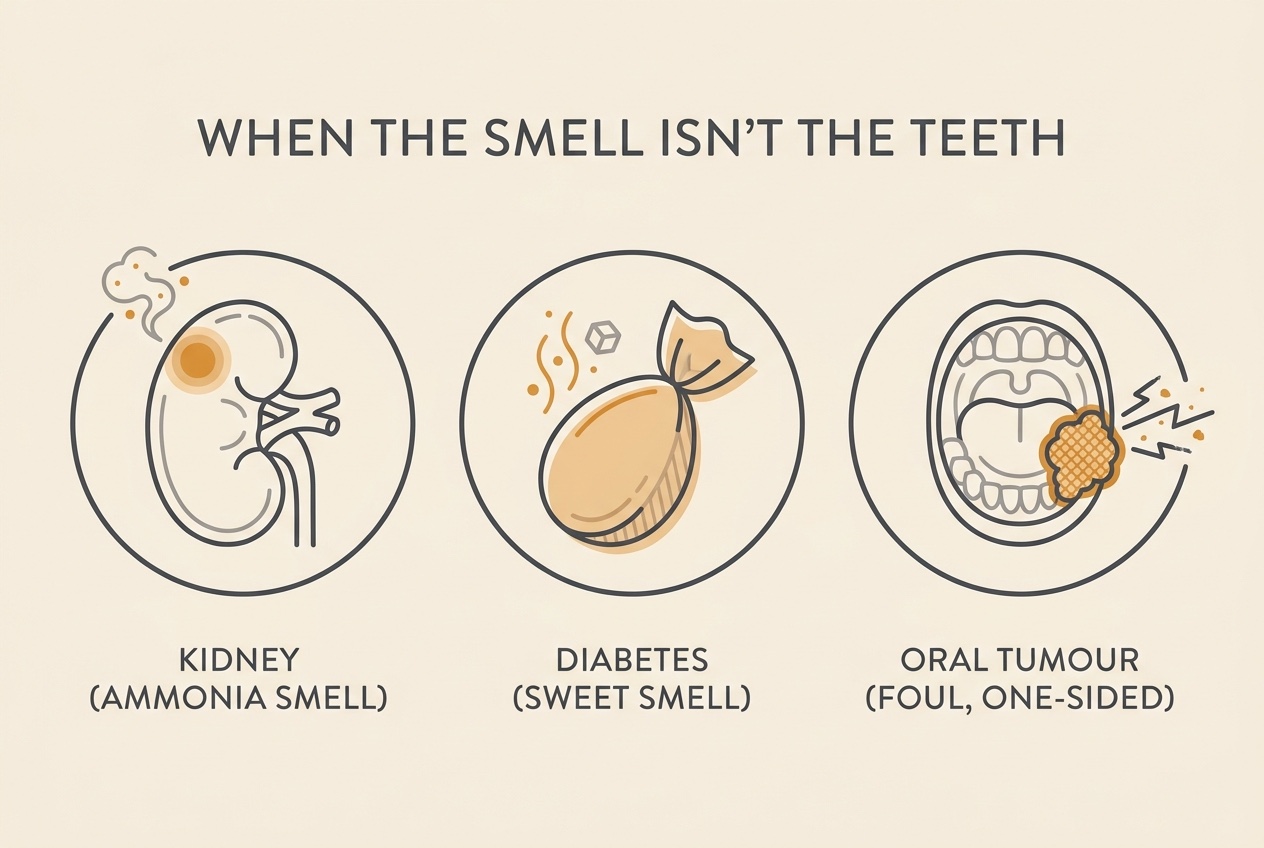
A kidney smell. When the kidneys are failing, waste products the kidney would normally clear build up in the blood, and some come out on the breath. The result is a distinctive ammonia-like or urine-like odour, quite different from the rotten-egg smell of gum disease. Advanced kidney disease can also cause ulcers in the mouth, which add their own smell (Merck Veterinary Manual). This matters most in older cats, in whom chronic kidney disease is common. If the bad breath comes alongside drinking more, weight loss, or a fussy appetite, that combination is worth a vet visit soon rather than eventually.
A sweet, "pear drops" or nail-varnish smell. This is the odour of ketones, and in a pet it points towards a diabetic crisis called ketoacidosis. It's uncommon, but it's an emergency. A distinctly sweet or acetone-like breath in a pet who is also drinking a lot, off their food, vomiting, or unusually flat is a same-day call to your vet or the out-of-hours service, not a wait-and-see.
A foul, one-sided, "rotting" smell with a lump. An oral tumour that has grown, ulcerated and become infected produces a genuinely putrid smell, often worse on one side, and frequently comes with drooling, a spot of blood, or reluctance to eat. Halitosis, hypersalivation and reluctance to eat are recognised as common signs of malignant oral tumours (Merck Veterinary Manual). If you can see or feel a mass in the mouth, or the smell is coming from one side and getting worse, get it checked promptly.
There are gentler explanations too. A dog who raids the cat's litter tray or eats something unspeakable on a walk will have terrible breath for entirely non-medical reasons. Skin infections in the folds of the lips, common in spaniels and other droopy-lipped breeds, can smell foul without the teeth being the main problem. And systemic and gut conditions can occasionally show up on the breath as well (see the review by Kim and colleagues on oral signs of body-wide disease). The point isn't to frighten you towards the rare things. It's that "it's only bad breath" is precisely the assumption that lets both the common dental cause and the occasional serious one go unexamined.
What to do about it this week
You don't need to panic over a whiff of bad breath, and you certainly don't need an emergency visit for it on its own. But you also shouldn't file it under "just dogs" and forget it. Here's the sensible order of things.
Do a calm smell-and-look tonight. Gently lift the lip at the back, where the big cheek teeth sit and where tartar lands first, and have a look and a sniff. A red rim along the gumline, brown or yellow build-up, a broken or discoloured tooth, or a smell that makes you wince all point at dental disease. Our step-by-step guide, how to check your pet's mouth at home, walks you through exactly what healthy and not-healthy look like, and how to do it without a wrestling match, which matters especially with cats. Please don't try to scrape any tartar off yourself, whatever you've seen online. You'll damage the tooth, miss the disease that lives below the gumline, and stand a fair chance of hurting the gum or getting bitten.
Book a routine dental check if the smell is persistent. If the bad breath is there day in, day out, that's a conversation with your vet, ideally before it becomes a mouthful of loose teeth. Caught at the "smelly but not yet dramatic" stage, a mouth is usually much cheaper and simpler to sort out.
Treat these combinations as urgent, not routine. Call your vet promptly, or the same day, if the bad breath comes with any of these:
- a distinctly sweet, pear-drops or nail-varnish smell in a pet who is also unwell, drinking a lot or vomiting (possible diabetic emergency),
- an ammonia or urine-like smell alongside increased drinking, weight loss or a poor appetite (possible kidney disease),
- a foul, one-sided smell with a visible lump, bleeding, or trouble eating (possible oral tumour),
- your pet refusing all food, or blood in the drool.
If you've read this far, it's probably because the smell has been nagging at you and some part of you suspected it wasn't nothing. Trust that. The kindest thing you can do with bad breath is stop treating it as background noise and treat it as the message it usually is: something in there needs a look. Lift the lip tonight, and if what you find gives you pause, let your vet look too. A mouth that's been quietly souring for months can very often be made sweet, and comfortable, again.
References
- Enlund, K.B., Brunius, C., Hanson, J., Hagman, R., Höglund, O.V., Gustås, P., Pettersson, A. (2020). Dog owners' perspectives on canine dental health, a questionnaire study in Sweden. Frontiers in Veterinary Science.
- Ito, N., Itoh, N., Kameshima, S. (2023). Volatile sulfur compounds produced by the anaerobic bacteria Porphyromonas spp. isolated from the oral cavities of dogs. Veterinary Sciences, 10(8):503.
- Lobprise, H., St Denis, K., Anderson, J.G., Hoyer, N., Fiani, N., Yaroslav, J. (2025). 2025 FelineVMA feline oral health and dental care guidelines. Journal of Feline Medicine and Surgery.
- Niemiec, B., Gawor, J., Nemec, A., Clarke, D., McLeod, K., Tutt, C., et al. (2020). World Small Animal Veterinary Association Global Dental Guidelines. Journal of Small Animal Practice. (full guideline: https://wsava.org/global-guidelines/global-dental-guidelines/)
- O'Neill, D.G., Roto, A., Church, D.B., McGreevy, P.D., Thomson, P.C., Brodbelt, D.C. (2021). Epidemiology of periodontal disease in dogs in the UK primary-care veterinary setting. Journal of Small Animal Practice.
- Merck Veterinary Manual. Disorders of the Mouth in Cats and Oral Tumors in Small Animals.
Free downloads
Companion worksheets to put what you've read into practice. Free PDFs, print at home.
Keep track of how your pet is doing
The owners who cope best are the ones who notice changes early. A simple health log shows you what is working, and what is not, before the next vet visit.
Start tracking, freeYou're not doing this alone
Compare treatment journeys and talk to owners managing teeth & mouth. Free to join.
Join PetsLikeMine