


Mitral Valve Disease Explained: The Leaky Valve Behind Most Canine Heart Murmurs
Alastair Greenway
BVM&S MRCVS
If your vet has mentioned mitral valve disease, or told you the murmur they heard points to a "leaky valve", start here. By a wide margin it is the most common heart condition we see in dogs, and it gets misunderstood more than almost any other, mostly because the word "disease" lands so heavily when the reality for most dogs is far gentler. Plenty of dogs go on to live happily for years after the diagnosis, often needing nothing more than a watchful eye. What I want to do here is set out in plain terms what the condition actually is, why some breeds are so prone to it, how it tends to unfold over time, and what you will notice and do as the owner along the way. Each stage and each treatment has its own home elsewhere in this space, and I will point you there rather than repeat it. Think of this as the map that ties everything together.
What mitral valve disease actually is
To picture what is going wrong, it helps to picture the part that is affected. The mitral valve is one of four valves in the heart, and it sits between the two chambers on the left side: the left atrium above and the left ventricle below. Its job is simple but vital. Each time the heart beats, the valve must open to let blood pass through, then close firmly to stop that blood washing back the wrong way as the ventricle squeezes it out to the body. A healthy valve seals like a well-fitted door.
In mitral valve disease, that door slowly stops sealing. The proper name for it is myxomatous mitral valve disease, often shortened to MMVD, and you may also hear it called degenerative or chronic valve disease, or endocardiosis. The "myxomatous" part describes what is happening to the valve tissue itself: over time the leaflets thicken, become lumpy and nodular, and start to bulge or prolapse rather than meeting cleanly (Merck Veterinary Manual). Tiny supporting cords can stretch too. The end result is a valve that no longer closes completely, so every time the heart contracts, a portion of blood leaks backwards from the ventricle into the atrium. That backward leak is called regurgitation, and the turbulence it creates is the whoosh your vet hears through the stethoscope.
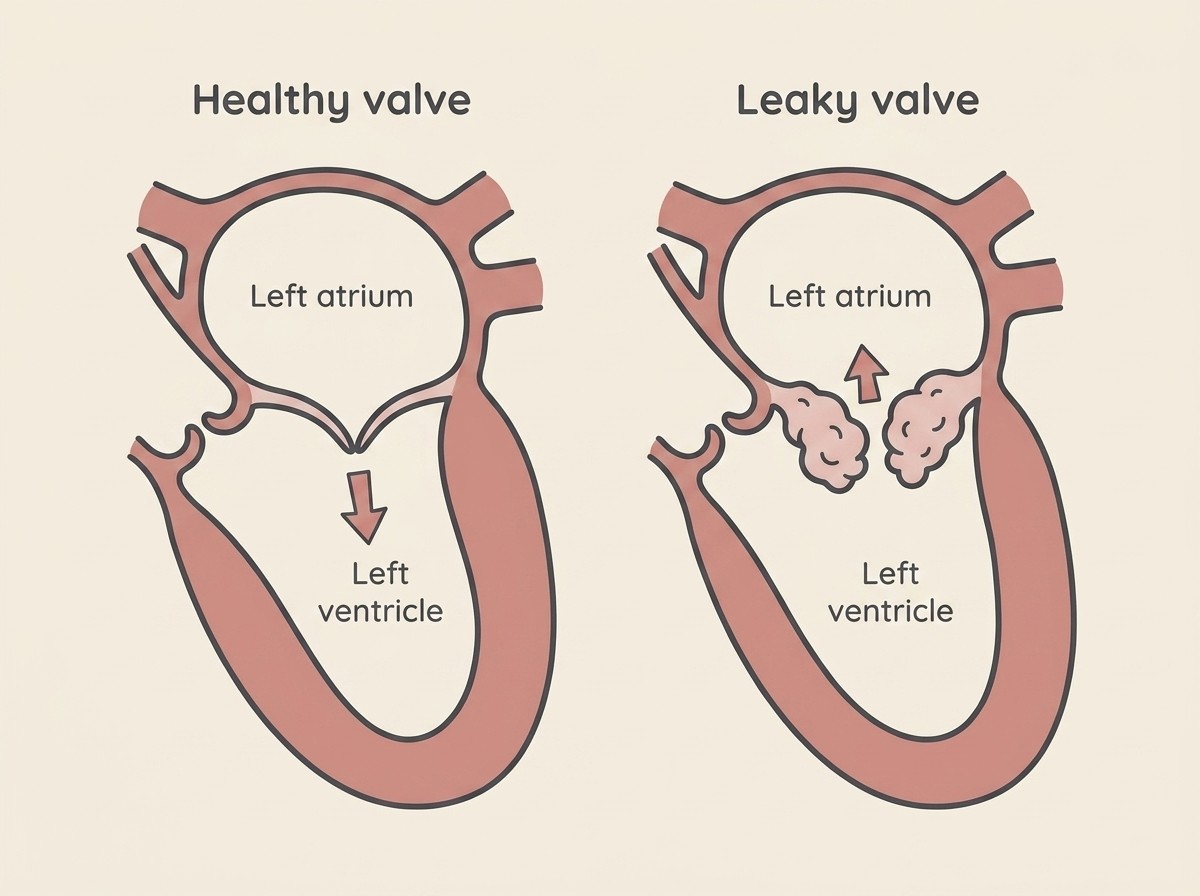
Early on, the leak itself is rarely the dangerous part. The trouble is the knock-on effect. Because some blood keeps sloshing backwards instead of moving forwards, the heart has to work a little harder to push the same amount of blood out to the body. To cope, the chambers on the left side gradually stretch and enlarge, much as any muscle adapts to a heavier load. For a long time this works, and the dog feels perfectly well. Only if the leak grows severe enough that the system can no longer keep up, and fluid begins to back up into the lungs, does the dog become unwell. That late event is congestive heart failure, and it is the destination of the journey rather than the starting point. Most dogs spend a long time well short of it.
Why it is so common, and why Cavaliers especially
Mitral valve disease accounts for the large majority of heart disease in dogs, somewhere around 75 per cent of all cardiac cases (Merck Veterinary Manual). It falls overwhelmingly on small and medium breeds: dachshunds, miniature and toy poodles, Chihuahuas, Pomeranians, papillons, and many small terriers and crossbreeds are all over-represented (Keene et al., 2019). In most of these breeds it tends to appear in middle age or later life, which is why an older small dog developing a murmur is such a familiar story in the consulting room.
Then there is the Cavalier King Charles Spaniel, which is in a category of its own. In this breed the disease starts earlier and runs more commonly than in any other. The figures are striking: roughly half of all Cavaliers have a murmur by the age of five, and nearly every surviving Cavalier has at least a low-grade murmur by ten, with the condition estimated to be around twenty times more prevalent than in dogs generally (UFAW, 2024). Where most breeds are diagnosed from six or seven years of age onwards, Cavaliers are often picked up at three or four. This comes down to inheritance, not bad luck. The condition is strongly heritable in the breed, driven by more than one gene, which is precisely why responsible breeding schemes screen the hearts of breeding dogs before they are mated (Keene et al., 2019). If you share your life with a Cavalier, none of this is cause for alarm, but it is good reason to have the heart listened to from a young age and at every annual check.
The murmur, and how the disease usually announces itself
For the great majority of dogs, the very first sign of mitral valve disease is not something you notice at home at all. It is the murmur your vet picks up on a routine examination, often at a vaccination appointment, long before the dog shows any outward change whatsoever. That is genuinely how the disease announces itself in most cases: quietly, on the end of a stethoscope, in a dog who seems entirely well.
It is worth being clear about what that murmur does and does not tell you, because owners often read far too much into it. A murmur is simply the sound of the turbulent, leaking blood. It confirms that a valve is letting blood through where it should not, but on its own it says very little about how serious things are. A loud murmur is not automatically a worse murmur, and the volume is a poor guide to how enlarged the heart is or how the dog will fare. I have written about this in full in what a heart murmur means, so I will not repeat it here; the short version is that the murmur is the prompt to look closer, not the answer in itself. To find out what the leak is actually doing to the heart, your vet needs to measure the heart's size, which is done with an ultrasound scan of the beating heart, called an echocardiogram, and sometimes a chest x-ray. Those tests are what move a dog from a vague "has a murmur" to a precise place on the journey.
The slow journey: ACVIM stages A to D in plain terms
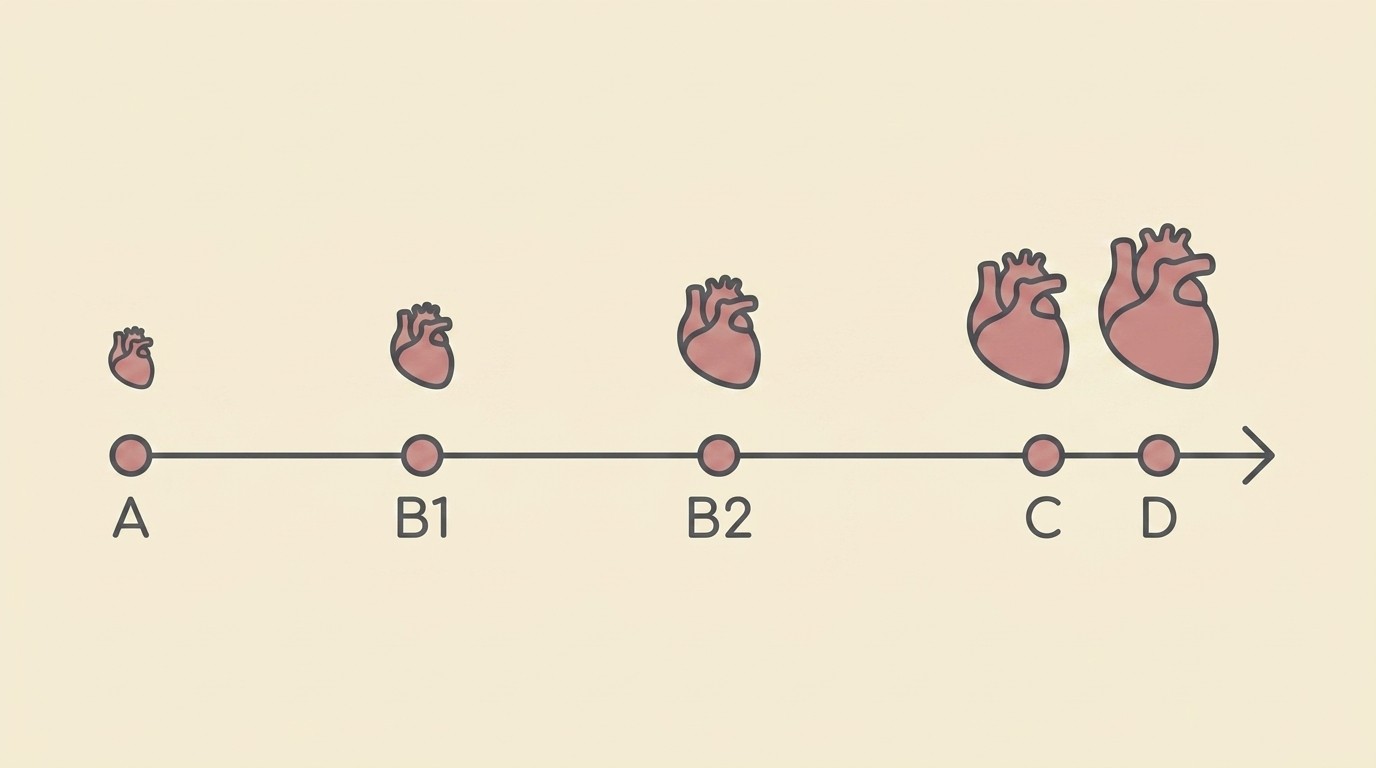
Vets describe that journey using a staging system from the American College of Veterinary Internal Medicine, the ACVIM stages, which sort dogs into four lettered steps (Keene et al., 2019). You will hear these letters a great deal once a diagnosis is made, so it helps to know the shape of them, even though each one has its own detailed home in the ACVIM stages article. In the broadest plain-English terms:
- Stage A is an at-risk dog with a completely healthy heart: no murmur, no leak, nothing yet. A Cavalier puppy sits here simply by being a Cavalier. There is nothing to treat, only to watch for in future.
- Stage B1 is the first real foothold of disease: there is a leak and a murmur, but the heart is still a normal size. The dog feels well and needs monitoring, not medication.
- Stage B2 is the turning point. The leak has gone on long enough that the heart has measurably enlarged, yet the dog still has no symptoms. This is the stage at which starting treatment early matters, and I will come back to it below.
- Stage C is the point at which the disease finally makes the dog unwell: heart failure has occurred, with fluid backing up into the lungs, and the dog needs a combination of medications to manage it. A dog stays in stage C even once those signs are well controlled.
- Stage D is the most advanced phase, where the heart failure no longer responds easily to standard treatment and the focus shifts firmly towards comfort.
If there is one thing to take from that list, it is that the stage, not the murmur and not your dog's age, is what drives the plan. It tells you whether the right response today is to watch, to start early treatment, or to manage active heart failure. And for most dogs, the movement from one stage to the next is measured in months and years, not days.
What you actually notice, and do, at each phase
In the early stages, A through B1 and often well into B2, the honest answer is that you notice almost nothing. Your dog runs, eats, plays and sleeps exactly as before. Your role is not to treat a sick dog but to build a quiet baseline of what "well" looks like, and to keep the agreed recheck appointments so your vet can track whether the heart is starting to change. The practical handbook for this watchful phase, including how often to recheck, is living with a dog in the pre-clinical stage.
The most powerful home habit, and one I encourage every owner of an affected dog to adopt, is counting the resting respiratory rate: the number of breaths your dog takes per minute while genuinely asleep. A calm, low rate is reassuring, and a rising trend is often the earliest hint that fluid is beginning to build, sometimes before any cough or tiredness appears. The resting respiratory rate guide explains exactly how to count it, and the breathing rate tracker turns it into a simple nightly record you can show your vet.
Things change in character once a dog reaches stage C. Now there are signs to manage and watch for: a faster resting breathing rate, increased effort to breathe, a soft cough, tiredness or reduced stamina on walks. This is the phase where daily medication becomes part of life, and where one rule matters above all others. Sudden fast, laboured or open-mouthed breathing at rest is an emergency and warrants an immediate call to your vet, whatever the murmur grade ever was. The detail of life at this stage lives in mitral valve disease and heart failure.
The reassuring truth, and the one decision that buys time
I want to finish where I began, because it is the part owners most need to hold on to. A diagnosis of mitral valve disease is not a short sentence. The pre-clinical phase, the stretch between the murmur first being heard and any symptom appearing, commonly lasts for years, and a meaningful proportion of affected dogs never go on to develop heart failure within their lifetime at all (Borgarelli and Buchanan, 2012). For a great many dogs, this is a condition they live alongside, not one they are quickly overtaken by. If you want the fuller picture of what the years ahead may hold, the prognosis article sets it out honestly.
There is also one genuinely encouraging piece of medicine worth knowing, and it is the reason stage B2 matters so much. A large international trial, known as the EPIC study, showed that starting a medication called pimobendan once a dog reaches stage B2, while still free of any symptoms, delays the onset of heart failure by around fifteen months on average compared with waiting (Boswood et al., 2016). That is a substantial stretch of good-quality time, bought before the disease ever makes the dog feel ill, and it is one of the most worthwhile interventions in all of canine cardiology. The full story of that decision and the measurements behind it is told in the ACVIM stages article.
References
- Keene BW, Atkins CE, Bonagura JD, et al. ACVIM consensus guidelines for the diagnosis and treatment of myxomatous mitral valve disease in dogs. Journal of Veterinary Internal Medicine. 2019;33(3):1127-1140.
- Boswood A, Haggstrom J, Gordon SG, et al. Effect of Pimobendan in Dogs with Preclinical Myxomatous Mitral Valve Disease and Cardiomegaly: The EPIC Study, A Randomized Clinical Trial. Journal of Veterinary Internal Medicine. 2016;30(6):1765-1779.
- Borgarelli M, Buchanan JW. Historical review, epidemiology and natural history of degenerative mitral valve disease. Journal of Veterinary Cardiology. 2012;14(1):93-101.
- Ware WA, Bonagura JD. Myxomatous Atrioventricular Valve Degeneration in Dogs and Cats. Merck Veterinary Manual (Professional Version), Circulatory System.
- Universities Federation for Animal Welfare (UFAW). Cavalier King Charles Spaniel: Mitral Valve Disease (MVD). Genetic Welfare Problems of Companion Animals.
- Parker HG, Kilroy-Glynn P. Myxomatous mitral valve disease in dogs: Does size matter? Journal of Veterinary Cardiology. 2012;14(1):19-29.
- Lewis T, Swift S, Woolliams JA, Blott S. Heritability of premature mitral valve disease in Cavalier King Charles spaniels. The Veterinary Journal. 2011;188(1):73-76.
Keep track of how your pet is doing
The owners who cope best are the ones who notice changes early. A simple health log shows you what is working, and what is not, before the next vet visit.
Start tracking, freeYou're not doing this alone
Compare treatment journeys and talk to owners managing heart health. Free to join.
Join PetsLikeMine