

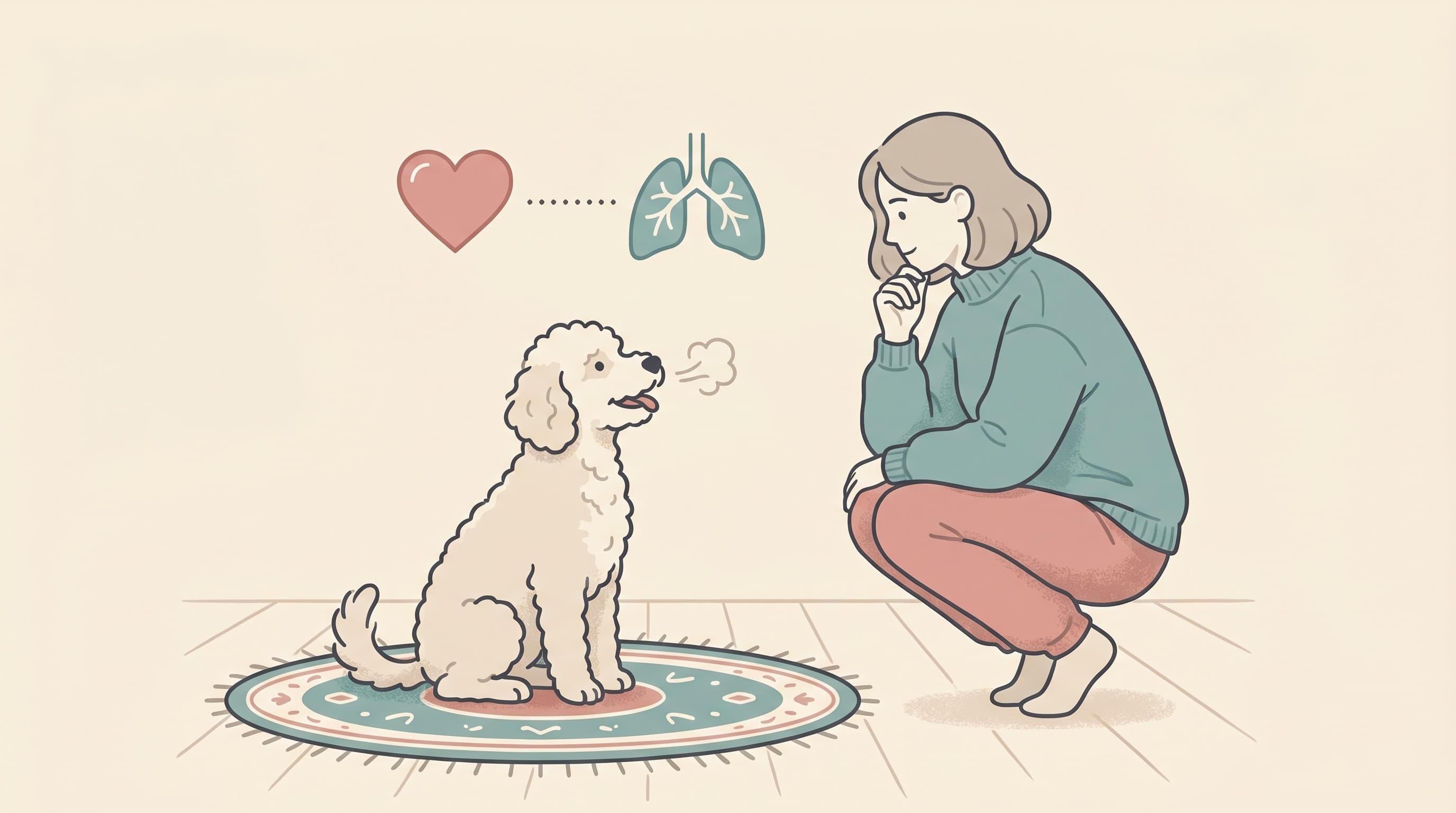
Is It a Heart Cough or an Airway Cough?
Alastair Greenway
BVM&S MRCVS
A dog has a heart murmur, then starts to cough, and the two facts seem to lock together into one frightening conclusion. The words "heart" and "cough" sit so close in most owners' minds that a single dry cough can ruin an evening. So here is the most useful thing to know first: in dogs, a cough is a surprisingly unreliable sign of heart failure on its own. Plenty of dogs with significant heart disease cough for reasons that have nothing to do with fluid in the lungs, and plenty of small breeds cough because of an airway problem they would have had with or without a murmur. Telling these apart is one of the genuinely worthwhile things you can learn as an owner, because it is the difference between a calm phone call in the morning and an unnecessary midnight dash, and, just as importantly, between catching real heart failure early and missing it.
Three different stories behind one cough
The first thing to understand is that "the cough" is not one thing. In a small-breed dog with a heart murmur, a cough can come from at least three quite separate mechanisms, and they have different urgencies and different treatments. Lumping them together is exactly how owners end up either frightened by a harmless cough or, less often, reassured by a dangerous one.
Broadly, the three are: an enlarged heart pressing mechanically on the airway, a separate airway disease that happens to live in the same kind of dog, and true heart failure, where fluid floods the lungs. They can also overlap, which is part of what makes this genuinely tricky even for vets. It is entirely possible for one Cavalier to have all three going on at once. Let us take them in turn.

An enlarged heart pressing on the airway
This is the mechanism most owners have never heard of, and it explains a huge number of coughs in dogs with mitral valve disease. To picture it, you need one piece of anatomy: the left atrium, the upper-left chamber of the heart, sits directly underneath the point where the windpipe splits into the two main airways to the lungs (the carina, and specifically the left mainstem bronchus). They are practically touching.
In mitral valve disease, the leaking valve causes the left atrium to stretch and enlarge over time. When it gets big enough, it physically pushes up against that left mainstem bronchus and squashes it. The airway lining is exquisitely sensitive to being prodded, so the dog coughs. This is sometimes called mainstem bronchus compression (Singh et al., 2012). The key point for you is this: it is a mechanical cough, caused by the size of the heart, not by any fluid in the lungs. The dog is not in heart failure. The lungs are dry.
That distinction changes everything, because the treatment is different. A cough from bronchial compression does not respond well to furosemide (the water tablet that clears fluid in true heart failure), because there is no fluid to clear. Loading a dog up with diuretics for a compression cough just dehydrates them. This kind of cough tends to be dry and harsh, often worse with excitement, pressure on the throat or a tight collar, and it does not usually come with the laboured, fast breathing of fluid on the lungs. It is the single most common reason a dog with a big heart coughs while remaining, in every other respect, perfectly well.
A separate airway disease in the same small dog
Here is an inconvenient truth of veterinary cardiology. The breeds most prone to mitral valve disease, the Cavalier King Charles Spaniel, the Yorkshire terrier, the chihuahua, the poodle, the Pomeranian, the Maltese, are the very same small breeds most prone to airway diseases that cause coughing in their own right. So a coughing small dog with a murmur very often has two separate problems, and the murmur is a red herring for the cough.
The two big ones are collapsing trachea and chronic bronchitis. A collapsing trachea is a windpipe whose cartilage rings have softened and flatten as the dog breathes, producing a very characteristic dry, honking cough, often likened to a goose honk, classically triggered by excitement, drinking, pulling on the lead or pressure on the throat (Maggiore, 2014). Chronic bronchitis is long-standing inflammation of the airways, which produces a cough that has been grumbling on for months and is often worse in the morning or with activity. Neither has anything to do with the heart. A dog can have a textbook heart murmur and a textbook collapsing-trachea cough at the same time, and treating the heart will do nothing for the cough.
This is why a good vet, faced with a coughing dog with a murmur, does not simply assume the heart is to blame. The job is to work out which problem, or which combination of problems, is actually driving the cough today, because the answer decides the treatment.
True heart failure, where the lungs fill with fluid
Now the one everyone is worried about. This is cardiogenic pulmonary oedema: the point at which the failing heart can no longer keep up, pressure backs up through the lungs, and fluid leaks out of the blood vessels into the lung tissue and the tiny air sacs. This is congestive heart failure, and it is a genuine emergency. It is also, importantly, the least common cause of a cough in a dog who is otherwise behaving normally.
The reason this one matters so much is not the cough itself but what travels with it. In true heart failure, the standout sign is not the cough, it is the breathing. The dog breathes faster and works harder to breathe, even while resting or asleep, because the fluid-filled lungs cannot exchange oxygen efficiently. You may see the belly and chest heaving with each breath, the dog reluctant to settle or lie flat, gums that look greyish or bluish rather than healthy pink, and a general flatness and loss of appetite. A soft, sometimes moist cough can be part of the picture, but it is the rising breathing effort that tells the real story.
In fact, in dogs (unlike in people), a cough is a relatively poor marker of heart failure, and breathing rate and effort are far more reliable. With heart disease, watch the breathing, not the cough.
How the vet tells them apart
When you bring in a coughing dog with a murmur, your vet is essentially trying to answer one question: are the lungs wet or dry? Almost everything they do is aimed at that.
Listening with the stethoscope helps but does not settle it, because the crackles of fluid can be subtle and a loud murmur tells you nothing about the lungs. The decisive test is usually a chest x-ray. On a radiograph, the vet can see whether the lungs show the pattern of fluid build-up that means heart failure, how enlarged the left atrium is, and whether it is sitting up against and narrowing that mainstem bronchus. The x-ray can often distinguish, at a glance, the dry compressed airway of the first story from the flooded lungs of the third (Keene et al., 2019). An echocardiogram, a heart ultrasound, adds detail about how the heart itself is coping, and airway-specific tests such as fluoroscopy or bronchoscopy may follow if a primary airway disease such as collapsing trachea is suspected. How these tests fit together is covered in the heart tests explained, so I will not re-tread that ground here.
There is one quick, cheap and genuinely useful bedside test worth knowing about: the response to furosemide. If a short course of the diuretic clearly settles the cough and the breathing within a day or two, that points strongly towards fluid, and therefore heart failure. If it makes no difference, the cough is much more likely to be coming from bronchial compression or a primary airway disease. Vets sometimes use this deliberately as a diagnostic trial. It is not something to attempt on your own, because furosemide given to a dog whose cough is not cardiac just leaves them dehydrated and feeling worse, but it is helpful to understand why your vet might suggest it.
Breathing rate: the number that lets you triage at home
This is where you, at home, become genuinely powerful. Because the dividing line between a harmless cough and the start of heart failure comes down to whether the lungs are filling with fluid, and because fluid shows up as faster breathing before the dog looks obviously ill, the most useful thing you can do is count your dog's resting respiratory rate. This is simply the number of breaths your dog takes per minute while sleeping or fully relaxed, where one breath is one in-and-out.
A healthy dog at rest almost always breathes fewer than around 30 breaths per minute, and most sit comfortably in the low twenties or below. A consistently rising rate, or any reading creeping up towards and beyond 40 while the dog is genuinely resting, is one of the earliest and most reliable warnings that fluid may be accumulating, often appearing before any change you would otherwise notice. The resting, or sleeping, respiratory rate is well established in veterinary cardiology as a sensitive home marker of developing congestion, which is precisely why cardiologists ask owners to track it. The beauty of it is that it turns the frightening question, "is this cough the heart?", into a number you can actually check.
So here is the practical rule. A dog who coughs now and then but whose resting breathing rate stays low and steady, and who is otherwise bright, eating and active, is very unlikely to be in heart failure, and the cough is far more likely to be bronchial compression or an airway problem to discuss at the next routine appointment. A dog whose resting breathing rate is climbing, who is breathing harder, off their food or unsettled, needs to be seen quickly, because that is the pattern of fluid on the lungs. Knowing exactly how to count it properly, and how to log it so you can spot a trend rather than panic over a single reading, is worth getting right: the resting respiratory rate guide walks through the technique, and the breathing rate tracker lets you record it night by night and see the line moving before your dog does.
A final word on the genuine emergency, so you are never caught out. If your dog is breathing fast and hard while resting, struggling to settle, or has gums that look grey, blue or very pale, do not wait to count anything: that is a crisis, and recognising a heart failure crisis sets out exactly what to do and when to ring the emergency vet. For everything short of that, the cough is a prompt to look at the breathing, not a verdict in itself. Most of the time, watching that quiet, steady rise and fall as your dog sleeps will tell you far more than the cough ever could.
References
- Singh MK, Johnson LR, Kittleson MD, Pollard RE. (2012) Bronchomalacia in dogs with myxomatous mitral valve degeneration. Journal of Veterinary Internal Medicine, 26(2), 312-319.
- Maggiore AD. (2014) Tracheal and airway collapse in dogs. Veterinary Clinics of North America: Small Animal Practice, 44(1), 117-127.
- Keene BW, Atkins CE, Bonagura JD, Fox PR, Haggstrom J, Luis Fuentes V, Oyama MA, Rush JE, Stepien R, Uechi M. (2019) ACVIM consensus guidelines for the diagnosis and treatment of myxomatous mitral valve disease in dogs. Journal of Veterinary Internal Medicine, 33(3), 1127-1140.
Keep track of how your pet is doing
The owners who cope best are the ones who notice changes early. A simple health log shows you what is working, and what is not, before the next vet visit.
Start tracking, freeYou're not doing this alone
Compare treatment journeys and talk to owners managing heart health. Free to join.
Join PetsLikeMine