

Your Dog Has Arthritis. Now What? The First 30 Days
Alastair Greenway
BVM&S MRCVS
The diagnosis is in. You've come home from the vet clinic with a prescription, a leaflet you'll probably never read again, and a head full of half-remembered advice. Now you're standing in the kitchen, looking at your dog, and you're not sure what to do first.
This article is for that moment.
I've sat across from plenty of owners in this exact situation over 25 years in practice. Some are devastated. Some are practical and businesslike. Some are quietly relieved that there's finally a name for what's been happening. Most are some combination of all three at once. Whatever you're feeling, it's normal, and there's no wrong way to process this news.
What I want to do here is give you a clear, practical map for the next month. Not everything you'll ever need to know about arthritis. Just what to focus on now, what can wait, and how to sidestep the common mistakes people make in the first few weeks after diagnosis. By the end of the 30 days, you should have a working management routine, some early sense of what's helping, and a clearer head about the longer journey ahead.
If you'd rather work from paper, our 30-day checklist puts the same week-by-week structure on a single printable page.
A few things to settle first
Your dog is not dying. Arthritis is not a death sentence. The vast majority of dogs diagnosed with arthritis live full, comfortable lives for years with appropriate management. I want to say this plainly at the start, because the diagnosis can feel catastrophic in the moment, and it shouldn't.
You haven't caused this. Most arthritis in dogs is rooted in developmental conditions and genetics. The way you've cared for your dog up to now has almost certainly not caused the disease, and you didn't fail to spot something obvious. The signs are designed to be missed. You're noticing now, and that's what counts.
You don't have to do everything at once. There's a temptation, especially in the first week, to throw everything at the problem simultaneously. Medications, supplements, hydrotherapy, joint diets, ramps, new beds, weight loss, exercise modification, all in week one. Don't. You'll exhaust yourself, your dog will be overwhelmed, and you won't know what's helping. Pace yourself. The next 30 days are about laying foundations.
And this is a long game. Arthritis management isn't a sprint. It's an ongoing process of small adjustments that compound over months and years. The best outcomes I see come from owners who settle into a sustainable rhythm rather than burning out from initial intensity.
Week One: Stabilise

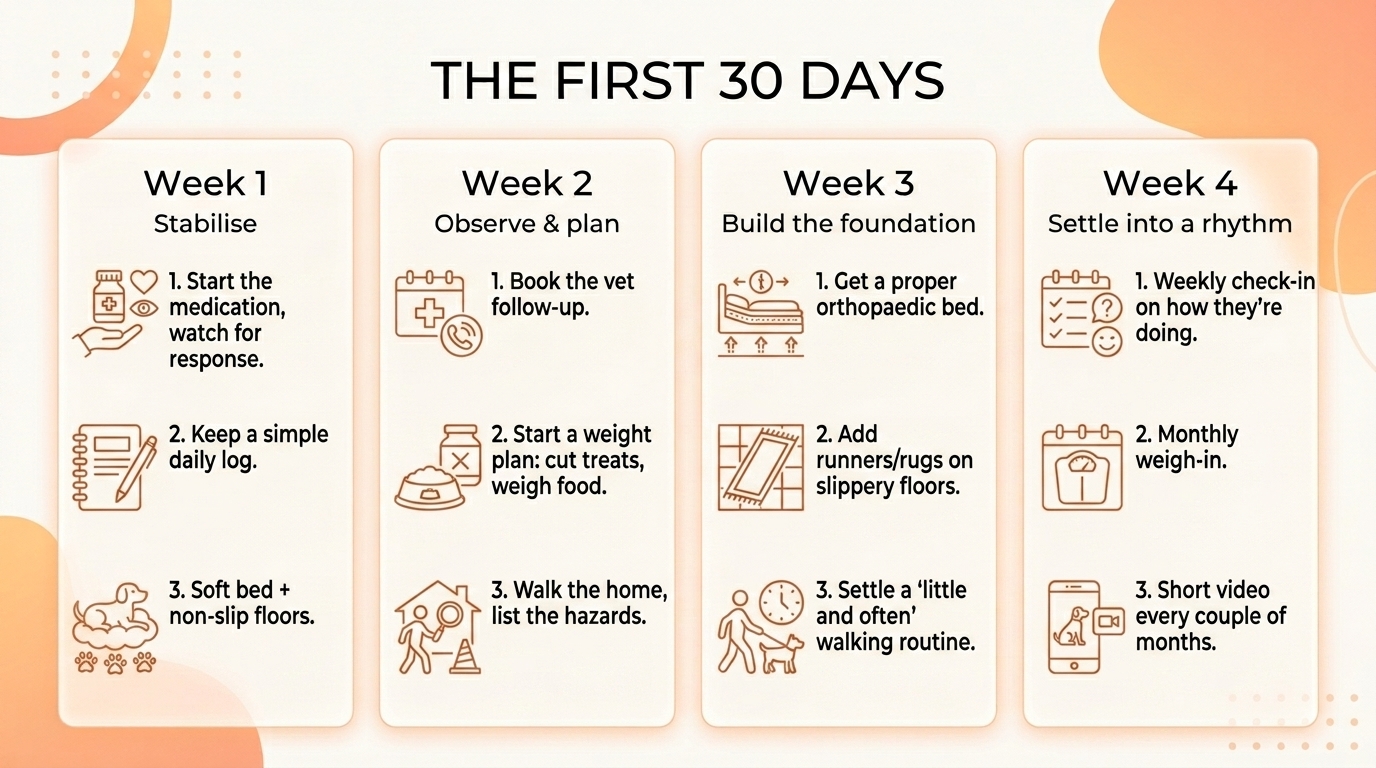
The first week is about getting your dog comfortable and getting to grips with the medication.
Start the medication and watch for response
If your vet has prescribed pain relief, start it as directed. The most common first-line medications are NSAIDs (meloxicam, carprofen, or robenacoxib) or anti-NGF therapy (Librela). Each works differently and has its own profile, which I cover in detail in our medication guide.
What to watch for in the first week:
Signs of improvement. Within three to seven days you should start to see something. Your dog might rise more easily in the morning. They might be more willing to engage with you. They might show more interest in their food, in walks, in play. The improvement is often subtle at first. You'll look back after a couple of weeks and realise how much has shifted.
Signs of side effects. Most dogs tolerate arthritis medications very well, but a small minority don't. Watch for vomiting, diarrhoea, reduced appetite, lethargy, or anything that seems unusual. Most side effects develop within the first week or two. If you see anything concerning, stop the medication and contact your vet. Don't try to push through.
No response at all. If after a week you can't see any change, that's also useful information. It might mean the dose needs adjusting, the medication needs changing, or there's something else going on. Make a note and bring it up at your follow-up.
Keep a simple log
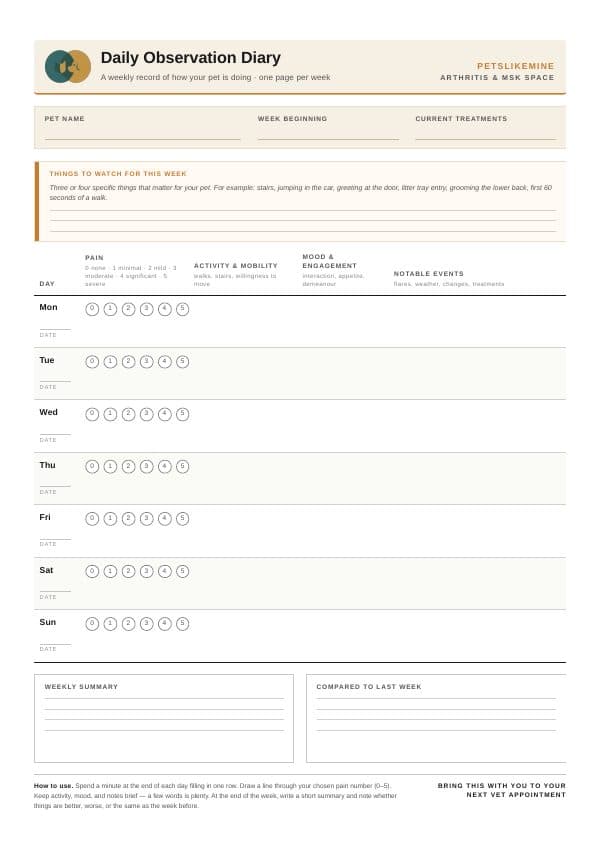
You don't need anything elaborate. A note on your phone, a page in a notebook, or our daily observation diary printed off and stuck on the fridge. Each day, jot down two or three things:
- How stiff your dog was getting up in the morning (out of 10, or just a quick descriptor)
- How they were after exercise
- Anything notable, good or bad
This serves two purposes. First, it gives you something concrete to share at your follow-up appointment. Second, it helps you spot the improvement (or lack of it) that's easy to miss when you're seeing your dog every day.
Leave the exercise alone for now
I know this seems counterintuitive. Surely you should be modifying exercise immediately? Not in week one. For now, your dog's exercise routine should stay roughly the same as it was before the diagnosis, with two exceptions:
- If your dog was clearly overdoing it before (ball-obsessed dogs who run themselves into pain, agility dogs still competing through obvious discomfort), dial that back to gentle lead walks
- If your dog seems much worse on a particular day, give them an easier day, the way you would for yourself with a flare-up of back pain
The reason to hold off on major exercise changes is that the medication needs a chance to work, and you need to see how your dog responds before deciding what exercise level is actually appropriate. Once they're comfortable on medication, the picture often looks quite different.
Set up basic comfort
Two quick wins in week one that don't require shopping or planning:
Make sure they have a soft, supportive place to sleep. If they're currently sleeping on a thin bed or a hard floor, put down extra padding. An old duvet folded twice gives a surprisingly good interim solution while you decide on a proper bed.
Address obviously slippery floors. If your dog is sliding around on laminate or tiles, put down a runner or some non-slip mats on their main routes. Slipping is one of the worst things for arthritic joints. This single intervention can make a noticeable difference within days.
That's it for week one. Medication, observation, basic comfort. Don't try to do more.
Week Two: Observe and Plan

By the start of week two, you should have a reasonable sense of whether the medication is working and how your dog is responding. This is the week to start thinking properly about the longer-term plan.
Book your follow-up
If your vet hasn't already scheduled a follow-up, book one for the end of week two or start of week three. The goal is to review:
- How your dog has responded to medication
- Any side effects
- Whether the dose needs adjusting
- Whether to consider adding adjunct treatments
- Whether blood tests are needed (often recommended after 4 weeks of NSAID therapy)
- What the medium-term plan looks like
Go with your log. Go with specific questions. Don't go in hoping your vet will magically know what to discuss.
A frank conversation about weight
If your dog is overweight, this is the single most important conversation to have. Weight loss alone, without any other intervention, can dramatically reduce arthritic pain. It's been shown to reduce or eliminate the need for medication in some dogs. It's free. And it's the one intervention with the strongest evidence base of all the things you can do.
But it's also genuinely hard. Dogs are sneaky about food, family members slip them treats, and a dog who's been in pain has often been less active and is now carrying extra weight as a result.
Have a frank conversation with your vet. Ask what your dog's ideal weight is. Ask how much they need to lose. Ask about a structured plan. Some vets offer weight clinics with a vet nurse, which can be enormously helpful for accountability and gradual change. If your vet doesn't, ask whether they can recommend resources.
For now, just two things:
- Stop or dramatically reduce treats. If treats are part of how you bond with your dog, replace them with affection, play, or a portion of their kibble counted toward their daily allowance.
- Weigh out the food rather than scooping it. Even careful scoopers are often 20-30% over the actual recommended amount.
We have a dedicated article on weight management coming up later in this series. For now, these two changes alone, made consistently, will start to shift the dial.
Walk through your home
Week two is when I'd start mentally going round your home and noting changes. Don't buy anything yet. Just notice.
- Where does your dog sleep? Is it warm, supportive, accessible?
- Where do they eat and drink? Are they having to crouch down or twist?
- Are there slippery floors on their main routes? Stairs they have to navigate?
- How do they get in and out of the car? On and off the sofa or bed?
- Where do they go to the toilet? Is the route easy?
Make a list of the issues you've spotted. Not a list of products to buy. A list of problems to solve. We'll come to solutions in week three.
Watch for the rebound
A subtle thing happens around the end of week two for many dogs. The medication kicks in, they feel better, and they suddenly want to do everything they used to do. The dog who was reluctantly limping along on walks is now charging around the garden like a puppy.
This is wonderful in one sense and slightly dangerous in another. A dog who has been in pain for months may have lost significant muscle mass and joint conditioning. Diving back into intense activity can cause flare-ups, sometimes severe ones. The medication is treating the pain. It isn't strengthening the joints.
So while your dog may feel like they can do anything, you need to be the sensible one. Build activity back up gradually. We'll work on this properly in week three.
Week Three: Build the Foundation
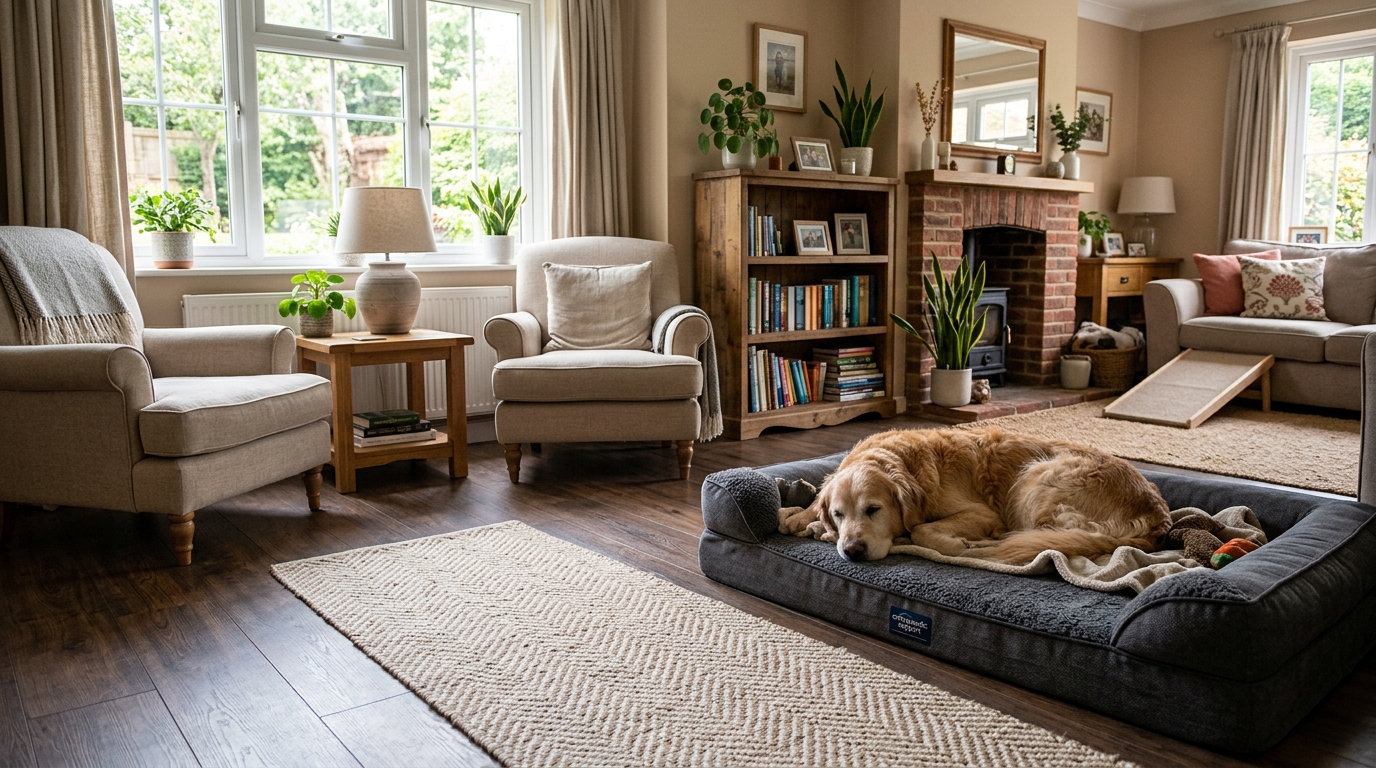
By week three, you have a stable medication routine, you've had your follow-up, you know roughly how your dog is responding, and you have a sense of what needs to change in your home and lifestyle. This is the week to start making changes.
Sort the bed
If your dog needs a proper orthopaedic bed (and most arthritic dogs do), this is the time to buy it. Don't agonise. The basics of a good orthopaedic bed are:
- Memory foam or supportive foam thick enough that your dog doesn't sink to the floor when they lie down
- Large enough for them to stretch out fully (most owners buy too small)
- Removable, washable cover
- Low enough entry that they don't have to climb in
- Non-slip base
A good one costs £60 to £150 for a medium to large dog. There are far more expensive options, and a few of them are worth it, but for most dogs the mid-range options work very well. We have an equipment guide on beds in the Arthritis & MSK space with specific recommendations.
If you've got the space and the budget, more than one bed is even better. One in the living area, one wherever they sleep at night. Many arthritic dogs benefit from having options.
Address the floors
If you have slippery floors in your home, this is one of the highest-impact, lowest-cost interventions you can make. Slipping on smooth floors:
- Causes acute pain flares
- Makes dogs anxious about moving around
- Can cause secondary injuries
- Damages confidence and increases reluctance to move at all
Solutions, in rough order of effectiveness:
Runners and rugs along the main routes. Even cheap runners from a hardware store make an enormous difference. Focus on the routes your dog uses most: kitchen to back door, hallway to living room, from bed to food bowls.
Non-slip socks or boots. These work for some dogs and not others. Worth trying if the rug solution isn't enough.
Paw grip products like ToeGrips that attach to the nails. These work well for some dogs and not for others.
Floor treatments that add grip to existing floors. More involved but useful in some homes.
You don't need to do all of these. Start with rugs and runners. If that's not enough, layer on the other options.
Get the basics of exercise right
By now you've seen how your dog responds to medication. You have a clearer picture of what they can comfortably do. This is the week to settle into a sustainable exercise routine.
For most arthritic dogs, the principles are:
Little and often beats long and occasional. Two or three shorter walks per day are usually better than one long walk. Adjust based on your dog's individual response.
Lead walks rather than free-running where possible, at least initially. Free-running dogs tend to overdo it, particularly on the first day they feel better. Controlled lead walks let you manage pace and duration.
Avoid sudden changes of direction. Ball chasing, frisbee, tug-of-war involving fast pulling. These activities load joints in ways that aggravate arthritis. They don't need to be banned forever, but during the initial settling phase they're best avoided.
Soft surfaces are better than hard. Grass, forest floor, soft sand are kinder than tarmac or concrete.
Warm up and cool down. A few minutes of slow walking at the start and end of every exercise session helps prepare and unload the joints.
A typical sustainable routine for a moderately affected medium-sized dog might be:
- Short gentle walk in the morning (10-15 minutes on lead)
- Lunchtime garden break with some gentle interaction
- Longer afternoon walk (20-30 minutes, mostly on lead, gentle pace)
- Evening garden break
Adjust up or down based on your dog's specific situation. Be guided by how they are the day after, not just during the activity itself. A dog who's fine on the walk but stiff the next morning has done too much.
Start thinking about supplements
By now your vet may have suggested some supplements, or you may have been researching them yourself. The evidence base for joint supplements is mixed (we have a dedicated article on what the evidence actually shows), but a few are worth considering.
Omega-3 fatty acids (from fish oil) have the best evidence base of any joint supplement. A good quality omega-3 supplement at a therapeutic dose can have measurable anti-inflammatory effects. Look for products specifying EPA and DHA content, not just "fish oil."
Green-lipped mussel has some reasonable evidence and is well tolerated.
Glucosamine and chondroitin are the most commonly recommended, though the evidence base is weaker than people often assume. They appear to help some dogs and not others, and they're generally safe to try.
Other supplements have weaker evidence. Don't feel obliged to spend money on multiple products. One or two well-chosen supplements at appropriate doses is much better than a kitchen shelf full of half-used pots.
Week Four: Settle Into a Rhythm

By week four, you should have:
- A working medication regime
- A comfortable bed and improved home environment
- A sustainable exercise routine
- A start on weight management if needed
- One or two evidence-based supplements (optional)
- A basic understanding of what's helping and what isn't
This week is about settling in and stepping back from the intensive management phase. You're not going to be making big changes every week from here on. You're going to be living with this condition, watching, and adjusting gently as needed.
Build monitoring into your routine
Long-term arthritis management benefits enormously from regular gentle monitoring. Not anxious checking, but mindful observation. Things to make part of your routine:
Weekly mental check-in. Once a week, take a moment to assess how your dog has been over the previous seven days. Stiffer or looser than last week? Walking the same distance comfortably? Any new behaviours that concern you?
Monthly weigh-in. If you're managing weight, weigh your dog monthly. Most vet practices offer free use of their scales. This is also a good chance to chat with the nurse and stay connected with the practice.
Photo and video every couple of months. Take a short video of your dog walking, rising from rest, and going up a step. Date it. Over time, these clips show you how things are changing in a way that day-to-day observation misses.
Some owners find a written diary works for them. Others find that drops off after the first month. If you'd like a more structured way to do the weekly check-in, that's part of what we built Sightline for. Sightline (sightline.vet) is a separate ConciergeVet tool that asks twelve to sixteen short questions a week and tracks a single composite score over time, so you can see whether the trend is improving, holding, or drifting. It produces a Sightline Report PDF that you can hand your vet at the next review.
I mention this because the underlying idea is the important bit, not the tool. The dogs who do best in the long term are the ones whose owners notice gradual change before it becomes a flare. A weekly note on your phone does that job. A structured app does it more consistently for some people. Whatever you use, the discipline of paying attention week by week is what matters.
Build a relationship with PetsLikeMine
If you haven't already, this is the time to dive into the community side of the platform. Read through other owners' stories. Post your own. Ask the questions you're not sure are silly enough to bother your vet with. Find owners whose dogs are at a similar stage to yours.
The single most valuable thing about a community like this isn't the information (you can find information anywhere). It's the realisation that you're not the only person navigating this, that other people have figured out clever solutions to problems you're encountering, and that there are good days and bad days for everyone.
Plan the next conversation with your vet
A second follow-up around 6 to 8 weeks after starting treatment is sensible for most dogs. By that point you'll have a much clearer picture of:
- Whether the current medication is doing enough
- Whether to add or change anything
- How weight loss (if applicable) is progressing
- Whether to consider adjunct therapies like hydrotherapy, physiotherapy, or acupuncture
- What blood monitoring is needed
Go in with specific observations and specific questions. The more you can articulate what's working and what isn't, the more useful the conversation will be.
What can wait beyond the first 30 days
It's worth being explicit about what isn't urgent. These are all things people sometimes rush into and then regret.
You don't need to commit to a lifetime medication plan. Pain management is dynamic. What works now may need to change later. Don't worry about "being on these tablets forever." Worry about getting your dog comfortable now.
You don't need to try every supplement. Pick one or two evidence-based options and stick with them long enough to see if they're helping (usually 6 to 12 weeks).
You don't need to buy every piece of mobility equipment. A good bed and some non-slip flooring covers most needs. Ramps, slings, harnesses, and other equipment can wait until you've identified specific needs.
You don't need to switch to a prescription joint diet immediately. Weight management and general nutrition matter more than specific joint diets in most cases.
You don't need to start hydrotherapy in week one. It's a brilliant adjunct for many dogs, but it works better once initial pain is controlled and your dog has settled.
You don't need to research every new treatment. Stem cells, PRP, monoclonal antibodies, gene therapy. These have their place, but they're not week-one decisions. Get the basics right first.
You don't need to feel guilty about exercise you did before diagnosis. Whatever happened in the past is in the past. Focus on what you're doing now.
What success looks like at 30 days
By the end of the first month, success doesn't mean your dog is symptom-free or running like a puppy. It means:
- They're more comfortable than they were
- They're getting up more easily in the morning
- They're engaging more with you and life
- You have a sustainable routine that doesn't feel overwhelming
- You're confident enough about the basics to face the next few months
- You know what to watch for and when to call the vet
- You feel less helpless than you did a month ago
If you've got those things, you're winning. The longer journey of arthritis management is built on this foundation.
References
- Marshall WG, Hazewinkel HAW, Mullen D, et al. The effect of weight loss on lameness in obese dogs with osteoarthritis. Veterinary Research Communications, 2010.
- Kealy RD, Lawler DF, Ballam JM, et al. Effects of diet restriction on life span and age-related changes in dogs. Journal of the American Veterinary Medical Association, 2002.
- Roush JK, Cross AR, Renberg WC, et al. Evaluation of the effects of dietary supplementation with fish oil omega-3 fatty acids on weight bearing in dogs with osteoarthritis. Journal of the American Veterinary Medical Association, 2010.
Free downloads
Companion worksheets to put what you've read into practice. Free PDFs, print at home.
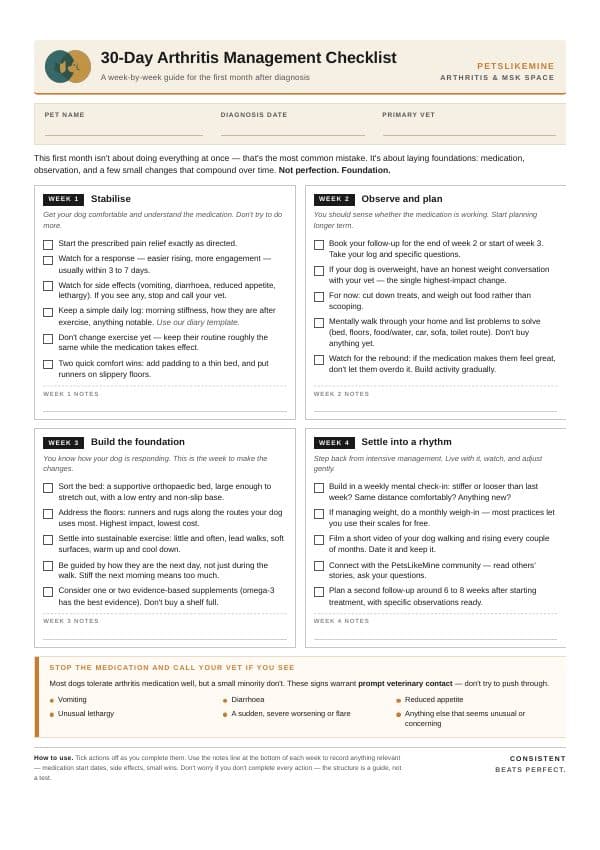
The First 30 Days: Week-by-Week Checklist
PDF · 356 KBA week-by-week guide for the first month after diagnosis. The conversations to have, the small changes to start, and the habits that compound across the years ahead.
Daily Observation Diary
PDF · 354 KBA weekly record of how your pet is doing, one page per week. The small details that compound across months: stiffness on rising, willingness on walks, mood, appetite, and the moments your gut says something's shifted.
Sister tool · Sightline
Track whether treatment is working
Sightline, a separate ConciergeVet tool, runs a short weekly check-in built on validated pain and mobility instruments, turns it into a single Sightline Score you can watch trend over weeks rather than judge on one bad day, and produces a report you can bring to your vet.
A written log, or our printable trackers, does much the same job.
See how Sightline tracks treatmentSee where your pet stands today
Tracking is the other half of managing arthritis. Take the 2-minute Mobility Check to see your pet's stage, then watch it shift as treatment takes effect.
Take the Mobility CheckYou're not doing this alone
Compare treatment journeys and talk to owners managing arthritis. Free to join.
Join PetsLikeMine