

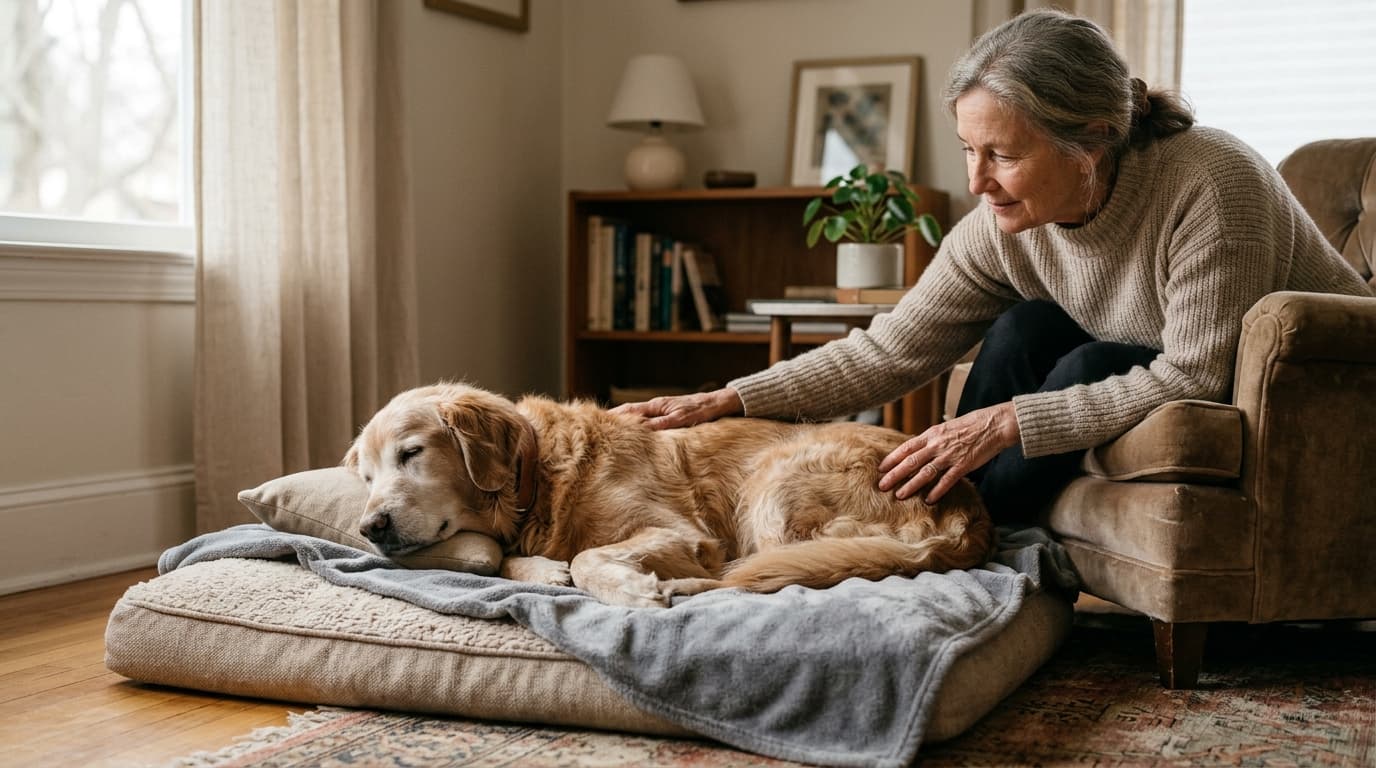
When Things Get Harder
Dr. Alastair Greenway
MRCVS, 25 years clinical experience
The earlier articles in this stage have been, for the most part, hopeful, and deliberately so. Most pets with arthritis live well for a long time, and the bulk of the journey is the long, manageable middle we've been describing. I stand by all of that.
It wouldn't be truthful to leave it there, though. Arthritis is a progressive condition, and for many pets there comes a time, often years down the line, when the management that worked so well starts to lose ground. The good days become a little less good. The bad spells last a little longer. The things that helped don't help quite as much as they once did. This article is about that time, when things get harder, and about facing it squarely without rushing to despair.
I want to be careful in how I write this, because there are two opposite mistakes owners make at this stage, and both cause harm. One is to miss the change entirely, to keep going as before while the pet slips, because the decline is gradual and the owner is so close to it. The other is to catastrophise, to read every bad week as the beginning of the end and tip into a grief that arrives long before it needs to. The wise path runs between those two, and this article is about finding it.
Bad patch, or a real change?

The first and most important skill at this stage is telling a normal bad spell apart from a true change in the underlying condition. The two can feel identical in the moment, and confusing them leads to a lot of unnecessary fear and, sometimes, premature decisions.
As we discussed in the article on living well, arthritis naturally waxes and wanes. A bad few days, or even a bad couple of weeks, is part of the normal rhythm. The hallmark of a bad patch is that it resolves: the pet returns to their previous baseline, the level they were at before the dip. Bad patches are upsetting but, in themselves, not a cause for alarm. They pass.
A genuine change is different. It's a shift in the baseline itself that doesn't resolve. The pet settles at a new, lower level and stays there, or continues gradually downward, rather than bouncing back. This is the thing to watch for, and it's precisely why the monitoring we've encouraged matters so much. An owner who has been tracking, even loosely, can look back over weeks and months and see whether they're looking at noise that returns to baseline, or a true downward step that holds. An owner relying on memory and impression often can't, because the decline is slow and the mind adjusts to it day by day.
So the practical advice is this. When things seem harder, resist both the urge to dismiss it and the urge to panic. Look at the trend over weeks. Use your records. And if the baseline has genuinely shifted and stayed shifted, that's the signal to act, not by giving up, but by going back to your vet.
Going back to the vet is not the end of the road
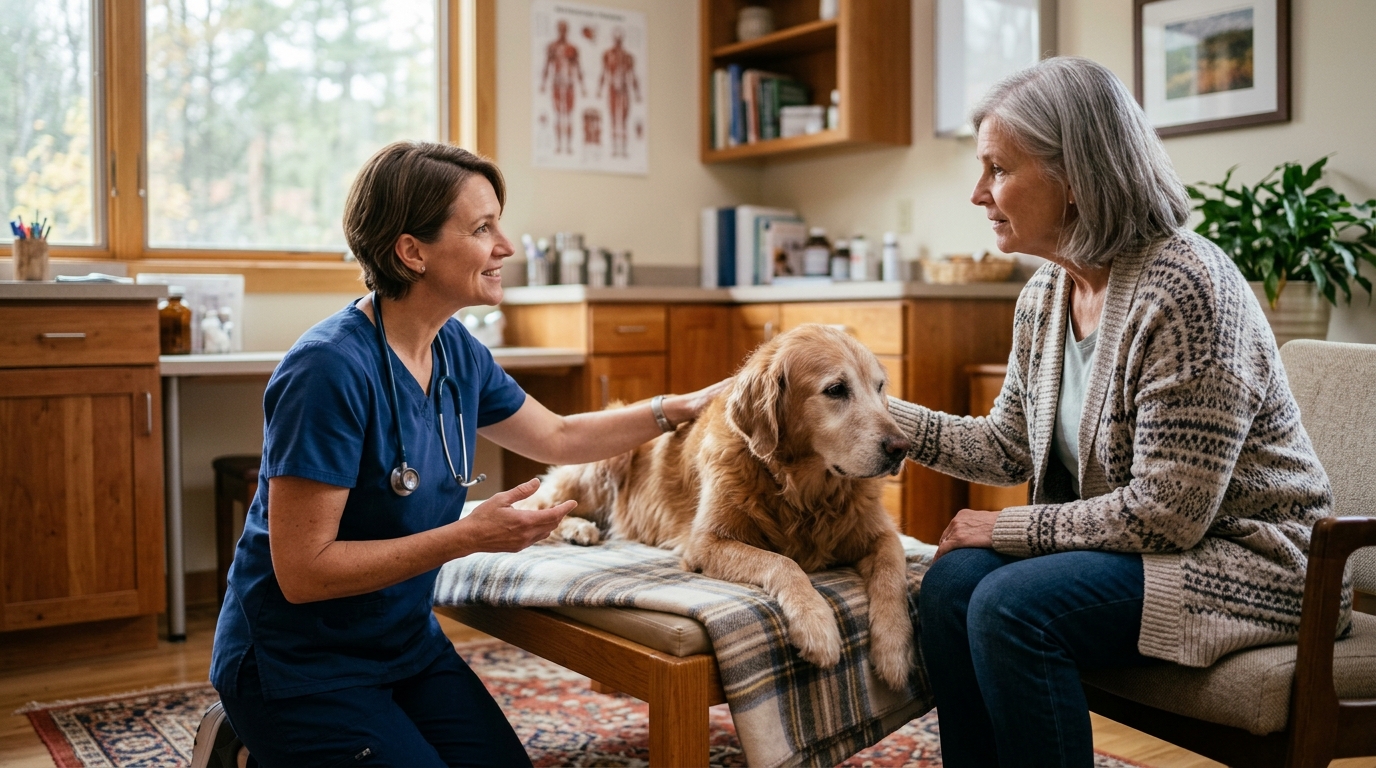
When the baseline shifts, the right response is a conversation with your vet, and I want to frame what that conversation actually is, because owners often dread it as the moment they'll be told there's nothing more to do.
That's almost never what happens. A decline in a previously well-managed pet usually means the management plan needs revisiting, not abandoning. There is very often more that can be done. The medication may need adjusting, or a new one adding to the combination. We talked in the medication articles about how arthritis pain is managed in layers, each acting on a different part of the problem; when one layer is no longer enough, another can often be added. Referral to a specialist or a pain clinic, which the dedicated article in this stage describes, opens up a further tier of options that general practice doesn't offer. Therapies can be intensified. The home can be adapted further.
The point is that "things are getting harder" is usually a prompt to escalate care, not to stop it. The conversation with your vet at this stage is a working one: what's changed, what can we adjust, what haven't we tried. Approached that way, it's far less frightening than the conversation owners imagine, and it frequently buys a pet a good further stretch of comfortable life.
Adapting further as needs change

Alongside the medical escalation, the practical side of care usually needs to step up too, and doing so thoughtfully can make a real difference to a pet who is finding things harder.
The home modifications you made earlier may need extending. The dog who managed the ramp may now need the bed moved downstairs entirely. The cat who coped with one low-sided litter tray may need several, placed closer together. Walks may need to become shorter and gentler again. The routine may need to slow further. None of this is defeat. It's the same responsive, adaptive care you've been providing all along, simply tuned to where your pet is now.
This is also the stage where the enrichment we discussed becomes more important, not less. As physical capacity narrows further, the mental and emotional life matters even more to a pet's wellbeing. A pet doing less should not mean a pet experiencing less. Keep their world rich within whatever their body can now manage.
And keep paying attention to comfort above all. At this stage, the central question of care gradually shifts. Earlier, much of the focus was on maintaining function and activity. As things get harder, the priority moves increasingly toward comfort and quality of life, toward ensuring that the days, whatever the pet can or can't do in them, are good days. That shift in emphasis is a natural and appropriate part of the journey.
Beginning to hold the bigger question
There comes a point, as things get harder, when it becomes right to begin holding a bigger question gently in mind: not yet "is it time," but "how is their quality of life, really?"
I choose those words carefully. I'm not saying that things getting harder means the end is near. For many pets, a hard patch leads to a revised plan and a good further chapter. What I am saying is that this is the stage where it becomes wise to start thinking clearly about quality of life as the central measure, rather than waiting until a crisis forces the question all at once.
Holding the question early, gently, and without panic is a kindness to both of you. It means you're paying the right kind of attention. It means that if the day does eventually come when quality of life is genuinely in question, you'll have been watching closely rather than looking away, and you'll be able to think clearly rather than being ambushed. Starting to ask "how is their quality of life?" isn't giving up on your pet. It's taking the responsibility of loving them seriously, all the way through.
The next article in this stage is devoted entirely to that question, to how to think about quality of life clearly and what frameworks can help. If things are getting harder for your pet and that's why you're here, please know that thinking about these things doesn't bring them closer. It simply means you're facing the journey with open eyes and a loving heart, which is all any of us can do for them.
Free downloads
Companion worksheets to put what you've read into practice. Free PDFs, print at home.
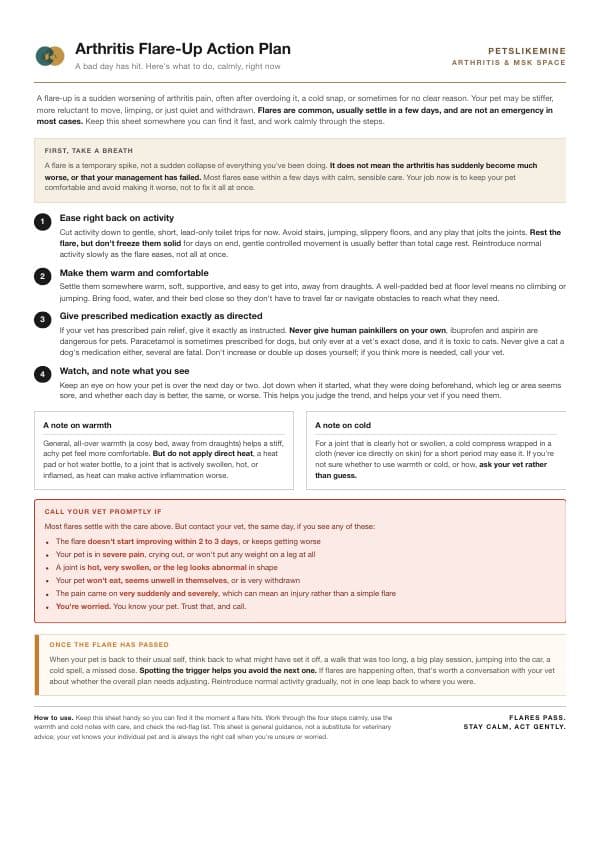
Arthritis Flare-Up Action Plan
PDF · 139 KBWhat to do when arthritis suddenly worsens. A calm, step-by-step plan for the first few days of a flare: ease back, keep them comfortable, give prescribed medication exactly as directed, and watch for the red flags that mean call the vet today. Flares are common and usually pass.
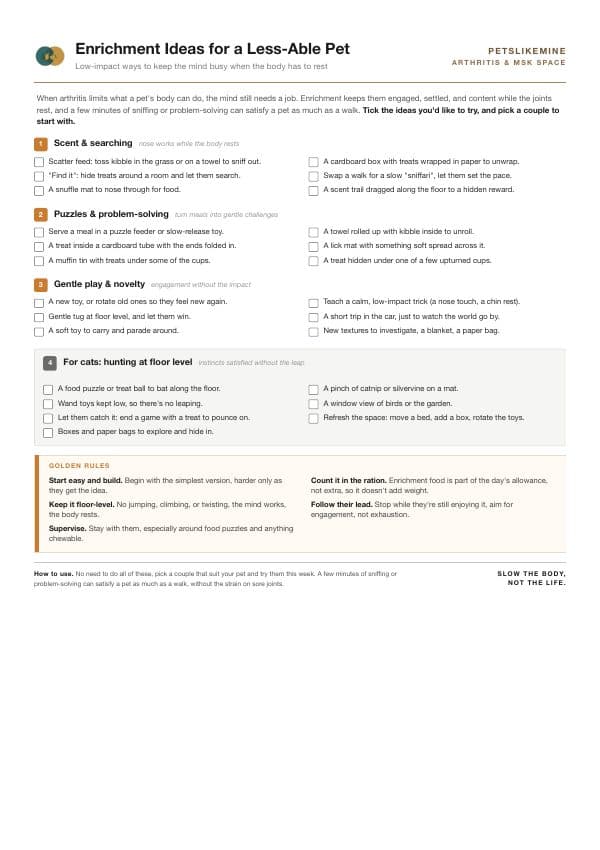
Enrichment Ideas for a Less-Able Pet
PDF · 124 KBA menu of low-impact ways to keep a pet's mind busy when arthritis limits the body. Scent work, puzzle feeders, gentle play, and a full feline section, mostly free and all at floor level. Tick what you'd like to try. Slow the body, not the life.
Sister tool · Sightline
Track whether treatment is working
Sightline, a separate ConciergeVet tool, runs a short weekly check-in built on validated pain and mobility instruments, turns it into a single Sightline Score you can watch trend over weeks rather than judge on one bad day, and produces a report you can bring to your vet.
A written log, or our printable trackers, does much the same job.
See how Sightline tracks treatmentSee where your pet stands today
Tracking is the other half of managing arthritis. Take the 2-minute Mobility Check to see your pet's stage, then watch it shift as treatment takes effect.
Take the Mobility CheckYou're not doing this alone
Compare treatment journeys and talk to owners managing arthritis. Free to join.
Join PetsLikeMine