


What to Avoid: Misinformation, Myths and Marketing
Alastair Greenway
BVM&S MRCVS
Owners of pets with arthritis are a marketing target. I want to say that plainly at the start, because once you see it, you can protect yourself and your pet from a great deal of wasted money and occasional genuine harm.
The logic is simple and a little cynical. You have a beloved animal with a chronic, incurable, sometimes painful condition. You are motivated, often anxious, and willing to spend to help. You are exactly the customer that sellers of miracle cures, unproven supplements, and subscription gadgets are looking for. The result is a marketplace awash with products and claims, some legitimate and useful, many useless, and a few actively harmful.
This article is about navigating that marketplace with a clear head. It covers the common myths that lead owners astray, the marketing tactics worth recognising, and a simple method for judging clearly whether something is actually working for your pet. None of this is about being cynical for its own sake. It is about spending your money and your hope where they will do your pet the most good.
Myths worth unlearning

Several persistent myths shape how owners approach arthritis, usually for the worse. Clearing them away is the foundation for good decisions.
"It's just old age." This is the most damaging myth of all, because it leads to nothing being done. Arthritis is a disease, not a synonym for ageing. Slowing down is not an inevitable consequence of years that owners simply have to accept. It is usually a sign of a treatable condition causing pain. A dog who is "just getting old" is very often a dog in pain who could feel substantially better with treatment. The belief that nothing can or should be done is wrong, and it costs animals years of comfort.
"Exercise makes it worse, so rest is best." Understandable, but mistaken. Appropriate, controlled exercise is part of good arthritis management, not the enemy of it. Movement maintains the muscle that supports the joints and keeps the joints themselves mobile. Too much, or the wrong kind, certainly causes a flare, but the answer is the right amount of the right exercise, not cage rest. A pet wrapped in cotton wool and discouraged from moving will deteriorate faster, not slower.
"Nothing can really be done, it only goes one way." Arthritis cannot be cured, and it is broadly progressive, both true. But the leap from there to "nothing can be done" is false and defeatist. A great deal can be done: weight management, exercise, pain relief, home modifications, therapies, and more, often producing dramatic improvements in comfort and mobility. Managed well, many arthritic pets live comfortably for years. Progressive does not mean untreatable.
"If my pet were really in pain, they'd cry out or limp obviously." Particularly dangerous for cats, but true of dogs too. Animals are evolved to hide pain, and chronic pain in particular rarely announces itself with yelping. It shows in subtle changes: reluctance, stiffness, reduced activity, behaviour shifts, a cat that grooms less or stops jumping. The absence of obvious distress is not the absence of pain.
"Supplements and natural products can't do harm, so they're worth a try." "Natural" does not mean safe, effective, or regulated. Some supplements interact with medications, some are contaminated or mislabelled, and almost all are far less rigorously tested than licensed drugs. More to the point, money spent on an ineffective supplement is money not spent on something that works, and time spent hoping a supplement will help is time a painful animal spends waiting. Worth a try is not a neutral act.
Spotting the sell
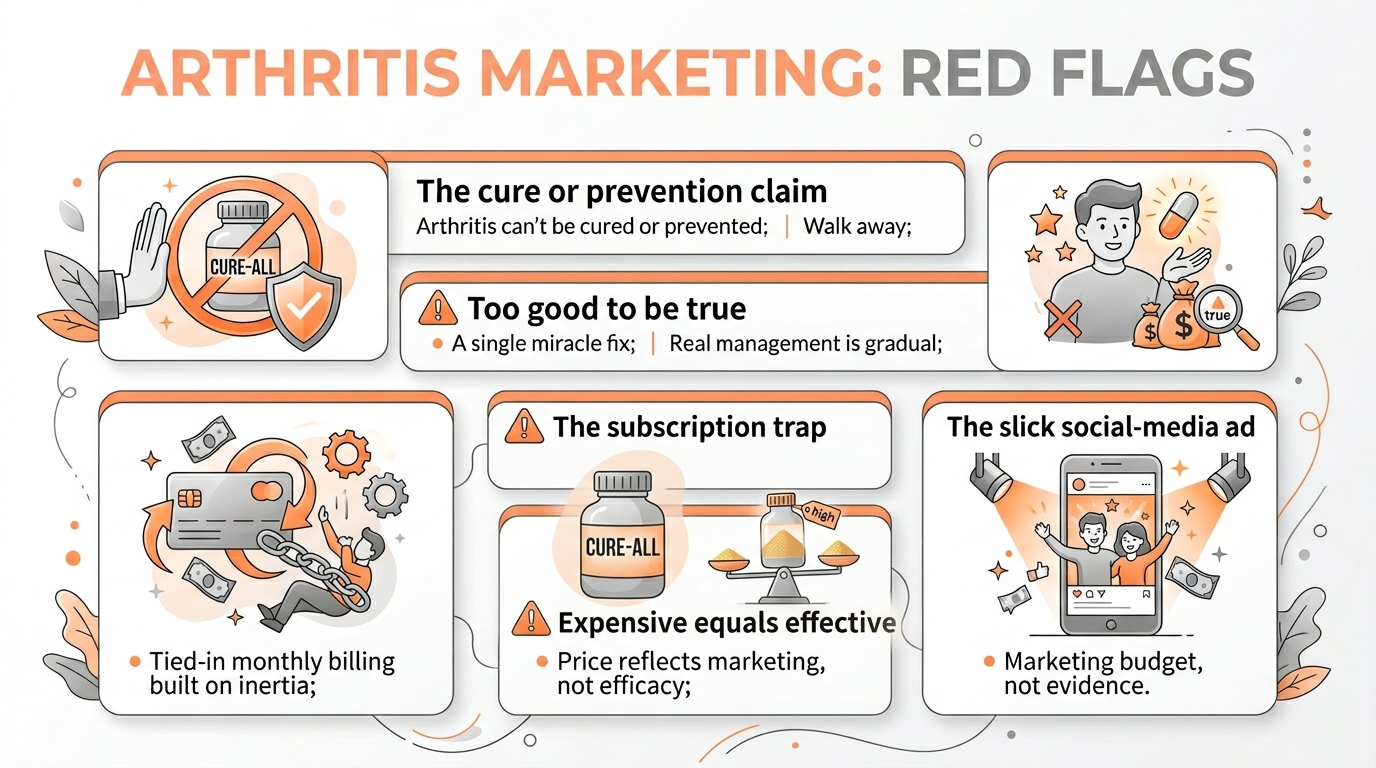
Beyond the myths sit the active sellers, and their tactics are recognisable once you know them.
The cure or prevention claim. This is the brightest red flag of all. Arthritis cannot currently be cured or prevented. Any product claiming to do either is, straightforwardly, making a claim that is not true. Walk away. A legitimate product helps manage the condition or relieve symptoms; it does not promise to cure or reverse it.
Too good to be true. The miracle device, the single supplement that transforms everything, the dramatic before-and-after testimonial. If it sounds too good to be true, it is. Real arthritis management is a combination of unglamorous measures producing gradual, modest, cumulative improvement. Anything promising a single dramatic fix is selling hope, not help.
The subscription trap. Be wary of products that tie you into an ongoing monthly subscription, particularly those marketed heavily on social media. The business model is built on inertia, on you continuing to pay long after you've stopped paying attention to whether it's working. A product confident in its value lets you buy it as you need it.
Expensive equals effective. It does not. Price is set by marketing and margins, not by efficacy. Some of the most effective interventions in arthritis, weight management and appropriate exercise, cost nothing. Some of the most expensive products do very little. Do not let a high price persuade you that something must be working.
The well-marketed social media ad. The slick video, the emotional testimonial, the urgency, the influencer endorsement. None of these is evidence. The quality of the marketing tells you about the marketing budget, not the product. Be especially sceptical of anything that arrives in your feed designed to make you feel that a good owner would buy it.
A reasonable rule of thumb: before spending on anything new, ask your vet or therapist. Not because they know every product, but because they can tell you whether the underlying idea has any basis, and they have no commission riding on your decision.
How to actually tell if something is working

This is what owners most often get wrong. Suppose you do decide to try something new, a supplement, a device, a therapy. How do you tell for certain whether it is helping? Because if you can answer that, you can cut through almost all the marketing on your own.
The problem is that arthritis naturally waxes and wanes. It has good spells and bad spells on its own, for reasons that have nothing to do with anything you've added. That makes judging a new intervention genuinely tricky, because the human mind is primed to see cause and effect where there may be only coincidence. It isn't a personal failing. It is so well documented that it has a name. In one study of dogs with arthritis given a dummy treatment, owners judged their dogs to have improved about 40% of the time, and vets examining the same dogs were fooled at a similar rate. We are all susceptible to it, which is exactly why a method matters.
Picture the common trap. Your dog has a bad week. Worried, you order a heavily advertised supplement. It arrives, you start it, and within days your dog is moving better. The supplement works! Except, your dog was having a bad spell, and bad spells end on their own. The improvement was very likely the natural upswing that was always coming. The supplement just happened to be there when it arrived, and now you'll pay for it for years, crediting it for something it didn't do. This is exactly how ineffective products build loyal customers.
To judge fairly, do three things.
First, get baseline data before you start. Spend a week or two recording how your pet actually is, before adding the new thing. Use a diary, the monitoring tools in this space, whatever captures the reality rather than your impression. Without a baseline, you are comparing the new state against a memory, and memory is unreliable and easily swayed by hope.
Second, judge over the long term, not the short. Because of the natural waxing and waning, short-term changes tell you almost nothing. Give a fair trial over weeks, and look at the overall trend across that time, not the first few days. A genuine effect shows as a sustained shift in the baseline, not a brief improvement that could be the disease's own rhythm.
Third, ideally change one thing at a time. If you add three new things at once and your pet improves, you've no idea which helped, and you may end up paying for two useless ones forever. Introduce changes one at a time where you can, so the trial actually tells you something.
This method, baseline first, judge over the long term, change one thing at a time, is the single most powerful tool you have against the entire marketing machine. It lets you find out for yourself whether something earns its place in your pet's care. Our Daily Observation Diary, and the structured weekly tracking in Sightline (sightline.vet), a separate ConciergeVet tool, are built to support exactly this kind of objective trial. Used well, they will save you money, protect your pet from useless or harmful products, and tell you which of the things you try are genuinely worth keeping.
Where to put your money instead
Most of what genuinely helps an arthritic pet is unglamorous and either cheap or free: keeping them lean, the right exercise, a comfortable home, the medication your vet prescribes, the therapies with real evidence behind them. The marketplace of miracle products exists not because those products work, but because the real answers are undramatic and the owners are motivated and worried.
References
Sister tool · Sightline
Track whether treatment is working
Sightline, a separate ConciergeVet tool, runs a short weekly check-in built on validated pain and mobility instruments, turns it into a single Sightline Score you can watch trend over weeks rather than judge on one bad day, and produces a report you can bring to your vet.
A written log, or our printable trackers, does much the same job.
See how Sightline tracks treatmentSee where your pet stands today
Tracking is the other half of managing arthritis. Take the 2-minute Mobility Check to see your pet's stage, then watch it shift as treatment takes effect.
Take the Mobility CheckYou're not doing this alone
Compare treatment journeys and talk to owners managing arthritis. Free to join.
Join PetsLikeMine