

Weight Management: The Single Most Effective Thing You Control
Alastair Greenway
BVM&S MRCVS
If I could give only one piece of advice to the owner of an overweight arthritic dog, it would be this: get the weight off, and the rest gets easier.
Not the supplements. Not the next medication. Not the new bed or the ramp or the daily physiotherapy. Weight loss. It's the most underrated, most powerful, and most consistently effective intervention available to you, and it costs nothing but discipline.
It works so well because excess weight in an arthritic dog is hurting them twice. Once mechanically, with every step loading already-damaged joints with forces they shouldn't have to bear. And once chemically, because fat tissue releases inflammatory substances that worsen the underlying joint inflammation. You're solving two problems with one intervention, and few things in medicine offer that ratio of effort to outcome.
This article is about doing it properly. Not crash dieting, which is dangerous. Not throwing in the towel because previous attempts have failed. Not feeling guilty about how your dog got here in the first place. A sensible, sustainable approach that genuinely works, and a clear-eyed look at why this is harder than it should be.
If your arthritic dog is overweight and you've been putting this off, I hope this is what makes you start. Not next month. Not after the holidays. This week. Because every day your dog carries excess weight is a day they're in more pain than they need to be.
The evidence is unusually compelling
Most things in veterinary medicine are debated. Weight management in arthritic dogs isn't really one of them. The evidence is consistent across multiple studies and several decades.
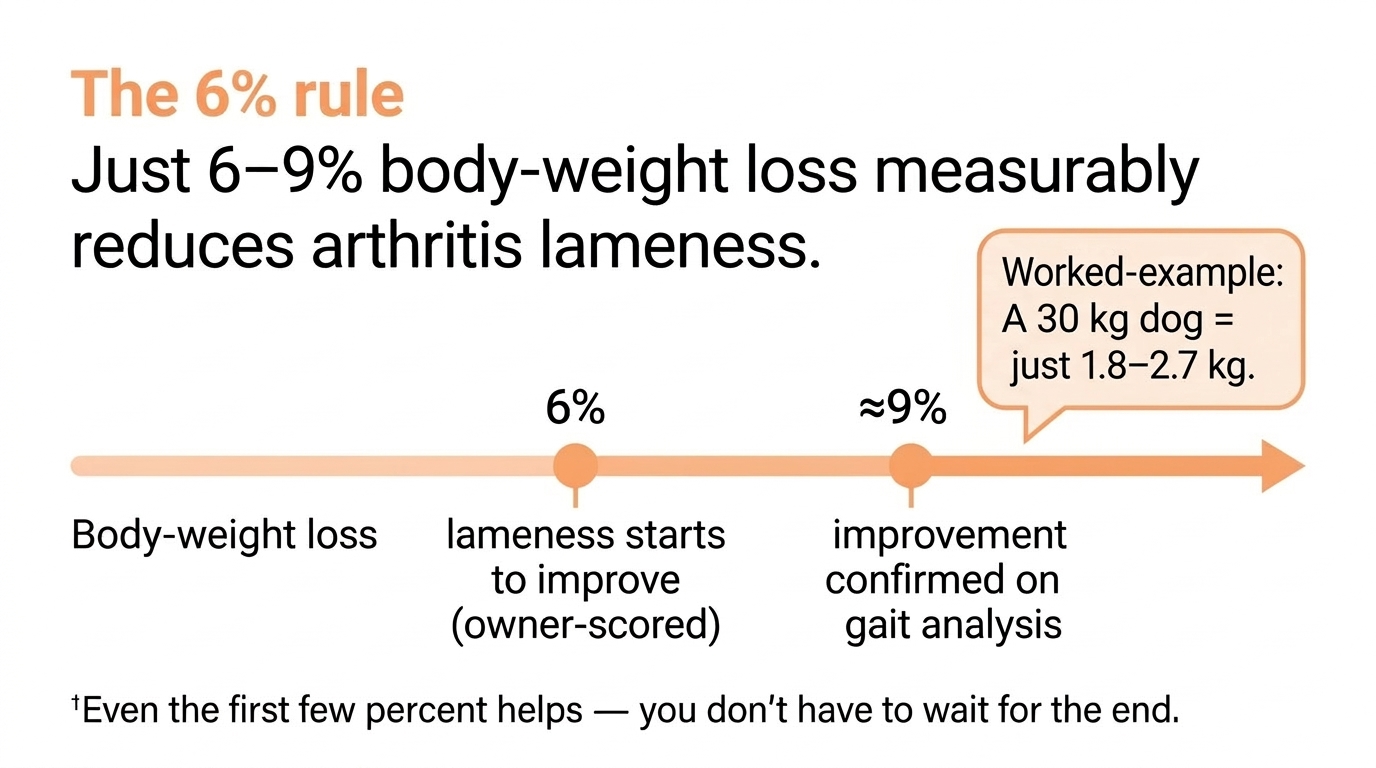
A landmark 2010 study by Marshall and colleagues examined obese dogs with osteoarthritis on a structured weight loss programme. They measured lameness using both subjective owner scoring and objective kinetic gait analysis, which measures the actual forces the dogs were putting through their legs. The results showed that body weight reduction produced a significant decrease in lameness from around 6% weight loss onwards, with the objective gait analysis confirming improvement from around 9% onwards. This wasn't subtle. These were measurable improvements in how the dogs were moving.
A small 2000 JAVMA study by Impellizeri and colleagues looked at nine dogs with hindlimb lameness from hip osteoarthritis on a weight loss programme. The dogs lost between 11% and 18% of their initial body weight, and their lameness was substantially improved by the end of the programme. The sample size is small, but the direction of effect lines up with everything else.
The longer-term picture comes from a 14-year longitudinal study of Labrador Retrievers (Kealy and colleagues), where one group was maintained at a lean body condition (around 4-5/9) and the other at a heavier condition (around 6-7/9). The lean dogs developed arthritis and other chronic diseases roughly two years later than their heavier siblings. Same genetics, same parents, same general environment. The lean dogs simply lived healthier for longer.
What does all this mean in practice? Even modest weight loss (6 to 9% of body weight in an overweight dog) produces clinically significant improvements in arthritis pain. That's the equivalent of a 30kg Labrador losing 1.8-2.7kg. It's an achievable target. And the improvement isn't subtle. It often allows dogs to reduce their pain medication, exercise more comfortably, and engage with life in ways they couldn't when they were carrying the excess weight.
This is one of the few interventions where the science really is settled.
Why fat hurts twice
To understand why weight loss is so powerful, it helps to understand the two ways excess weight worsens arthritis. The mechanical aspect is intuitive. The chemical aspect is less well known but equally important.
The mechanical problem
Picture an arthritic joint as a damaged hinge. Every time the joint moves and bears weight, the damaged surfaces grind against each other. The cartilage, already worn, takes another small amount of damage. The joint capsule, already inflamed, gets a fresh insult. The bone underneath, already remodelling abnormally, accumulates more stress.
Now picture that hinge having to deal with 20% more force on every single movement. Every step, every rise from rest, every walk, every greeting at the door. The accumulated wear over a year, a month, even a week, is dramatically worse than it would be at a normal weight.
This isn't a small effect. The forces through a dog's joints during normal activity can be 2-3 times their body weight, and during running or jumping considerably more. Adding 20% to that base load multiplies the damage. It's not linear; it's compounding.
That's why weight loss alone, with no other change, can produce measurable improvements in arthritis pain. You're not curing anything. You're reducing the mechanical insult that the joint receives on every movement.
The chemical problem
Here's the part most owners don't know about, and it changes how you think about excess weight in an arthritic dog.
Fat tissue used to be thought of as inert storage. Just inactive padding. We now know it's nothing like that. Fat tissue, particularly visceral fat (the fat around abdominal organs), is metabolically active. It produces hormones and inflammatory signalling molecules that circulate throughout the body.
The specific molecules involved include adipokines (like leptin and adiponectin), pro-inflammatory cytokines (like TNF-alpha and IL-6), and various other inflammatory mediators. Together, these create what's called a chronic low-grade inflammatory state. The body is, in effect, slightly inflamed all the time.
For an arthritic dog, this is a disaster. Arthritis is fundamentally a disease of joint inflammation. The body is already producing inflammatory chemicals at the affected joints. Now add a constant background of additional inflammation from the fat tissue. The whole system is dialled up. Pain is worse. Damage progresses faster. Medications work less effectively because they're fighting more inflammation.
When you reduce the fat tissue, you reduce this systemic inflammatory load. The body becomes a less hostile environment for the joints. Pain settles. Damage slows. Medications work better.
This is why weight loss in an arthritic dog often produces improvements that seem disproportionate to the amount lost. You're not just reducing the mechanical load. You're reducing the inflammatory drive that's making everything worse.
Recognising the problem
Before we get into solutions, there's a hard truth to confront. Most owners of overweight dogs don't know their dogs are overweight.
UK and US studies have consistently found that around 55% of dog owners with overweight dogs do not realise their dogs are overweight. They look normal because we've adjusted our visual reference for what a normal dog looks like, and that reference has drifted heavier over the years. Dog food packets show pictures of plump, glossy dogs that look healthy to most people but are actually overweight. Vets often soften the message because they don't want difficult conversations.
So we have a population of dogs where over half the obese ones aren't recognised as obese by the people who love them.
If you're uncertain whether your dog is overweight, that's a good starting position. The realistic answer for most arthritic dogs is "probably yes, at least a bit." The next step is to actually assess it properly.
Body condition scoring: how to do it
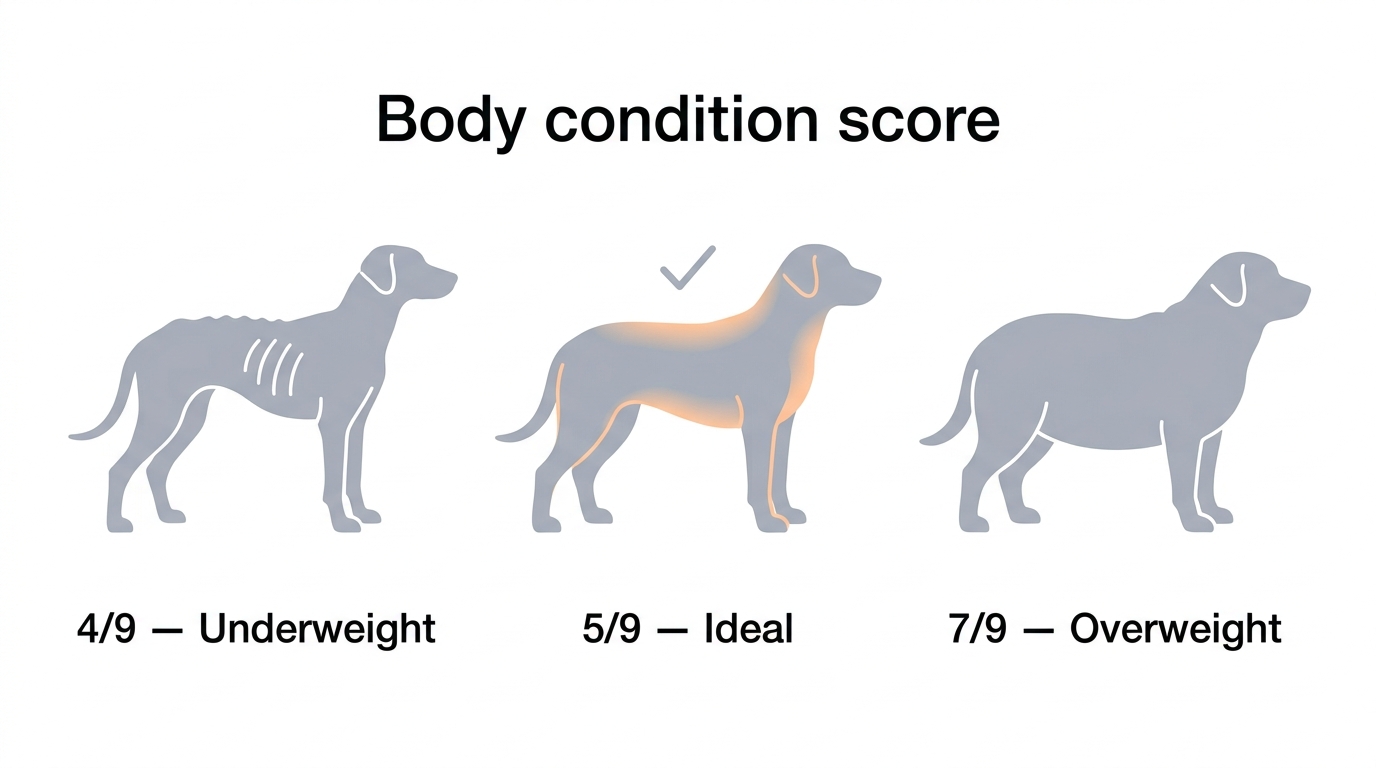
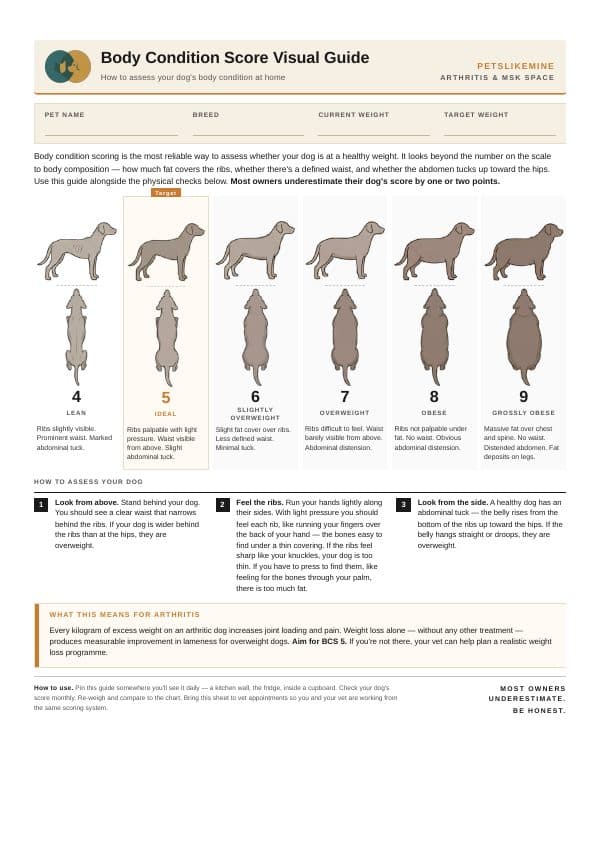
Body condition scoring is the standard veterinary method for assessing a dog's body condition independently of breed or absolute weight. It works on a 9-point scale (some systems use 5-point; we'll stick with 9 for clarity).
| Score | Description |
|---|---|
| 1/9 | Emaciated: ribs, lumbar vertebrae, and pelvic bones easily visible. No discernible body fat. Obvious loss of muscle mass. |
| 2/9 | Very thin: ribs and pelvic bones easily visible. No palpable fat. Minimal muscle mass. |
| 3/9 | Thin: ribs easily palpated with no fat covering. Tops of lumbar vertebrae visible. Pelvic bones prominent. Obvious waist. |
| 4/9 | Underweight: ribs easily palpated with minimal fat. Waist easily noted, viewed from above. Abdominal tuck evident. |
| 5/9 | Ideal: ribs palpable without excess fat covering. Waist observed behind ribs when viewed from above. Abdominal tuck evident. |
| 6/9 | Overweight: ribs palpable with slight excess fat covering. Waist discernible viewed from above but not prominent. Abdominal tuck apparent. |
| 7/9 | Heavy: ribs palpable with difficulty; heavy fat cover. Noticeable fat deposits over lumbar area and base of tail. Waist absent or barely visible. No abdominal tuck. |
| 8/9 | Obese: ribs not palpable under very heavy fat cover or palpable only with significant pressure. Heavy fat deposits over lumbar area and base of tail. Waist absent. No abdominal tuck. Obvious abdominal distension may be present. |
| 9/9 | Severely obese: massive fat deposits over thorax, spine, and base of tail. Waist and abdominal tuck absent. Fat deposits on neck and limbs. Obvious abdominal distention. |
The target for any healthy dog is 4-5/9. For an arthritic dog, you absolutely want them at this lean end of the scale. A 6/9 is overweight enough to be making the arthritis materially worse. A 7/9 or above is significantly compromising their treatment.
How to actually do the assessment
Three things to do, ideally with someone else to help observe:
1. Hands-on rib check. Run your hands gently along your dog's sides over their ribs. Use the kind of pressure you'd use to feel the back of your own hand. You should be able to feel each rib clearly, with just a thin layer of fat covering. If you have to push hard to feel ribs, your dog is too heavy. If you can see the ribs clearly through the coat, they're too thin.
2. View from above. With your dog standing, look down on them from directly above. You should see a clear waist behind the ribcage, with the body narrowing distinctly before widening again at the hips. If the body is straight-sided or, worse, wider at the waist than the ribcage, your dog is overweight.
3. View from the side. Look at your dog from the side. You should see a clear abdominal tuck, with the belly line rising from the bottom of the ribcage up toward the back legs. If the belly line is flat or sags down, your dog is overweight.
Combining all three views gives you a much more accurate assessment than any one alone. Take photos. Repeat the assessment monthly. The visual record over time is more reliable than your day-to-day perception.
Our BCS visual guide puts the 1-9 scale on a single page with side-on and top-down silhouettes for each score, so you can pin it on the fridge and check against the same reference each month.
If you're not sure, your vet practice can do this assessment for you, often as a free nurse appointment. Asking for an objective body condition score is one of the most useful five-minute conversations you can have.
Don't trust breed standards
A common mistake is to compare your dog to the "ideal weight" for their breed. Don't.
Breed standard weights are averages, often based on dogs that themselves were overweight by current standards. They don't account for individual frame size, muscle mass, or skeletal proportions. Two Labradors of the same height can have ideal weights that differ by 4-5kg depending on their individual conformation.
The body condition score is breed-independent. A lean Labrador might weigh 28kg or 35kg depending on their individual frame. The number doesn't matter. The body condition does.
This is also why pet food packet recommendations are often wrong for individual dogs. The "feed 320g per day for a 30kg dog" calculation assumes a standard activity level and metabolism that may not match your specific dog at all. Use the body condition score, not the packet, to decide how much your dog actually needs.
Setting a realistic target
Once you've established that your dog is overweight (whether mildly at 6/9 or seriously at 8/9 or above), the question is how much weight needs to come off and how quickly.
How much?
For arthritis purposes, getting your dog to a 4-5/9 body condition is the goal. The exact weight that represents this depends on your individual dog, but a useful rough guide:
| Current BCS | Approximate weight to lose |
|---|---|
| 6/9 | 10-15% of current body weight |
| 7/9 | 15-25% of current body weight |
| 8/9 | 25-35% of current body weight |
| 9/9 | 35%+ of current body weight |
So a 30kg Labrador at body condition 7/9 would need to lose roughly 4.5-7.5kg to reach ideal. That's a significant project, but it's also entirely achievable over 6-12 months with a sensible plan.
Even getting partway there matters. Remember, the evidence shows meaningful clinical improvement from 6-9% weight loss. If your dog needs to lose 20%, the first 6% already produces real benefit. You don't have to wait for the end of the programme to see results.
How quickly?
Slow and steady. Always.
The recommended rate of weight loss for dogs is about 1-2% of body weight per week. So a 30kg dog losing 300-600g per week is on target. Faster than this risks several problems: muscle loss alongside fat loss, hunger that makes the regime unsustainable, and metabolic adaptation that makes ongoing loss harder.
A 4.5kg target on a 30kg dog at 1.5% per week is roughly 10-12 weeks. A 7kg target would be 16-18 weeks. These are realistic timeframes for the project, not weeks.
Setting weekly targets is much more useful than thinking about the total. "We need to lose 500g this week" is actionable. "We need to lose 7kg" is overwhelming.
Cats are different
A note for the cat owners reading this. Weight loss in cats follows different rules. Cats should never be put on rapid weight loss programmes because they're at risk of a serious condition called hepatic lipidosis (fatty liver disease), which can be fatal. Feline weight loss should be slow (0.5-1% per week maximum) and ideally supervised by a vet. For an arthritic cat, the principles are the same as for dogs, but the execution needs more caution.
Building a programme that actually works
The theory is easy. The execution is where most owners fail. Let me give you a practical framework that genuinely works.
Step 1: Get a baseline
Before you change anything, measure where you are.
- Weigh your dog precisely. Most vet practices have walk-in scales you can use for free.
- Body condition score them properly.
- Take front, side, and top-down photographs.
- Note current daily food intake (be straight with yourself about treats, table scraps, and "training rewards").
- Date everything.
You'll come back to this baseline. The early weeks of weight loss can be discouraging because changes are small. Having clear baseline data lets you see progress that day-to-day observation misses.
Step 2: Calculate the actual food requirement
Work out how much your dog should actually be eating, not how much they currently are. The most reliable approach is:
For weight maintenance at ideal weight, most adult dogs need roughly 50-65 kcal per kg of ideal body weight per day for sedentary dogs, more for active dogs. So a Labrador whose ideal weight is 28kg needs roughly 1,400-1,800 kcal/day to maintain that weight.
For weight loss, reduce that by 20-30%. So our Labrador would be on roughly 1,000-1,400 kcal/day during weight loss.
Now look at the calories per 100g on the food packet. Calculate the actual grams of food this represents. You'll often find it's significantly less than you've been feeding.
For an arthritic dog who's exercising less than they used to, the calculation may be even lower because their daily energy expenditure is reduced compared to when they were fully active.
If maths isn't your thing, your vet practice can calculate this for you. Many practices offer free weight loss clinics where a nurse will work out the right portion and check progress.
Step 3: Measure food precisely
This is the single biggest practical change for most owners.
Most people use scoops or cups, which are wildly inaccurate. Studies have shown that the same scoop can deliver portions varying by 20-30% from person to person and even day to day. If you're trying to manage calories within 100kcal of the target, scoop measurement isn't accurate enough.
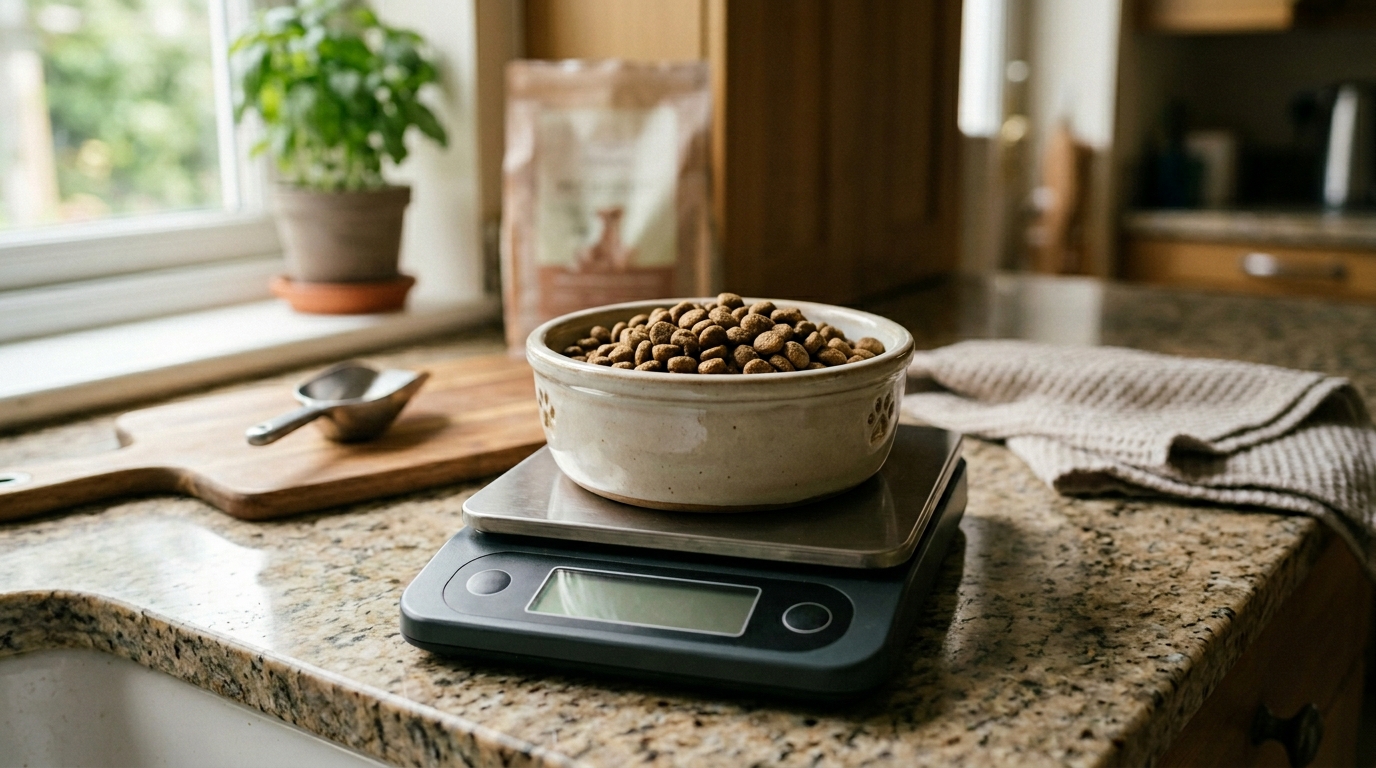
Use a kitchen scale. Weigh out each meal. Yes, every time. It takes 30 seconds and removes one of the biggest sources of over-feeding.
If your dog is on multiple meals per day, you can pre-weigh the day's allowance into a single container in the morning, then split it across meals from that container. This works well for busy households.
Step 4: Address the treat problem
Treats are usually the silent saboteur of weight loss programmes. Owners stop measuring food carefully but assume the treats don't count. They do. Sometimes treats represent 20-30% of a dog's daily caloric intake without anyone realising.
The realistic options:
Eliminate treats entirely for the weight loss period. This is the cleanest approach. Most dogs are over the disappointment within a couple of weeks. Replace the treat ritual with affection, brief play, or training rewards using portions of their daily food allowance.
Calculate treats into the daily total. If you give one small dental chew per day (often 50-80 kcal), reduce the main food by that amount. This works but requires more discipline than most owners actually maintain.
Replace high-calorie treats with low-calorie alternatives. Many vegetables are essentially calorie-free and dogs enjoy them. Carrots, green beans, broccoli, courgette, cucumber. Just be aware that some dogs find these underwhelming compared to their usual treats, and forcing the substitution can affect compliance.
The single biggest treat issue I see in practice is multiple family members or visitors giving treats independently, each thinking "it's just one." If three people each give your dog three "small" treats per day, that's nine treats. For a Labrador that could easily represent half their daily calories. Coordinate within the household ruthlessly.
Step 5: Deal with the begging problem
One of the hardest parts of a weight loss programme is the dog adapting to reduced food. Many dogs will, in the early weeks, give you significant feedback about this. Whining at the food bowl, staring at you mournfully during meals, following you to the kitchen, behaving as if they're starving.
This is psychologically tough. We have a strong cultural conditioning that hunger is suffering, and watching a beloved pet appear hungry is genuinely upsetting.
A few things to know:
The hunger feedback usually settles within 2-3 weeks as the dog's metabolism adapts. The intense begging phase isn't permanent.
Dogs are not actually being starved. A weight loss diet of appropriate calories is meeting all their nutritional needs. The "hunger" they're showing is largely behavioural and habit-driven.
You can make food more satisfying without adding calories. Dividing the daily ration into more meals (say, four small meals instead of two larger ones) keeps the dog feeling more regularly fed. Slow feeders extend mealtime, which feels more satisfying than wolfing food in 30 seconds. Adding low-calorie filler like steamed vegetables can bulk out meals without adding meaningful calories.
Some weight loss diets are specifically formulated for satiety. Prescription veterinary weight loss foods are often high in fibre and protein, designed to make dogs feel full on fewer calories. If your dog is struggling with hunger on a standard reduction, switching to a satiety-focused weight loss food may help.
Family discipline matters more than dog discipline. Most diet failures aren't because the dog overcame the family. They're because the family gave in. If your dog stares at you sadly and you decide a few extra treats won't hurt, the diet is over. Coordinate this within the household. Agree the plan. Stick to it.
Step 6: Use weigh-ins as accountability
Weekly or fortnightly weigh-ins are essential. You need objective data, not impression.
Most vet practices have walk-in scales that you can use whenever they're open. Some have specific weight clinics with a vet nurse, which add accountability and professional support. Some pet shops also have free scales.
Pick a regular time and routine. Same day, same time, before food, with the dog in the same posture. Record the weight. Note the body condition score every 4 weeks. Take photos every 4 weeks.
If weight is dropping at the target rate, continue the current programme. If weight isn't dropping, reduce food slightly further (5-10%). If weight is dropping too fast (over 2% per week), increase food slightly.
This data-driven approach removes the emotional decisions and makes the programme much more likely to succeed.
Step 7: Maintain the gains
The most common pattern I see in practice is dogs who lose weight successfully and then gradually regain it over the following year. The weight loss feels like a project with a beginning and an end. Once the goal is reached, the strict regime relaxes, and the weight creeps back.
This isn't a personal failing. It's how humans (and their pets) tend to behave. The solution is to think about weight loss as the start of a permanent change in how you feed your dog, not as a short project.
Once your dog reaches their target weight, you'll need to slightly increase their food (back to the maintenance level for their new lower weight, which is less than they'd need at their old higher weight). Continue weighing food, continue monthly weigh-ins, continue body condition scoring. The discipline that got them to target weight is the discipline that keeps them there.
Many dogs benefit from staying on a weight management or "light" food permanently after weight loss, as these tend to be lower calorie-density than standard foods.
Common obstacles and how to overcome them
"We've tried before and failed"
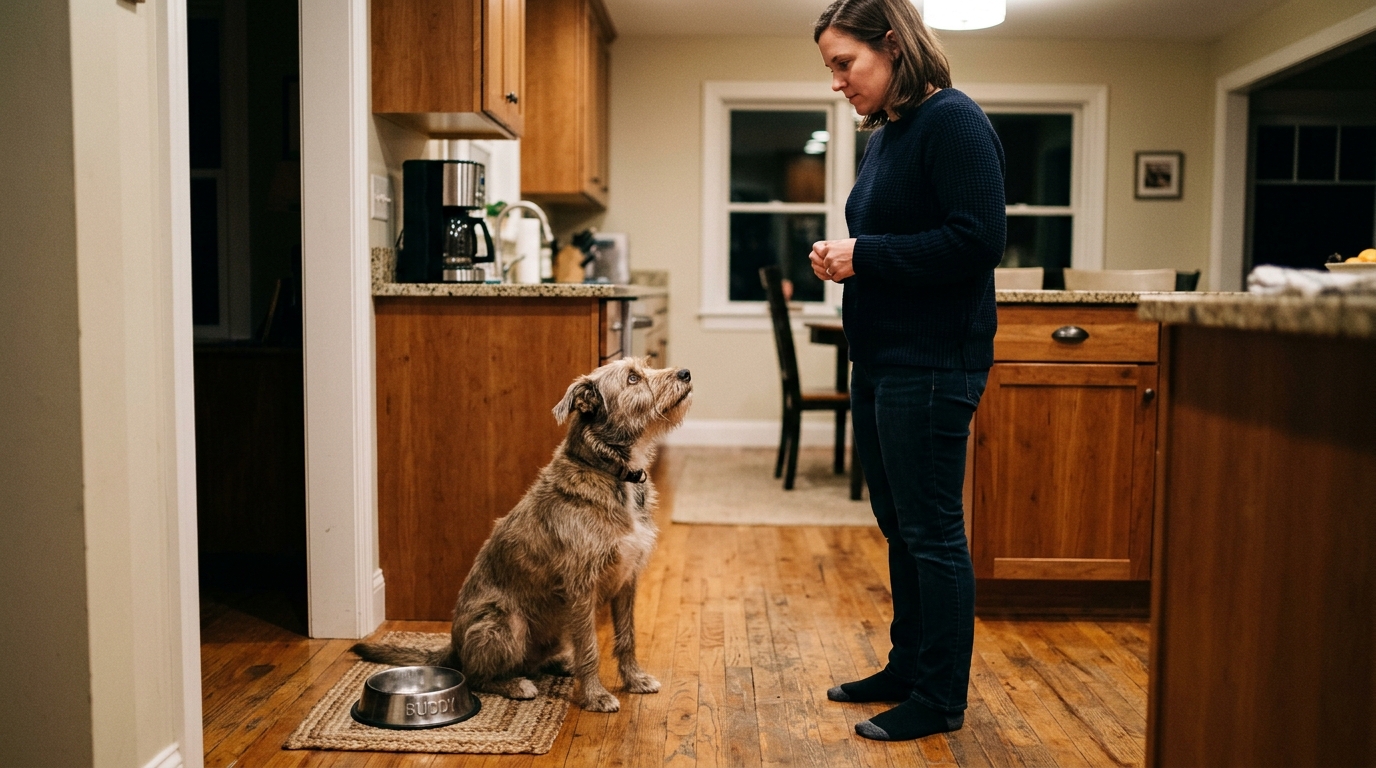
Most owners of overweight dogs have tried weight loss at some point and failed. This is so common that I'd say it's the norm, not the exception. What matters now is what's different this time.
Usually the failures came from:
- Vague plans ("we'll feed her less") rather than specific calorie targets
- Lack of measurement (no scales for food, irregular weigh-ins)
- Family non-coordination (one person sticks to the plan, another doesn't)
- No clear endpoint or progress markers
- Trying to do too much, too quickly
A more structured approach addresses each of these. Specific numbers, weighing food, household coordination, weekly weigh-ins, gradual realistic progression.
"My partner/parent/children won't cooperate"
This is real, and it kills more weight loss programmes than any other factor.
The conversation with the family member who's slipping treats needs to be direct but not blaming. "We've all been feeding her without realising, and the vet's said her weight is making her arthritis worse. From now on, [agree the system] in our house. I know it's hard. Let's do this together for her."
If a particular family member can't or won't engage with the plan, you may need to remove the treats they give from access. Putting treats in a locked container, keeping table scraps out of reach during meals, or finding ways to occupy children with non-food rewards for the dog.
For visitors who give treats, a single sentence is usually enough: "We're trying to get some weight off her for her arthritis. Could you not give her any treats while she's losing? It really makes a difference."
Most people respect this when it's explained, even if their initial instinct is to fuss over the dog with food.
"The diet food is so expensive"
Prescription weight loss diets are more expensive than standard food, often substantially so. They're not strictly necessary if your dog will lose weight on a measured portion of their normal food, but they offer advantages (better satiety, balanced nutrition at reduced calorie levels, controlled fibre).
The real cost calculation: if a prescription diet costs an extra £15-20 per month over standard food, that's around £200 a year. For a dog losing weight successfully, this often allows reduction in pain medication that more than offsets the additional food cost. It also produces better welfare outcomes.
If prescription diet isn't an option, a measured portion of mid-range standard adult or senior food can absolutely work. Just be more careful about the satiety problem.
"She just looks so sad"
The look most owners are interpreting as "starvation" or "sadness" is usually "I would like more food, please." It isn't suffering. It isn't malnutrition. It's a dog asking for something they're used to having.
Dogs are remarkably good at exploiting this human discomfort. The pleading eyes, the mournful sighs, the following you around. These are behaviours that work, which is why dogs do them. They're not signals of distress. They're signals of "I have learned that this gets me food."
Hold the line. The hunger feedback settles. The pleading reduces. And the dog whose pain control has improved through weight loss becomes a happier, more engaged dog overall.
"She's so old, what's the point now?"
This one is genuinely heartbreaking when I hear it, because the older arthritic dog often has more to gain from weight loss than a younger one. Older dogs already have less reserve. Their joints are more compromised. Their pain control needs are higher. Removing the excess weight makes the remaining years better.
It's never too late. A 12-year-old arthritic Labrador can lose weight just as effectively as a 5-year-old, and the proportional benefit on their quality of life is often greater.
"We're already doing everything else"
For some owners, weight loss is the last lever. They've added supplements, they've optimised medication, they've modified the home, they've started hydrotherapy. The weight thing is too hard, or too uncomfortable, so it gets put off.
I understand this. But the evidence is clear that weight management is more impactful than most of those other interventions. If you're going to focus your effort somewhere, focus it here first. Get the weight off, and you may find that the other interventions you were considering aren't even needed at the same level.
What success looks like
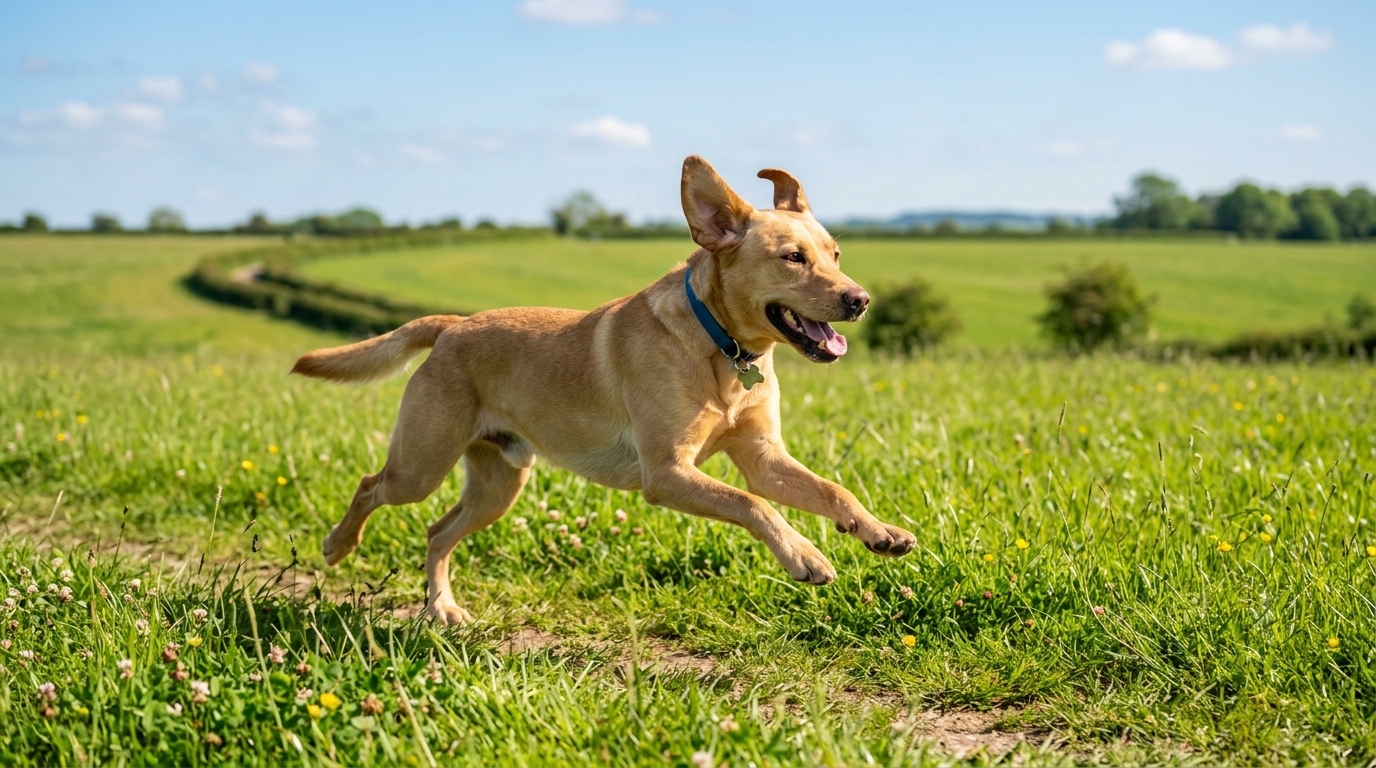
Six months into a successful weight loss programme, you should see:
- Your dog at or close to a 4-5/9 body condition score
- A measurable improvement in mobility and pain signs
- Possibly a reduction in pain medication requirements (in conversation with your vet)
- Better exercise tolerance
- Improved engagement and energy
- A sustainable feeding routine that doesn't feel constantly stressful
Most owners are surprised by how much difference the weight loss makes. Dogs they thought were "just getting old" become more like the dog they remember from a few years ago. The energy comes back. The interest in life comes back. The willingness to do things they'd given up on returns.
That is what weight loss can do for an arthritic dog, and why I'd argue it's the most undervalued intervention in canine arthritis management.
A final thought
If you've recognised that your dog is overweight, please don't let the recognition sit there. Don't wait for the next vet appointment. Don't wait for the new year. Don't wait until the weather improves.
Today, this week, start the assessment. Weigh your dog. Body condition score them. Look at what they're being fed. Calculate what they should be fed. Get a kitchen scale. Have the conversation with the family.
I've seen this conversation transform dogs. Six months later, the same family is in clinic with a dog who looks completely different. More energy. Better movement. Less pain. They wonder how they let it get to where it had got to. And they don't go back, because the difference is so obvious.
References
- Marshall WG, Hazewinkel HAW, Mullen D, et al. The effect of weight loss on lameness in obese dogs with osteoarthritis. Veterinary Research Communications, 2010;34(3):241-253.
- Impellizeri JA, Tetrick MA, Muir P. Effect of weight reduction on clinical signs of lameness in dogs with hip osteoarthritis. Journal of the American Veterinary Medical Association, 2000;216(7):1089-1091.
- Kealy RD, Lawler DF, Ballam JM, et al. Effects of diet restriction on life span and age-related changes in dogs. Journal of the American Veterinary Medical Association, 2002;220(9):1315-1320.
Free downloads
Companion worksheets to put what you've read into practice. Free PDFs, print at home.
Sister tool · Sightline
Track whether treatment is working
Sightline, a separate ConciergeVet tool, runs a short weekly check-in built on validated pain and mobility instruments, turns it into a single Sightline Score you can watch trend over weeks rather than judge on one bad day, and produces a report you can bring to your vet.
A written log, or our printable trackers, does much the same job.
See how Sightline tracks treatmentSee where your pet stands today
Tracking is the other half of managing arthritis. Take the 2-minute Mobility Check to see your pet's stage, then watch it shift as treatment takes effect.
Take the Mobility CheckYou're not doing this alone
Compare treatment journeys and talk to owners managing arthritis. Free to join.
Join PetsLikeMine