

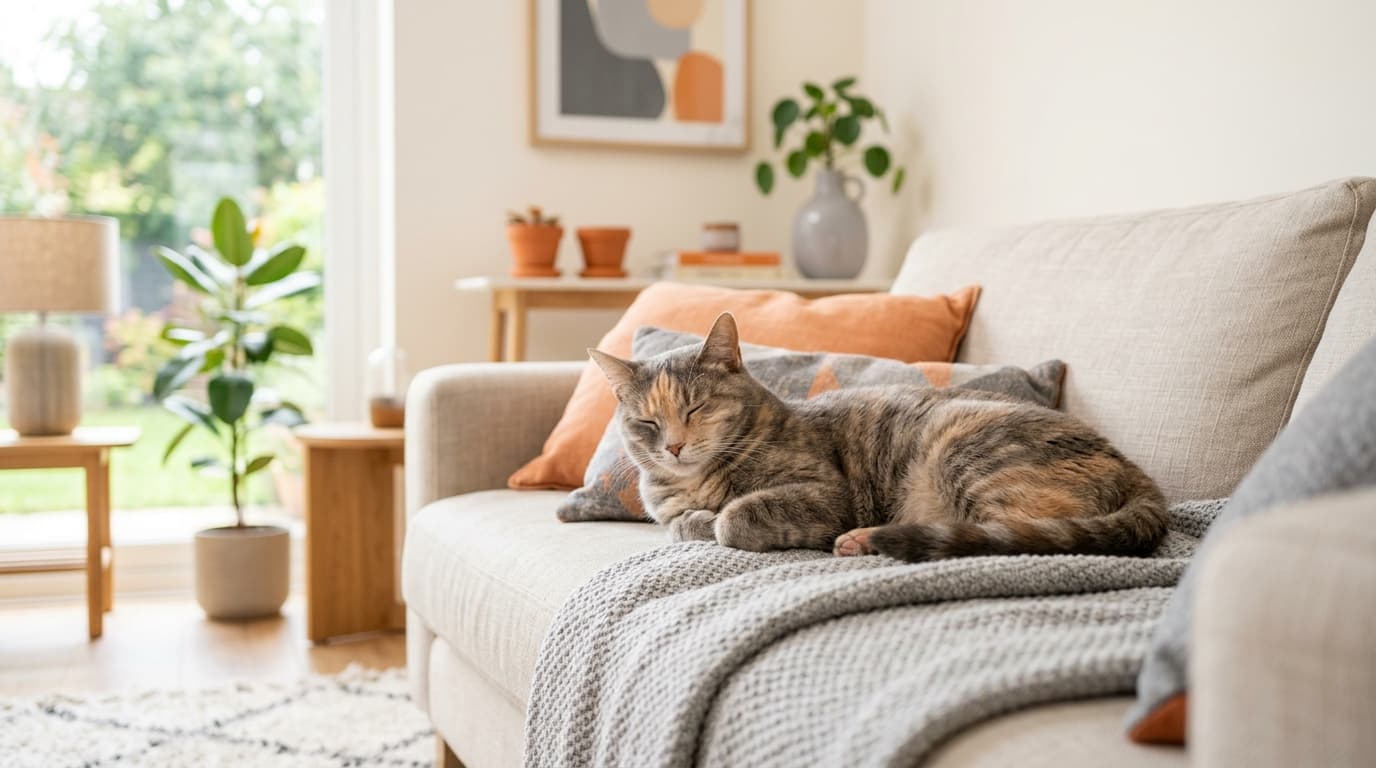
Weight Management for the Arthritic Cat
Alastair Greenway
BVM&S MRCVS
Weight is one of the few arthritis levers entirely in your hands, and in cats it is both common and stubborn. Feline weight loss is its own discipline, though: rush it and you risk a dangerous liver complication. Here is how to take the load off an arthritic cat's joints safely.
You must never try to slim a cat quickly. Cats are not dogs, and a cat that loses weight too fast, or suddenly stops eating, can develop a life-threatening liver condition. So while helping your arthritic cat to a healthier weight is genuinely one of the best things you can do for them, it has to be done slowly, gradually, and with your vet's guidance. Keep that front of mind as you read the rest.
Why weight is the lever you control
Of all the things that affect an arthritic cat, weight is one of the few you can directly change. Every extra gram a cat carries is extra load passing through joints that are already sore, so reducing excess weight directly reduces the burden on those joints. Even a modest reduction can make a real difference to how comfortably a cat moves.
That makes weight management one of the most powerful owner-controlled interventions in the whole condition, arguably the single most effective thing you can do at home, alongside good pain relief and a well-adapted environment. It is worth doing. It just has to be done the feline way.
Cats are not small dogs about weight
This needs its own approach, rather than borrowing from dog advice, because feline physiology is genuinely different. Cats are obligate carnivores with a metabolism built around protein, and they handle food, fasting, and fat very differently from dogs. Most importantly, they respond very differently to going without food, which is the heart of the safety issue below.
So the brisk calorie-cutting that might be safe for a chunky Labrador is genuinely dangerous for a cat. The principles, eat less and move more, are superficially similar, but the execution for cats has to respect their physiology, and getting that wrong can cause serious harm. This is one area where importing the dog approach is not just unhelpful but risky.
Never starve a cat thin
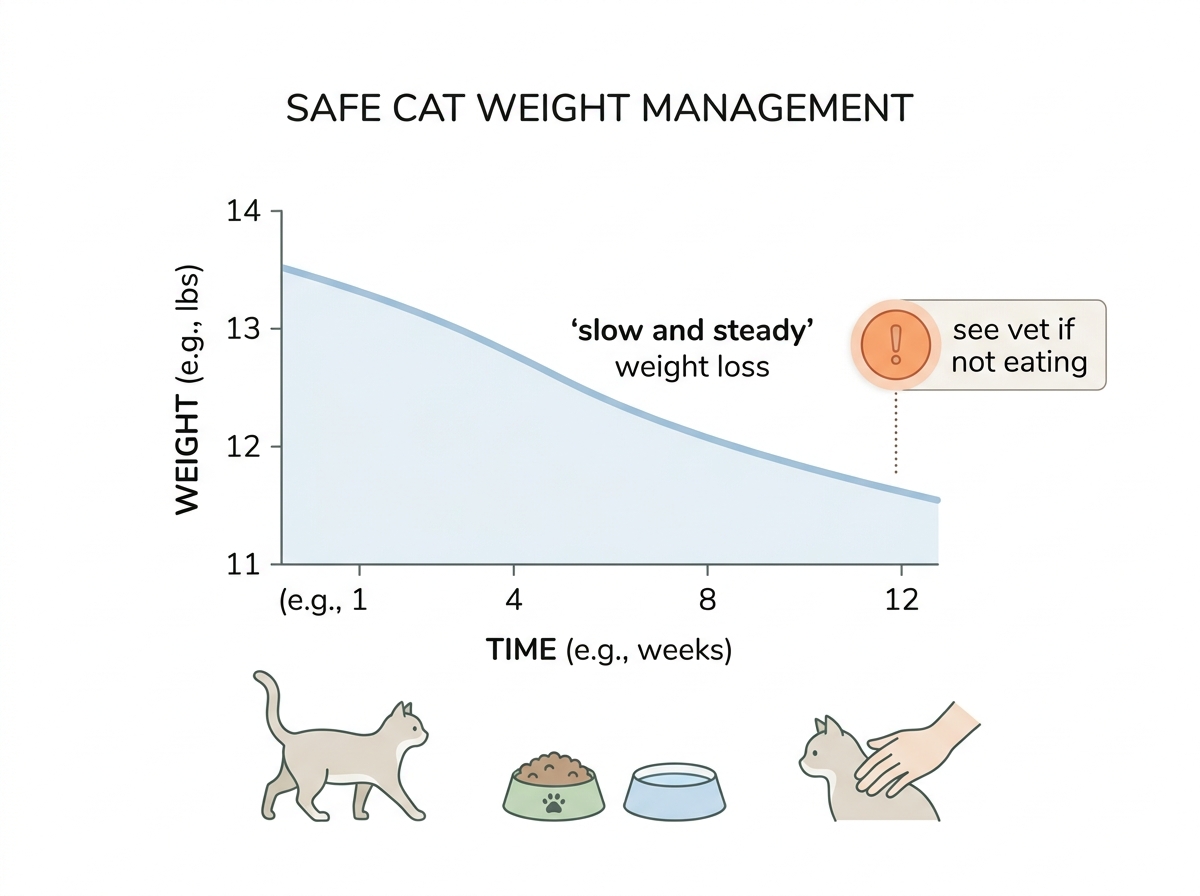
Let me explain the danger properly, because it is the thing that matters most. Cats are uniquely prone to a condition called hepatic lipidosis, or fatty liver. When a cat takes in far too few calories, or stops eating altogether, their body mobilises fat faster than the liver can process it, the liver becomes overwhelmed and clogged with fat, and it begins to fail. It is a serious, potentially fatal condition, and overweight cats are at particular risk, which is exactly the population we are trying to help.
This is why the rules for feline weight loss are non-negotiable: it must be slow and gradual, it must be supervised by your vet, and you must never make a sudden, severe cut to your cat's food. Crash-dieting a cat is genuinely dangerous. And there is a crucial warning sign to act on: if a cat on a weight-loss plan stops eating, or eats markedly less, for even a day or so, contact your vet promptly rather than waiting, because a cat that goes off its food is a cat at risk.
I am deliberately not giving you a target rate of loss or a calorie figure here, because the safe rate varies between cats and is something your vet sets for your individual cat, taking their starting weight and health into account. The principle is what matters: slow, steady, supervised, never sudden, and never improvised at home.
Setting a target and measuring properly
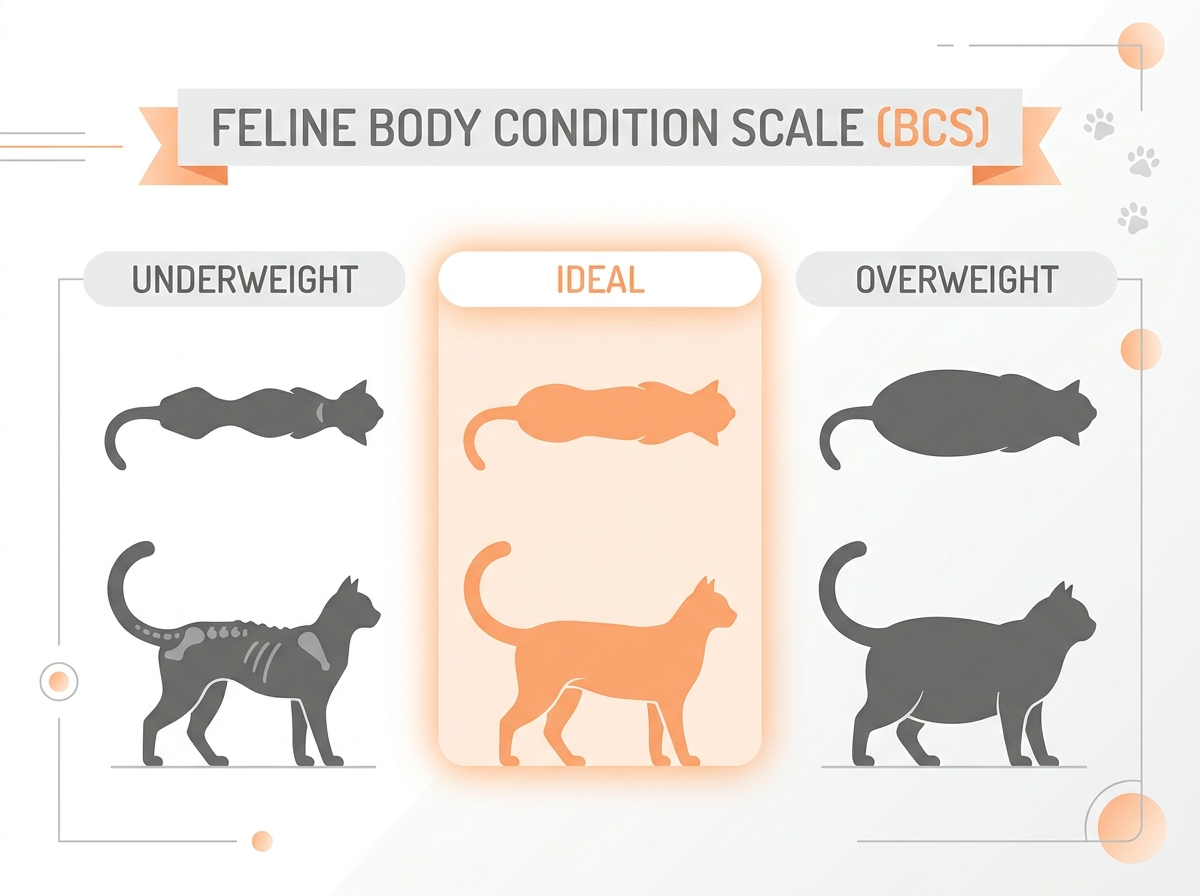
Good weight management starts with knowing where you are and where you are going, measured rather than guessed.
Your vet will assess your cat's body condition score, a structured way of judging whether a cat is underweight, ideal, or overweight, and set a sensible target weight to work toward. You can learn the basics of body condition at home too. As a rough guide, you should be able to feel your cat's ribs fairly easily without pressing hard, and see a waist when you look down at them from above. But eyeballing is unreliable, especially with fluffy cats and especially as change happens slowly, so actual weighing, on the same scales, on a schedule agreed with your vet, is the reliable way to track progress. What gets measured gets managed, and a number you can follow over time beats an impression.
Feeding for safe, steady loss
The core of feline weight loss is controlled, measured feeding, done safely. In practice this usually means feeding measured portions rather than leaving food down all day, so you actually know how much your cat is eating, and often switching to an appropriate diet, frequently a therapeutic weight-management food, chosen with your vet. These diets are formulated to satisfy a cat on fewer calories while keeping the nutrition complete.
One feline-specific point matters here: preserving muscle. Older cats are already prone to losing lean muscle mass, so a good feline weight-loss approach is protein-forward, keeping protein adequate to protect muscle while reducing overall calories, which is part of why a properly formulated diet beats simply feeding less of the normal food. And the quiet saboteurs, treats and free-feeding, need facing up to: treats add up faster than owners think, and a bowl left down all day makes any plan impossible to follow. If your cat also has kidney disease, the diet question gets more complicated, because renal needs and weight needs can pull in different directions, which we discuss in our article on arthritis and kidney disease; that balance is one for your vet.
When you have more than one cat
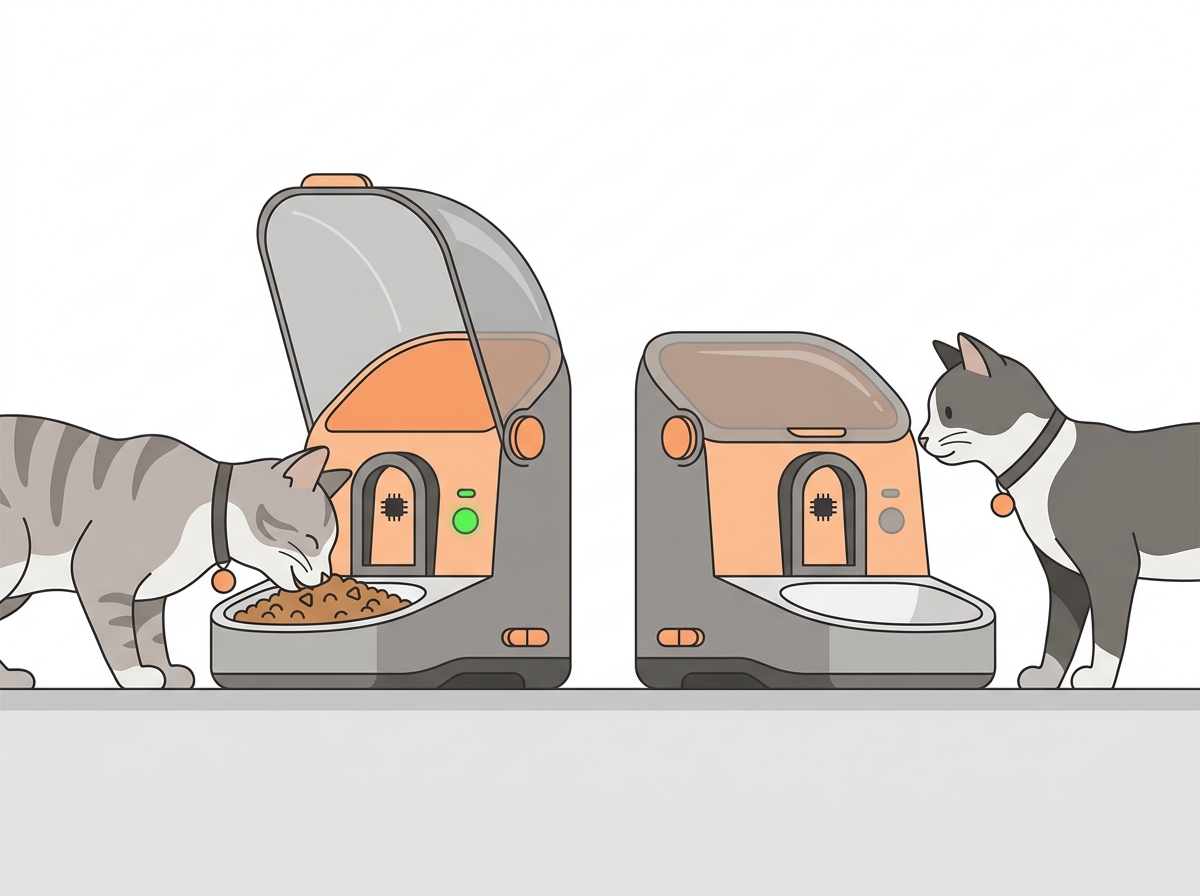
If you have more than one cat, you have just met one of the hardest practical obstacles in feline weight management: stopping the dieting cat from simply eating everyone else's food. A carefully measured portion is worthless if your cat then raids the other bowls.
There are real solutions. Microchip-activated feeders open only for the specific cat they are programmed to, which neatly solves the raiding problem. Separate feeding stations, feeding cats in different rooms, and supervised mealtimes rather than food left down all day all help. It takes some effort to set up, but in a multi-cat home it is often the difference between a plan that works and one that quietly fails, so it is worth getting right from the start rather than wondering why the scales will not move.
Indoor-cat activity within arthritis limits
Movement is the other side of weight management, but for an arthritic cat it has to be gentle and pitched to what sore joints can manage. The aim is to add a little activity without asking for the painful leaps.
Gentle, low play trailed along the floor, hunting games at ground level, and food-dispensing puzzles that make a cat work a little for their food all add small amounts of movement and engagement without demanding height or impact. We cover this in detail in our article on keeping an arthritic cat active; the point for weight is simply that even modest extra movement helps, and it can be added in arthritis-friendly ways. It will never be the main lever, feeding is, but it supports the effort and lifts the cat's mood at the same time.
Keeping it going
Finally, a word about expectations, because feline weight loss tests the patience. It is meant to be slow, and that slowness is the safety feature, not a failure, so do not be discouraged by gradual progress on the scales. The right approach is steady and sustainable: regular weigh-ins on the schedule your vet sets, careful tracking, and adjustments along the way as your cat responds. Plateaus happen and can be worked through with your vet rather than by suddenly slashing food.
Helping an arthritic cat to a healthier weight is one of the most valuable, and most lasting, things you can do for their comfort. Done the feline way, slowly, safely, measured, and supervised, it takes real load off sore joints and can genuinely improve how your cat moves and feels. Just hold onto the rule: never rush it, never crash-diet a cat, and if your cat stops eating, call your vet. Safe and steady is the whole game.
References
- German AJ. The growing problem of obesity in dogs and cats. The Journal of Nutrition, 2006.
- Brooks D, Churchill J, Fein K, et al. 2014 AAHA Weight Management Guidelines for Dogs and Cats. Journal of the American Animal Hospital Association, 2014.
- Center SA. Feline hepatic lipidosis. Veterinary Clinics of North America: Small Animal Practice, 2005.
- Bennett D, Zainal Ariffin SM, Johnston P. Osteoarthritis in the cat: 2. how should it be managed and treated? Journal of Feline Medicine and Surgery, 2012.
Sister tool · Sightline
Track whether treatment is working
Sightline, a separate ConciergeVet tool, runs a short weekly check-in built on validated pain and mobility instruments, turns it into a single Sightline Score you can watch trend over weeks rather than judge on one bad day, and produces a report you can bring to your vet.
A written log, or our printable trackers, does much the same job.
See how Sightline tracks treatmentSee where your pet stands today
Tracking is the other half of managing arthritis. Take the 2-minute Mobility Check to see your pet's stage, then watch it shift as treatment takes effect.
Take the Mobility CheckYou're not doing this alone
Compare treatment journeys and talk to owners managing arthritis. Free to join.
Join PetsLikeMine