

The Quality of Life Conversation
Alastair Greenway
BVM&S MRCVS
There comes a point with some chronic conditions when a pet can no longer be made meaningfully better, and the question that has been hovering at the edge of things has to be looked at directly: is their life, as it now is, still a good one for them? This article is about that question, how to think about it clearly, and how to approach, eventually, the most difficult decision any of us make for the animals we love.
There is nothing here that demands to be acted on today. It is here to help you think clearly and kindly when the time comes to weigh these things, and to reassure you that you do not have to find your way through it alone. If this is in front of you now, take it gently, at your own pace.
We have written it together, the two of us, because between us we have sat with a great many owners through this conversation, and because it deserves more than one voice. The decision is not easy, and there is no formula that makes it simple, because none exists. But there is real help to be had in how you approach it, and that is what we want to offer.
What "quality of life" actually means
When a pet's condition can no longer be meaningfully improved, the question that matters most is no longer "can we make this better?" but "is their life, as it is now, still a good one for them?" That is the quality of life question, and it is worth being clear about what it does and doesn't mean.
It does not mean a perfect life, or a pain-free one, or the life they had when they were young. Almost no older animal with a chronic condition has those. It means a life that, on balance, still holds more comfort than suffering, more good than bad, more of the things that make a life worth living to them than not.
Everything turns on that phrase, "to them." We are not asking whether their life looks acceptable to us, measured against the active animal they used to be. We are asking whether, from inside their own experience, the days are still good ones. A dog who can no longer run but who relishes their meals, settles comfortably, greets you with pleasure, and dozes contentedly in the sun is, by their own measure, very possibly having a good life. Our grief at what they've lost is ours, not theirs. Quality of life is judged from where they stand, not from where we wish they still stood.
Good days and bad days
For most owners, understanding their pet's quality of life comes down to a simple accounting: good days set against bad ones.
A good day is one where the pet is comfortable, eats, engages, rests well, and does at least some of the things they enjoy. A bad day is one dominated by pain, reluctance, distress, or an inability to do the things that matter to them. No life is all good days, and a string of bad days within a generally good stretch is not, on its own, cause for a decision. What matters is the balance over time, and the direction it is moving.
While the good days clearly and consistently outnumber the bad, and especially while the pet still takes evident pleasure in things, quality of life is holding. When the balance tips, when the bad days come to outnumber the good and the good days themselves become less good, that is the signal that quality of life is genuinely in question. Track this carefully, rather than from memory, and you give yourself one of the most useful tools there is, because the change is usually gradual and the loving mind tends to round upward, remembering the good days and discounting the bad. A truthful record protects against that kindly self-deception, and helps you see the true balance and its direction.
Frameworks that can help
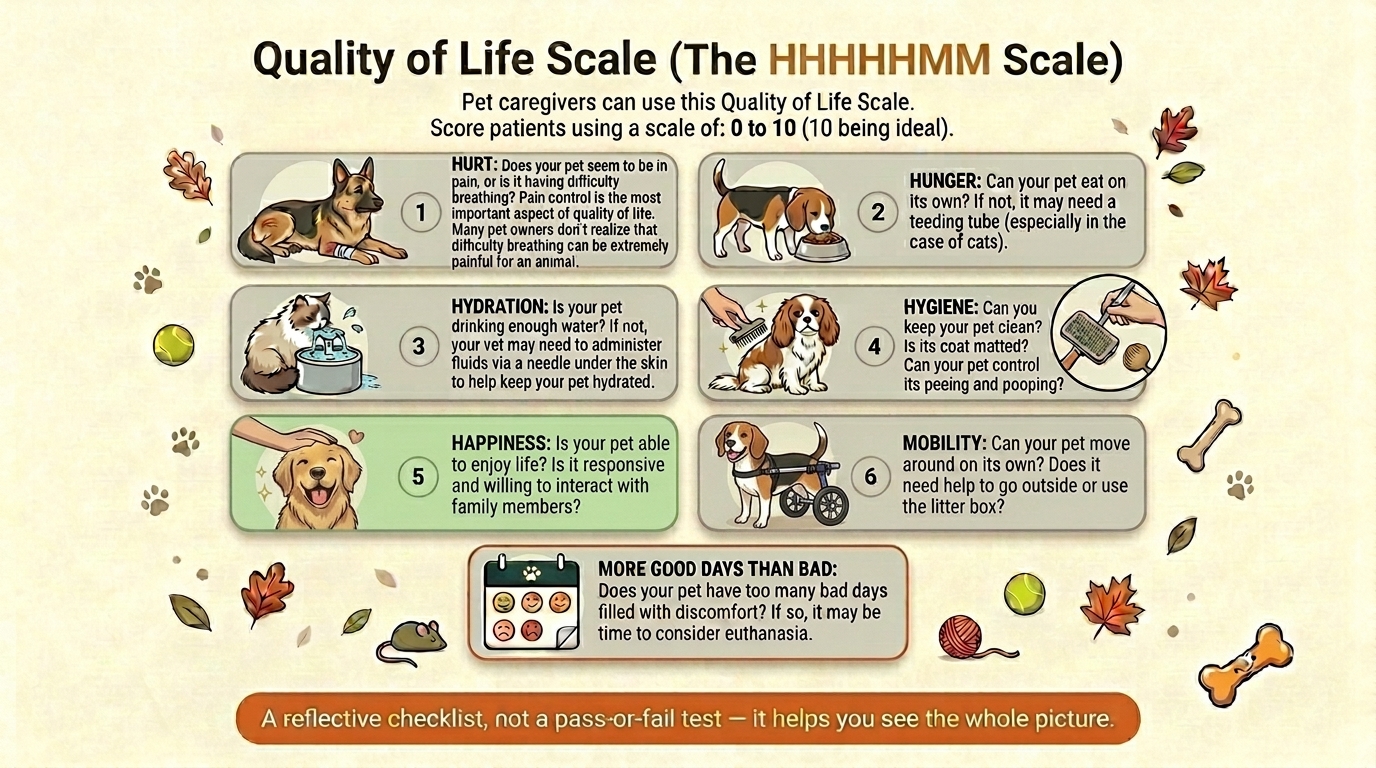
Holding all of this in your head is hard, especially when you are emotionally close to it. Several structured frameworks exist precisely to help, by turning an overwhelming question into a set of smaller, answerable ones. They do not make the decision for you, and they are not pass-or-fail tests. They are tools for thinking clearly and thoroughly, and many owners find them a genuine comfort because they give shape to something that otherwise feels formless.
Two are widely used and worth knowing.
The HHHHHMM scale, sometimes called the Quality of Life Scale, was developed by the veterinary oncologist Dr. Alice Villalobos as part of her "Pawspice" approach to end-of-life care. Its letters stand for the dimensions it asks you to consider: Hurt, Hunger, Hydration, Hygiene, Happiness, Mobility, and More good days than bad. You score each, gently and without flinching, and the exercise of doing so draws your attention to the full picture rather than fixating on any single aspect.
The JOURNEYS quality of life scale, developed by Dr. Katie Hilst, works on a similar principle across its own set of dimensions, including pain, mobility, appetite, hygiene, and the pet's overall engagement with the world around them. Like the HHHHHMM scale, its value is in the structure it provides: a series of considered questions that, taken together, build a true overall picture.
You can use these frameworks on your own, on paper, and many owners do. They can also be tracked over time, which is often more revealing than a single snapshot, because the trend tells you as much as the number. The structured tracking in Sightline (sightline.vet), a separate ConciergeVet tool, includes a quality-of-life focus mode built around exactly these frameworks, for owners who want to follow the picture over time with the dimensions laid out for them; but the frameworks themselves are freely available and yours to use however helps. What matters is not which tool you choose, but that you bring careful, structured attention to the question rather than carrying it formlessly and alone.
Questions to ask yourself, and your vet
Alongside the formal frameworks, some plainer questions often cut to the heart of it. Ask them gently, and answer them truthfully.
Is my pet still doing the things they love, or that made them who they are? Are they more comfortable than not, across a typical day? When I picture the coming weeks, am I hoping for more good time, or mainly fearing suffering? Am I keeping them here for them, or for me? That last question is a hard one, and asking it is not a sign of a cruel owner but of a brave and loving one.
Your vet is your most important partner in this, and there are questions worth asking them directly. What is realistic from here? Is my pet in pain that we cannot adequately control? What would the coming weeks or months likely look like? And the question many owners find hardest to ask but most valuable to hear answered plainly: if this were your own pet, what would you be thinking? A good vet will not make the decision for you, because it is not theirs to make, but they can give you the clinical reality and their experienced perspective, and that is a great help when you are trying to see clearly through love and grief.
On the decision itself
We will not pretend to tell you when. No one can, because it depends on your individual pet, their specific condition, what they value, and what can and cannot be controlled. Anyone offering a universal rule for the timing of this decision is offering false certainty about something that has none.
But we can offer a few plain things that owners have told us helped.
There is rarely a single obvious moment, a clear line that is crossed. More often there is a period in which the question is genuinely open, during which a thoughtful, loving owner could reasonably decide either way. If you are in that uncertain period, agonising, it does not mean you are failing to see an obvious answer. It usually means there isn't one yet, and that uncertainty is itself information: while it is genuinely balanced, there is usually still good life there.
Many owners fear, above all, "leaving it too long," allowing suffering out of their own inability to let go. This fear is itself a sign of a loving owner, and holding it consciously helps guard against it. The kindest decisions are usually made a little before they feel absolutely forced, in a calm moment rather than a crisis, while you can still give your pet a gentle, dignified passing surrounded by the people who love them, rather than in an emergency. Thinking about it before it is forced upon you is not morbid. It is the final act of the same responsible love that has run through all their care.
And whatever you decide, and whenever, please hold on to this: a decision made out of love, to spare an animal suffering, is never a betrayal of them. It is the last kindness, and often the hardest one, that we do for the animals who have given us so much. Owners torment themselves with guilt over this decision more than almost anything else, and we want to say clearly that choosing to end suffering, at the right time, for the right reasons, is an act of love, not a failure of it.
You are not alone in this
You do not have to carry this alone.
Your vet is there not only for the clinical decisions but to talk it through, more than many owners realise; ask them, because most will gladly give you the time. The people who share your pet's life, your family, your friends, can carry some of the weight if you let them in. And there are others who have walked this exact path, in the PetsLikeMine community and beyond, who understand in a way that only those who have been through it can, and who can offer the quiet companionship of shared experience. If you are struggling with anticipatory grief or the loss of a pet, your veterinary practice can also point you toward pet bereavement support services. You do not have to manage these feelings alone.
This is the hardest part of loving an animal: that we almost always outlive them, and that their care sometimes asks this of us at the end. But the grief is the price of the love, and the love was worth it. If you are facing this now, be gentle with yourself, take the help that is offered, and know that asking these hard questions, far from being a failure of hope, is the truest expression of how much you love them.
Whatever stage you are at as you read this, we hope it has helped you feel a little more able to face the question squarely and a little less alone in it. That is the most we can offer, and it is offered with deep respect for what you and your pet have shared.
References
- The HHHHHMM Quality of Life Scale, developed by veterinary oncologist Dr Alice Villalobos as part of her Pawspice end-of-life care programme. (Independent validation: Animals (Basel), 2023, PMC10044252.)
- The JOURNEYS Quality of Life Scale, developed by Dr Katie Hilst of Journey's Home, Madison, Wisconsin.