

Monitoring Your Cat at Home: Tracking Pain You Can't See
Alastair Greenway
BVM&S MRCVS
For a cat with arthritis, the home is the clinic. Feline arthritis is invisible at the vet, and the X-ray rarely tells us how much it hurts, so the most valuable data in the whole condition comes from you, watching at home, over time. What follows is a simple, sustainable way to track pain you cannot see, and to know when things are changing.
In feline arthritis, the owner is the most important monitoring instrument there is. Not the X-ray, not the clinic exam, you. That isn't flattery, it's a clinical reality. The goal here is to give you a light, repeatable way to watch your cat that produces genuinely useful evidence, without turning you into an anxious obsessive who scrutinises every movement. A sustainable habit beats an intense one that burns out.
Why home is the feline gold standard
Three things make the home the right place to monitor a cat's arthritis, and they're worth understanding because they explain everything that follows.
First, the X-ray does not tell us how much it hurts. The degree of arthritis visible on a radiograph correlates poorly with how much pain a cat is actually in; cats with dramatic-looking joints can cope well, and cats with modest-looking changes can be very sore. So we cannot simply image a cat and read off their suffering. Behaviour is the better guide.
Second, feline arthritis is usually symmetrical. Unlike a dog with one bad hip who limps on one side, cats typically have arthritis in the same joints on both sides of the body, so there's often no limp to spot. The dog owner's instinct of "watch for a limp" simply fails for cats. What changes instead is what they do, how they move through their day, not how they favour one leg.
Third, and we covered this in detail in our article on the cat-friendly vet visit, the signs hide at the clinic. A frightened cat on the table shows almost nothing. The real picture only exists at home, where the cat is relaxed and living normally.
Put those three together and the conclusion is clear: for cats, home observation over time is not a supplement to monitoring, it largely is the monitoring. And it is something only you can do.
Start by establishing a baseline
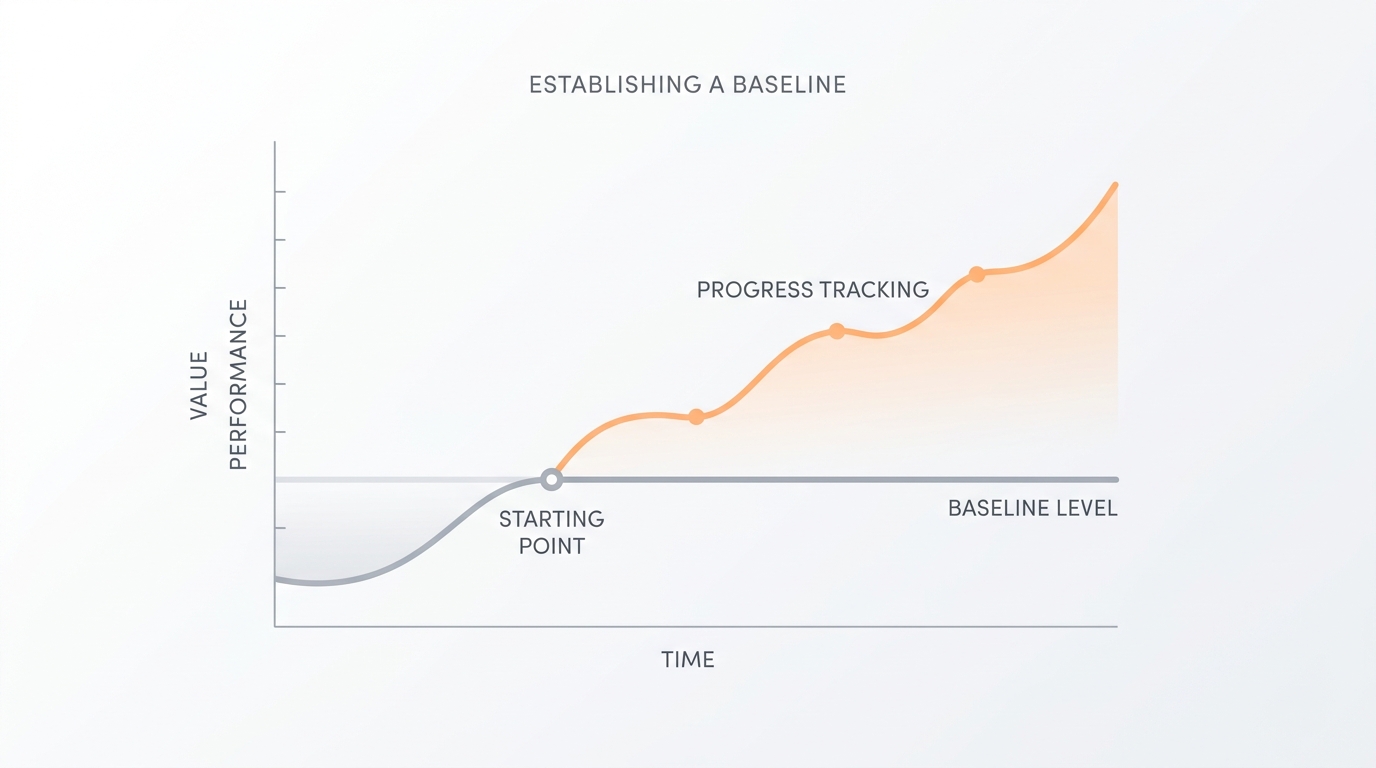
Before you can spot change, you need to know what you're changing from. This is the step people skip, and skipping it undermines everything after it.
Spend a week or two, ideally before any new treatment starts or changes, simply noting how your cat is on a normal day. How high do they jump, and how willingly? How do they take the stairs? How is their coat? How much do they play, sleep, interact? This is your baseline, the "this is my cat now" picture. Without it, you're comparing the present against memory, and memory is unreliable and easily coloured by hope or worry. With a baseline written down, you have something solid to measure against, and the gradual changes that would otherwise slip past become visible.
This matters especially when you start a treatment. If you want to know whether something is working, you need the before, not just the after.
What to actually watch
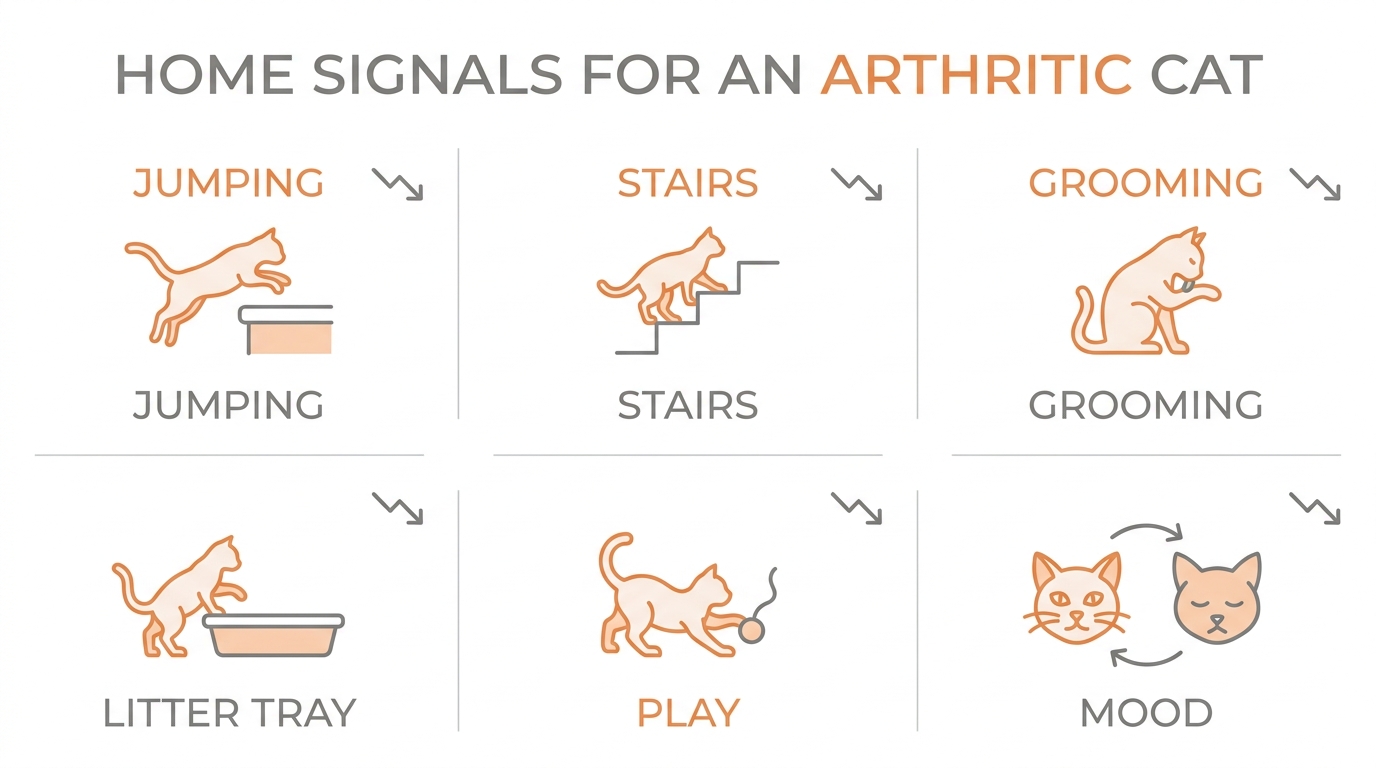
Here are the behaviours that tell you the most. You don't need to track all of these obsessively; pick the ones that are most telling for your cat and keep a casual eye on them.
Jumping is often the single most useful marker. Watch both the height your cat will attempt and their willingness. A cat who used to sail onto the kitchen counter and now goes up in stages, or picks a lower route, or no longer bothers, is telling you something.
Stairs work the same way: taking them slower, one at a time, or avoiding them.
Grooming is a classic feline arthritis signal. A cat who cannot twist comfortably stops grooming the hard-to-reach places, so look for a scruffy, matted, or scurfy coat especially over the back and hindquarters. Occasionally the reverse happens, with a cat over-grooming directly over a painful joint.
Litter-tray habits matter and are easily misread. A stiff cat may struggle to climb into a high-sided tray, may have accidents nearby, or may adopt an awkward posture. This is frequently mistaken for a behavioural problem when it's actually pain, so it's worth watching closely.
Play, sleep, sociability, and temperament round out the picture. Less play, more sleeping, more hiding, more withdrawal, or new irritability when handled can all reflect chronic discomfort. A cat in persistent pain often simply becomes quieter and less engaged, which is easy to write off as "just getting older."
The thread through all of these is the same: feline arthritis shows up as things the cat stops doing. You're watching for the slow subtraction of normal behaviour.
Validated tools you can use
You don't have to invent your own system. Researchers have developed structured, owner-facing tools for exactly this, and using one gives you a consistent score rather than a vague impression.
The best known is the Feline Musculoskeletal Pain Index, or FMPI, an owner-completed questionnaire covering activity, mobility, and quality of life, developed specifically to assess degenerative joint disease pain in cats. More recently, a screening checklist was developed to help flag cats who may be in DJD-related pain in the first place, designed to be quick and usable.
Let me be clear about what these tools are and are not, because that clarity is part of using them well. They are screening and tracking aids, not diagnoses. They help you notice and put a number on things, and they make your observations consistent and shareable with your vet. But they aren't perfect; research has shown, for instance, that owner-rated scores can be influenced by expectation, which is one reason a structured baseline and careful tracking matter so much, and why your vet interprets the scores alongside everything else rather than reading them as a verdict. Used in that spirit, as a consistent way to watch a trend rather than a test that passes or fails, they're genuinely valuable.
Film it: video as evidence
If there's one practical habit I'd press on every cat owner, it's to film short videos. A 20-second clip can change a consultation, because it shows the real cat the clinic never sees.
Film the things that reveal mobility: a jump up and a jump down, your cat walking away from the camera, and getting in and out of the litter tray. Keep the clips, date them, and film the same things every so often. Over months, comparing an old clip with a recent one reveals gradual change far more reliably than memory ever could, and it gives your vet something concrete to assess. We go into the filming technique in our movement-video guidance; for cats the key is to capture them relaxed and moving naturally at home.
Following the trend over time
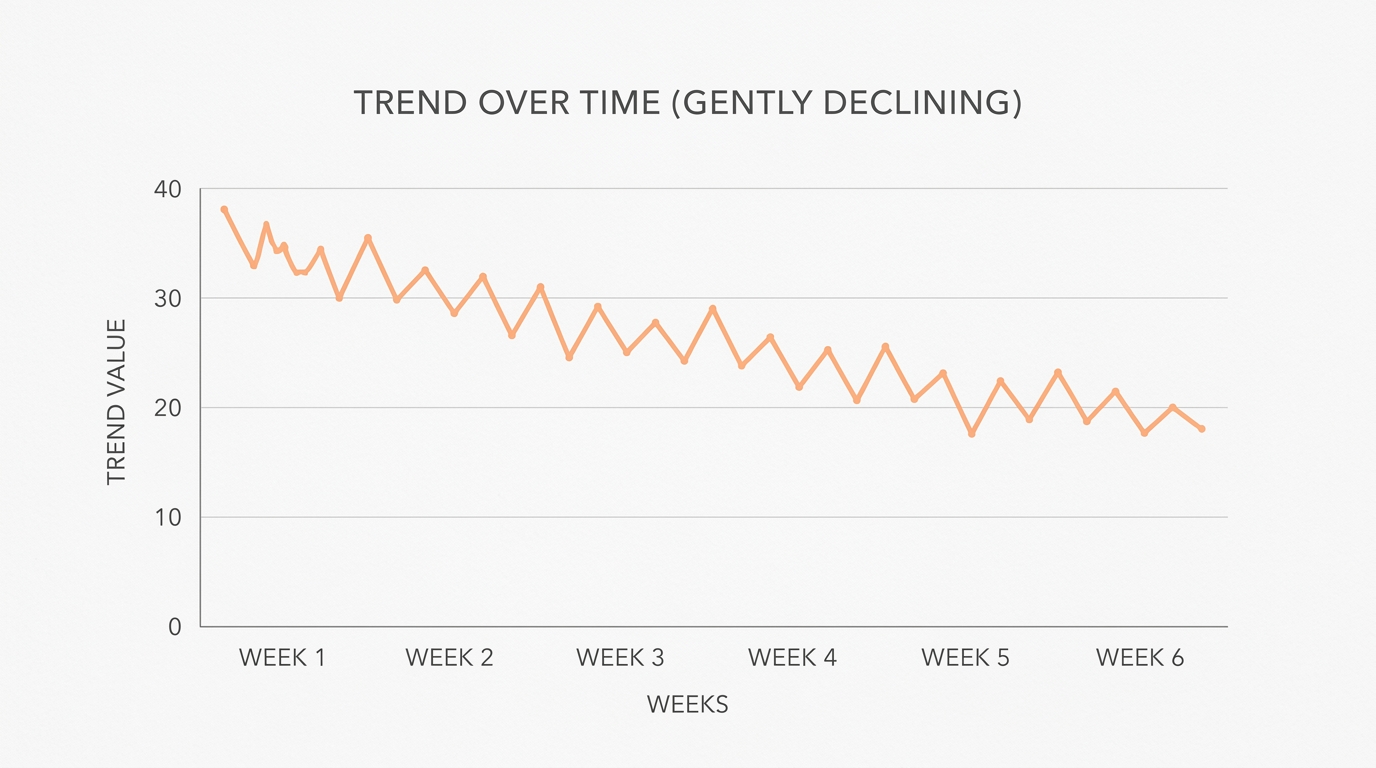
A single snapshot is far less useful than the trend, because arthritis changes slowly and has good and bad spells along the way. What you're really trying to see is the direction of travel over weeks and months, not the noise of any single day.
A light cadence works best: a quick check-in weekly or monthly, using your chosen markers or a structured tool, dated so you can look back. The aim is to distinguish a passing bad week, which returns to baseline, from a genuine downward drift, which does not. That distinction is hard to make in the moment and easy to make in hindsight if you've kept a record.
For owners who want a structured way to do this, Sightline, a ConciergeVet tool well suited to cats, offers an adaptive weekly assessment that turns your observations into a single trackable score over time, with a report you can share with your vet. It's an optional way to make the trend visible; the underlying habit, watching consistently and recording faithfully, is the thing that matters, however you choose to do it.
Knowing when to act
The point of all this watching is to act at the right time, neither panicking at every off day nor missing a real decline. A few simple principles help.
A single bad day, or even a bad few days that then recover, is usually just the normal waxing and waning of arthritis and not a cause for alarm. What warrants a call is a genuine, sustained change: a new and persistent drop in what your cat will do, a marker that has shifted and stayed shifted over a couple of weeks, or a clear downward step in their comfort that does not bounce back. A treatment that was helping and now seems to be losing ground is also worth a conversation.
A sudden, marked change is different from a slow drift and should prompt a prompter call, because an abrupt worsening can mean something other than arthritis, an injury, or another problem entirely. And, as ever, if you are simply worried, that is reason enough. You know your cat better than anyone, and a trend you have tracked carefully is exactly the kind of evidence that lets your vet help.
That's the whole approach: establish a baseline, watch the handful of markers that matter, film the occasional clip, keep a light record of the trend, and act on sustained change rather than daily noise.
References
- Benito J, Hansen B, DePuy V, et al. Feline Musculoskeletal Pain Index: responsiveness and testing of criterion validity. Journal of Veterinary Internal Medicine, 2013.
- Enomoto M, Lascelles BDX, Gruen ME. Development of a checklist for the detection of degenerative joint disease-associated pain in cats. Journal of Feline Medicine and Surgery, 2020.
- Lascelles BDX, Dong YH, Marcellin-Little DJ, et al. Cross-sectional study of the prevalence of radiographic degenerative joint disease in domesticated cats. Veterinary Surgery, 2010.
- Klinck MP, Frank D, Guillot M, Troncy E. Owner-perceived signs and veterinary diagnosis in 50 cases of feline osteoarthritis. Canadian Veterinary Journal, 2012.
Sister tool · Sightline
Track whether treatment is working
Sightline, a separate ConciergeVet tool, runs a short weekly check-in built on validated pain and mobility instruments, turns it into a single Sightline Score you can watch trend over weeks rather than judge on one bad day, and produces a report you can bring to your vet.
A written log, or our printable trackers, does much the same job.
See how Sightline tracks treatmentSee where your pet stands today
Tracking is the other half of managing arthritis. Take the 2-minute Mobility Check to see your pet's stage, then watch it shift as treatment takes effect.
Take the Mobility CheckYou're not doing this alone
Compare treatment journeys and talk to owners managing arthritis. Free to join.
Join PetsLikeMine