


Managing a Flare-Up: What to Do on a Bad Day
Alastair Greenway
BVM&S MRCVS
Even a well-managed arthritic pet will have bad days. A flare-up is a sudden spell of more pain and stiffness, and it is frightening when you do not know what to do, and dangerous if you reach for the wrong thing. Here is how to handle a flare safely at home, what never to give, and when a bad day is actually something that needs the vet.
This article is the fuller companion to our one-page Arthritis Flare-Up Action Plan, which you can download and keep somewhere you will find it fast. The download is the quick-reference card for the moment a flare hits; this article explains the why behind each step, so you understand not just what to do but the reasoning that makes it safe. If you only have thirty seconds in a worried moment, use the download. When you have time to understand it properly, read this.
What a flare actually is
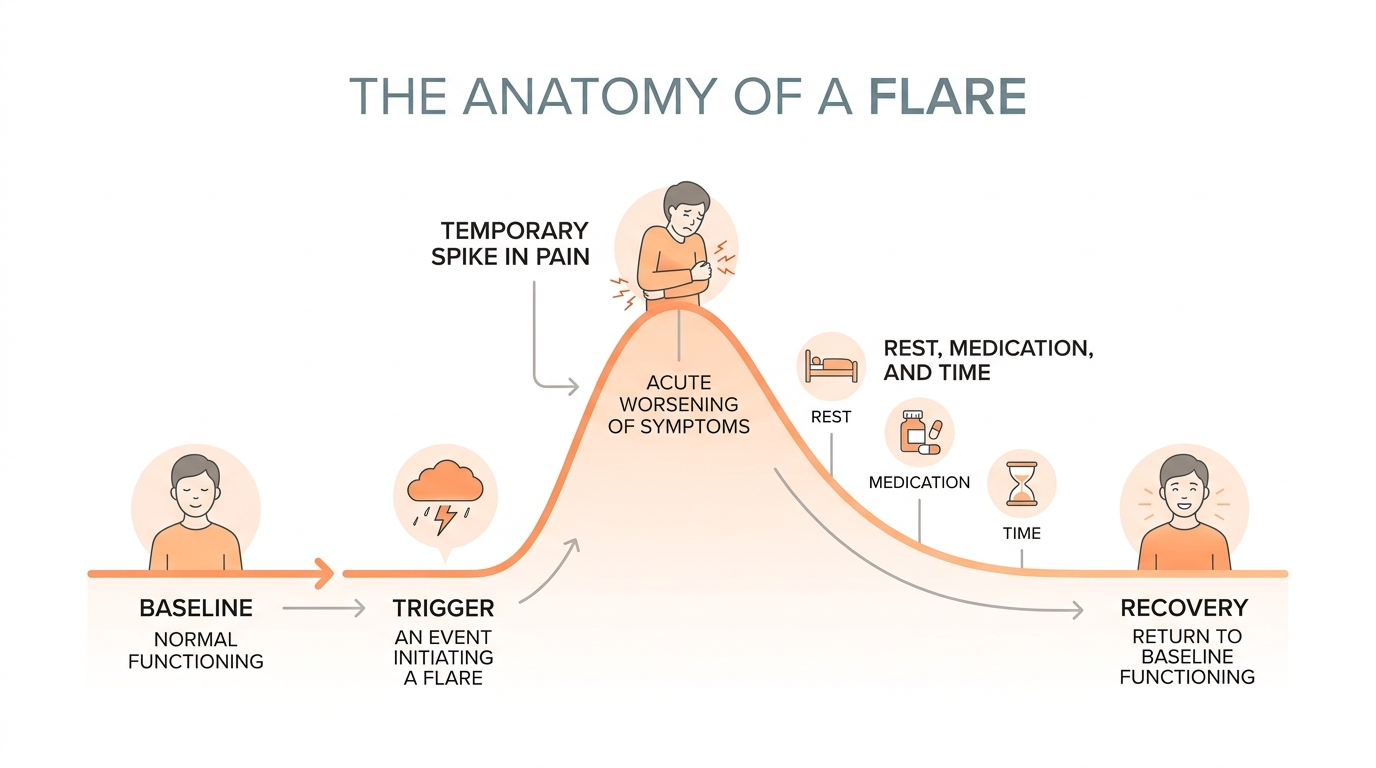
When your pet suddenly seems much worse, stiffer, limping, reluctant, or just quiet and withdrawn, the instinct is to panic and assume the worst. So the first and most important thing is to understand what a flare is, because that understanding is itself calming.
A flare-up is a temporary worsening of arthritis pain on top of your pet's usual baseline. It is a spike, and it is not a permanent collapse of everything you have been doing. Arthritis naturally waxes and wanes; good days and bad days are part of the condition, and a bad day, even a bad few days, does not mean the disease has suddenly lurched forward or that your management has failed. Most flares settle within a few days with calm, sensible care. So your job in a flare is not to fix everything at once. It is to keep your pet comfortable, avoid making things worse, and let it pass, while staying alert to the few signs that mean a bad day is actually something more. Take a breath. You can handle this.
What tends to set one off
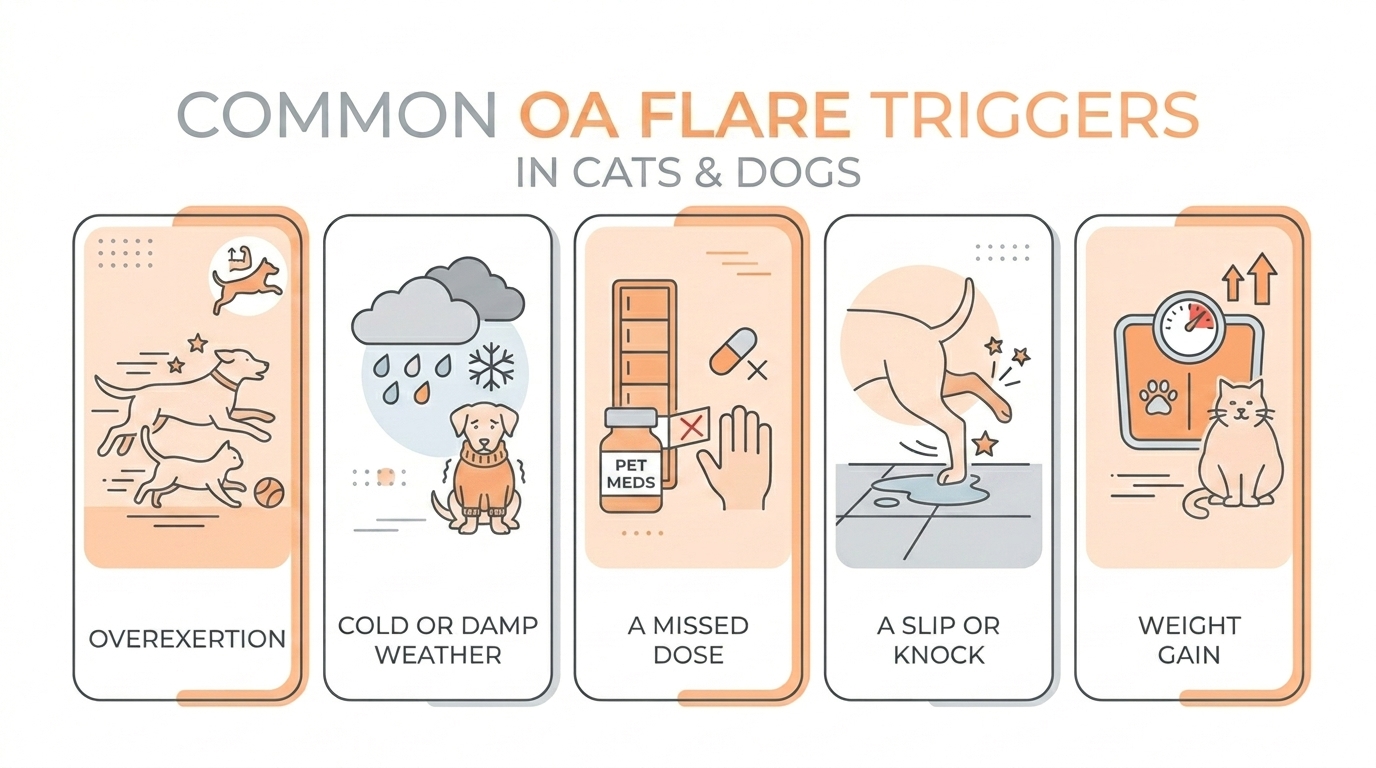
Flares often have a cause, and naming the common ones is useful, because a trigger you can identify is a trigger you can often avoid next time.
The classic is overdoing it, the "weekend warrior" pattern, where a pet that is gently active all week has one big day, a long walk, a marathon play session, a visiting family that gets them overexcited, and pays for it the next day. Cold or damp weather is another frequent culprit, with many arthritic pets noticeably stiffer in winter. A slip or a minor knock can set one off, as can a missed dose of regular medication, a new or unusual activity, or a gradual creep in weight that has quietly added load. None of these is a failing on your part; they are simply the things that tend to tip a managed pet into a bad spell, and knowing them helps you head off the next one.
First response at home
When a flare hits, there are four calm steps, and they are the heart of the action plan. Here is each one with the reasoning behind it.
Ease right back on activity. Cut back to gentle, short, lead-only toilet trips for a dog, and reduce a cat's need to jump or climb, for now. Avoid stairs, jumping, slippery floors, and any play that jolts the joints. The goal here is relative rest, and this matters, not total confinement. Do not freeze your pet solid in a crate for days; gentle, controlled movement is generally better for an arthritic joint than complete immobility, which stiffens things further. And crucially, do not try to "walk it off." The instinct to exercise through it is exactly wrong in a flare. Ease back, then reintroduce normal activity gradually as things settle, rather than stopping everything and then leaping back to full activity.
Make them warm and comfortable. Settle your pet somewhere warm, soft, supportive, and easy to get into, away from draughts, with food, water, and their bed close by so they do not have to travel far or tackle obstacles. General warmth genuinely helps a stiff, achy body feel more comfortable, and reducing the demands on sore joints lets them rest and recover. (More on warmth, and its one important caveat, below.)
Give prescribed medication exactly as directed. This is the step with the most important safety content, and it has its own section next. In short: if your vet has prescribed pain relief, give it exactly as instructed, and do not change anything on your own.
Watch, and note what you see. Keep an eye on your pet over the next day or two, and jot down when the flare started, what they were doing beforehand, which area seems sore, and whether each day is better, the same, or worse. This helps you judge whether it is settling as it should, helps you spot the trigger for next time, and gives your vet something concrete if you do need to call. It connects directly to the home monitoring we describe in our monitoring article.
Medication during a flare: the safety section
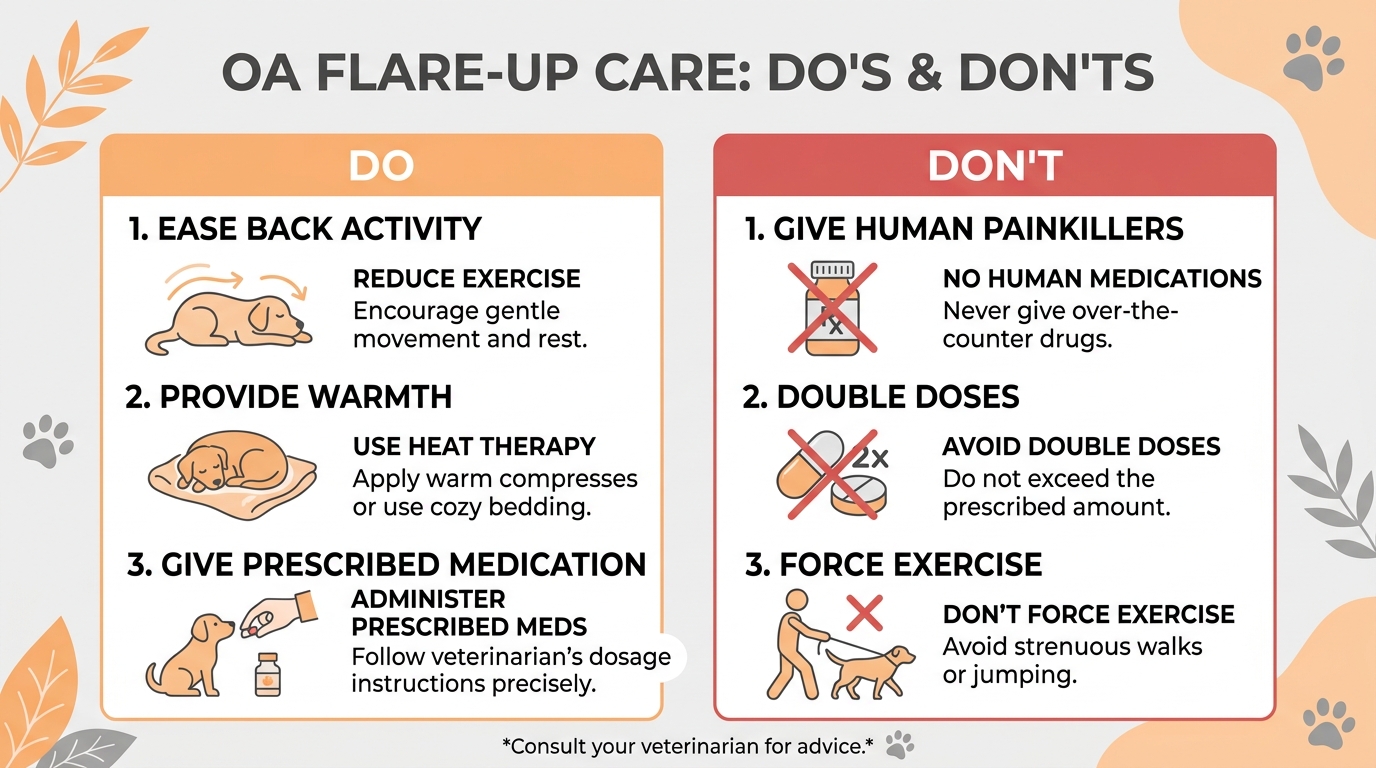
This is the part to read most carefully, because it is where a worried owner, trying to help, can do real harm. The single firmest rule of a flare is this: do not start, increase, double, or combine medications on your own.
Above all, never reach for human painkillers. This is genuinely dangerous. Ibuprofen and aspirin are toxic to pets and must never be given. Paracetamol, also called acetaminophen, is sometimes prescribed for dogs by a vet, but only at the vet's exact dose, and it is toxic to cats and can be fatal to them, so it must never be given to a cat at all. And never give a cat a medication meant for a dog, since several common ones are poisonous to cats. The reason these warnings are so stark is that pets, especially cats, process these drugs very differently from people, and a dose that seems small can cause severe or fatal harm.
Beyond the human-medicine danger, do not double up or combine your pet's own doses, and do not self-escalate the medication because the flare seems bad. If your vet has given you a written flare or breakthrough plan, follow that plan exactly. If they have not, and you feel your pet needs more than their usual relief, call the vet rather than improvising. Reaching for more medication on your own, even your pet's own medication, can cause overdose or dangerous interactions. The safe response is the vet's guidance, not your best guess in a stressful moment.
A note on warmth, and on cold
Warmth and cold both have a place in a flare, but they are not interchangeable, and getting this right matters.
General, all-over warmth, a cosy bed away from draughts, helps a stiff, achy pet feel more comfortable, and it is safe and soothing. But do not apply direct heat, a heat pad or a hot water bottle, to a joint that is actively swollen, hot, or inflamed, because heat can make active inflammation worse. For a joint that is clearly hot or swollen, a cold compress wrapped in a cloth, never ice directly against the skin, applied for a short period, may help instead. If you are unsure which to use, or how, ask your vet rather than guessing. The simple rule of thumb: gentle general warmth for overall stiffness, cool for a specific hot and swollen joint, and ask if in doubt.
When a "flare" is an emergency
Most flares are not emergencies and settle with the care above. But some things that look like a flare are actually something more serious, an acute injury or another problem, and these need prompt veterinary attention, not home rest. Contact your vet promptly, the same day, if you see any of these:
The flare does not start improving within two to three days, or keeps getting worse. Your pet is in severe pain, crying out, or will not put any weight on a leg at all. A joint is hot, very swollen, or the leg looks abnormal in shape. Your pet will not eat, seems unwell in themselves, or is very withdrawn, and for a cat that stops eating, this is especially important given the risks of feline anorexia. There are signs of wobbliness, dragging, or weakness that could point to a neurological problem rather than arthritis. The pain came on very suddenly and severely, which can suggest an acute injury rather than a simple flare.
And one more, which matters as much as any clinical sign: if you are worried. You know your pet better than anyone, and that instinct is worth trusting. A phone call to the vet is always reasonable.
Riding it out
For an ordinary flare without red flags, the realistic picture is reassuring. Most settle over a few days with relative rest, your pet's existing pain relief, warmth, and time. You are not aiming to do anything dramatic; you are providing the conditions for it to pass and watching that it does.
As your pet improves, reintroduce normal activity gradually rather than either stopping everything for good or leaping straight back to full activity, which can simply trigger the next flare. A steady, gradual return to their usual routine is the goal. The flare passes, your pet returns to their baseline, and life resumes.
Preventing the next one
Once your pet is back to their usual self, a little reflection pays off. Think back to what might have set this flare off, the too-long walk, the big play session, the jump into the car, the cold spell, the missed dose, and use it to head off the next one. Over time, your home monitoring record helps you see the pattern of what triggers your individual pet.
The broader prevention is the everyday management this whole space describes: consistent, paced exercise rather than the boom-and-bust pattern of quiet days punctuated by big ones, keeping your pet lean, keeping them warm, and a steady, reliable medication routine without missed doses. Flares can never be entirely eliminated, arthritis will always have its bad days, but good, consistent management makes them less frequent and less severe.
When flares are telling you something
Finally, a flare, or rather a pattern of them, can carry a message. An occasional bad day is just the nature of arthritis. But flares that are becoming more frequent, more severe, or harder to settle are a sign that the underlying plan may need reviewing. That is not a cause for alarm; it is useful information, exactly the kind of trend our monitoring article helps you spot, and it is worth a conversation with your vet about whether the medication, the activity, or the overall approach needs adjusting. Arthritis changes over time, and the management sometimes needs to change with it. Recurrent flares are one of the ways your pet tells you that time has come.
Keep the action plan to hand, work through the steps calmly when a bad day comes, never reach for the medicine cabinet on your own, and call the vet when the red flags or your own worry say to. Handled that way, the bad days are manageable, and they pass.
References
- Monteiro BP, Lascelles BDX, et al. 2022 WSAVA guidelines for the recognition, assessment and treatment of pain. Journal of Small Animal Practice, 2023.
- Gruen ME, Lascelles BDX, Colleran E, et al. 2022 AAHA Pain Management Guidelines for Dogs and Cats. Journal of the American Animal Hospital Association, 2022.
- Allen AL. The diagnosis of acetaminophen toxicosis in a cat. Canadian Veterinary Journal, 2003.
- Veterinary Poisons Information Service (VPIS). Guidance on ibuprofen and paracetamol toxicity in dogs and cats.
Sister tool · Sightline
Track whether treatment is working
Sightline, a separate ConciergeVet tool, runs a short weekly check-in built on validated pain and mobility instruments, turns it into a single Sightline Score you can watch trend over weeks rather than judge on one bad day, and produces a report you can bring to your vet.
A written log, or our printable trackers, does much the same job.
See how Sightline tracks treatmentSee where your pet stands today
Tracking is the other half of managing arthritis. Take the 2-minute Mobility Check to see your pet's stage, then watch it shift as treatment takes effect.
Take the Mobility CheckYou're not doing this alone
Compare treatment journeys and talk to owners managing arthritis. Free to join.
Join PetsLikeMine