


Living Well With Arthritis: The Long Game
Alastair Greenway
BVM&S MRCVS
When a dog or cat is first diagnosed with arthritis, most owners ask me some version of the same question, even if they don't say it out loud. How long have we got? Underneath it sits a fear that the diagnosis is the beginning of the end, that life from here is a managed decline, that the good years are behind them.
Let me answer that fear directly. For most pets, an arthritis diagnosis is not the beginning of the end. It is the beginning of a long, manageable chapter that can stretch across many good years. The dogs and cats I have looked after with arthritis have, by and large, gone on living lives that were full, comfortable and happy, for a long time. Arthritis is something you live with, not something you are immediately dying from. The whole point of all the management and the monitoring and the modifications is to make that long chapter a good one.
This article is about the long view. Not the first 30 days, which we covered right at the start, and not the hard decisions that come much later, which the articles after this one address with care. This is about the long, steady middle, the years of living well with a condition that is part of your pet's life but does not have to define it.
Pace it like a marathon
Arthritis management is a marathon, not a sprint. This shapes everything about how you should approach it.
In a sprint, you give everything immediately and it is over quickly. New owners often approach arthritis this way, throwing themselves into it, buying everything, changing everything, monitoring obsessively, running themselves into the ground in the first month. And then, inevitably, the intensity isn't sustainable, and it lapses, and they feel guilty about the lapse.
A marathon is different. You find a pace you can hold for the long haul. You accept that some days you'll do more and some days less. You build habits that are sustainable rather than heroic. You pace yourself, because you are going to be doing this for years, and the version of care that helps your pet most is the version you can actually keep up.
This matters because arthritis care is, above all, consistent care. The dog who gets a steady, sustainable level of attention every week for three years does far better than the dog whose owner went all-out for two months and then burned out. Find the pace you can hold. That is the kind that lasts.
Good days, bad days, and the rhythm between
One of the things that unsettles owners most in the early going is the variability. Your pet is doing beautifully for a fortnight, and then has a stiff, sore few days for no obvious reason, and you panic that everything has stopped working or the arthritis has suddenly worsened.
This waxing and waning is the normal rhythm of arthritis. It is not a sign of failure. Joints have better and worse spells, influenced by weather, activity, the surface they've been walking on, how they slept, and sometimes nothing you can identify at all. A bad few days, followed by a return to the usual baseline, is the disease behaving exactly as it does.
Learning this rhythm is one of the quiet skills of living well with arthritis. Once you understand that the bad patches usually pass, you stop reacting to every dip as a crisis. You learn to watch the trend over weeks and months rather than the noise of any single day. You learn the difference between a normal bad spell, which resolves, and a genuine change in the baseline, which persists and warrants a conversation with your vet. (Our article on monitoring, and the tracking tools that go with it, are built precisely to help you tell those two things apart.)
This is also why you should never judge a new treatment or a change by a few days. Arthritis naturally improves and worsens on its own, so a few good days after starting something new might be the treatment, or might just be the natural upswing that was coming anyway. The long view is the only reliable view.
Adjusting expectations without lowering them
There is a balance to strike here, and getting it right is part of the art of living well with a chronic condition.
On one hand, you do need to adjust expectations. The dog who used to run for two hours may not do that any more, and asking them to is neither kind nor wise. Part of living well is accepting the pet in front of you now, with the body they have now, rather than grieving the one they were five years ago.
On the other hand, adjusting expectations is not the same as lowering them. A well-managed arthritic pet should still have a good life, full of the things they enjoy, adapted to what their body can do. The goal is not a diminished life lived carefully. It is a full life, lived differently.
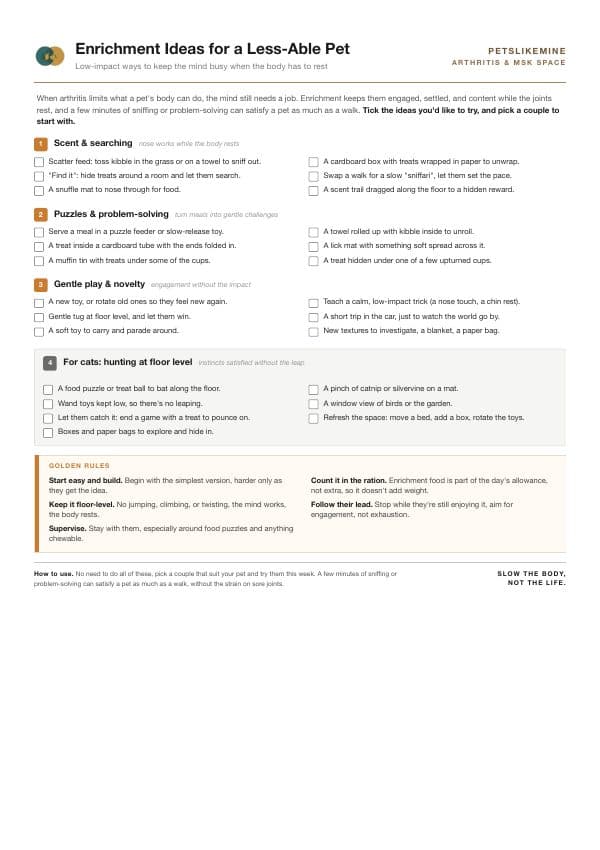
In practice this means finding the new version of the things your pet loves. The two-hour run becomes three shorter, gentler walks in interesting places. The leap onto the bed becomes a ramp they use happily. The long swim becomes a session of hydrotherapy. The point is not to subtract activities until little is left, but to translate the things that bring joy into forms the arthritic body can manage. That is a creative, hopeful task, not a mournful one, and the next article in this stage, on enrichment, is devoted to it.
Looking after the carer
Here is something that doesn't get said enough. Over a multi-year condition, the owner's own stamina is part of the equation, and it needs looking after.
Caring for a pet with a chronic condition is a long emotional and practical commitment. There is the daily medication, the monitoring, the appointments, the cost, the worry, the gradual adjustments. Over years, this accumulates. Owners can become quietly worn down by it, and worn-down owners find it harder to provide the steady, consistent care that helps most.
So I say this plainly: looking after yourself is part of looking after your pet. Build a routine that is sustainable for you, not just optimal for them. Accept help where it's offered. Don't aim for perfection, which is exhausting and unnecessary, aim for good and consistent. Use the tools and the community available to you so you are not carrying it all in your head alone. And forgive yourself the imperfect days, because there will be many over the years, and they do not undo all the good days around them.
A pet does not need a perfect carer. They need a present, steady one who is still standing years from now. Pace yourself accordingly.
Celebrating what they can still do
The last thing about the long view is easy to lose sight of amid all the management.
It is easy, when you are focused on a chronic condition, to start seeing your pet through the lens of their disease. You watch for stiffness, you note the bad days, you monitor and adjust and worry, and gradually the arthritis can come to dominate how you see the animal. That would be a quiet tragedy, because the arthritis is the least interesting thing about them.
Make a point of noticing what they can still do, and taking pleasure in it. The contented sigh as they settle into a warm bed. The interest in a new smell on a gentle walk. The pleasure of a meal, a gentle game, a sunny spot, your company. These are the things their life is actually made of, and they are still there, still available, still worth celebrating. A dog dozing happily in the sun is not a sick animal being managed. They are a content animal having a good day, and good days are the entire point.
The years after an arthritis diagnosis can be among the most tender and connected of your time together. The pace is slower. The pleasures are quieter. The bond, often, gets deeper, because you are paying closer attention than you used to. Many owners tell me, looking back, that this long chapter held some of their most precious time with their pet.
That is the long game. Not a managed decline, but a long, good chapter, lived at a sustainable pace, full of adapted pleasures, paying close and loving attention to an animal who still has a great deal of living to do.
The articles that follow in this stage deal with the harder parts of the journey, the times when things get more difficult, and eventually the hardest conversation of all. But they come later.
Free downloads
Companion worksheets to put what you've read into practice. Free PDFs, print at home.
Sister tool · Sightline
Track whether treatment is working
Sightline, a separate ConciergeVet tool, runs a short weekly check-in built on validated pain and mobility instruments, turns it into a single Sightline Score you can watch trend over weeks rather than judge on one bad day, and produces a report you can bring to your vet.
A written log, or our printable trackers, does much the same job.
See how Sightline tracks treatmentSee where your pet stands today
Tracking is the other half of managing arthritis. Take the 2-minute Mobility Check to see your pet's stage, then watch it shift as treatment takes effect.
Take the Mobility CheckYou're not doing this alone
Compare treatment journeys and talk to owners managing arthritis. Free to join.
Join PetsLikeMine