

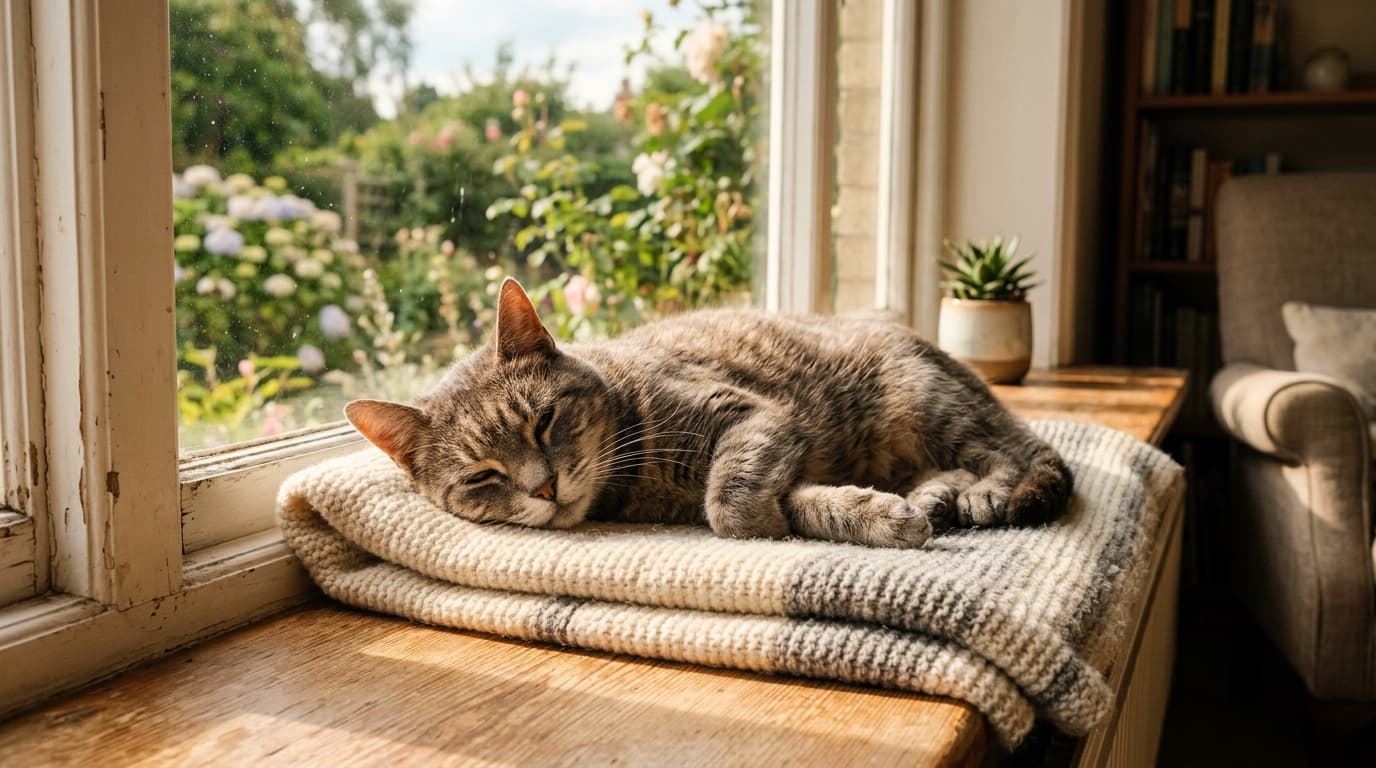
Living Well and Ageing With an Arthritic Cat: The Long View
Alastair Greenway
BVM&S MRCVS
An arthritis diagnosis in an older cat is not the beginning of the end. It is the start of a long, manageable chapter that can run for years of good, comfortable life. This article takes the long view for cats: ageing well, keeping life rich as the years pass, and recognising gently and clearly when the balance begins to change.
Toward the end, this article deals with the harder parts of the journey. Take it at your own pace. There is nothing here you must act on today; it is here to help you think clearly and kindly when the time comes, and to reassure you that the road ahead is, for most cats and for a long while, a good one.
A long chapter, not a countdown
When owners hear that their cat has arthritis, many quietly assume the worst, that this is the start of a decline, that the good years are behind them. I want to answer that directly: for the great majority of cats, an arthritis diagnosis is something to live with, well, for years. It is a manageable condition, not an immediate threat to life.
The cats I have cared for with arthritis have, by and large, gone on enjoying their lives, their sunny spots, their meals, their routines, their people, for a long time after diagnosis. The pain relief, the home adjustments, and the monitoring all exist to make that long chapter a comfortable one. The first thing to hold onto: this is the beginning of a manageable chapter, very probably a long one, not a countdown.
One thread in an ageing cat's health
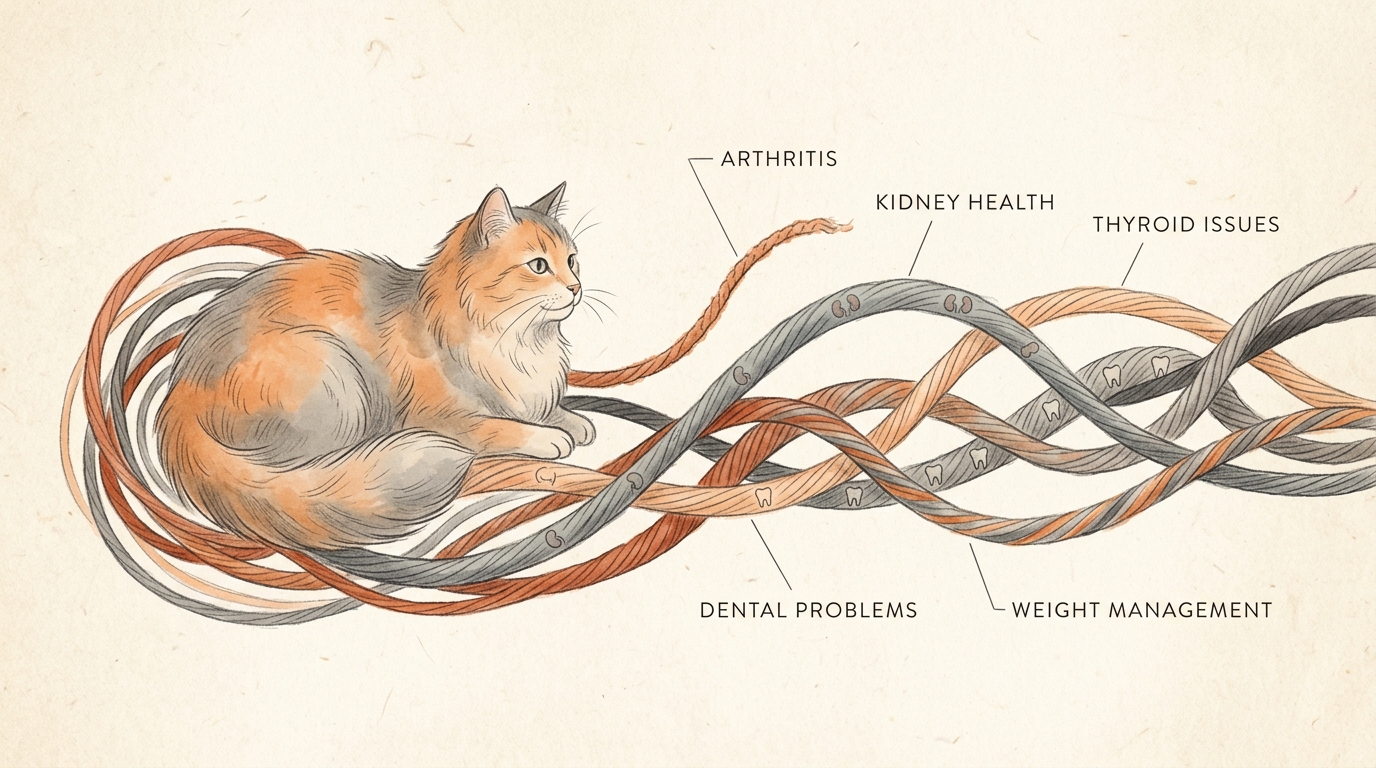
Arthritis in an older cat rarely travels entirely alone, and managing the long view well means caring for the whole ageing cat, not just the joints.
Senior cats are prone to several conditions that often overlap: chronic kidney disease, an overactive thyroid, dental disease, heart disease, weight changes, and the gradual cognitive changes of old age. These frequently coexist with arthritis, and they can blur together, since the same vague signs of "slowing down" can come from any of them. This is partly why arthritis is so often missed in the first place; it hides among the other changes of age.
What this means in practice is that the long view is a whole-cat view. Your vet will want to keep an eye on more than the joints, and conditions interact in ways that matter for treatment, as we discuss in detail in our article on arthritis and kidney disease, where the two most common senior-cat conditions create a genuine balancing act. Managing an arthritic cat well over the years means managing an ageing cat well, attending to the whole animal as the years accumulate.
Keeping life rich as they slow down
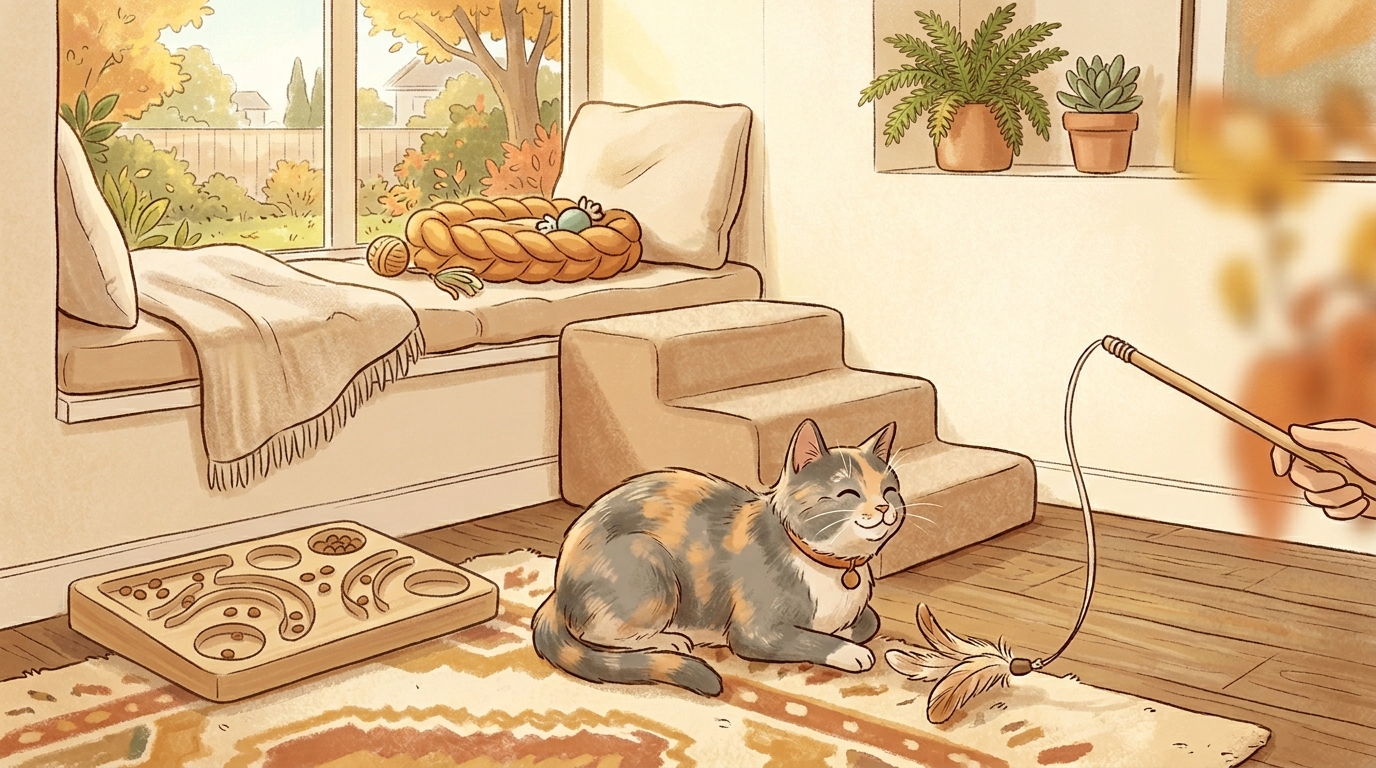
A cat who moves less should not, because of that, experience less. One of the kindest things you can do across the long middle of this journey is to keep your cat's life rich and engaged, adapted to what their older, stiffer body can now manage.
That means protecting the things that make a cat's life feel like a cat's life. Keep favourite high spots reachable with steps or ramps, so a cat who loved a windowsill does not lose it. Keep warmth available, since a warm, soft, accessible resting place is a genuine comfort to stiff joints. Keep gentle play in the routine, with wand toys trailed low along the floor and food puzzles that let a cat hunt at ground level, so the hunting instinct stays satisfied without the leaps that now hurt. Keep their world easy to navigate, with resources close and obstacles removed. Our articles on home modifications and on enrichment go into the practical detail; the principle is simply that a slower life can still be a full one, and keeping it full is squarely in your hands.
This matters for wellbeing more than people sometimes realise. A cat kept gently engaged, warm, comfortable, and included stays more themselves, for longer, than one whose world quietly shrinks to match their reduced mobility. Do not let the world shrink. Adapt it instead.
Looking after yourself, too
A word for you, because caring for a cat through a long condition asks something of the carer. Over years, the medication, the monitoring, the appointments, the watching, and the worry all accumulate, and it is easy to wear yourself down or to feel guilty on the days when you cannot do everything perfectly.
So I will say plainly what I tell owners in the consulting room: this is a marathon, not a sprint, and looking after yourself is part of looking after your cat. Build a routine you can sustain rather than an exhausting ideal. Accept help. Forgive yourself the imperfect days, there will be many over the years, and they do not undo the good you do across all the others. A steady, present carer who is still going strong years from now is worth far more to a cat than a perfect one who burns out. Pace yourself for the long haul.
Telling drift from real decline
Across a long condition, the hardest perceptual task is telling the slow drift of ordinary ageing from a meaningful decline. They can look alike day to day, and because change is gradual, the mind adjusts to it and we stop noticing.
This is exactly where the home monitoring we describe elsewhere earns its keep. An owner who has kept even a light record, of how their cat jumps, grooms, plays, and moves, can look back over months and see the real direction of travel, rather than relying on a memory that quietly recalibrates. A bad week that returns to normal is just the ordinary waxing and waning of arthritis. A genuine, sustained step down that does not recover is the thing to notice, and noticing it in good time, rather than in hindsight, is a kindness to you both. Our article on monitoring your cat at home sets out how to keep that record without it becoming a burden.
Seeing change clearly is not pessimism. It is the attentiveness that lets you adjust care at the right moments, and it means that if the day eventually comes when bigger questions need asking, you will be seeing clearly rather than caught unaware.
Quality of life, for cats specifically
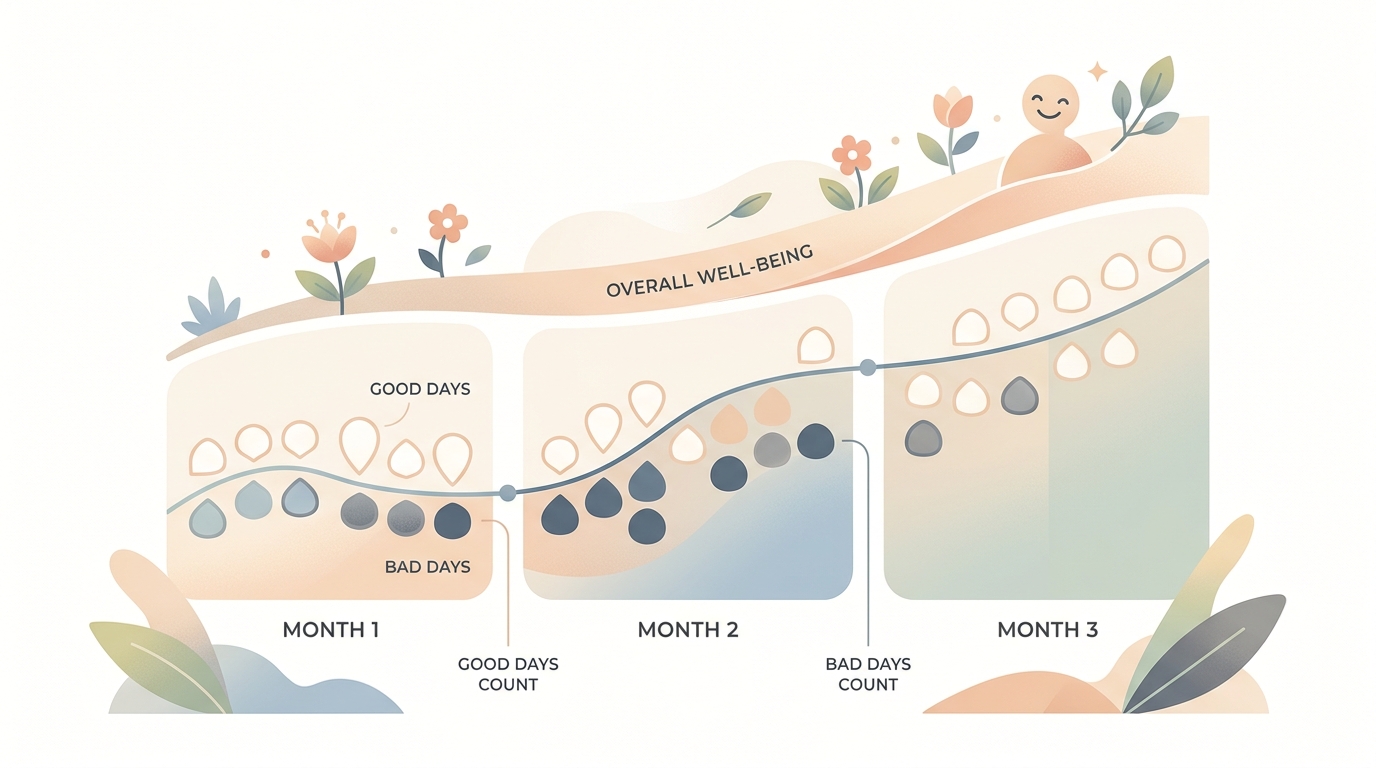
There may come a time, often far down the line, when the central question shifts from "how do we treat this?" to "how is their quality of life, really?" Holding that question gently, and squarely, is part of loving a cat all the way through.
Quality of life means a life that, on balance, holds more comfort than suffering, more good than bad, judged from inside the cat's own experience rather than against the agile young cat they once were. For cats specifically, the signs to weigh are the feline ones: are they still grooming, eating with interest, seeking warmth and company, comfortable more often than not, still doing at least some of the things that make them them? Their famous stoicism makes this genuinely harder to judge than in a dog, which is exactly why structure helps.
Structured frameworks exist to turn an overwhelming question into smaller, answerable ones. The best known is the quality-of-life scale developed by the veterinary oncologist Dr Alice Villalobos, sometimes called the HHHHHMM scale, which asks you to consider, and gently score, dimensions such as hurt, hunger, hydration, hygiene, happiness, mobility, and whether there are more good days than bad. Some owners also find a simple "rule of three" helpful: name the few things your cat most loves, and watch whether they can still enjoy them. These tools do not make the judgement for you, and they are not pass-or-fail tests. They give shape to something that otherwise feels formless, and many owners find that a real comfort. Tracked over time, gently and faithfully, they help you see the trend rather than be ambushed by it.
The same care applies here as in our dog quality-of-life article: this is a structured, ongoing reflection, not a single panicked judgement made on a bad day. Held that way, it becomes a way of paying the right kind of loving attention, not a verdict you dread.
When kindness asks a harder question
Eventually, for some cats, the long view reaches its most difficult point, the question of when continued life is no longer kind. I will not say much here, partly because it deserves the fuller, gentler treatment we give it in our dedicated quality-of-life article, and partly because it is so individual that no article can tell you when.
What I will say is this. If that time comes, you will not face it alone. Your vet is there not only for the medicine but to talk it through plainly, and most will gladly give you that time. The decision, when it comes, is made out of love, to spare suffering, and choosing it at the right time is one of the last and hardest kindnesses we do for the animals who have shared our lives. It is never a betrayal of them. For now, though, that conversation is for later, very probably much later, and only if and when it is needed. Our quality-of-life article is there, gently, when you want it.
An arthritis diagnosis in your cat is not a countdown. It is the start of a long chapter that, managed with care, can hold years of warm, comfortable, contented life, the sunny spots and the quiet companionship and the small daily pleasures that make up a cat's good life. The harder parts come later, if at all, and you will meet them when you need to, with help.
References
- Bellows J, Center S, Daristotle L, et al. Aging in cats: common physical and functional changes. Journal of Feline Medicine and Surgery, 2016.
- Villalobos A. Quality-of-life assessment techniques for veterinarians. Veterinary Clinics of North America: Small Animal Practice, 2011.
- Tatlock S, Gober M, Williamson N, Arbuckle R. Development and preliminary psychometric evaluation of an owner-completed measure of feline quality of life. The Veterinary Journal, 2017.
- Monteiro BP. Feline chronic pain and osteoarthritis. Veterinary Clinics of North America: Small Animal Practice, 2020.
Sister tool · Sightline
Track whether treatment is working
Sightline, a separate ConciergeVet tool, runs a short weekly check-in built on validated pain and mobility instruments, turns it into a single Sightline Score you can watch trend over weeks rather than judge on one bad day, and produces a report you can bring to your vet.
A written log, or our printable trackers, does much the same job.
See how Sightline tracks treatmentSee where your pet stands today
Tracking is the other half of managing arthritis. Take the 2-minute Mobility Check to see your pet's stage, then watch it shift as treatment takes effect.
Take the Mobility CheckYou're not doing this alone
Compare treatment journeys and talk to owners managing arthritis. Free to join.
Join PetsLikeMine