

Keeping Them Happy: Enrichment When Walks Aren't Enough
Alastair Greenway
BVM&S MRCVS
When a dog's walks get shorter, or a cat stops doing its acrobatic laps of the house, owners naturally worry about the physical side. Are they getting enough exercise? Are the muscles wasting? Is the weight creeping on? Those are good questions.
There's a quieter problem that rides along with reduced activity, though, and it gets far less attention than it deserves. A pet whose body has slowed down still has a mind that hasn't. The arthritic dog who used to come home from a two-hour ramble pleasantly tired, mentally satisfied by all the smells and sights and small adventures, now comes home from a ten-minute potter still wide awake and under-stimulated. The cat who used to patrol, hunt, climb and explore now spends far more of the day asleep, not always because they're content, but sometimes because there's little else to do.
Enrichment is the answer here, and I want to make the case strongly. For a pet whose physical activity is restricted, mental and emotional enrichment is not a nice extra. It is essential welfare, one of the most valuable, lowest-cost, most joyful things you can do for an arthritic pet, and it is the subject I most often wish owners asked about more.
Why a slowed-down pet still needs stimulation
Dogs and cats are not built to be idle. They evolved to spend their days solving the problem of staying alive, finding food, navigating territory, using their remarkable senses. We have removed almost all of that work from their lives, and we substitute for it mainly through exercise and play. When arthritis takes a chunk of the physical activity away, it doesn't reduce the underlying need for engagement. It just removes the main way that need was being met.
An under-stimulated pet is not simply bored in the mild way we might be on a dull afternoon. Chronic under-stimulation shows up as real welfare problems: frustration, restlessness, attention-seeking, sometimes destructiveness, sometimes a flat, withdrawn low mood that owners mistake for the pet "just getting old" or "slowing down." Quite often, what looks like the arthritis making a dog dull and quiet is partly the boredom that came with the reduced activity, and that part is very fixable.
There's a lovely double benefit, too. Mental work is genuinely tiring in a good way. A dog who has spent twenty minutes working their nose and brain on a scent game is as satisfyingly tired afterwards as one who has had a much longer walk, without any of the joint loading. For an arthritic pet, that is close to perfect: the satisfaction and the tiredness of a good outing, with none of the wear on the joints.
Engaging the senses while sparing the joints
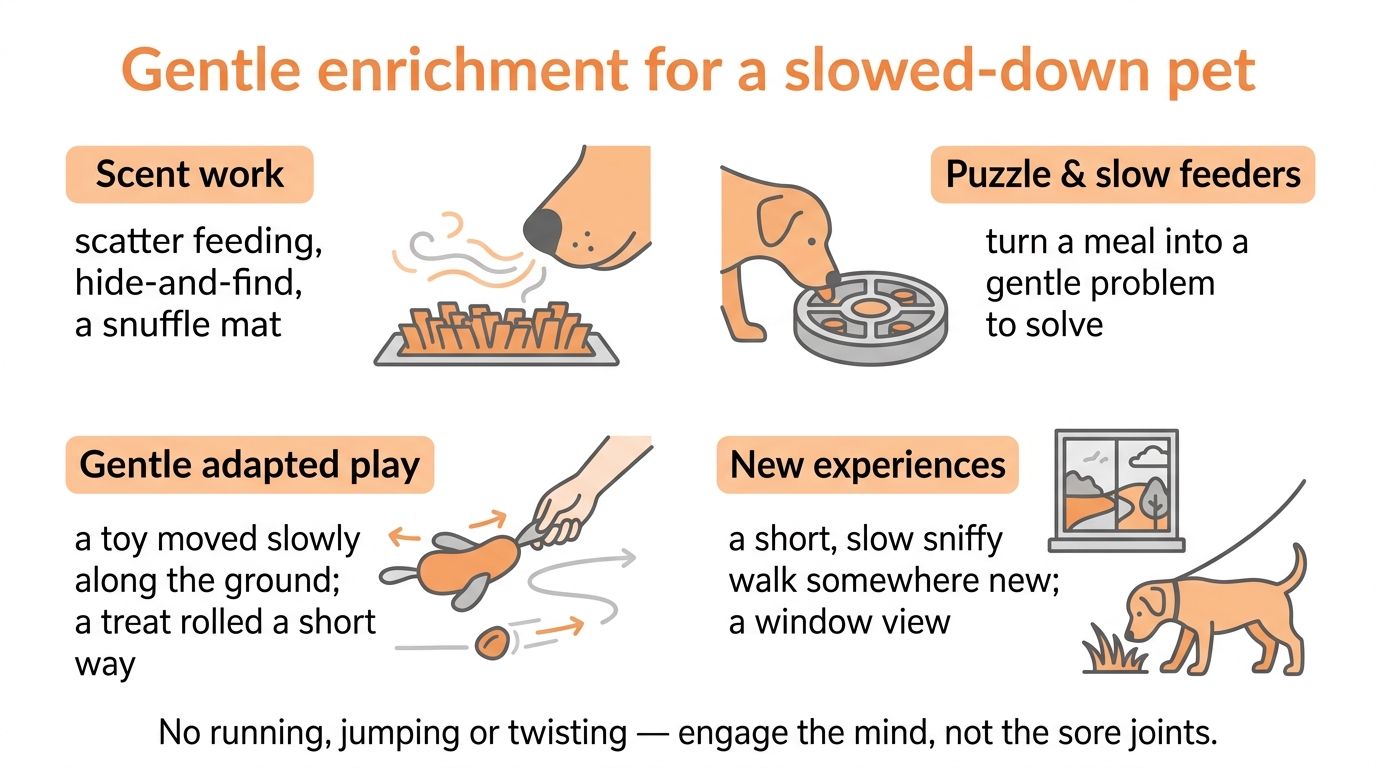
The guiding principle is simple. We are looking for activities that engage the senses and the mind, while asking very little of the painful joints. No running, no jumping, no twisting, no sustained standing if that's hard. Plenty of sniffing, thinking, problem-solving and gentle pottering.
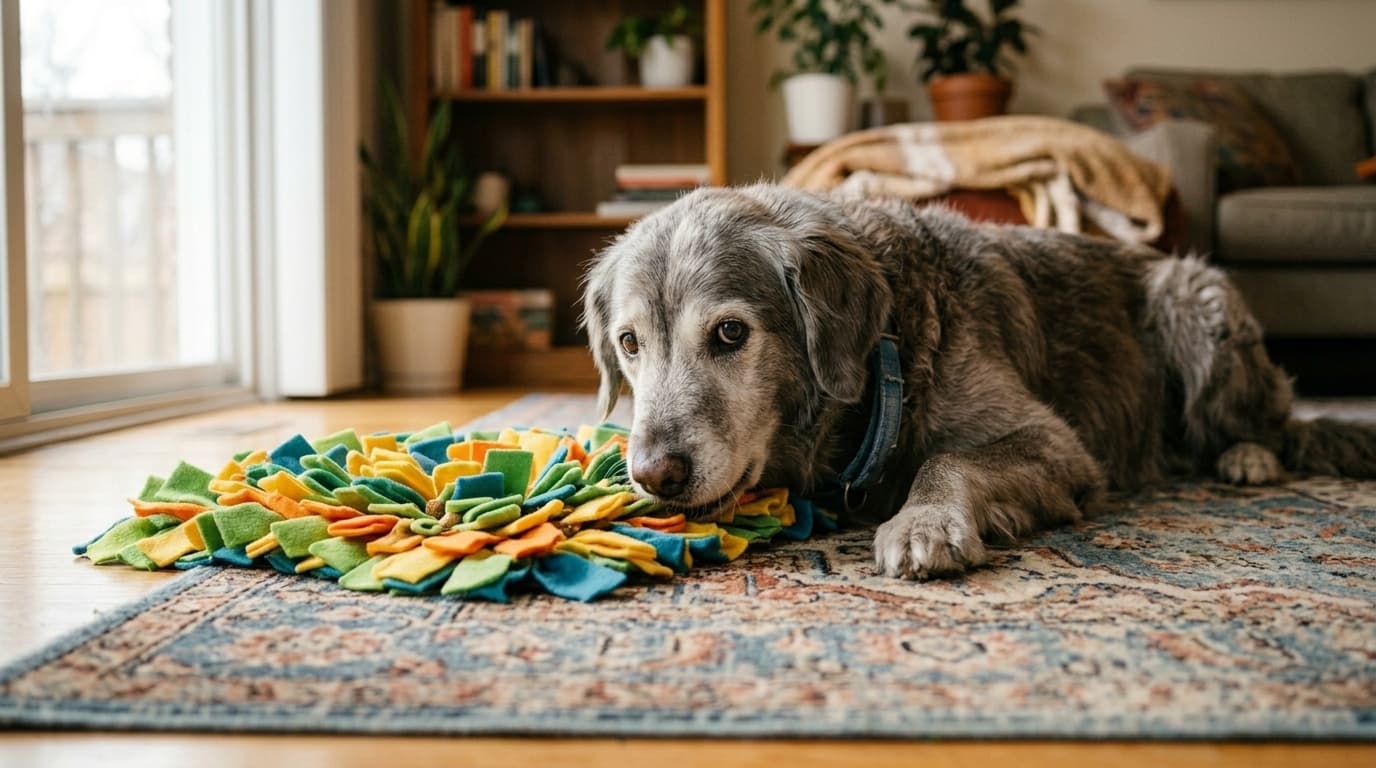
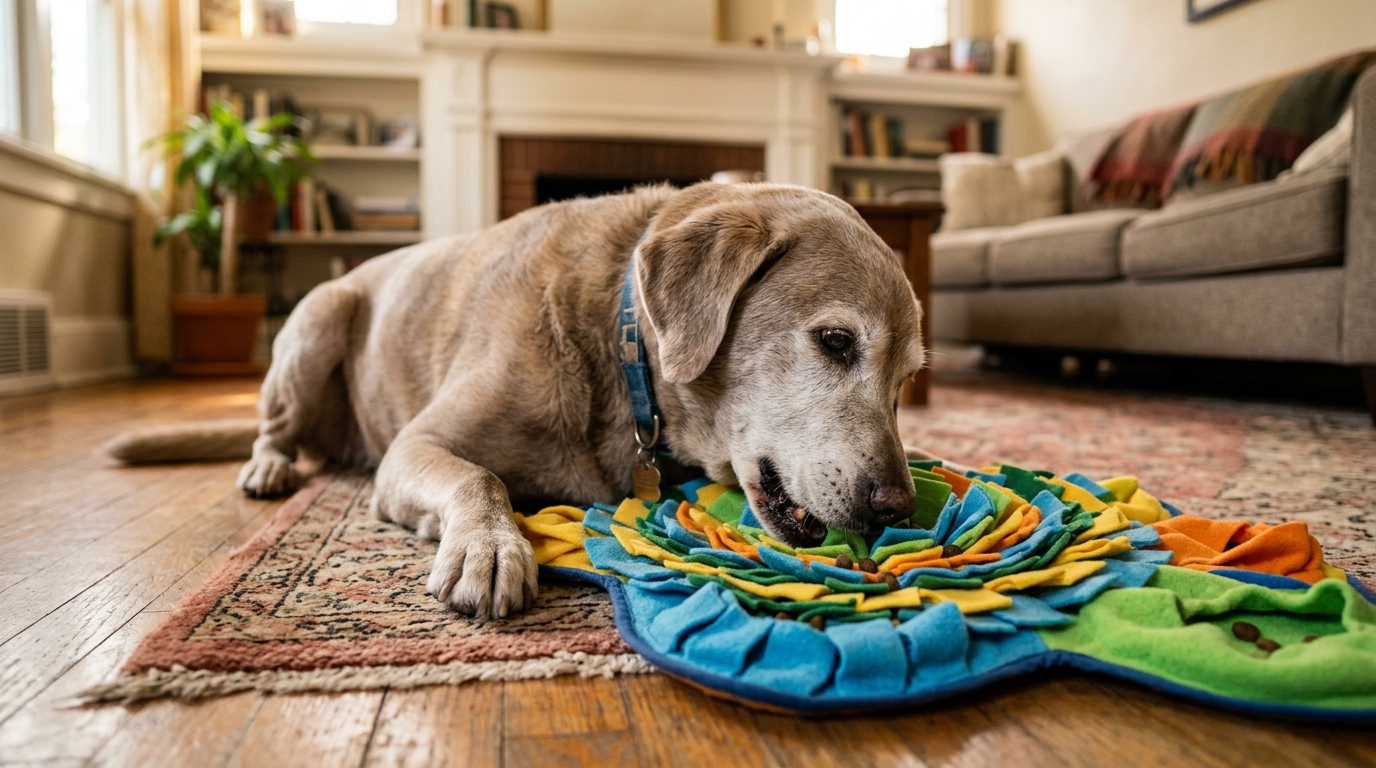
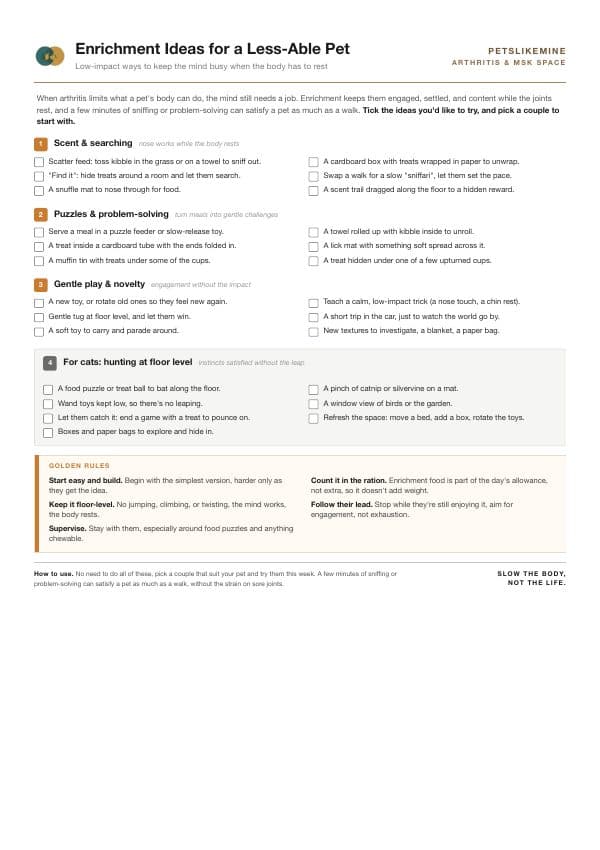
Scent work is the crown jewel. A dog's sense of smell is extraordinary, and using it is deeply satisfying for them. The beauty of scent work for an arthritic dog is that the nose does the work while the body barely moves. Scatter a handful of their food in the grass and let them snuffle it out. Hide treats around a room and let them find them at their own pace. A snuffle mat, a fabric mat with fronds they nose through to find kibble, turns a meal into ten minutes of happy, low-impact searching. None of this asks anything of the joints, and it engages the part of the brain dogs most love to use.
Puzzle feeders and slow feeders turn eating, which already happens, into a problem to solve. Instead of a bowl emptied in thirty seconds, the meal becomes a gentle puzzle that occupies the mind. There are countless designs, from simple to fiendish, and you can make your own with a muffin tin and some tennis balls, or a cardboard box stuffed with scrunched paper and treats. Start easy so they succeed and stay keen, then make it gradually harder.
Gentle play, adapted. Play does not have to mean a frantic game of fetch. A toy moved slowly along the ground for a cat to stalk from a sitting position. A treat rolled a short distance for a dog to amble after. A gentle game of "find it" with a favourite toy. The instinct to play and engage usually survives arthritis perfectly well, even when the body that used to express it needs the game dialled right down.
New experiences, gently. Enrichment isn't only toys and games. It is novelty and interest. A short, slow walk somewhere new, where the point is to stop and sniff rather than to cover ground, is far richer for a dog than a longer trudge round the same old block. A change of route. A window with a view of the garden. A cardboard box to investigate. Variety is genuine enrichment, and much of it costs nothing.
Cats are not just small dogs here either
Feline enrichment deserves its own thought, because cats engage with the world differently and an arthritic cat's needs are easy to overlook.
Cats are predators in miniature, and their enrichment is built around hunting behaviours: stalking, pouncing, batting, capturing. With an arthritic cat, the challenge is to keep those instincts satisfied without asking for the leaps and sprints that now hurt.
Food puzzles work beautifully for cats, perhaps even better than for dogs, because hunting for food is so deeply natural to them. Puzzle feeders and treat balls let a cat "work" for food at floor level. Scattering a portion of dry food for them to find turns a meal into a low hunt.
Wand toys and ground-level play let a cat express the stalk-and-pounce sequence from a comfortable position. Move the toy along the floor rather than flicking it up high, so they can engage without leaping. Let them catch it often, because the satisfaction is in the capture, not the chase.
Scent and texture matter to cats too. Catnip, silver vine, a new cardboard box, a paper bag, a window perch with a view of birds, all provide interest without physical demand. Even rearranging where their resources sit, within the accessibility limits we discussed in the home assessment, can refresh a stale environment.
What you're after for a cat is exactly what you're after for a dog: a mind kept busy and instincts kept satisfied, in a body that is being asked to do very little.
The bond, and the joy of it
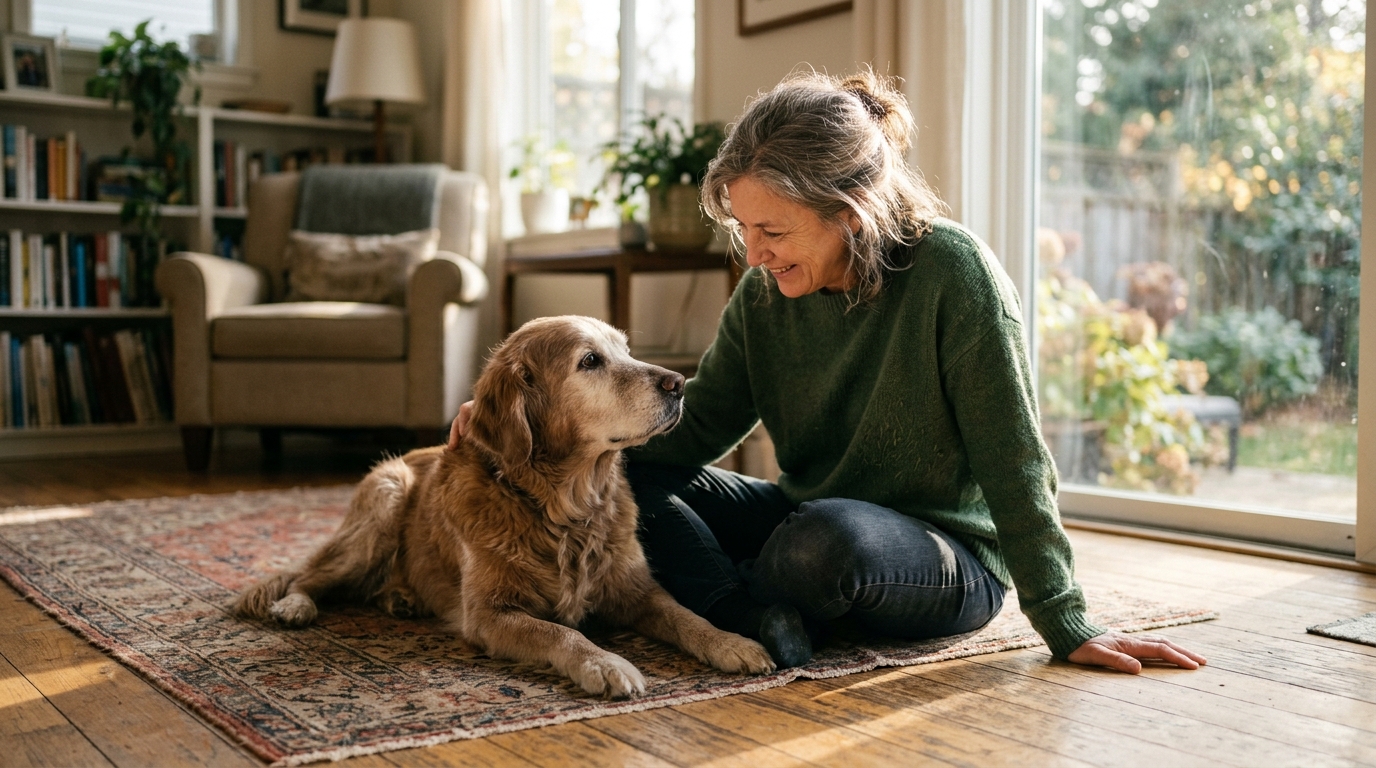
Enrichment is fun, for both of you. So much of caring for an arthritic pet is, by necessity, a bit serious: the medication and the monitoring and the worry. Enrichment is the part that is pure pleasure. Watching a dog's tail go as they work out a puzzle, seeing a cat's eyes go wide as they stalk a toy, sharing the small triumph when they find the hidden treat. These are joyful moments, and they are good for you as much as for them.
They also deepen the bond at exactly the time it matters most. An arthritic pet, less able to initiate the activity they used to, can become a more passive presence in the home, and the relationship can quietly flatten into one of care rather than companionship. Enrichment keeps the companionship alive. It gives you things to do together that you both enjoy, beyond the management. It keeps your pet an active participant in their own life rather than a patient being looked after.
When the walks get shorter, do not let your pet's world get smaller to match. Fill the space the lost activity left with scent and puzzle and gentle play and novelty and your attention. A pet whose body has slowed but whose mind is still engaged, still curious, still having small daily adventures, is a pet living well. And keeping them happy this way is one of the genuine pleasures of the long chapter you are in together.
The next articles in this stage turn to the harder parts of the journey. But right in the middle of the serious business of management, there is joy still to be had, and providing it is squarely in your hands.
Free downloads
Companion worksheets to put what you've read into practice. Free PDFs, print at home.
Sister tool · Sightline
Track whether treatment is working
Sightline, a separate ConciergeVet tool, runs a short weekly check-in built on validated pain and mobility instruments, turns it into a single Sightline Score you can watch trend over weeks rather than judge on one bad day, and produces a report you can bring to your vet.
A written log, or our printable trackers, does much the same job.
See how Sightline tracks treatmentSee where your pet stands today
Tracking is the other half of managing arthritis. Take the 2-minute Mobility Check to see your pet's stage, then watch it shift as treatment takes effect.
Take the Mobility CheckYou're not doing this alone
Compare treatment journeys and talk to owners managing arthritis. Free to join.
Join PetsLikeMine