

How Feline Arthritis Is Diagnosed: Why There Is No Single Test
Alastair Greenway
BVM&S MRCVS
There is no blood test or single scan that diagnoses arthritis in a cat. The diagnosis is a piece of detective work: your story, a careful examination, an X-ray that tells only part of the truth, and sometimes a treatment trial that proves the point. Here is how vets actually reach the diagnosis, and why it takes more than a picture.
Most owners expect diagnosing arthritis to come down to a single, definitive moment, a blood result, or an X-ray that lights up the problem. When that does not happen, it can feel unsatisfying, even as though the vet is unsure. So I want to explain how the diagnosis is genuinely made, because understanding it will make the whole process make sense, and will show you why some of the more surprising parts, like a treatment trial counting as a diagnostic step, are not guesswork at all but sound clinical reasoning.
Why there is no single test
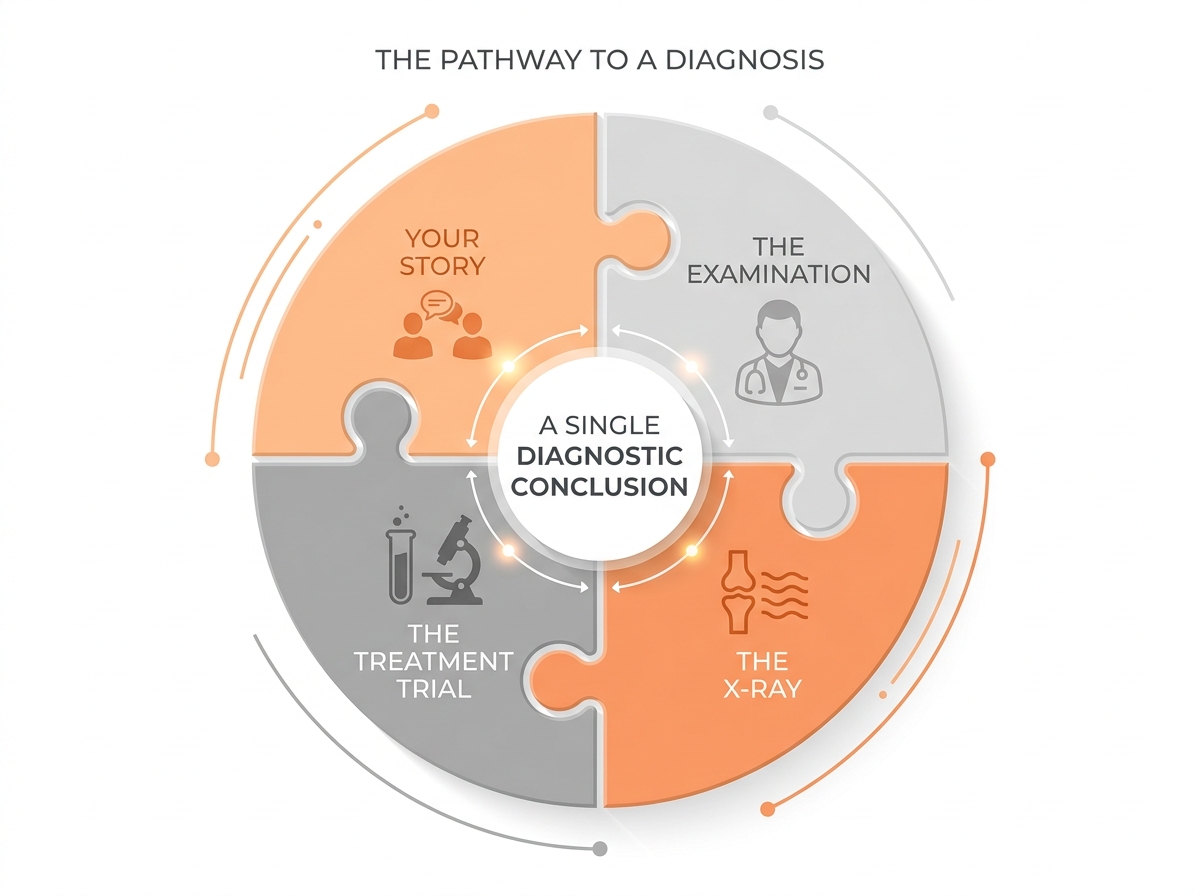
Let me start with the central fact. There is no one test that confirms arthritis in a cat. The diagnosis is built, like a picture assembled from several pieces, from your account of what is happening at home, a careful physical examination, the interpretation of X-rays, and sometimes the cat's response to a trial of pain relief. No single one of these is definitive on its own; it is the way they fit together that produces the diagnosis.
This is not a weakness of veterinary medicine. It is simply the nature of this particular disease in this particular species. Cats are subtle, stoic, and difficult to examine when stressed, and arthritis in cats does not announce itself the way a broken leg does. So the diagnosis is a considered conclusion drawn from several lines of evidence, not a single readout. Once you see it that way, the rest follows.
Your history is the first and best evidence
The most valuable piece of the picture is something only you can provide: the story of what your cat is doing at home. Because the signs of feline arthritis are behavioural and show themselves in the cat's normal life, and because the cat will hide them at the clinic, your observations are not just helpful background, they are central evidence.
What the vet most wants to hear is how your cat's life has changed. Are they jumping less, or taking the journey up in stages? Hesitating at the stairs? Grooming less, with a scruffier coat? Having trouble with the litter tray? Sleeping more, playing less, hiding, or becoming grumpy when handled? These everyday observations are exactly the material a diagnosis is built from, which is why the home video and notes we describe in our monitoring article, and the way to bring them to the appointment we cover in our cat-friendly visit article, matter so much. A good history does more to point toward arthritis than almost anything that happens in the consulting room. You are the most important witness.
What a hands-on exam shows, and where it falls short in cats
Next comes the physical examination. The vet will feel the joints and move the limbs, checking range of motion, feeling for thickening or grating within a joint, and watching for signs of pain or resistance on manipulation. In a cooperative cat, this can reveal a great deal.
But the examination has real limits in cats, and it is only fair to acknowledge them. To begin with, feline arthritis is usually present on both sides of the body at once, so there is often no helpful asymmetry, no obvious limp on one leg, to point the way. Then there is stress, which blunts the exam: a frightened cat tenses every muscle, resists handling, and masks the very pain we are trying to detect, so a tense clinic cat can examine far more normally than they really are. And the correlation between what we can feel on examination and the true extent of disease is imperfect. So the examination contributes to the picture, but, like the history, it is a piece rather than the whole.
What the X-ray can and cannot tell you
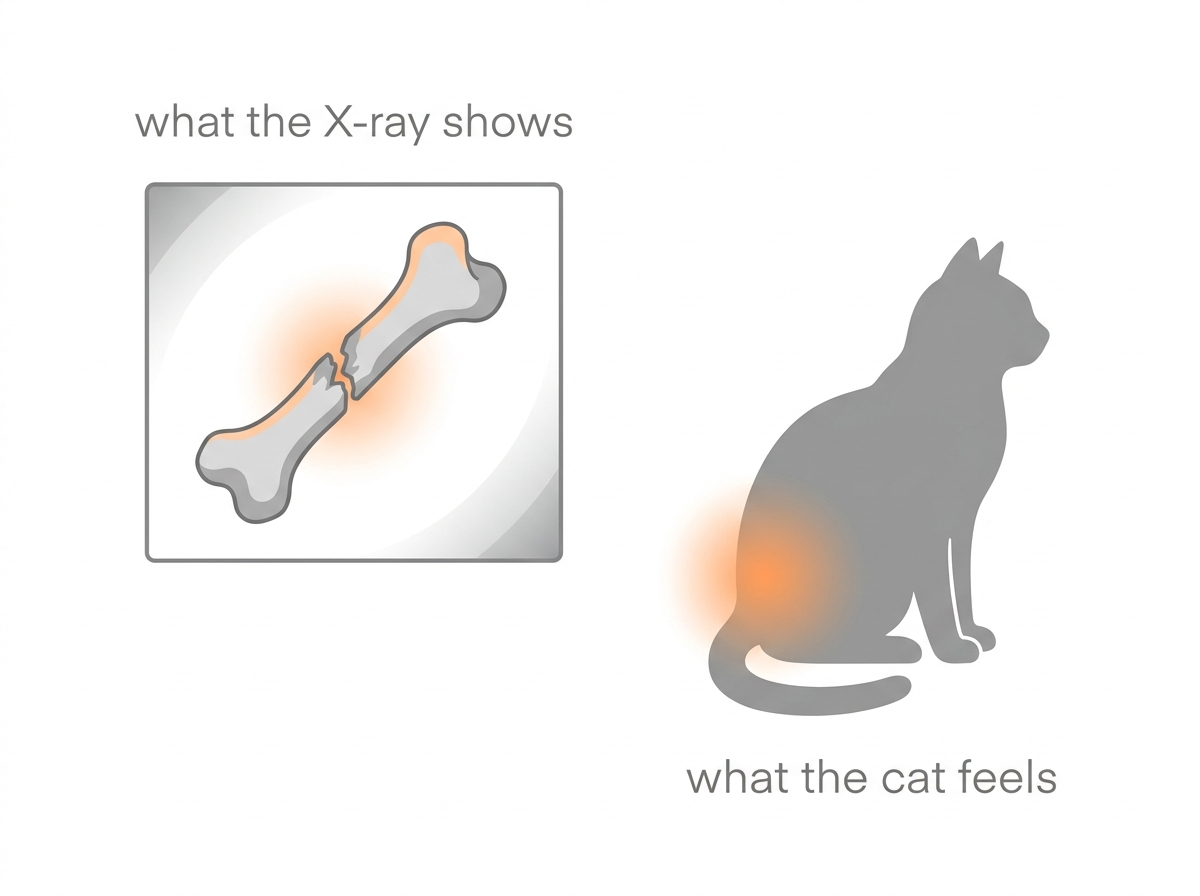
This part catches owners off guard, so it is worth being very clear. An X-ray does not simply confirm or rule out painful arthritis in a cat.
X-rays show structural change in the bones and joints, and they are genuinely useful. But two real limitations come with them. The first is that the appearance on the X-ray correlates poorly with how much pain a cat is actually in: a cat with dramatic-looking changes may be coping well, while a cat with modest-looking films may be very sore. Cats also tend to form less obvious radiographic change than some other species, which makes the films harder to read. The second follows from this: a normal-looking X-ray does not exclude painful arthritis, and a dramatic one does not by itself prove that the arthritis is the source of the cat's problem.
So why do vets take X-rays at all? For good reasons, just not the one owners assume. They help rule out other conditions that might explain the signs, they are important if surgery is ever being considered, and they add to the overall picture. What they do not do is serve as a single "confirm pain" test. Understanding that prevents a common disappointment, the sense that "the X-ray was normal so it can't be arthritis," which simply is not how feline arthritis works.
The treatment trial as a diagnostic tool
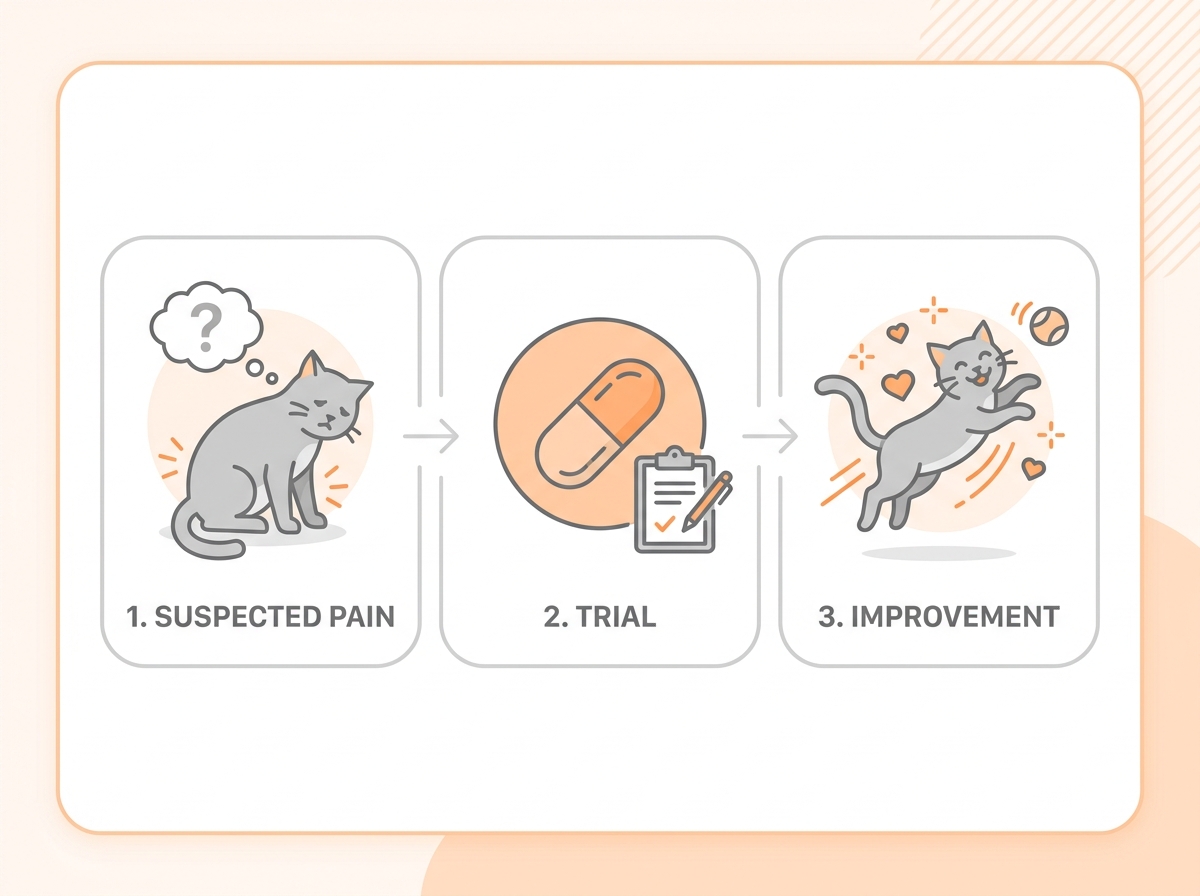
Now for the step that sounds least like a diagnosis and is in fact one of the most useful. A carefully monitored trial of appropriate pain relief is a legitimate, well-established way to help confirm arthritis pain in a cat.
The logic is simple and sound. If we suspect arthritis from the history and examination, and we give appropriate pain relief under veterinary direction, and the cat then does more, moves more freely, and seems happier, that improvement is itself diagnostic information: it tells us the cat was in pain and that the pain responds to treatment. This approach has been studied formally, with owners assessing their cats' behaviour before and after analgesic treatment and reporting clear changes. Far from being a guess, the response to a properly conducted trial is real evidence, and it sidesteps the limitations of both the exam and the X-ray by going straight to the question that matters: is this cat in pain that we can relieve?
It is, of course, a trial conducted by your vet, with the right medication, dose, and monitoring, not something to attempt yourself. But if your vet proposes one, understand that it is a recognised and sensible diagnostic step, not a shot in the dark.
Ruling out the mimics, and the company arthritis keeps
A good diagnosis also means considering what else could explain the signs, and recognising what often comes alongside arthritis. The vague changes of feline arthritis, slowing down, hiding, eating or grooming differently, overlap with several other conditions common in older cats: chronic kidney disease, an overactive thyroid, dental disease, and high blood pressure among them.
These conditions both mimic arthritis, producing similar vague signs, and frequently accompany it, since they share the same older population. This is why your vet will often run a broader senior health work-up, blood and urine tests and blood pressure, alongside assessing the joints, rather than looking at the joints in isolation. It is also why the interaction between arthritis and these other conditions matters so much for treatment, as we discuss in detail in our article on arthritis and kidney disease. Diagnosing the arthritis well means seeing it in the context of the whole ageing cat.
Putting the picture together
So the diagnosis comes together like this: your history raises the suspicion and provides the richest evidence; the examination adds what it can, within its limits; the X-ray rules things out and fills in structural detail without being a pain test; a monitored treatment trial can confirm that suspected pain is real and treatable; and the whole is interpreted against the backdrop of the other conditions of older cats.
One last point matters as much as any of the others: the diagnosis is a working conclusion, not a closed verdict. Feline arthritis is managed and monitored over time, and the picture is revisited as the cat responds to treatment and as the years pass. An initial diagnosis is the start of an ongoing, adjustable understanding of your cat, supported by the home monitoring you do between visits, rather than a single label fixed forever. That is not vagueness; it is good medicine, matched to a subtle disease in a subtle species. Understanding how the diagnosis is reached lets you be the most useful partner in reaching it, and the best evidence of all starts with you, watching at home.
References
- Bennett D, Zainal Ariffin SM, Johnston P. Osteoarthritis in the cat: 1. how common is it, and how easy to recognise? Journal of Feline Medicine and Surgery, 2012.
- Lascelles BDX, Dong YH, Marcellin-Little DJ, et al. Cross-sectional study of the prevalence of radiographic degenerative joint disease in domesticated cats. Veterinary Surgery, 2010.
- Bennett D, Morton C. A study of owner observed behavioural and lifestyle changes in cats with musculoskeletal disease before and after analgesic therapy. Journal of Feline Medicine and Surgery, 2009.
- Enomoto M, Lascelles BDX, Gruen ME. Development of a checklist for the detection of degenerative joint disease-associated pain in cats. Journal of Feline Medicine and Surgery, 2020.
- Lascelles BDX, Robertson SA. DJD-associated pain in cats: what can we do to promote patient comfort? Journal of Feline Medicine and Surgery, 2010.
Sister tool · Sightline
Track whether treatment is working
Sightline, a separate ConciergeVet tool, runs a short weekly check-in built on validated pain and mobility instruments, turns it into a single Sightline Score you can watch trend over weeks rather than judge on one bad day, and produces a report you can bring to your vet.
A written log, or our printable trackers, does much the same job.
See how Sightline tracks treatmentSee where your pet stands today
Tracking is the other half of managing arthritis. Take the 2-minute Mobility Check to see your pet's stage, then watch it shift as treatment takes effect.
Take the Mobility CheckYou're not doing this alone
Compare treatment journeys and talk to owners managing arthritis. Free to join.
Join PetsLikeMine