

How Dogs Hide Pain: Why You're Not Failing as an Owner
Dr. Alastair Greenway
MRCVS, 25 years clinical experience
When an owner finds out their dog has been in pain for months or years before they realised, the response is usually some variation of the same thing. "I should have known. I'm a terrible owner. How did I miss this?"
I want to address that directly, before we go any further.
You're not a terrible owner. You missed the signs because dogs are extraordinarily good at hiding pain. Vets miss it too, frequently. Behaviourists miss it. Trainers miss it. People who have had dogs their whole lives miss it. The signs of chronic pain in dogs are designed to be missed, both by evolution and by the nature of how the condition progresses. If you missed them, you're in the company of essentially every dog owner who has ever lived.
This article is about understanding why dogs hide pain, what that means for how you observe your dog, and how to develop the kind of attentive awareness that catches changes earlier in the future. It's also, frankly, an article about letting go of the guilt that almost every owner feels at this stage.
Why dogs hide pain in the first place
To understand why your dog has been quietly carrying around discomfort, you need to understand a bit about how their brains work.
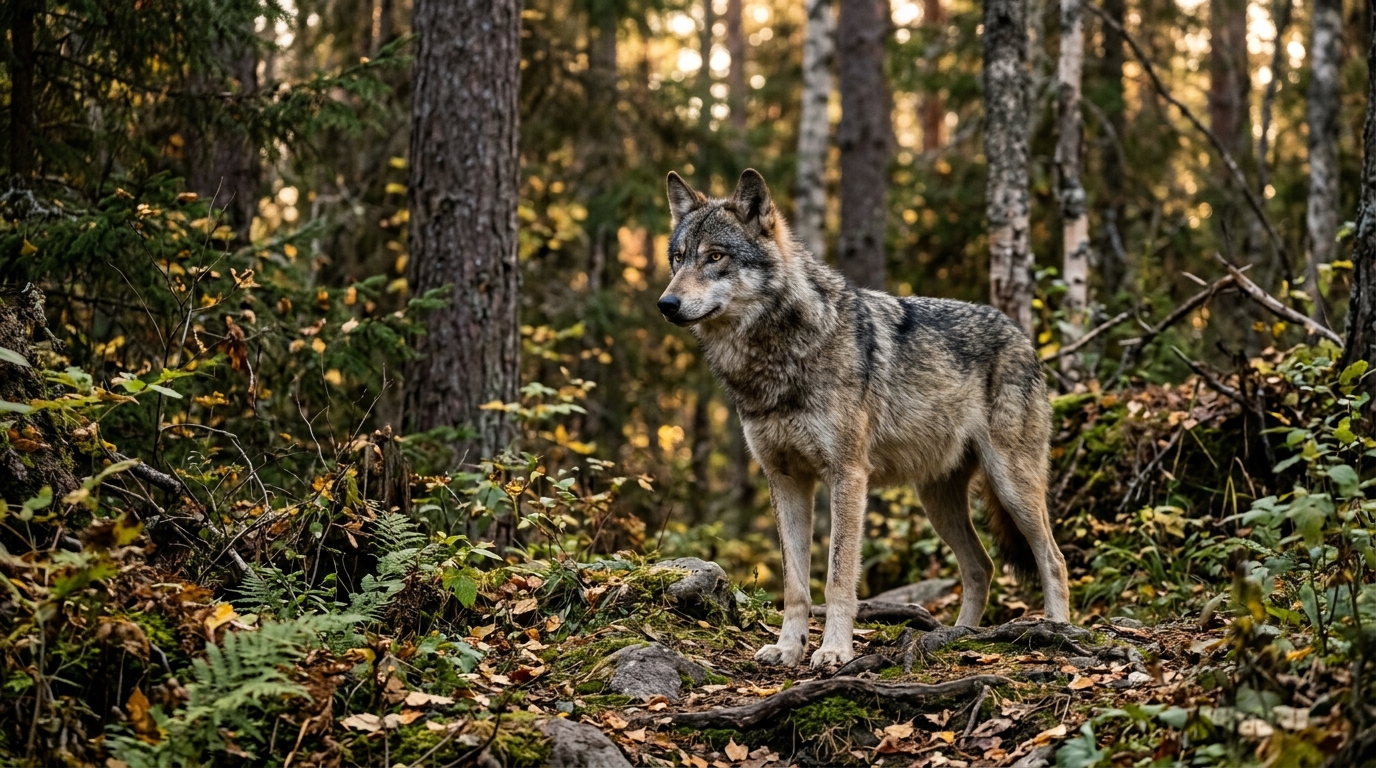
Dogs descended from wolves, and wolves are both predators and prey. In a wild context, displaying weakness has serious consequences. A predator showing pain becomes less effective at hunting. A pack animal showing weakness risks losing social status, being driven from the group, or becoming a target for rivals. A vulnerable animal becomes prey for larger predators. Across millions of years of evolution, the animals who masked discomfort survived to reproduce. The ones who advertised their pain didn't.
This instinct hasn't gone away in our domestic dogs. The pampered Labrador on the sofa is running the same evolutionary software as a wolf in the wilderness, even if there's nothing in the lounge that's going to eat them. The instinct to hide pain is hardwired, and it persists regardless of how safe and loved your dog is.
Different breeds express this differently. Working dogs, terriers, and many of the more stoic temperaments tend to hide pain extraordinarily well. They were selected, over generations, for their ability to keep working through discomfort. A working sheepdog who limped home from every long day in the hills wouldn't have been the dog you chose to breed from. So we have, perhaps unintentionally, created lines of dogs that suppress pain expression even more than their ancestors did.
This is why some dogs with significant arthritis present with almost no obvious signs. Their genetic makeup tells them to suck it up and get on with things. The pain is real and substantial, but it's filtered through a temperament that was built not to show it.
Acute pain and chronic pain look nothing alike
There's an important distinction that explains a lot of why owners miss arthritis pain.
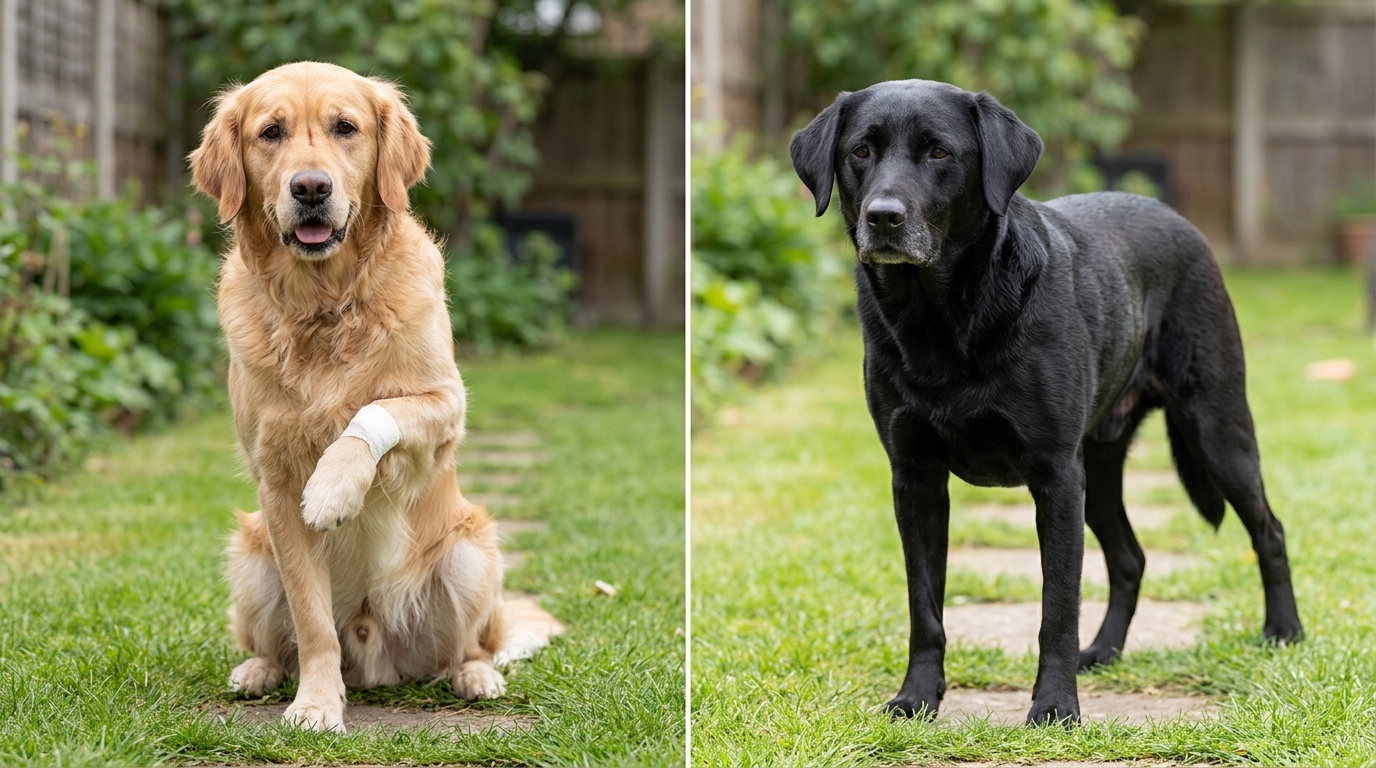
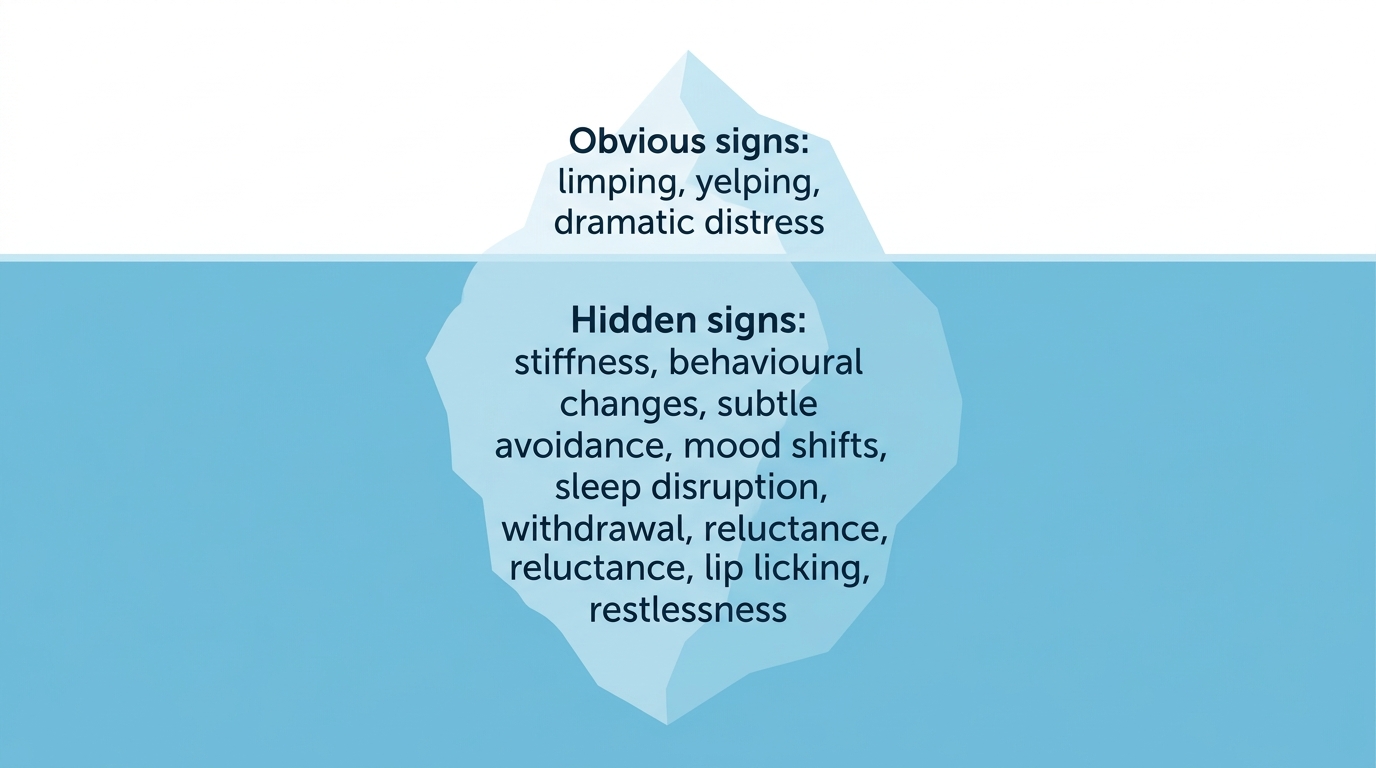
When a dog experiences acute pain, the kind that comes on suddenly from an injury, the response is often dramatic and obvious. They yelp, they limp dramatically, they hold the leg up, they may snap if you touch the affected area. This is the picture of "a dog in pain" that most people carry in their heads. It's vivid, it's hard to miss, and it prompts an immediate response.
Chronic pain is completely different.
When pain has been present for weeks, months, or years, it becomes the dog's baseline. They don't yelp because there's nothing new to yelp at. They don't limp dramatically because limping would slow them down without changing anything. They learn to live with it, and their body and behaviour adapt to function around the discomfort.
This adaptation is so successful that even vets sometimes underestimate how much pain a chronic arthritis patient is in. The dog walks reasonably well into the consultation room. They don't cry out during examination. There's no obvious distress. It's only when you start asking the right questions and looking for the subtle signs that the picture becomes clear.
The implication is important: the absence of obvious pain signs does not mean the absence of pain. A dog who isn't yelping or limping dramatically may still be in significant chronic discomfort. They've just adapted.
Vocalising or crying out is actually quite uncommon with chronic pain. The pain is constant, which normalises the condition, so most dogs won't cry or whimper unless the pain is severe or the onset is sudden. Many dogs won't vocalise even then. The complete absence of vocal signs of distress tells you essentially nothing about whether your dog is in pain.
Why owners are particularly placed to miss it
It's not just that dogs hide pain. It's that owners are uniquely positioned to miss what they are showing.
Gradual change is invisible. Arthritis progresses over months and years. Each individual day, your dog moves and behaves very similarly to the day before. The change happens too slowly to register. It's only when you look back at videos from a year or two ago, or at the way your dog moved when they were younger, that the cumulative shift becomes obvious.
This is the same reason we don't notice our children growing. Day to day, no change. Six months later, they're suddenly an inch taller. With arthritis it's the same. The dog you see today is essentially the same as yesterday, but the dog of two years ago was a different creature entirely.
You're not in a comparison situation. A vet examining a strange dog can compare what they see against thousands of other dogs they've examined. An owner sees mostly one dog. You don't have a mental database of normal. Your dog's slightly stiff way of getting up is just how they get up.
You're emotionally invested. It's genuinely hard to accept that your dog is in pain. There's a powerful psychological pull towards more benign explanations. "She's just getting old." "He's been a bit lazy lately." "She's never been a morning dog." These explanations let you not have to acknowledge that your dog is suffering, which is something none of us wants to acknowledge.
You see them differently than others do. Friends and family who haven't seen your dog for a while often notice changes you've missed. "She seems slower than last time I saw her." "Is he limping?" These outside observations can be jarring because the person seeing your dog less often is using a comparison point months in the past, while you've been gradually recalibrating without realising.
The signs themselves are subtle. As I covered in detail in our article on signs most owners miss, much of what indicates chronic pain in dogs looks like personality, mood, or "just being a dog." Lip licking. Yawning. Slight reluctance to engage. Subtle changes in play. None of these scream "pain" until you know to look for them.
None of this is your fault. It's the structure of the situation. The signs are designed to be missed, the progression is designed to be invisible, and the natural human response is to choose explanations that don't require you to confront difficult truths. This isn't moral weakness. It's how humans work.
What pain actually does to your dog's behaviour
Chronic pain is not just a physical sensation. It changes how dogs experience their entire lives.
Mood and personality changes. A dog in chronic pain often becomes a slightly different version of themselves. Less playful. More irritable. Quicker to react to small annoyances. More withdrawn. More clingy. Different dogs respond differently. Some become more demanding of attention. Others retreat. But almost universally, chronic pain dulls the brightness of the dog you knew.
Sleep disruption. Pain interferes with comfortable rest. Your dog may shift position frequently, get up and lie down repeatedly, sigh or groan when settling, or sleep in different positions than they used to. The reduced rest then compounds the pain, because joints stiffen up further during the night and the dog is starting each day from a worse position.
Reduced engagement with the world. A dog in pain often stops doing the things that defined them as a dog. The toy that used to come out every evening sits unused. The walk that was the highlight of the day becomes a chore. The greeting at the door becomes less enthusiastic. They're not depressed in the human sense, but they've quietly disengaged from parts of their own life.
Anxiety and reactivity. Chronic pain frequently increases anxiety. The dog who used to be confident becomes uncertain. The dog who tolerated handling becomes prickly. The dog who loved other dogs becomes wary, particularly of younger or more boisterous ones who might bump into them. This often gets misinterpreted as a behavioural problem and addressed with training, when the underlying issue is pain.
This last point is worth dwelling on. A significant proportion of "behavioural problems" in older or middle-aged dogs are actually pain-driven. Aggression in a previously friendly dog. Reactivity that wasn't there before. Reluctance to be handled. Avoidance of stairs or jumping. Snapping at children or other dogs. These can all be signs of pain rather than personality flaws.
If you've been working on behavioural issues with your dog and not making the progress you expected, it's worth asking whether pain might be a factor. Many behaviourists now routinely screen for orthopaedic and other pain conditions before doing significant behaviour work. The success rate of behaviour modification rises dramatically once underlying pain is addressed.
You're not failing your dog now
If you're reading this far, you've crossed a threshold that most dog owners never cross. You're learning about chronic pain in dogs. You're trying to understand what your dog has been experiencing. You're equipping yourself to be a better advocate.
This is not what failing dog owners do. Failing dog owners assume their dog is "just getting old" and never investigate further. They don't seek out information. They don't think critically about behavioural changes. They don't consider whether their dog might be in pain. You're not doing any of those things.
Whatever happened before today is in the past. The walks your dog struggled through that you didn't realise were too long. The exercise you encouraged that was actually painful. The behavioural quirks you attributed to personality that were actually discomfort. All of it. Done.
What matters is what happens now. And from this point forward, you're going to be paying attention. You're going to notice things you missed before. You're going to advocate for your dog with their vet. You're going to make decisions based on a clearer understanding of what your dog is experiencing.
That isn't failure. That's growth.
Training a better eye for pain
Encouragingly, the skill of recognising subtle pain signs can be developed. Most owners, once they understand what they're looking for, get dramatically better at spotting it. A few habits build that eye.
Establish a baseline. Spend a week or two really paying attention to how your dog moves, behaves, and engages with life. Take videos. Make notes. Get specific. How quickly do they rise from a lying position? How do they posture when they sit? Do they jump onto the sofa or scramble? How long are walks before they show any reluctance? What's their normal pattern of play? This baseline is your reference point for spotting changes.
The real difficulty with baselines is that most of us don't actually do this. We mean to. Then a fortnight passes and the notes are scrappy or non-existent. That's part of why we built Sightline. Sightline (sightline.vet) is a separate ConciergeVet tool that runs a short adaptive weekly questionnaire and turns it into a tracked score over time, so a baseline accumulates almost passively from the answers you've already given.
I'm not suggesting you need an app to do this. A pinned note on your phone, dated, with five lines a week, works just as well if you stick to it. The point is that the dog in your head a year ago is different from the dog in front of you today, and you need some trail of evidence to see that drift. Pick whichever method you'll actually keep up.
Watch transitions and positions. Many subtle pain signs show up not in steady movement but in transitions. Standing up. Lying down. Stepping onto and off the sofa. Getting in and out of the car. Climbing in and out of the bath. Each of these requires specific coordinated movement, and a dog avoiding pain in a particular joint will often show subtle reluctance, hesitation, or compensation in these moments.
Notice what's missing. Often the most important sign isn't what your dog is doing but what they're no longer doing. The toy they don't pick up anymore. The greeting they don't perform. The chase they don't initiate. The sleeping spot they no longer use. Pay attention to absences as well as presences.
Track outside events that change behaviour. What does your dog do after a longer walk? After playing more vigorously? After sleeping in a colder room? Notice the relationships between activity and subsequent comfort. A dog who's fine during exercise but stiff the next morning has done too much. A dog who recovers within an hour is more resilient. These patterns tell you a lot.
Use video systematically. Once every couple of months, take a short video of your dog walking, rising from rest, going up a step, and turning. Date it. Save it. Compare across the videos over time. This is the single most reliable way to spot gradual changes that day-to-day observation misses. That same footage can also be analysed objectively, turning a set of clips into comparable data rather than relying on impression alone.
Trust other people's observations. When friends, family, or your vet remark on something that surprises you ("She seems stiff today"), don't dismiss it. They're seeing your dog with fresher eyes. Their observations are worth taking seriously.
Learn the subtle signals. Lip licking when handled in a particular spot. Slight turning away from a touch. A pause before climbing onto something they used to manage easily. An almost imperceptible hesitation. Once you know to look for these, you start to see them.
A practical exercise: today

Do this small exercise. Find your dog. Watch them for a few minutes without doing anything else. Just watch.
How are they lying? Are they shifting position? Is one leg sticking out at an odd angle that suggests it's uncomfortable folded under?
If they're awake, call them gently. How quickly do they respond? How do they get up? Are they using a particular leg to push off? Is there a slight pause before they commit to rising?
Walk them slowly across the room. How do they place their paws? Are they shifting weight evenly? Does their pace look natural?
Touch them gently along their back, down each leg, around their hips and shoulders. Watch their face. Do they pull away from any particular area? Do they lip lick or yawn during the examination? Do they tense slightly?
You may notice things you've never paid attention to before. Or you may confirm that your dog is moving and responding normally. Either way, you've now done something most owners never do: deliberately observed your dog for signs of discomfort. That habit, repeated weekly or even daily, transforms your awareness.
When pain has been chronic
For dogs whose arthritis has been present and unrecognised for a long time, there's an additional dimension worth understanding.
When pain has been present in the nervous system for months or years, the nervous system itself starts to change. Pain pathways become more efficient at firing. The spinal cord becomes more sensitised. The brain becomes more attentive to pain signals. This process, called central sensitisation, means that the experience of pain becomes more intense even if the underlying joint damage isn't progressing.
This is why some dogs respond beautifully to medication and others, with apparently similar joint changes, respond much less well. The dogs whose pain has been managed early haven't developed the sensitisation. The dogs whose pain has been chronic for years have, and their pain is now harder to treat.
The practical implication is that if your dog has been in unrecognised pain for a long time, you may need a more multimodal approach to pain management than a dog whose pain was caught early. This doesn't mean their pain can't be controlled. It usually can be. It just means we may need to use several different medications and approaches together rather than relying on a single intervention.
We cover this in more detail in our article on chronic pain and central sensitisation.
The forgiveness step
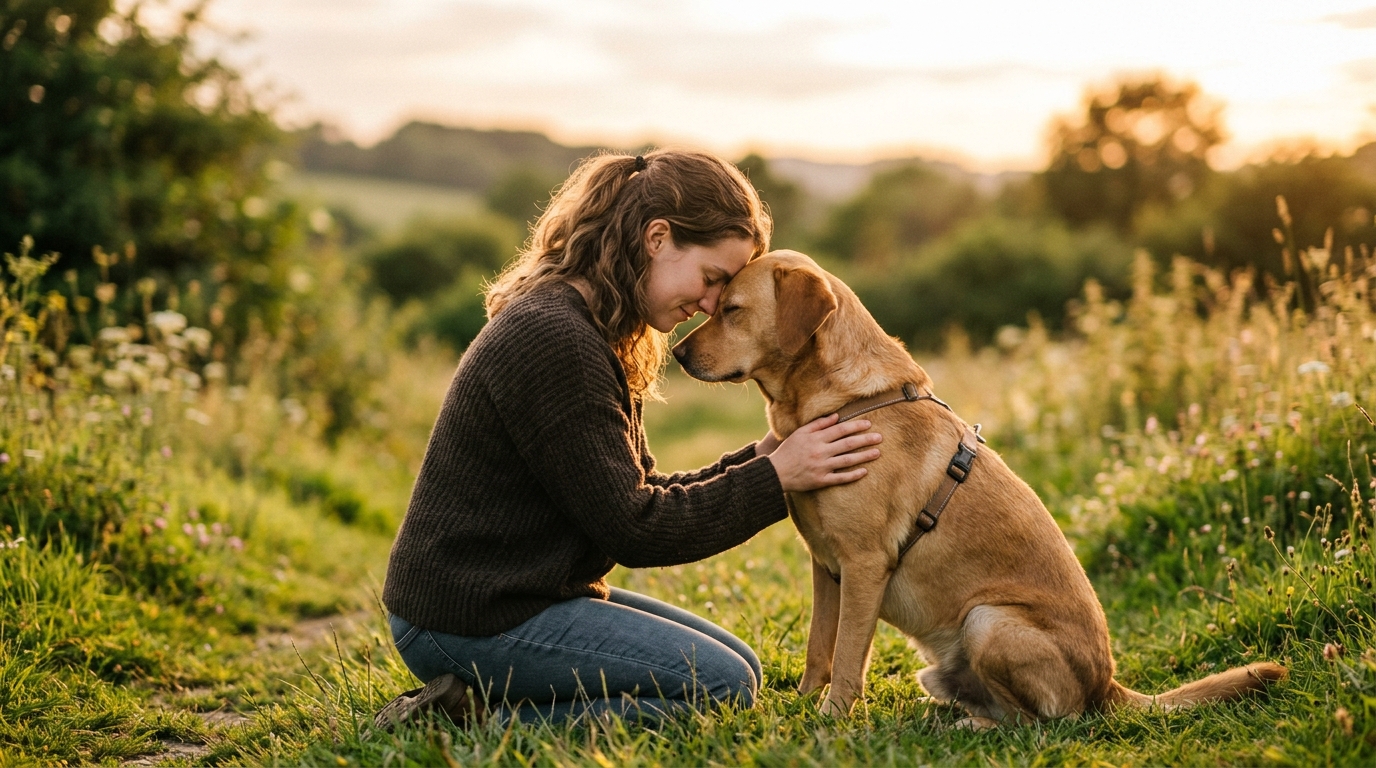
I see this same emotional response in owner after owner.
The guilt about not noticing sooner is, in my professional opinion, often more harmful than helpful. It eats up emotional energy that could be going into managing your dog's care now. It makes the consultations harder. It interferes with the relationship between you and your dog. And it's based on an unrealistic standard that almost nobody could meet.
Your dog didn't know they were missing out on better pain control. Dogs don't have a concept of "I could be feeling better than this." They have the experience they have. Now, with treatment, they'll have a better experience. They won't be looking back at the years of inadequate management with regret. They'll just be enjoying feeling better.
The relationship you have with your dog isn't diminished by what you missed. It's defined by what you do now. And you're doing the right things. You're learning. You're paying attention. You're advocating. You're providing care.
That's enough. That has always been enough.
A final thought
Twenty-five years of veterinary practice has shown me one consistent pattern. Owners who arrive carrying guilt about what they missed are not, in my experience, the inattentive or careless ones. They're often the most thoughtful, observant, and emotionally engaged owners I work with. The guilt itself is a sign of how much they care.
If that's you, please let the guilt go. Your dog is lucky to have someone who cares this much. Channel the energy into what you can do now, today, this week, this month. That's what your dog needs from you.
The signs are designed to be missed. You missed them like almost every owner who has ever lived. And now you've spotted them, and now you're acting, and that is exactly what a good owner does.
References
Free downloads
Companion worksheets to put what you've read into practice. Free PDFs, print at home.
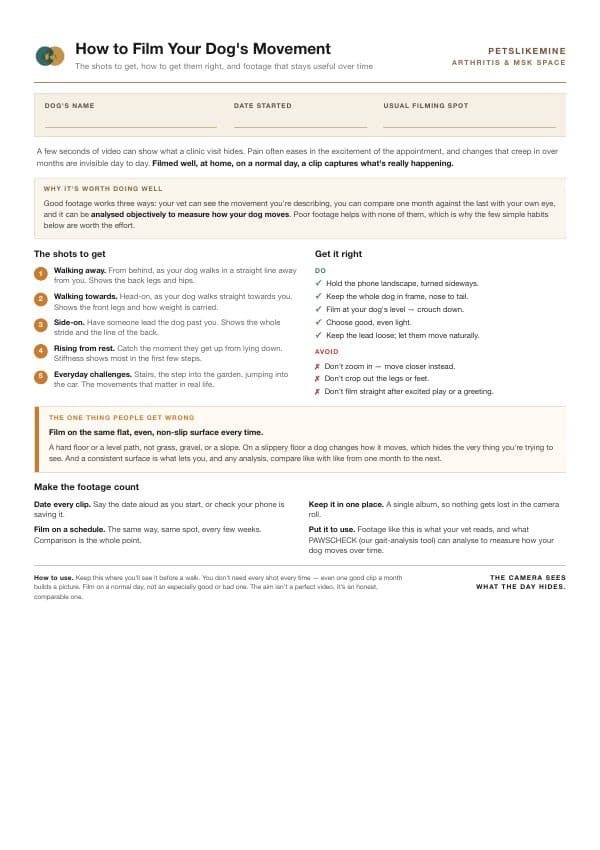
How to Film Your Dog's Movement
PDF · 127 KBA printable guide to capturing video your vet, and you, can actually use. The five shots that show how your dog really moves, how to get them right, and the one detail that makes or breaks the footage: the surface. Film on a normal day and the camera catches what a clinic visit often hides.
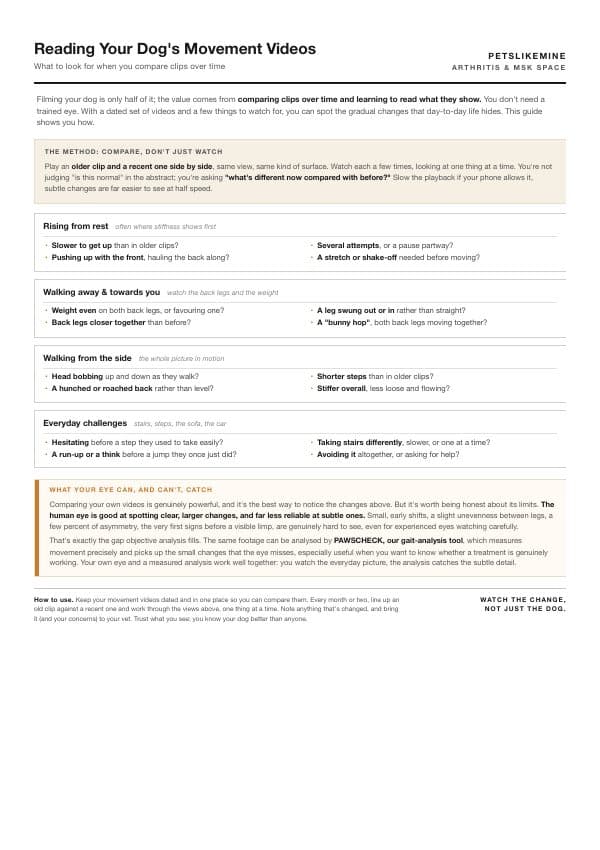
Reading Your Dog's Movement Videos
PDF · 89 KBThe companion to the filming guide: how to actually read the clips you have captured. Line up an older video against a recent one, watch one thing at a time across four everyday views, and spot the gradual changes day-to-day life hides. With an honest note on the subtle shifts the eye misses, and where objective gait analysis picks up.
Sister tool · Sightline
Track whether treatment is working
Sightline, a separate ConciergeVet tool, runs a short weekly check-in built on validated pain and mobility instruments, turns it into a single Sightline Score you can watch trend over weeks rather than judge on one bad day, and produces a report you can bring to your vet.
A written log, or our printable trackers, does much the same job.
See how Sightline tracks treatmentSee where your pet stands today
Tracking is the other half of managing arthritis. Take the 2-minute Mobility Check to see your pet's stage, then watch it shift as treatment takes effect.
Take the Mobility CheckYou're not doing this alone
Compare treatment journeys and talk to owners managing arthritis. Free to join.
Join PetsLikeMine