

Home Physiotherapy: Exercises You Can Do Together
Alastair Greenway
BVM&S MRCVS
Most articles on home physiotherapy for arthritic dogs end up either too vague to be useful or too technical to be safe. They tell you to "do some gentle stretches" without explaining how, or they describe complex protocols that need professional supervision to perform safely.
This one is meant to be different. It sets out to actually teach you a set of physiotherapy techniques you can do with your arthritic dog at home, every day or several times a week, that will genuinely contribute to their comfort and function. The exercises come from standard veterinary rehabilitation practice. They're safe when done as described. They're free, take very little time, and over weeks and months produce real benefit.
A word on what home physiotherapy can and can't do. It isn't a replacement for professional rehabilitation, hydrotherapy, or acupuncture. It's an additional layer of intervention that complements the rest of your dog's care. The dogs who do best are the ones whose owners do small amounts of structured physio work consistently, day after day, year after year. Across the lifetime of arthritis management, that consistency adds up to something genuinely meaningful.
This is also the article that will pair most closely with future video content. Some of these exercises are best learned by watching them being done, which is something written text can never fully convey. I'll describe each technique as clearly as I can here, and when our companion course content launches, the videos will show you exactly how it looks in practice.
Before we get into specific exercises, a few framings that matter.
What you're actually working towards
Home physiotherapy is aiming at a handful of specific targets:
Joint range of motion. Joints stiffen when they don't move through their full range. The capsule contracts, soft tissues lose elasticity, and the effective range shrinks. Regular gentle movement through full range prevents this loss.
Muscle maintenance and strengthening. Arthritic dogs lose muscle around painful joints, which removes natural protection. Targeted exercises maintain and build the muscles that support compromised joints.
Proprioception and balance. A dog's awareness of their body in space (proprioception) is often impaired in arthritis. Balance exercises preserve and improve this, reducing falls and improving overall function.
Pain management through movement. Gentle, supported movement produces local circulatory improvements, reduces muscle tension, and triggers some of the same descending pain inhibition that other therapies activate.
Bonding and wellbeing. Time spent doing structured physio with your dog strengthens your relationship, gives them positive attention, and is often genuinely enjoyable for both of you.
No single session does much on its own. The effects compound over time. A dog who's been receiving daily home physiotherapy for a year is structurally different from a dog who hasn't.
Ground rules before you start
Run through these before any home physiotherapy programme:
Get veterinary clearance. Talk to your vet about whether home physio is appropriate for your dog's specific situation. Most arthritic dogs are good candidates, but some have contraindications (acute injuries, unstable disease, specific surgical histories) that warrant caution.
Get a diagnosis first. Don't try to treat undiagnosed lameness with home exercises. The cause matters; what helps an arthritic dog may worsen a fracture or disc problem.
Start gently. Even safe exercises can cause flare-ups if pushed too hard too quickly. Start at the lowest level of any exercise and build over weeks.
Watch your dog's response. The day-after assessment is your most important guide. If your dog is stiffer or sorer the day after an exercise session, you've done too much. Pull back.
Stop if there's pain. If your dog vocalises, pulls away, becomes anxious, or shows clear discomfort, stop immediately. Pain during exercise is a signal that something's wrong.
Don't force anything. All physiotherapy should be cooperative. If your dog doesn't want to participate today, don't force them. Try again later, or tomorrow.
Build it into the routine. Brief daily sessions are more useful than long occasional ones. Five to ten minutes most days is better than 45 minutes once a week.
Quality over quantity. Five repetitions done well are better than fifteen rushed and forced.
With those framings clear, let's get into the actual exercises.
Part 1: Passive range of motion (PROM)
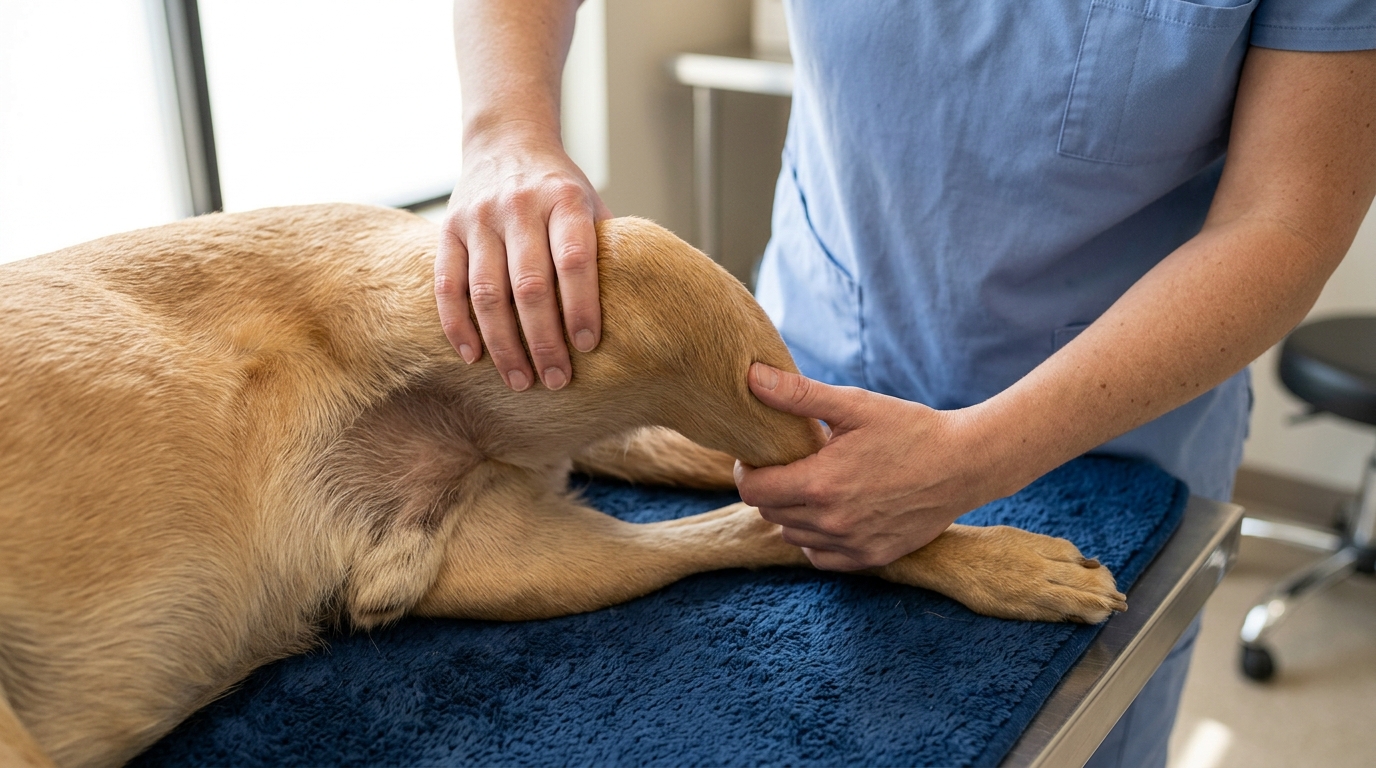
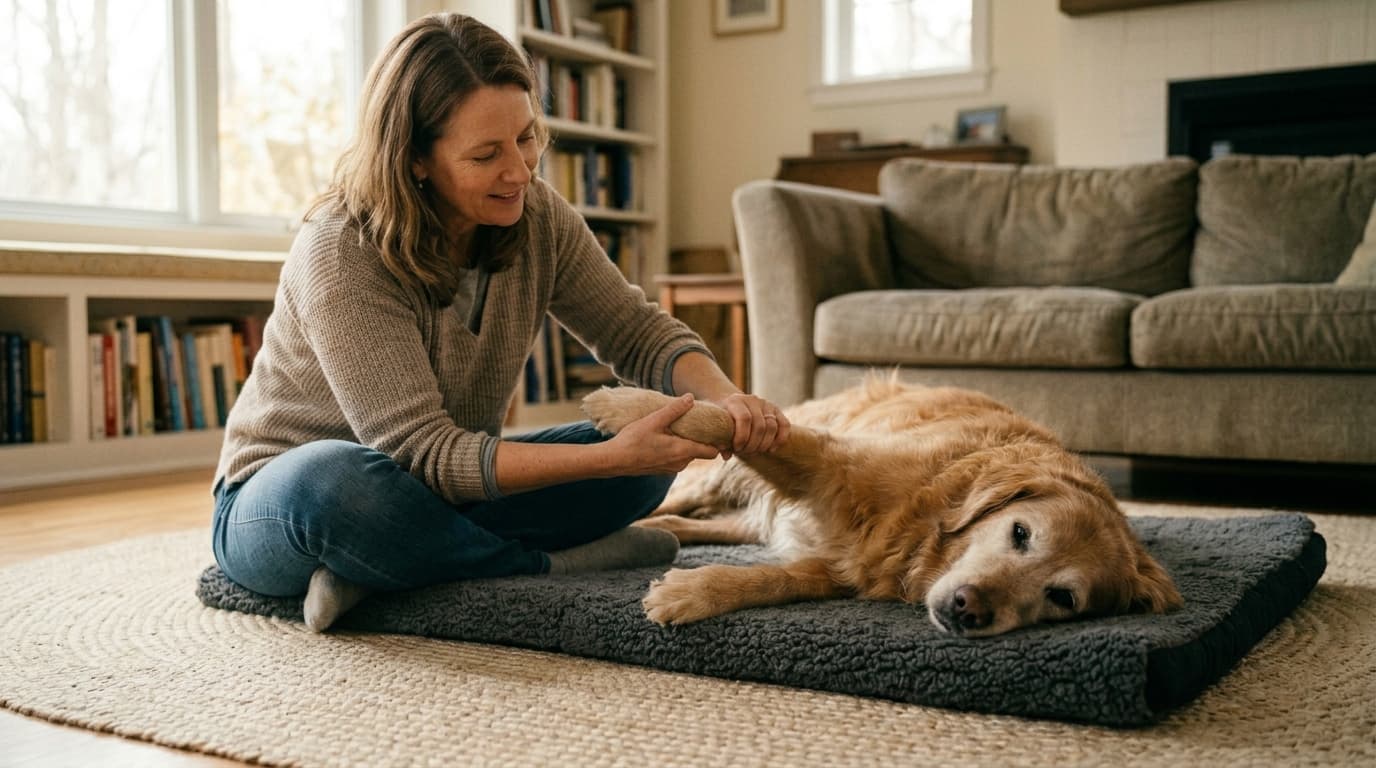
Passive range of motion exercises involve you moving the dog's joints through their natural range while the dog remains relaxed. The dog doesn't do the work; you do, gently. The purpose is to maintain joint mobility and prevent the stiffening that arthritis tends to cause.
PROM is best done when your dog is calm and relaxed, ideally lying on their side on a soft surface. Many dogs come to enjoy these sessions, particularly if you pair them with gentle massage and quiet attention.
Before starting
Warm-up matters. PROM works better on warm muscles. A gentle 5-10 minute walk before doing PROM helps, or a warm compress placed on the area for a few minutes. Don't do PROM on a cold, stiff dog who's just woken from a nap; do it after some gentle activity.
Position the dog correctly. Most dogs are most comfortable lying on their side on a soft mat or bed. The leg you're working on should be the one on top. Support the dog with your other hand to keep them stable and relaxed.
Use light pressure. PROM is gentle. You should be moving the joint through its available range, not forcing it beyond. The dog should remain relaxed throughout.
Move slowly. Each movement should take 3-5 seconds, not a quick rep.
Working through the joints
For each joint, the principle is the same: hold the limb gently, support the joint above and below, and move it through its natural range of motion slowly and smoothly.
Hip joint (flexion and extension). With your dog lying on their side, place one hand on the thigh just below the hip joint, and the other hand supporting just above the stifle (knee). Gently bring the thigh forward toward the dog's chest as far as it goes comfortably. Hold for 3-5 seconds. Then slowly extend the leg backward, again as far as is comfortable. Hold for 3-5 seconds. Repeat 5-10 times.
Stifle (knee) flexion and extension. With the dog still on their side, place one hand supporting the thigh just above the stifle, and the other hand holding the lower leg just below the stifle. Gently flex the stifle so the lower leg comes toward the body. Hold for 3-5 seconds. Then gently extend the stifle so the lower leg moves away from the body. Hold for 3-5 seconds. Repeat 5-10 times.
Hock (ankle) flexion and extension. With your dog still on their side, place one hand on the lower leg just above the hock, and the other hand supporting the paw. Gently flex the hock (bringing the paw toward the body). Hold for 3-5 seconds. Then extend (pointing the paw away from the body). Hold for 3-5 seconds. Repeat 5-10 times.
Shoulder flexion and extension. Move to the front legs. With one hand on the shoulder, use the other hand to support the leg just above the elbow. Bring the leg forward (flexion) as far as comfortable. Hold for 3-5 seconds. Then back to neutral. Then gently extend the leg backward (toward the dog's tail). Hold for 3-5 seconds. Repeat 5-10 times.
Elbow flexion and extension. With one hand supporting just above the elbow, use the other hand on the forearm just below the elbow. Gently flex the elbow (bringing the paw toward the shoulder). Hold for 3-5 seconds. Then extend (straightening the leg). Hold for 3-5 seconds. Repeat 5-10 times.
Carpus (wrist) flexion and extension. With one hand supporting the forearm just above the wrist, use the other to hold the paw. Gently flex (bringing the paw toward the elbow). Hold for 3-5 seconds. Then extend (pointing the paw outward). Hold for 3-5 seconds. Repeat 5-10 times.
Are you doing it right?
The dog should remain relaxed throughout. If they tense up, pull the leg away, or vocalise, you've gone too far or too fast. Back off and try again more gently.
Some dogs become quite sleepy during PROM sessions. That's a good sign; it suggests they're comfortable and the parasympathetic nervous system is engaging.
If you're unsure whether your technique is right, ask your vet, a veterinary physiotherapist, or a qualified canine rehabilitation practitioner to show you. A single demonstration session is much more useful than reading written descriptions.
How often, and for how long
PROM can be done daily, ideally as part of an evening routine when the dog is relaxed. The whole sequence for both sides shouldn't take more than 10-15 minutes once you're practised.
If your dog has had a stressful day, skip the PROM and do it tomorrow. Forcing PROM on a tense dog is counterproductive.
Part 2: Active exercises
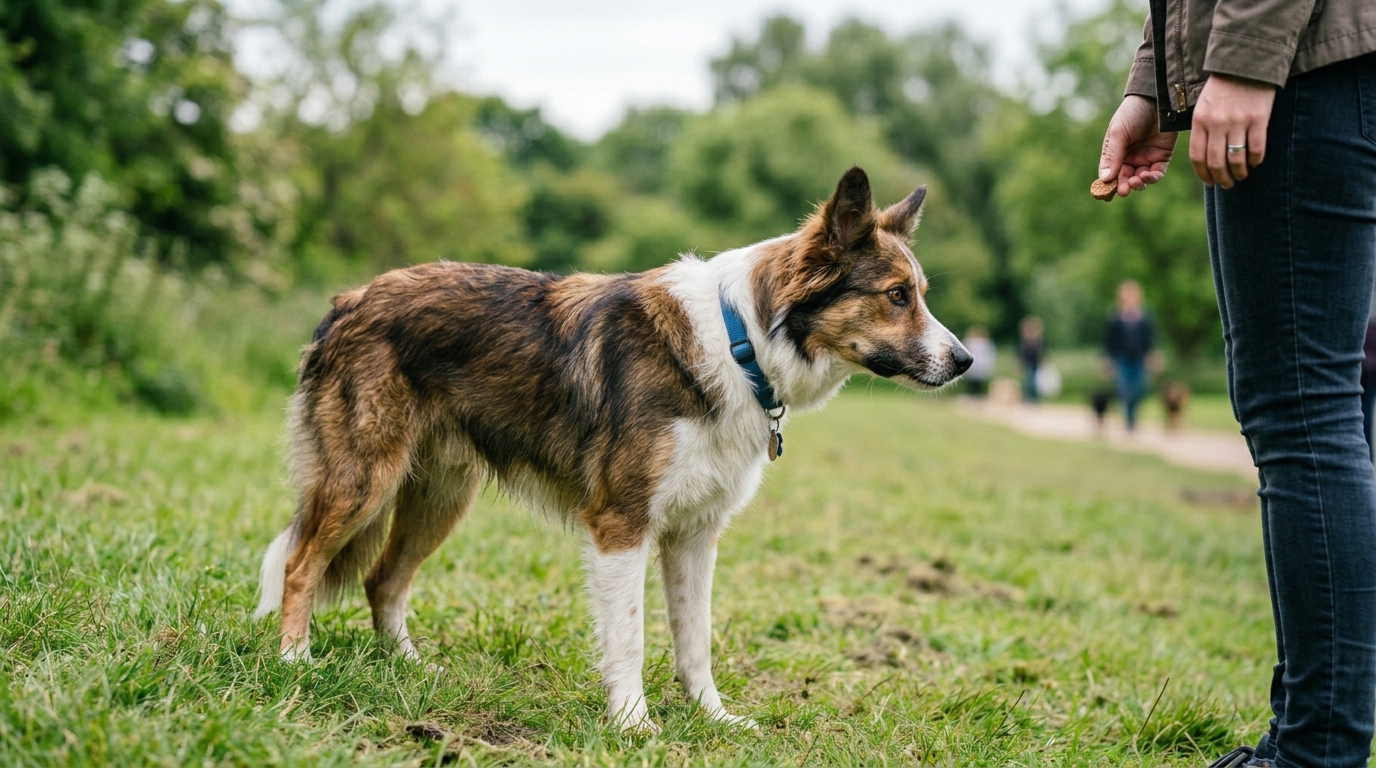
Active exercises are ones where your dog does the work, usually responding to a cue or following a treat. These are the muscle-building and balance-improving exercises.
Cookie reaches (lateral flexion stretches)
This is one of the most useful active exercises for arthritic dogs. It encourages spinal flexibility, neck range of motion, and gentle balance work.
How to do it:
- Have your dog standing in a relaxed position. They should be on a non-slip surface.
- Hold a small high-value treat at the level of their shoulder.
- Slowly move the treat back along their body toward their hip on the same side. They should turn their head and neck to follow it.
- The goal is for them to gently flex their neck and spine sideways to reach for the treat, ideally turning enough that they're looking back toward their tail on that side.
- Hold the treat there for a moment, then give it.
- Reset to neutral position.
- Repeat on the other side.
Progression:
- Start with the treat at shoulder level (easier reach)
- Progress to lowering the treat slightly so they have to flex down as well as around
- Aim for them to look back toward their tail comfortably
Goal: 5-10 reaches per side, once or twice daily.
What to watch for: They should turn their head and neck, not just their eyes. Their feet should stay still and they should keep their balance. If they have to take a step to follow the treat, you may be moving it too fast or too far.
Cookie reaches between front legs
A variation that targets thoracic spine flexibility specifically.
How to do it:
- Have your dog standing in front of you.
- Hold the treat at the level of their chest and slowly move it down between their front legs.
- They should lower their head and stretch downward to reach it.
- Once they're stretching nicely, slowly draw the treat back toward their belly so they need to extend the stretch a little further.
Goal: 3-5 reaches, once or twice daily.
Three-leg stand
One of the best exercises for building hindlimb strength and core stability. It also tests proprioception.
How to do it:
- Have your dog standing in a balanced position on a non-slip surface.
- Gently lift one front paw (just an inch or two off the ground).
- Hold for 5-10 seconds, supporting the leg so the dog isn't doing the lifting work.
- Lower the paw back to the ground.
- Move to the diagonal back leg and do the same.
- Then the other front leg.
- Then the other back leg.
Progression:
- Start with very short holds (3-5 seconds)
- Build to 10-15 second holds as they become more comfortable
- Eventually you can lift two diagonal legs (front left and back right, then front right and back left)
Goal: Each leg held 5-10 seconds, 2-3 cycles, once or twice daily.
What to watch for: Your dog should remain balanced and relaxed. If they're trembling, leaning heavily on you, or stepping to rebalance, the hold is too long for them right now. Reduce duration.
Slow sit-to-stand exercises
These work the muscles around hips, stifles, and core. They look simple, and they're surprisingly effective.
How to do it:
- Have your dog standing in a controlled position.
- Ask them to sit slowly. Reward.
- Ask them to stand back up slowly. Reward.
- Repeat several times.
The key word is slowly. Most dogs do these exercises too quickly, dropping into sit and bouncing back up. The therapeutic benefit comes from controlled descent and controlled rise, which works the muscles eccentrically and concentrically.
Progression:
- Start with regular sits on a flat surface
- Progress to sits with the front paws slightly elevated (on a low step or thick book) to shift weight to the hindquarters
- For more advanced dogs, sit-stand on a slightly unstable surface like a thick foam pad
Goal: 5-10 controlled sit-stands, once or twice daily.
What to watch for: Posture matters. Your dog should sit square (back legs symmetrical) and stand straight. If they're sitting sideways or popping up asymmetrically, they're compensating for pain or weakness and need professional assessment.
Slow stand-to-down exercises
The complement to sit-stand, targeting different muscle groups.
How to do it:
- From a standing position, ask your dog to slowly lie down.
- The descent should be controlled, not a flop.
- Then ask them to slowly stand back up.
This is harder than sit-stand for many dogs. Don't be discouraged if they can't do it in a controlled way initially.
Goal: 3-5 controlled stand-down-stand cycles, once or twice daily.
Walking up gentle hills
A simple but effective exercise. Walking uphill loads the hindquarters more than flat walking, strengthening the muscles around the hips.
How to do it:
- Find a gentle slope (a slight incline, not a steep hill).
- Walk your dog up the slope at a slow controlled pace.
- Walk back down, again controlled.
Important caveat: Walking down steep slopes is hard on the forelimbs. Choose gentle slopes only, and walk down slowly. For dogs with significant forelimb arthritis, you may need to avoid downhill work and walk only on flat or gently uphill terrain.
Goal: 5-10 minutes of gentle uphill walking integrated into normal walks.
Walking over poles (cavaletti)
A wonderful exercise for proprioception, coordination, and gentle joint mobility. You're essentially asking your dog to step deliberately over obstacles.
How to do it:
- Lay out 4-6 broom handles, dowel rods, or specific cavaletti poles on the ground.
- Space them approximately at your dog's natural stride length apart.
- Walk your dog over them at a slow steady pace.
- The dog should step over each pole deliberately rather than rushing through.
Progression:
- Start with poles flat on the ground
- Progress to slightly raised poles (5cm or so), supported on small blocks or cones
- Increase to dog hock height for more proprioceptive challenge
Goal: 5-10 passes over the pole course, once or twice daily.
What to watch for: Your dog should lift their feet over each pole, not drag them across or knock them. Knocked poles indicate they're not lifting their feet enough, which suggests reduced proprioception or limb awareness.
Balance work on unstable surfaces
For dogs at a more advanced level of home physiotherapy, balance work on unstable surfaces builds core strength and proprioception.
How to do it:
- Get a stable foam pad, a low balance disc, or even a folded blanket on a non-slip surface.
- Have your dog stand on the unstable surface.
- Initially just having them stand and balance for 30 seconds is the exercise.
- Progress to weight-shifting (gently pressing one shoulder to encourage them to rebalance) or to controlled sits and stands on the surface.
Safety: The unstable surface shouldn't be so unstable that your dog can't keep balance. Start very gentle. The point is to challenge balance, not to cause falls. Always have them on a non-slip surface and ideally with someone supporting them.
Goal: 30-60 seconds of balance work, once daily.
This exercise is genuinely difficult and quite intense for arthritic dogs. Don't start here. Build to it once they're comfortable with the other exercises.
Part 3: Therapeutic massage
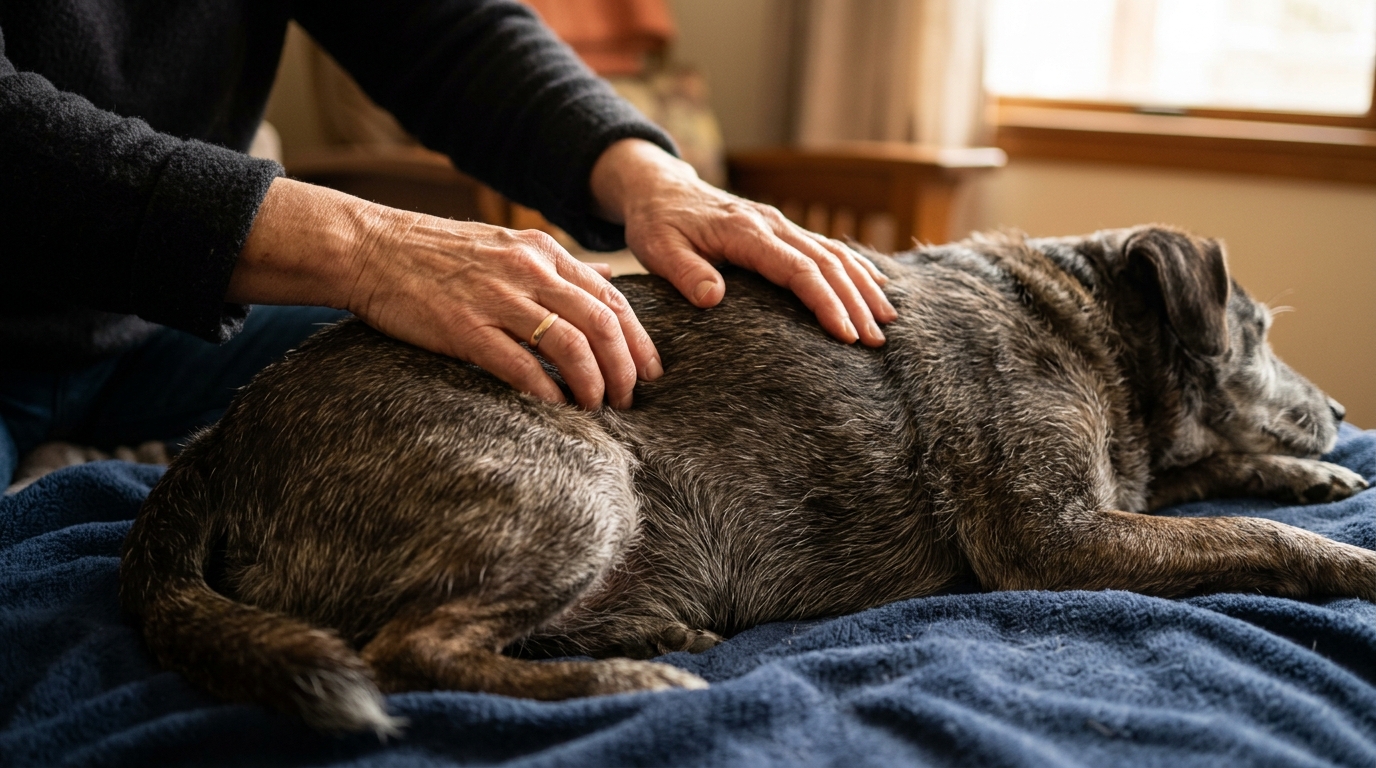
Beyond formal exercises, basic therapeutic massage at home can be valuable for arthritic dogs.
Gentle massage, kept simple
Massage doesn't need to be complex. The simple principles are:
Use gentle pressure. Your fingertips should press in just enough that you can feel the dog's muscles, but not so hard that you're causing discomfort.
Move slowly. Massage strokes should be slow and rhythmic, not fast or jerky.
Work in the direction of muscle fibres rather than against them. Generally, this means strokes that travel along the length of muscles rather than across them.
Pay attention to your dog's response. If they relax into your touch, you're doing well. If they tense up or move away, you've gone too hard or hit a sore spot.
Stop on sore spots. Don't push through resistance. If a specific area is clearly painful, leave it alone and focus elsewhere.
A routine to follow
A simple routine for an arthritic dog:
-
Start with overall stroking. Long gentle strokes along the entire body, from head to tail, just above the surface. This relaxes the dog and prepares them for more focused work.
-
Effleurage (light gliding strokes) on the back. Slow strokes from neck to tail along the muscles either side of the spine. 5-10 strokes.
-
Gentle circular motions on the shoulders and chest. Small circular movements with fingertips, releasing tension in the trapezius and pectoral muscles.
-
Effleurage on the hip muscles. Slow strokes along the gluteal muscles and along the back of the thighs.
-
Gentle kneading of the legs. Where comfortable, a gentle kneading motion can be applied to the thigh muscles and forearm muscles. This shouldn't be deep tissue massage; light kneading only.
-
Finish with overall stroking. Return to the long slow strokes from earlier.
Duration: 5-10 minutes total. Daily if possible.
This isn't replacing professional therapeutic massage. It's complementary care that provides contact, comfort, and modest physiological benefits.
Where to tread carefully
Some areas need extra gentleness or avoidance:
- Directly over arthritic joints (work around them, not over them)
- Areas where the dog has shown sensitivity
- The throat and sensitive belly areas
- Recent surgical sites
If your dog has had specific guidance from a veterinary physiotherapist, follow their recommendations.
Putting it all together
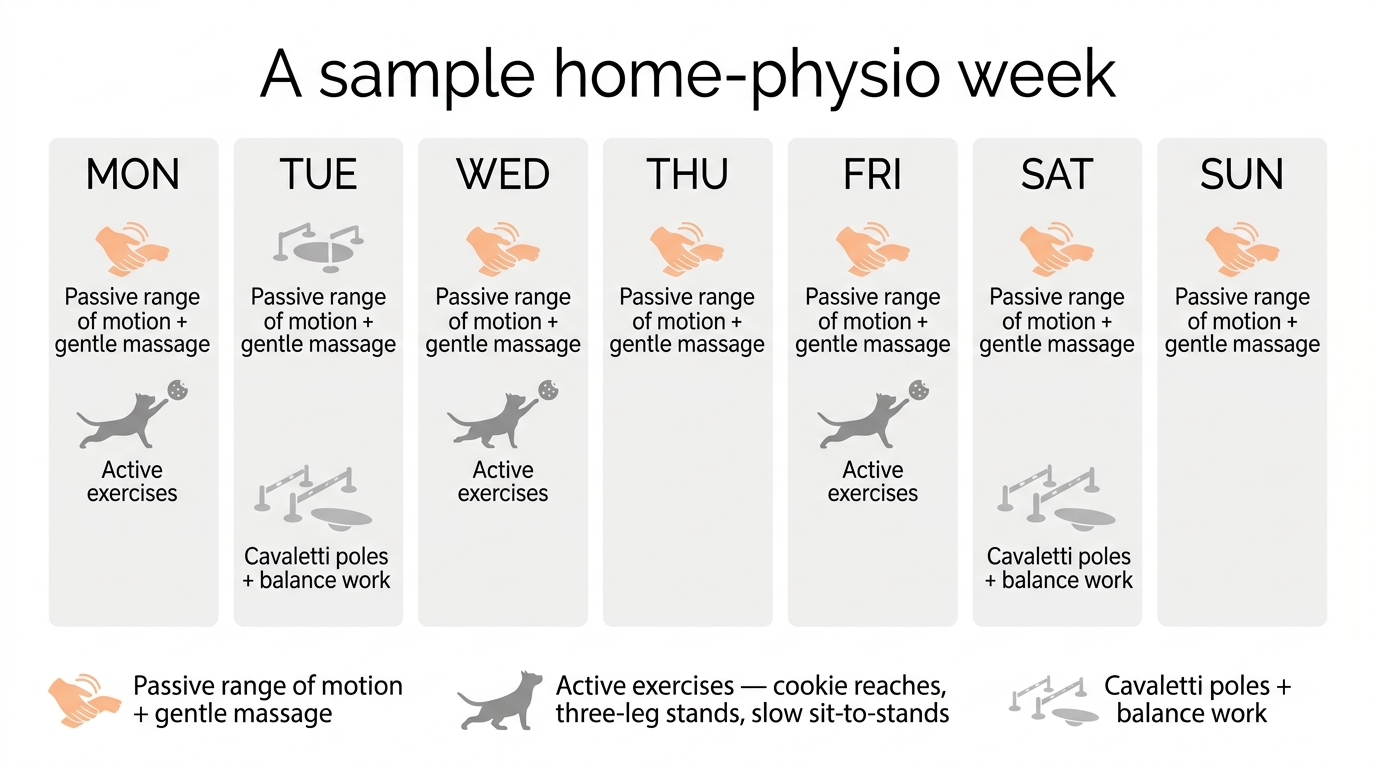
A typical home physiotherapy routine for an arthritic dog might look like:
Morning (5-10 minutes):
- Short gentle walk to warm up
- 5-10 cookie reaches each side
- Three-leg stands (each leg for 5-10 seconds)
Evening (10-15 minutes):
- Gentle massage (5 minutes)
- Passive range of motion sequence (5-10 minutes)
- A few slow sit-stands
Two or three times per week:
- Cavaletti pole work
- Walking up gentle hills (integrated into normal walks)
- Balance work for those advanced enough
None of this is prescriptive. Build the routine that works for you and your dog. What matters most is consistency. A simple routine done most days produces far more benefit than an elaborate one done occasionally.
Working with your veterinary team
Home physiotherapy works best when it's part of a coordinated care plan. A few practical points:
Discuss your routine with your vet. They should know what you're doing at home. They may have specific recommendations based on your dog's individual situation.
Consider a veterinary physiotherapy consultation. Even a single appointment with a veterinary physiotherapist (ACPAT, IRVAP, or equivalent) can be enormously useful. They'll assess your dog, identify priorities, and either do hands-on work themselves or teach you specific exercises tailored to your dog. Cost is typically £50-100 for an initial consultation.
Combine with other interventions. Home physio complements rather than replaces other treatments. Dogs receiving hydrotherapy, acupuncture, or appropriate medication respond better to home physio because the underlying pain is being controlled.
Re-evaluate periodically. Your dog's needs change over time. The exercises that work at year one of arthritis management may need adjustment by year three. Periodic review with your vet or physiotherapist keeps the programme current.
When to seek professional help
Some situations call for professional input rather than a home programme alone:
- Your dog has had a sudden deterioration that isn't responding to the usual approach
- New areas of pain or stiffness have developed
- Your dog has had recent orthopaedic surgery
- You're not sure your technique is correct
- You're seeing changes you don't understand
- Your dog's quality of life is declining
In any of these situations, a referral to a veterinary physiotherapist is worthwhile. They have skills and assessment capabilities that no home programme can match.
For dogs whose arthritis is being managed primarily at home with medication and basic physio, a periodic professional review (perhaps every 6-12 months) is a sensible way to ensure the programme remains optimised.
A practical commitment
Here's the plain pitch for home physiotherapy. Five to fifteen minutes a day, most days, for the rest of your dog's life. That's the commitment.
It isn't small in terms of consistency, but it isn't large in terms of total time. The cumulative effect across months and years is significant. Dogs whose owners commit to this kind of daily care typically maintain function for longer, experience fewer flare-ups, and engage more fully with their lives.
That cumulative effect is also the hardest thing to see. Day to day, your dog looks essentially the same as yesterday, and the months of patient work compound invisibly. It's one of the reasons we built Sightline. Sightline (sightline.vet) is a separate ConciergeVet tool that runs a short weekly assessment and tracks the trajectory over time, which is the right time horizon for seeing whether daily physio is actually holding the line.
I'm not pretending an app does the work. The work is the five to fifteen minutes a day. But it's a fair question to ask whether the effort is paying off, and a tracked score over months answers that question better than memory. A written log does the same job if you keep it up. Whichever you choose, having some long-term picture beyond impressions is worth doing.
There's another practical benefit: the routine becomes a positive experience for both of you. Many dogs come to look forward to their physio time, particularly the massage components. It's quiet attention, gentle touch, and bonding. For owners of arthritic dogs who can't do the energetic activities they used to share, home physio becomes an alternative form of shared time that's positive and therapeutic.
A final thought
Home physiotherapy is one of the most undervalued interventions in canine arthritis management. It's free. It's safe when done correctly. It produces real benefit over time. It strengthens your bond with your dog. And it's entirely within your control.
The dogs I see doing best in long-term arthritis management are the ones whose owners do the boring work consistently. Daily walks at appropriate intensity. Daily home physio. Regular weight monitoring. Consistent medication administration. None of it dramatic. All of it adding up over time.
Your arthritic dog can benefit from home physiotherapy starting today. Pick two or three exercises from this article. Try them with your dog this evening. See what they tolerate well. Build from there. Within a few weeks, the routine becomes second nature, and the cumulative benefits start to compound.
You're not just doing exercises with your dog. You're providing structured therapeutic care that few owners take the time to deliver. Your dog is genuinely better off for it.
Sister tool · Sightline
Track whether treatment is working
Sightline, a separate ConciergeVet tool, runs a short weekly check-in built on validated pain and mobility instruments, turns it into a single Sightline Score you can watch trend over weeks rather than judge on one bad day, and produces a report you can bring to your vet.
A written log, or our printable trackers, does much the same job.
See how Sightline tracks treatmentSee where your pet stands today
Tracking is the other half of managing arthritis. Take the 2-minute Mobility Check to see your pet's stage, then watch it shift as treatment takes effect.
Take the Mobility CheckYou're not doing this alone
Compare treatment journeys and talk to owners managing arthritis. Free to join.
Join PetsLikeMine