

Home Modifications: Room by Room
Dr. Alastair Greenway
MRCVS, 25 years clinical experience
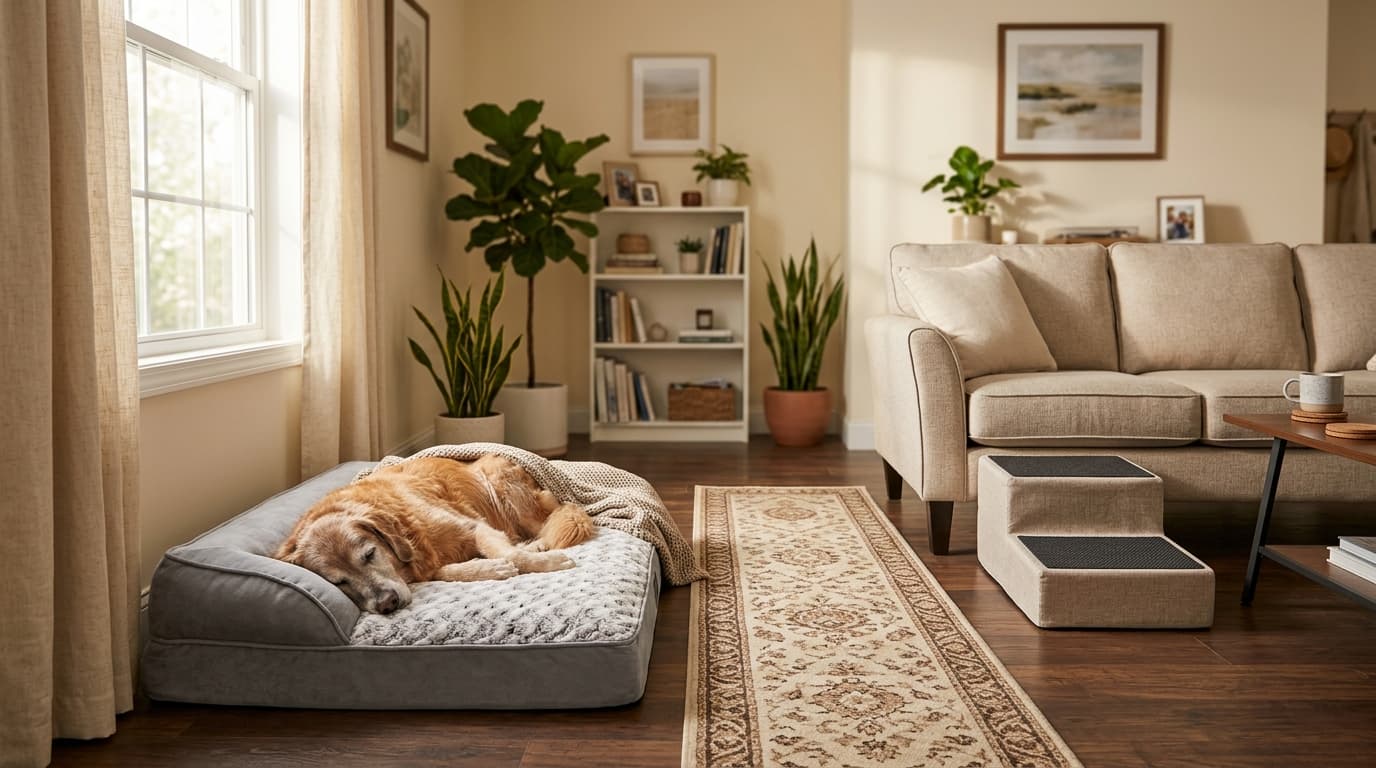
Your arthritic dog spends most of their life inside your home, not out on walks. They're moving around the kitchen, the hallway, the living room, the garden. They're getting up from beds, climbing on and off furniture, navigating thresholds, crossing the floor to a water bowl. Every one of those movements either helps them or hurts them, depending on what's underneath them and around them.
Of all the things you can do for arthritis, home modification is one of the most cost-effective. Medication is a recurring cost; this is a one-time investment. Weight loss takes weeks; this works immediately. Physiotherapy needs you present; this works 24 hours a day whether you're paying attention or not. And the results are often visible within hours of making changes.
So let's walk through your home as if I were doing a clinical assessment with you, room by room and surface by surface, finding the problems and the fixes. Some changes cost nothing (rearranging furniture, blocking access to certain areas). Some are cheap (rugs, runners, low-rise water bowls). Some are bigger investments (orthopaedic beds, proper ramps, flooring changes). I'll be straight about what's worth spending money on and what isn't.
By the time you reach the end, you should have a clear plan for turning your home into a place that actively supports your dog rather than working against them.
Slippery floors come first
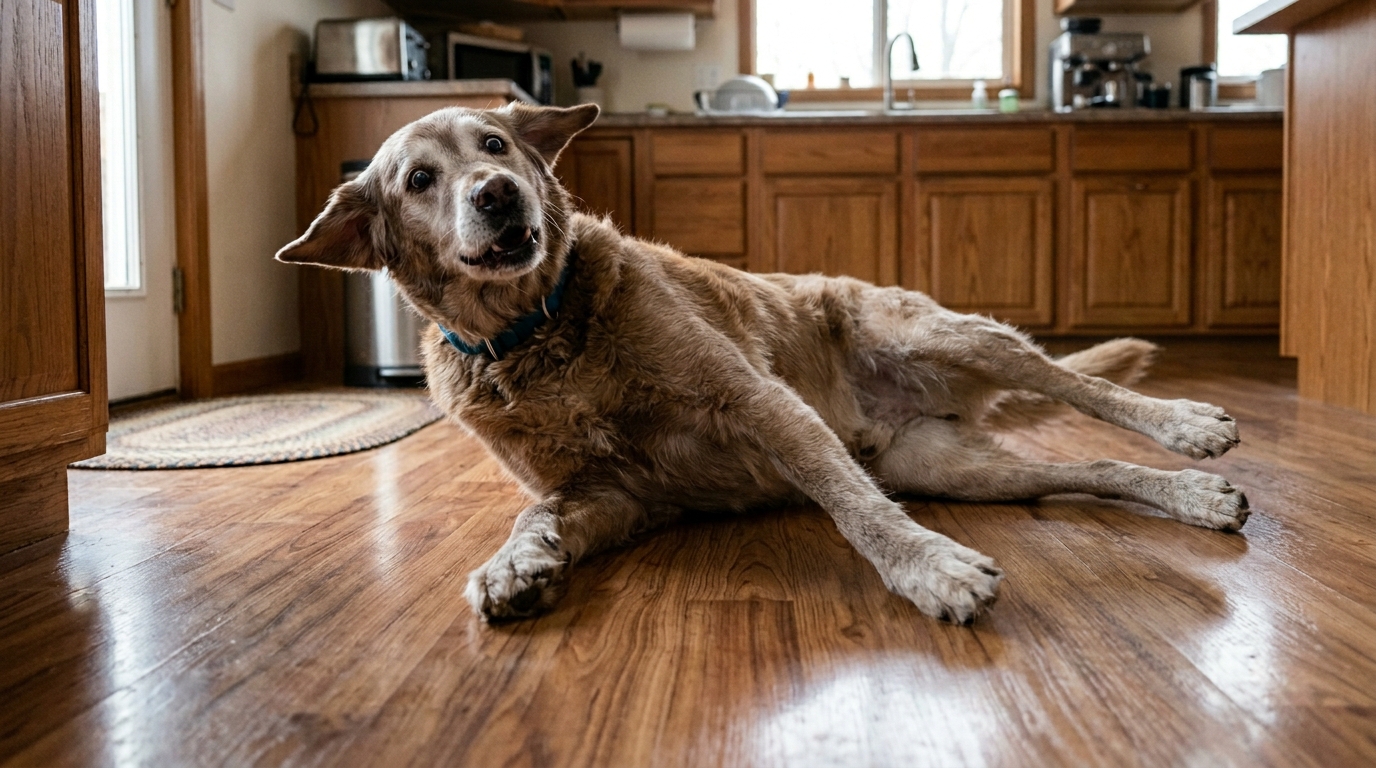
If I had to name the single most impactful home modification for arthritic dogs, it would be sorting out slippery floors. Nothing else produces such a dramatic immediate improvement in confidence, mobility, and pain.
Walk into any modern UK home and you'll see laminate, tiles, polished wood, or vinyl across kitchens and hallways. These surfaces are easy to clean, durable, and good to look at. They're also a nightmare for an arthritic dog.
Why a slick floor does so much harm
A dog standing on a slippery surface can't get proper purchase. Each step takes muscular effort just to stop them sliding. That leaves several layers of harm.
Acute injury risk. A slip on a hard floor can cause an immediate pain flare or, in worse cases, actual injury. A dog whose hindlimbs splay out beneath them on laminate has just stretched their hip joints in ways those joints don't tolerate well. Some of the worst arthritis flares I see in practice follow exactly this kind of incident.
Gait alteration. A dog who can't trust their footing develops a modified gait to compensate. They shorten their stride, lower their centre of gravity, tense their core, and recruit muscles in ways they wouldn't normally need to. Over time that creates secondary problems in joints and muscles that weren't originally affected.
Loss of confidence. Owners often don't fully appreciate this one. A dog who has slipped repeatedly becomes nervous about moving. They hesitate before stepping out from carpet onto laminate. They avoid certain routes through the house. They turn reluctant to come when called if it means crossing the slippery area. The psychological impact is real and significant.
Getting up becomes difficult or impossible. This is the worst end of the problem. A dog lying on a slippery floor needs hindlimb strength and grip to rise. If the floor is slick and they're old or weak, they may genuinely struggle to get up. I have seen dogs euthanised for "not being able to walk" who, when placed on grippy flooring, walked perfectly well. The flooring was the disability, not the disease.
Solutions, in order of cost and effectiveness
You don't need to relay your entire home. Start with the highest-impact targeted interventions and work from there.
Runners and rugs along the main routes. This is the cheapest, easiest, and often the most effective intervention. Identify the routes your dog uses most often: from their bed to the door, kitchen to garden, hallway to living room. Lay non-slip backed rugs or runners along these routes. You don't have to cover every inch of slippery floor; you just have to create reliable grippy pathways.
For most UK homes, two or three runners and a couple of rugs will cover the essential routes. Total cost from somewhere like IKEA, Dunelm, or B&Q is £30-100 depending on what you choose. The transformation in your dog's confidence is often noticeable within days.
Important detail: make sure the runners and rugs themselves don't slip on the floor. Non-slip rug pads underneath, or runners with integral non-slip backing, are essential. A rug that slides when the dog steps on it is worse than no rug.
Yoga mats or rubber matting in key spots. Where you need targeted grip in a specific area (under the food bowl, at the bottom of the stairs, in front of the back door), individual yoga mats or rubber mats work well. They're easy to clean, easy to wash, easy to move, and inexpensive. A few yoga mats from a sports shop cost £20-30 and solve specific spot problems neatly.
Paw grip products. Several commercial products try to add grip directly to the dog's paws rather than to the floor. The main categories:
-
Non-slip socks or boots. Fabric socks with rubberised soles. Work well for some dogs but not others. Cheaper options often fall off; better quality ones (around £15-25) stay on more reliably. Suit some dogs but not those who are uncomfortable with anything on their feet.
-
Sprays or wax-based pad coatings. Applied to the paw pads to increase grip. Effects are temporary (hours rather than days). Cost is modest. Worth trying for occasional use but not a daily solution.
-
ToeGrips and similar nail-band products. Rubber bands that fit around the dog's nails to provide grip from the nail rather than the pad. Can work well for some dogs. Require some application learning. Cost around £20-30 for a pack.
These products are useful, but treat them as a supplement to floor modifications rather than a replacement. Solve the floor first, then add paw grip if you need additional support.
Replacing flooring. This is the nuclear option for serious problems. Laminate or tile can be replaced with carpet, cork tiles, low-pile commercial vinyl with grip texture, or rubber flooring. The veterinary-approved flooring brands (such as those endorsed by Canine Arthritis Management) provide specifically formulated low-slip surfaces.
Cost is significant. Replacing flooring in even a single room can run to several hundred pounds, and whole-house changes are thousands. This is usually only worthwhile when you're already considering re-flooring for other reasons. Most homes can achieve dramatic improvement with runners and rugs at a fraction of the cost.
Assess your own floors today
Walk through your home now. Look at each area through your dog's eyes.
- Kitchen floor: usually tile or laminate, often heavily used by the dog. High priority.
- Hallway: usually the main thoroughfare. High priority.
- Living room: often carpeted (good) but may have hard areas around fireplaces or under furniture.
- Bathroom: tile floor often used as a cool resting place. Worth a small mat.
- Bedrooms: usually carpeted, but consider edge transitions.
- Entrance hallway and threshold: where wet paws meet hard floor, particularly slippery. Worth a long absorbent mat.
Make a list of the priority areas and address them in order of how much time your dog spends there.
Their bed is where most of life happens
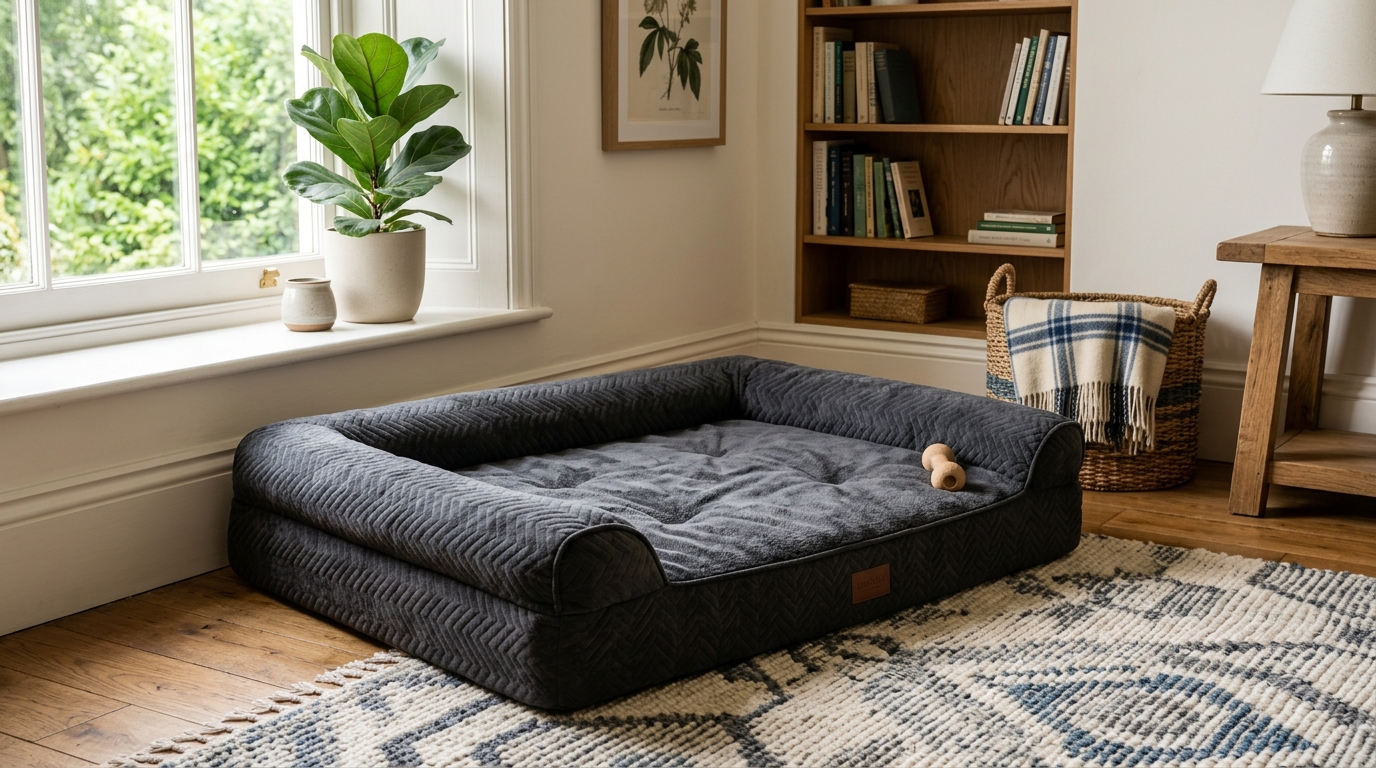
Your dog probably spends 12-18 hours a day on their bed. Whether that bed is supportive or not makes an enormous difference to their comfort, joint health, and quality of sleep.
What actually makes an orthopaedic bed good
The marketing for "orthopaedic dog beds" is wildly variable. Some products are genuinely supportive. Others are basic cushions with a marketing claim attached. The features that actually matter:
Thickness and density. A good orthopaedic bed should have at least 7-10cm of supportive foam, ideally memory foam or similar high-density foam that doesn't compress under the dog's weight. Press down hard with your hand. If you can feel the floor through the bed, it's not thick enough. Your arthritic dog certainly can.
Memory foam specifically. Memory foam distributes weight evenly and reduces pressure points. Cheaper foams or polyester fillings don't do this. A bed that's been compressed flat after a few weeks of use isn't doing its job.
Size. Most owners buy beds that are too small. Your dog should be able to stretch out fully on the bed with room to spare. A medium-sized dog (Labrador, Spaniel size) needs a bed at least 100cm long. Large dogs need 110-120cm. Curled up isn't the test; extended is.
Low entry. Many orthopaedic beds have raised sides or bolsters that look attractive but make access difficult for an arthritic dog. The bed should be easy to step onto and step off. If your dog is hauling themselves over a bolster every time, that's a daily aggravating movement.
Removable, washable cover. Beds get dirty. They need to be washable. Sealed beds where you can't get the foam out are difficult to maintain hygienically.
Non-slip base. The bed itself shouldn't slide when your dog steps on it. Most quality beds have a textured or rubber-grip underside.
Waterproof inner layer. For older dogs particularly, incontinence becomes a possibility. A waterproof inner layer under the cover protects the foam itself from damage.
What's worth spending
Quality orthopaedic beds in the UK range from about £60 (entry-level genuine memory foam) to £300+ (premium therapeutic beds). For most dogs, £80-150 buys an excellent bed that will last several years and provide proper support.
Avoid the cheapest "orthopaedic" beds you'll find at supermarkets and pet shops for £20-40. These are usually polyester-filled cushions with marketing claims. Your dog will be lying directly on the floor through them within weeks.
If you can afford more than one quality bed, your dog probably benefits from it. Many arthritic dogs do better with a bed in their main resting area (living room, kitchen) and another wherever they sleep at night. Some need access to a bed in multiple rooms.
Where to put it
Location matters as much as the bed itself.
Warm but not hot. Cold rooms exacerbate stiffness in arthritic dogs. Avoid placing beds in unheated utility rooms, on cold tiles, or near draughts. A spot near a radiator (but not so close it overheats) is often ideal.
Away from draughts. Door bottoms, window sills, and stairwells all generate cold air movement. These are bad bed locations.
Quiet but social. Your dog wants to be near family. Don't exile them to a quiet corner where they feel isolated. Beds work best in rooms where the family spends time, in a corner that's quiet enough to rest in but not separate from the household.
Easy to get to and from. The bed shouldn't require navigating slippery floors, stairs, or thresholds to reach. A bed in a perfect spot that the dog struggles to get to isn't useful.
Multiple options. Some dogs benefit from having choices. A cooler spot for warm days, a warmer spot for cold ones, an area near the family for daytime, a quieter area for night. Multiple beds give them options.
Getting on and off furniture
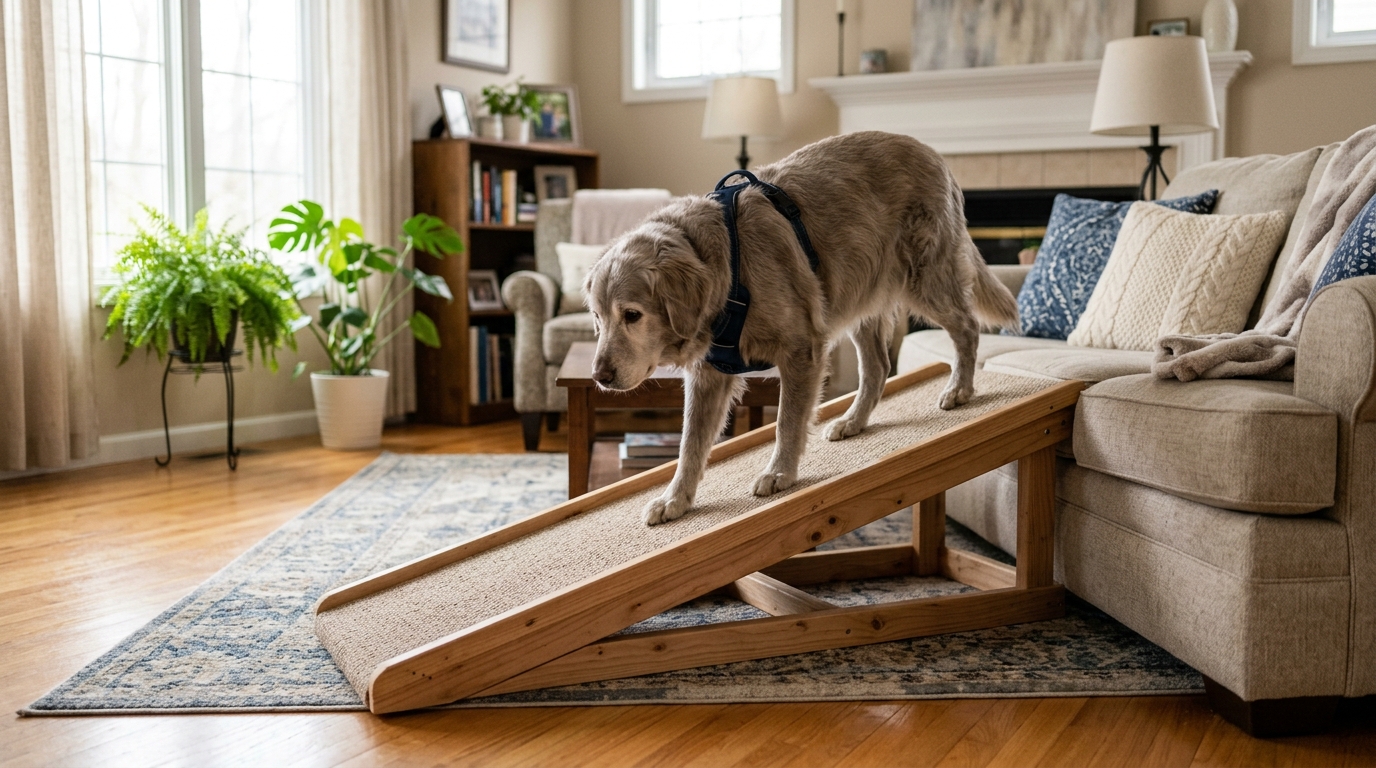
Many arthritic dogs have spent their lives jumping on and off sofas, beds, and chairs. This becomes a problem as the arthritis progresses, but it's a habit that's hard to break.
The jumping itself causes harm. Landing on hard floors with arthritic joints transmits forces those joints can't tolerate. Worse, missed landings (slipping off the edge of a sofa, miscalculating the height) cause acute injuries.
Should they be on the furniture at all?
This is a household decision that goes beyond medical advice. Many dogs sleep with their owners or share the sofa for cuddles. For most arthritic dogs, this can continue, but with assistance.
What you want to avoid is unassisted jumping. A dog who launches themselves up onto the sofa with no thought, lands awkwardly, and dismounts in a dramatic descent is hurting themselves regularly. A dog who walks calmly up a ramp or set of steps to reach the sofa is not.
Pet steps versus ramps
There's an ongoing debate about which is better. Both have their place.
Ramps provide a gentler slope and are kinder on joints during ascent and descent. They take up more floor space and may be harder to integrate aesthetically into a living room. Better for dogs with significant hip or stifle problems.
Pet steps take up less floor space and look more like furniture. They require the dog to flex and extend joints to climb each step. Less ideal for severely affected dogs but often fine for milder cases.
For most arthritic dogs, ramps are the better choice if you can accommodate them. Look for:
- Gentle incline (no more than 25-30 degrees ideally)
- Wide enough surface (at least 40cm for medium dogs)
- Non-slip surface or grip strips
- Stable construction that doesn't wobble when the dog uses it
- Side rails or barriers to prevent falling off the edge
- Long enough to bridge the height comfortably without being too steep
UK ramp prices: £40-100 for portable folding ramps, £100-250 for more substantial fixed ramps. For sofas and beds, you want something that bridges around 50-60cm of height for a typical UK sofa.
For pet steps:
- Wide treads (your dog's whole paw should fit comfortably)
- Non-slip surface on each step
- Stable, doesn't move when used
- Tall enough to actually reach where the dog needs to get to
- Carpeted or rubberised top surface
UK pet steps prices: £30-80 for typical home-use products.
Teaching them to use it
Some dogs take to ramps and steps immediately. Others are reluctant. The trick is to introduce them gradually:
- Place the ramp or steps without expecting the dog to use it. Let them sniff and investigate.
- Use treats to encourage them to put one paw on it.
- Gradually progress to multiple paws, then full use.
- Praise enthusiastically every successful use.
- Once they're using it, consistently encourage that route rather than letting them jump.
The hardest part is often family compliance. If one family member lifts the dog onto the sofa rather than encouraging them to use the ramp, the dog learns to wait for the lift. Coordinate within the household.
In and out of the car
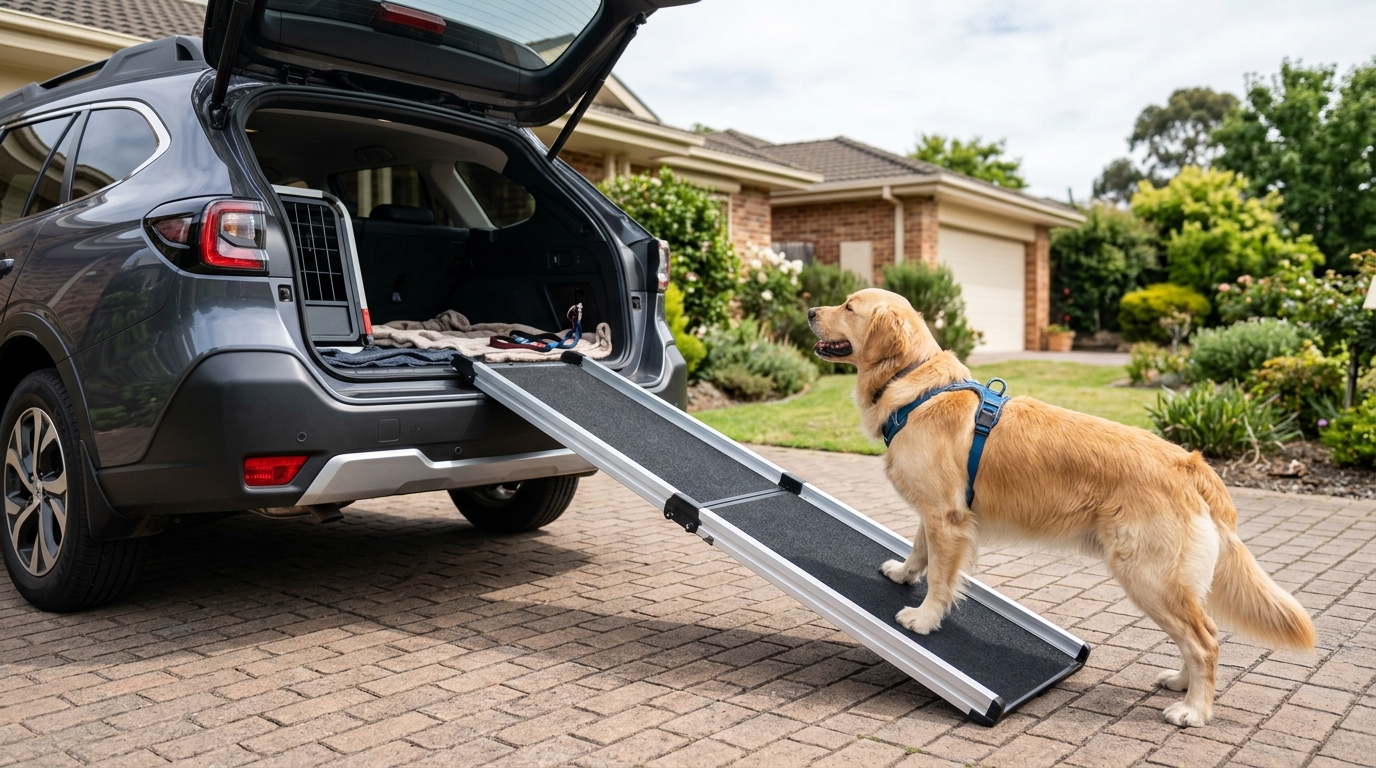
Getting in and out of the car is one of the moments where many arthritic dogs are most at risk of injury. The jump up is significant. The jump down is often worse, with all of the body weight landing on the front legs.
Car ramps
A proper car ramp is one of the best investments you can make for an arthritic dog who travels regularly.
Key features:
- Long enough to provide a gentle incline (longer is better; aim for at least 180cm)
- Non-slip surface
- Wide enough for your dog (40-50cm minimum)
- Folding design for easy storage
- Stable when in use (some have legs to support the middle)
- Weight rating appropriate to your dog
Avoid very short ramps that create a steep incline. They feel like a worse version of jumping. The whole point is the gentler angle.
UK car ramps: £40-100 for decent options. £100-200 for high-quality longer ramps with better surfaces.
If a ramp isn't practical
Lifting the dog yourself. For smaller dogs this works fine. For medium and large dogs it's hard on your own back and may not be sustainable. Help'Em Up harnesses and similar products provide handles that make lifting easier and safer.
A booster step. A folding step that fits in the boot can break the height into two smaller jumps rather than one big one. Less ideal than a ramp but better than the full jump.
Lower vehicles. If you're considering a new car and your dog will travel regularly, lower-loading vehicles (saloons or estates rather than SUVs) make life dramatically easier for arthritic dogs.
For very advanced cases, some owners install permanent ramp systems in their vehicles. These are typically used by professional dog handlers and some assistance dog organisations but can be worth investigating for a much-loved dog with significant mobility needs.
Food and water access
Owners often miss this one, and it matters more than you might think.
Bowl height
For most arthritic dogs, slightly raised food and water bowls are kinder than floor-level ones. The reasoning is that a dog with hip, elbow, or spinal arthritis bending down to floor level repeatedly throughout the day is putting their compromised joints into extreme flexion.
The right height is roughly chest height when the dog is standing comfortably. Not so high that the dog has to reach up, but high enough that they're not bending down.
Important caveats:
- For deep-chested breeds (Great Danes, Standard Poodles, etc.), the relationship between raised bowls and gastric dilatation-volvulus (bloat) is contested. The Glickman 2000 JAVMA study identified raised bowls as a significant risk factor for GDV in large and giant breeds, though some subsequent research has challenged that finding. Discuss with your vet if you have a deep-chested at-risk breed.
- For dogs with cervical (neck) arthritis, slightly raised bowls may be particularly helpful as they avoid the dog needing to extend their neck downward.
- For dogs with no spinal or neck issues, the height matters less than the practicality.
Bowl options include adjustable-height stands, fixed-height raised feeders, or simply placing bowls on a shallow box of appropriate height. Cost ranges from £10-30 for basic raised feeders to £50-100 for adjustable or designed feeding stations.
Water in more than one place
Arthritic dogs may not bother walking across the house to get to water if it's an effort. Having water available in multiple locations encourages adequate hydration.
A water bowl in their main resting area, another near food, and a third near garden access ensures they don't have to make a journey to drink. This becomes more important as mobility decreases.
Slow feeders and puzzle bowls
For dogs who eat too fast, slow feeders force them to take time over meals. For arthritic dogs particularly, this serves another purpose: it makes mealtime a longer, more engaging activity that stimulates the mind without requiring physical activity.
Slow feeders cost £10-30 typically. Puzzle feeders that require the dog to work for food (rolling, pushing, opening compartments) cost £15-50. These work better for dogs who are reasonably bright and motivated by food.
Out in the garden
The outside is part of your dog's environment too, so don't overlook it.
Surfaces underfoot
The same principles as indoor flooring apply outside, just with different surfaces.
- Decking and wood surfaces become extremely slippery when wet. Many garden decks are a major hazard for arthritic dogs in wet weather. Anti-slip strips can help, or covering the deck temporarily during wet periods.
- Loose paving that wobbles when stepped on can cause slips. Identify and fix loose slabs.
- Wet leaves on hard surfaces become very slippery in autumn. Sweep main routes during the season.
- Mud and standing water on grass routes can lead to slips. Consider grass grids or stepping stones along the most-used paths.
- Steep slopes and steps are problematic. Where possible, route the dog around them. Where not possible, add ramps or grips.
Toileting access
Your dog needs to be able to get to their toileting area easily. If they have to go down steps or across a slippery patio to reach the garden, that journey itself becomes a problem.
Solutions:
- Ramp from the back door to the garden
- Non-slip mats along the route
- A toileting area closer to the house if the garden is large
- Outdoor lighting for evening trips
- Shelter from rain at the back door so they can pause if the weather is bad
For very advanced cases, indoor toileting solutions (puppy pads, grass mats) can be a kindness rather than forcing a struggling dog outside in bad conditions.
Dog flaps
A dog flap that was easy to use when your dog was young may now be a daily struggle. The bending, flexing, and pushing through the flap loads the joints in ways arthritic dogs find difficult.
Watch your dog using the flap. If they're struggling, consider:
- Removing the flap and leaving the door open during the day
- Installing a larger flap that requires less bending
- Replacing flap access with a regular routine of going through the door
- For sleep-time, accepting they may need to be let out
Stairs
Stairs are one of the most discussed home modifications, and one of the most variable in their actual impact on dogs.
Up and down stairs
Going up stairs requires significant hindlimb strength and flexes the hips and stifles. Going down stairs loads the forelimbs heavily and is often harder for dogs with elbow or shoulder problems.
For mildly affected dogs, normal stair use is usually fine, particularly if the stairs have good grip (carpet or non-slip strips). For moderately affected dogs, restricting or modifying stair use is reasonable. For severely affected dogs, eliminating stair use is often necessary.
Solutions
Adding grip to existing stairs. Carpet runners on hardwood stairs, or stair-tread strips on tiled stairs. Significantly improves traction and confidence. £30-80 for materials.
Stair gates. If you want to prevent the dog from using stairs entirely, baby gates work well. Place them at the top and bottom.
Sleeping arrangements that avoid stairs. Move the dog's bed to the floor they spend most of their day on, so they don't need to go up stairs to sleep.
Assisting them up and down. For dogs who occasionally need to navigate stairs, a Help'Em Up or similar support harness allows you to provide support while they walk. Better than carrying for medium and large dogs.
Carrying smaller dogs. Small breeds can be safely carried up and down stairs by able-bodied owners. Large breeds shouldn't be carried because of the risk to both dog and owner.
Stair lifts. Some owners install proper stair lifts. This is the expensive option but for owners with multi-storey homes and a much-loved dog with significant mobility needs, it can be genuinely worthwhile.
Walk it through yourself
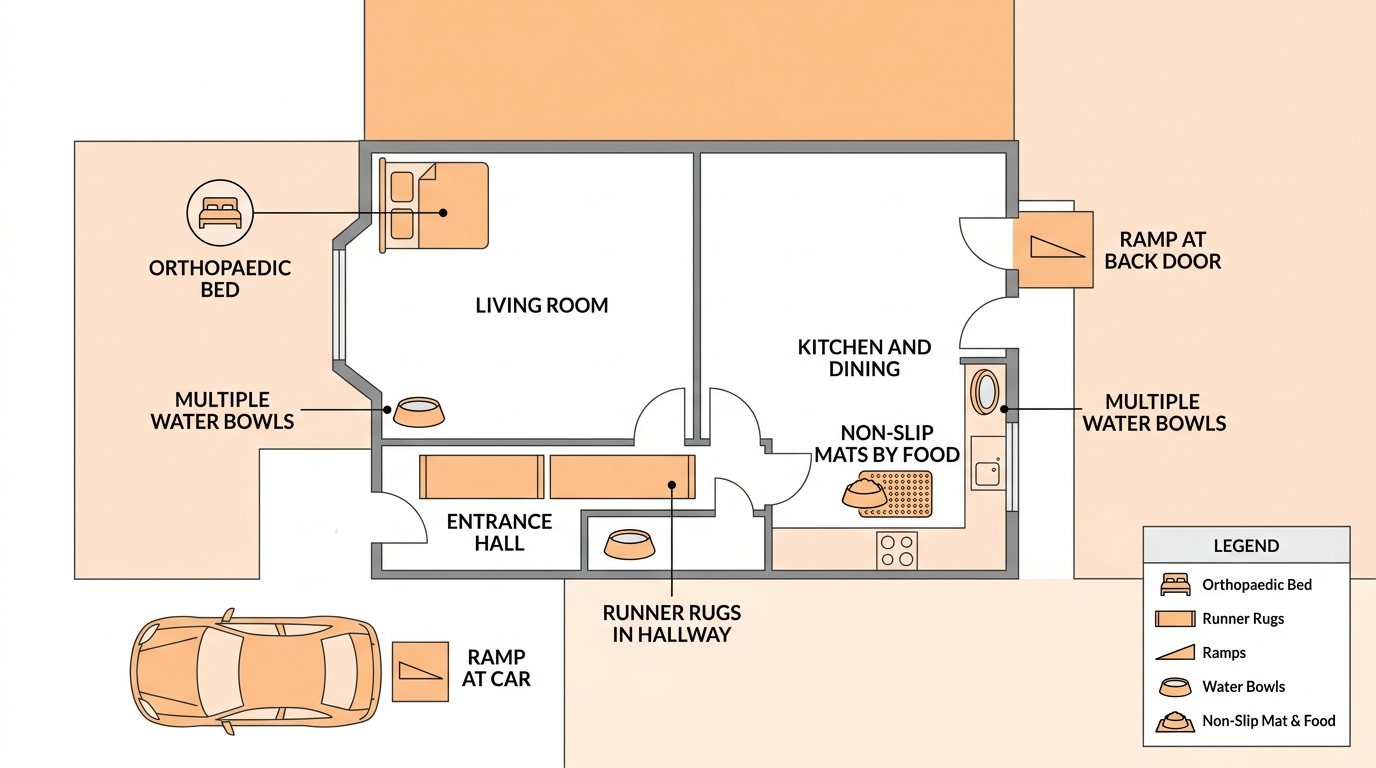
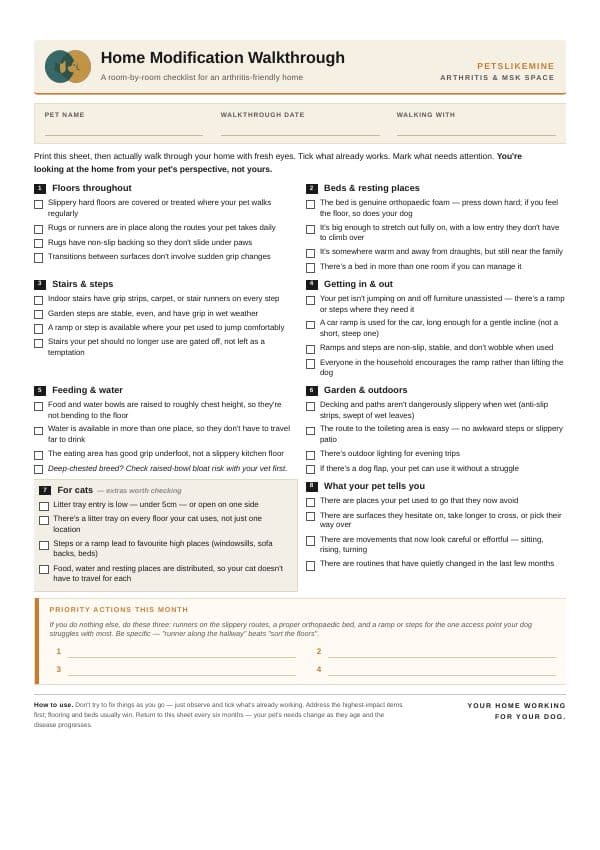
Do a walk-through of your home. Take this as a checklist (we've also turned it into a printable room-by-room walkthrough if you'd rather work off paper):
- Stand at your dog's bed. Look at the route from bed to back door. What surfaces does it cross? Where are the slippery patches?
- Look at the bed itself. Is it supportive? Is it the right size? Is it easy to get into and out of?
- Walk to where your dog drinks water. How far do they have to go? Is the bowl at a sensible height?
- Identify the furniture they get on and off. Is there a ramp or steps? Are they actually using them?
- Open the back door. What surface do they walk onto? Is there a step? Is it slippery when wet?
- Walk around the garden. Where's the toileting area? How do they get there? What's the route like in wet weather?
- If you have stairs, watch the dog use them (if they currently do). Are they struggling? Slipping? Reluctant?
- Consider where the dog rests during the day. Is it warm enough? Quiet enough? Comfortable enough?
Make a list of the issues you've identified. Address them in order of how often the dog encounters each problem and how serious the consequences are.
Three things for this week
If you do nothing else, do these three things in the next week:
1. Add runners or rugs to the most slippery routes your dog uses daily. This is the single highest-impact intervention you can make for most arthritic dogs. Total cost: £30-80. Time required: an hour.
2. Assess the bed. If it's not a proper orthopaedic bed with at least 7cm of memory foam, order one. Total cost: £60-150. Delivery time: a few days.
3. Look at one specific problem area (furniture access, car access, stair access, or whatever applies most to your dog) and add either a ramp, steps, or non-slip solution as appropriate. Total cost: variable, often £40-100.
These three changes alone, made this week, will produce a noticeable difference in your dog's comfort and confidence. The other modifications can be added gradually over time.
One last thing
None of the home modifications I've described here are dramatic. They're not expensive in the grand scheme of pet care. They're not technical. But the cumulative effect of getting them right is enormous.
Your dog moves around their environment thousands of times a week. Every one of those movements either supports them or stresses them. Modifying the environment so that more of those movements are supported is one of the most effective things you can do.
I see owners spend hundreds of pounds on supplements that may or may not work, while their dog slides daily across a laminate kitchen floor that's making everything worse. Get the basics right first. Runners, rugs, a good bed, a ramp where needed. Then add the more advanced interventions.
Your home should be working for your dog, not against them. With a few thoughtful changes, it can be.
References
Free downloads
Companion worksheets to put what you've read into practice. Free PDFs, print at home.
Sister tool · Sightline
Track whether treatment is working
Sightline, a separate ConciergeVet tool, runs a short weekly check-in built on validated pain and mobility instruments, turns it into a single Sightline Score you can watch trend over weeks rather than judge on one bad day, and produces a report you can bring to your vet.
A written log, or our printable trackers, does much the same job.
See how Sightline tracks treatmentSee where your pet stands today
Tracking is the other half of managing arthritis. Take the 2-minute Mobility Check to see your pet's stage, then watch it shift as treatment takes effect.
Take the Mobility CheckYou're not doing this alone
Compare treatment journeys and talk to owners managing arthritis. Free to join.
Join PetsLikeMine