

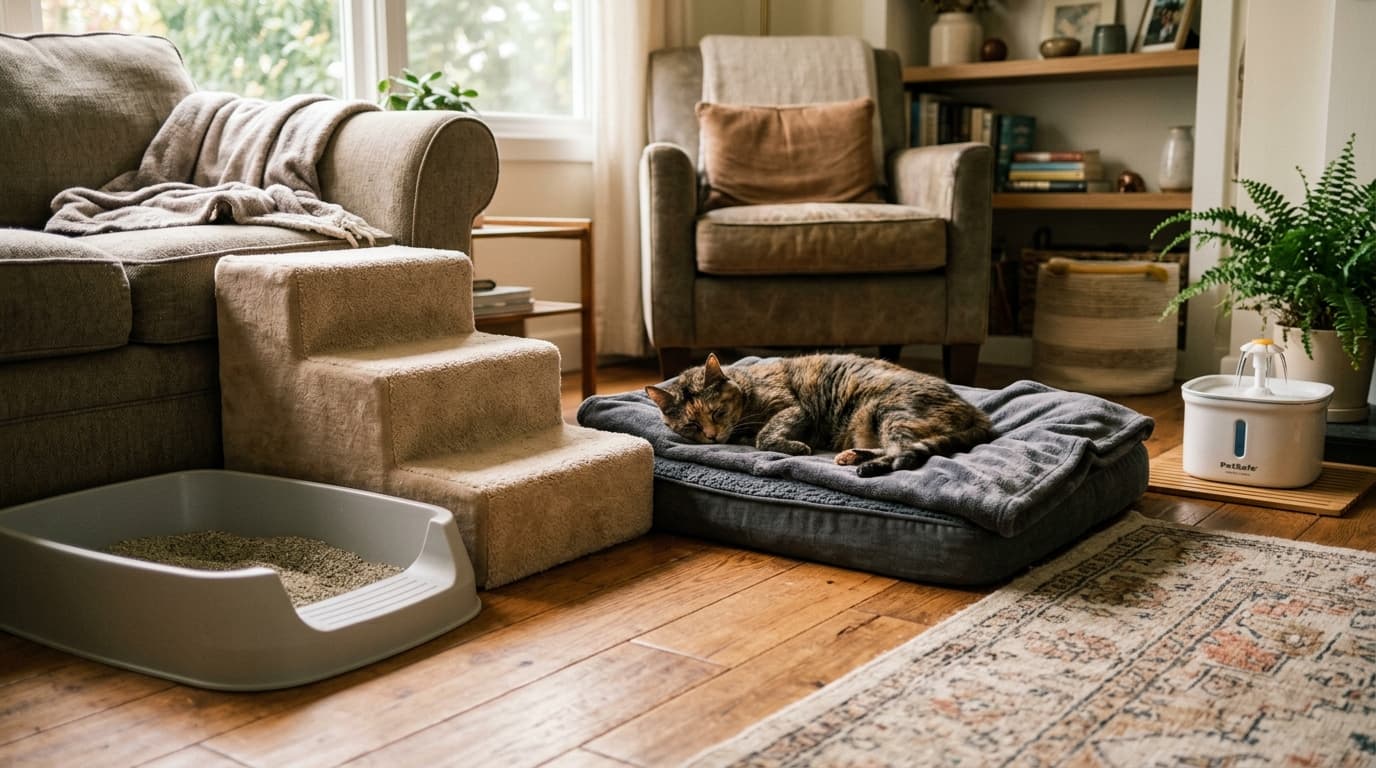
Home Modifications for Arthritic Cats
Alastair Greenway
BVM&S MRCVS
For an arthritic cat, your home is their entire world. Unlike a dog who escapes for walks and outings, a cat lives almost exclusively within the four walls of your house. Every jump, every step, every climb, every trip to the litter tray happens inside the space you've created for them. The design of that space either supports them or works against them, every single hour of every single day.
This is one of the most powerful interventions available to you, and it's almost entirely within your control. You don't need a prescription. You don't need to wait for veterinary advice. You can start making changes today that will improve your cat's comfort and quality of life within hours. And the cumulative impact of getting this right is genuinely significant.
What follows walks through the modifications that matter most, from the litter tray to the food bowl to the favourite resting place. Some are free or nearly so (rearranging furniture, blocking access to dangerous routes). Some are cheap (low-entry trays, pet steps, soft beds). Some are larger investments. I'll tell you plainly what's worth spending money on and what isn't, and which changes produce the biggest returns.
Why cats need this more than dogs do
It's worth understanding why environmental modification is proportionally even more important for cats than for dogs.
Cats live in a smaller world. Their universe is your house and possibly your garden. Every uncomfortable surface, every awkward jump, every difficult litter tray transaction is a daily event repeated hundreds of times per year. The environment determines a much larger share of their wellbeing than it does for a dog who gets out for walks.
Cats have fewer medication options. While Solensia has been a transformative addition to feline arthritis management, the pharmaceutical toolkit for cats remains narrower than for dogs. Environmental modification has to do more of the heavy lifting in feline care.
Cats prize vertical access. A cat who can't reach their favourite high places isn't just inconvenienced; they've lost something psychologically important. Vertical access is part of feline emotional wellbeing, not just physical accessibility.
Cats hide pain even better than dogs. A cat who's struggling with their environment may not communicate it clearly. They may just stop using areas, gradually withdraw, develop "behavioural" problems that are really physical limitations being expressed. The environment changes things they tell you about, and many things they don't.
The cost-benefit ratio is excellent. Most of the modifications I'll describe cost less than a single bag of premium cat food. Some cost nothing at all. The impact-to-cost ratio is hard to match with any other intervention.
This is the work where attentive owners can transform their cat's experience without medical intervention. It's worth taking seriously.
Start with the litter tray
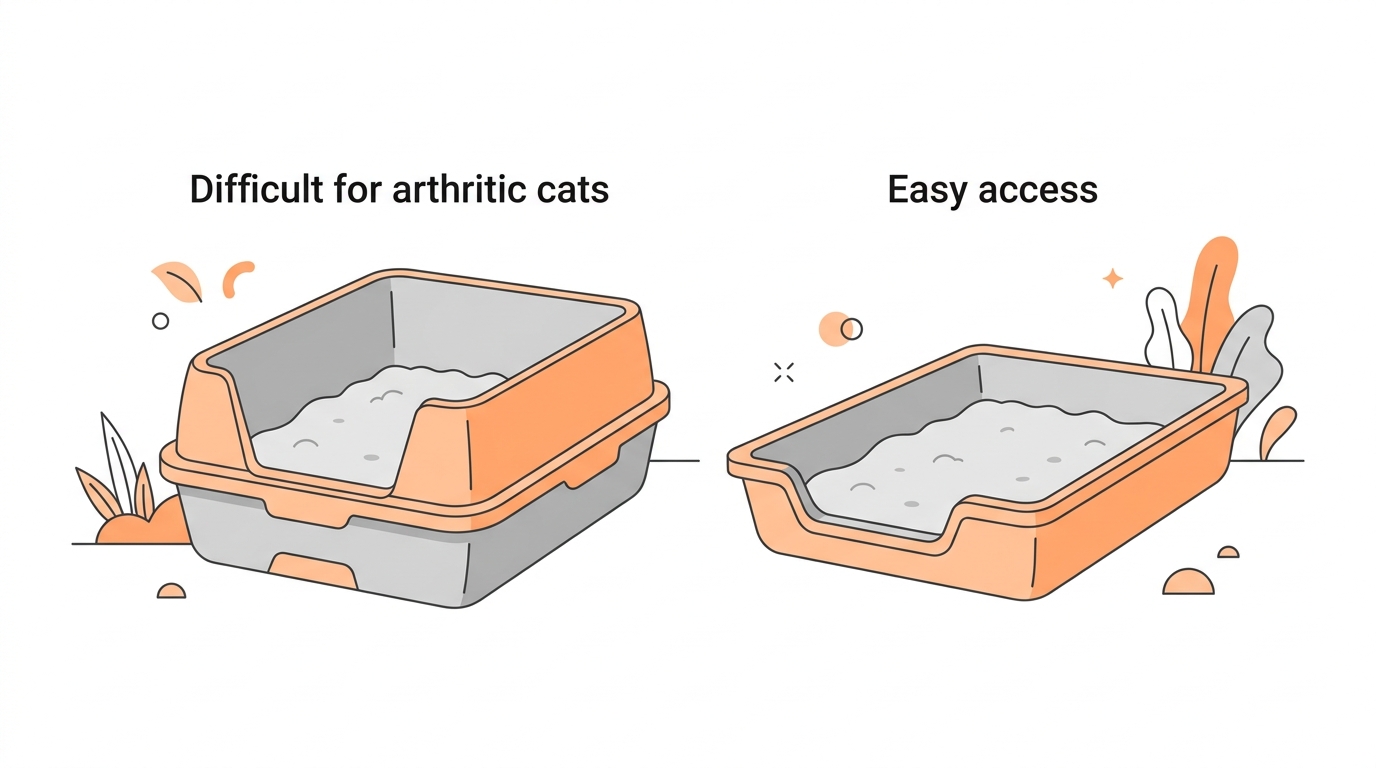
If I could only make one modification for an arthritic cat, it would be improving the litter tray situation. This is the single highest-impact change, and the one most commonly overlooked.
Why it matters so much
Litter trays were not designed with arthritic cats in mind. Most commercial trays have sides 15-25cm high. For a healthy adult cat, this is nothing. For a cat with hip arthritis, spinal arthritis, or hindlimb stiffness, climbing over this wall multiple times per day is painful, frustrating, and ultimately unsustainable.
What happens next is one of the most common scenarios in feline medicine. The cat starts going just outside the tray. Or in a different spot in the house entirely. Or stops urinating regularly because the experience has become so unpleasant. Their owner becomes increasingly frustrated with what looks like behavioural deterioration. They try different litters, different positions, deterrents, additional trays. They consider behavioural medication, or in the worst cases, rehoming.
The underlying problem, in many of these cases, is that the cat is in pain and the litter tray has become physically too difficult to use comfortably. Modify the tray and the problem often resolves entirely. The cat hasn't become "naughty." They're trying to manage their needs with a body that hurts.
Low-entry trays
The single most important feature for an arthritic cat is a low-entry point. The ideal entry height is no more than 5-8cm from the floor. This allows the cat to walk into the tray with minimal leg lifting.
Options:
Purpose-designed low-entry trays. Several manufacturers make trays specifically for senior cats. These typically have one low side (5-10cm) for entry while keeping the other sides higher (15-20cm) to contain litter. Cost in the UK is £15-30. Several specialist brands are available; the design matters more than the brand.
Modified existing trays. If you can't or don't want to buy a new tray, you can cut down one side of an existing plastic tray. Use a sharp serrated knife or hot knife to cut a low entry point. Smooth any rough edges. This is essentially free and works perfectly well.
Storage container trays. Some owners use shallow under-bed storage containers as litter trays. These can be much lower than commercial trays and are inexpensive. Look for ones around 5-8cm deep.
Tray-style trays. Very shallow trays designed more like baking trays than boxes. Work well for cats who only need a small accessible surface. May produce more litter scatter if the cat scratches enthusiastically.
What to avoid:
Top-entry covered boxes. These were once trendy and remain popular for reducing litter scatter. They're terrible for arthritic cats, requiring them to jump up, climb over a high edge, and lower themselves down. Avoid entirely.
High-sided trays. Standard trays with 15-25cm walls. Either replace or modify.
Self-cleaning trays with complex entry geometries. Some automated trays have rotating components, lids, or unusual entry shapes. They can work for some cats but are best avoided for those with mobility issues.
Size matters too
Beyond the entry height, the tray needs to be large enough for the cat to posture comfortably inside. Older cats may need more space than they did when younger because they can't crouch as tightly.
A good rule of thumb: the tray should be at least 1.5 times the cat's body length (nose to base of tail). For a typical domestic cat, that's a tray at least 40-50cm long internally. Many standard trays are too small for this.
If your cat appears to posture awkwardly in their tray, or hangs out over the edge, the tray is too small.
More than one, in more than one place
This is critical, particularly in multi-storey homes. An arthritic cat shouldn't have to navigate stairs to reach a litter tray. They shouldn't have to walk across the entire house to find one. The minimum standard is one tray per floor of the house, plus an additional tray for redundancy.
If you have a multi-cat household, the standard formula (one tray per cat, plus one extra) applies. So a household with two cats needs three trays. A household with three cats needs four. Most multi-cat households are significantly under-provisioned.
For your arthritic cat specifically, position trays:
- On the floor they spend most of their day on
- In quiet, accessible locations (not next to noisy appliances)
- Away from busy routes where another cat might block access
- With enough light for night-time visits (older cats may have reduced vision)
- Not against walls that could trap the cat in a corner
The cost of additional trays is modest (£10-30 each). The benefit in reducing accidents and stress is significant.
Choosing the litter itself
For arthritic cats specifically:
Softer, finer litter is more comfortable for sore paws than coarse pellet litter. Older cats sometimes develop paw sensitivity that wasn't present when younger.
Low-dust matters because older cats sometimes have respiratory issues that benefit from minimising airborne particles.
Unscented is generally preferred. Some older cats develop sensitivities to scented litters.
Consistent depth. Around 5-8cm is generally good. Too shallow and the cat can't dig comfortably; too deep and they may sink into it awkwardly.
Don't change litter suddenly. If you're switching, do it gradually over a week or two, mixing the old and new in increasing proportions. Cats often resist abrupt change to anything in their tray setup.
Non-slip surroundings
Place a non-slip mat outside the tray. Cats stepping out of a tray onto slippery floor are at risk of slipping, particularly if they're a bit unsteady. The mat also catches litter, which keeps the area cleaner. A simple rubber-backed mat from a hardware store (£5-15) does the job.
Resting places, where they spend most of their lives
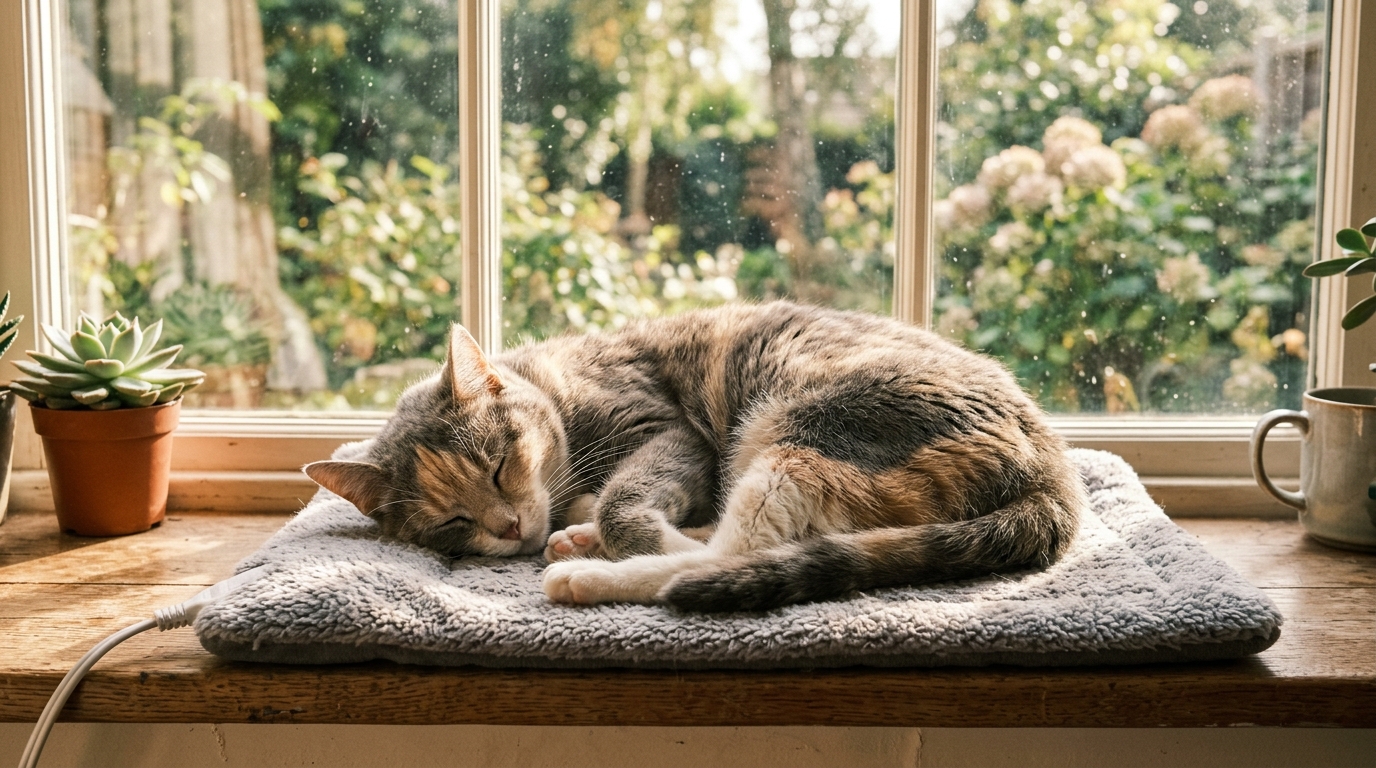
Cats sleep an enormous proportion of the day. For an arthritic cat, the quality of their resting places matters disproportionately because they're in them so much.
What makes a good bed for an arthritic cat
Sufficient padding. A bed should provide proper support without bottoming out under the cat's weight. Cheap cushions compress flat within weeks and become useless. Memory foam beds provide better support that lasts.
Warmth. Cold worsens arthritic stiffness considerably. Beds in cold spots actively work against your cat. Position beds away from draughts, near radiators (but not too close), in sunny spots where possible.
Easy access. The bed shouldn't require climbing over high edges or jumping into. A cat who has to haul themselves into their resting place every time is being aggravated, not comforted.
Appropriate size. Some cats like to sprawl; others curl tightly. Most arthritic cats benefit from beds large enough to allow stretched-out resting positions, because curling tightly can be uncomfortable for sore joints.
Washable cover. Older cats may have occasional accidents. Removable, machine-washable covers extend bed life and maintain hygiene.
Specific bed types worth considering
Memory foam cat beds. Provide proper support. Cost £25-50 for quality options. Worth the investment for an arthritic cat.
Heated cat beds. Either self-warming (using the cat's own body heat) or low-wattage electrically heated. Either can transform comfort in cold weather. Self-warming pads cost £10-20, electric heated pads £20-40. Excellent value for impact.
Donut or curling beds with low sides. Some cats like the security of partial walls around their resting place. Choose ones with low entry, not high bolsters.
Igloo or covered beds. Some cats love the enclosed security. Make sure the entry is large and easy, not a small hole requiring contortion.
Window perches. Many cats love watching the world from a windowsill. Padded window perches that hang from the window or attach to the sill let arthritic cats enjoy this without needing to jump up. £20-50 for various designs.
Spread the beds around the house
Cats benefit from choice. The optimal resting place depends on the time of day, the weather, the household activity, and the cat's mood. A single bed in a single location forces them to either use it or rest somewhere less comfortable.
Aim for at least 3-4 designated good resting spots around the house. A warm spot. A cooler spot. A spot near the family. A quiet retreat spot. Different beds, or just designated spots with soft padding, give the cat options.
For multi-storey homes, beds should be available on every floor the cat uses, so they don't need to navigate stairs to find comfort.
Vertical access
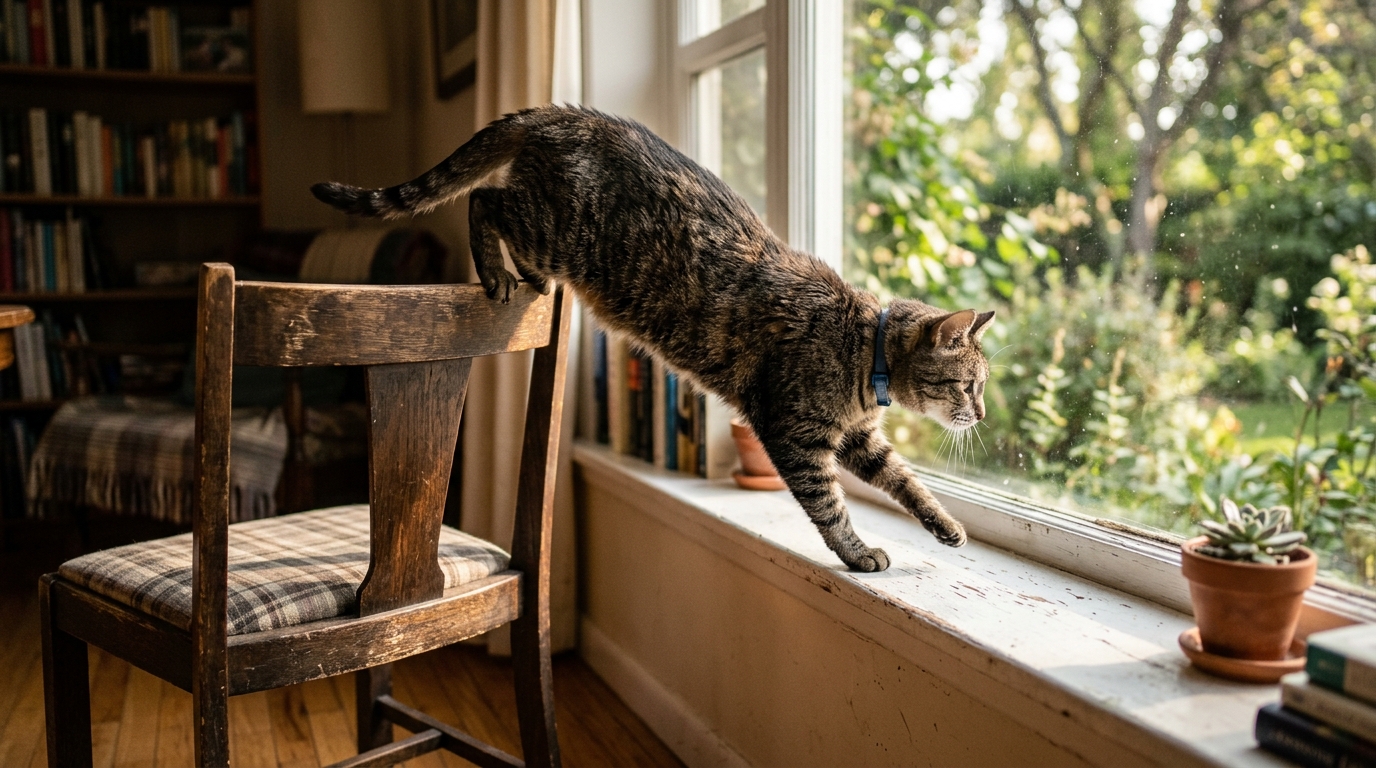
Cats value being elevated. Climbing, jumping, surveying from above. These are central to feline psychology, not just preferences. An arthritic cat who can no longer reach their preferred high places has lost something significant in their daily life.
The instinct is sometimes to "remove the dangers" by blocking access to high places. This is well-meaning but counterproductive. The cat still wants to be up there. Blocking access leaves them frustrated and grounded. Better to make the elevation achievable instead.
Pet steps and ramps
Pet steps are a series of stairs designed to bridge from floor level to elevated surfaces. They work well for cats who can still climb but can't jump. Available in various heights:
- Two-step models (around 25cm rise) for low surfaces
- Three to four-step models (35-50cm rise) for sofas, beds, low windowsills
- Larger multi-step models for higher surfaces
Cost ranges from £20-80 depending on size and quality. Look for ones with:
- Carpeted or textured surfaces for grip
- Sturdy construction that doesn't wobble
- Treads wide enough for the cat to step on (some are too narrow)
- Stable bases that don't shift when used
Ramps provide a gentler incline than stairs and are easier on joints. Better for cats with more severe arthritis. Available in various lengths:
- Short ramps for sofa-level surfaces
- Longer ramps for beds or higher surfaces
- Very long ramps for major elevation differences
Cost £30-100. Look for:
- Non-slip surface (essential)
- Gentle incline (not too steep)
- Side rails to prevent stepping off
- Wide enough surface for the cat to walk comfortably
- Stable, doesn't wobble
For most cats, ramps are easier than stairs because they don't require the joint flexion of climbing each step. But ramps take more floor space.
Intermediate stepping stones
A clever and often free approach: arrange existing furniture so that the cat can stage their journey to high places.
For example, if your cat used to jump onto the kitchen worktop and can't manage it now, place a sturdy stool or low cabinet next to the worktop. The cat now has a smaller jump from floor to stool, then stool to worktop. Two manageable jumps instead of one impossible one.
Similarly, a chair next to a sofa next to the windowsill creates a route up. A low storage box next to the bed enables sofa-level access.
This costs nothing and uses furniture you already have. The trick is thinking about routes from the cat's perspective and creating the intermediate steps that bridge gaps that have become too large.
Cat trees and climbing structures
For active cats and those at earlier stages of arthritis, cat trees provide vertical access in a structured way. Look for designs with:
- Multiple platforms at different heights
- Gentle ramps or wide steps between platforms (not vertical poles requiring jumping)
- Padded or carpeted surfaces
- Stable base that doesn't tip
- Variety of platform sizes for different preferences
Cost varies widely; quality cat trees are £80-200. Cheaper options often have stability problems.
For more advanced arthritis, cat trees may need to be supplemented or replaced with steps and ramps to specific destinations rather than free-climbing structures.
Bringing the high spots down
Sometimes the best solution is to bring the cat's favourite places to a height they can manage. If they used to love the top of the wardrobe and can't get there anymore, can you create an equally satisfying spot at sofa height? A padded shelf, a chair with a view, a cat hammock under a window.
You can't always relocate what they want, but it's worth thinking about which of their high places matter most and which could be substituted with more accessible alternatives.
Food and water access
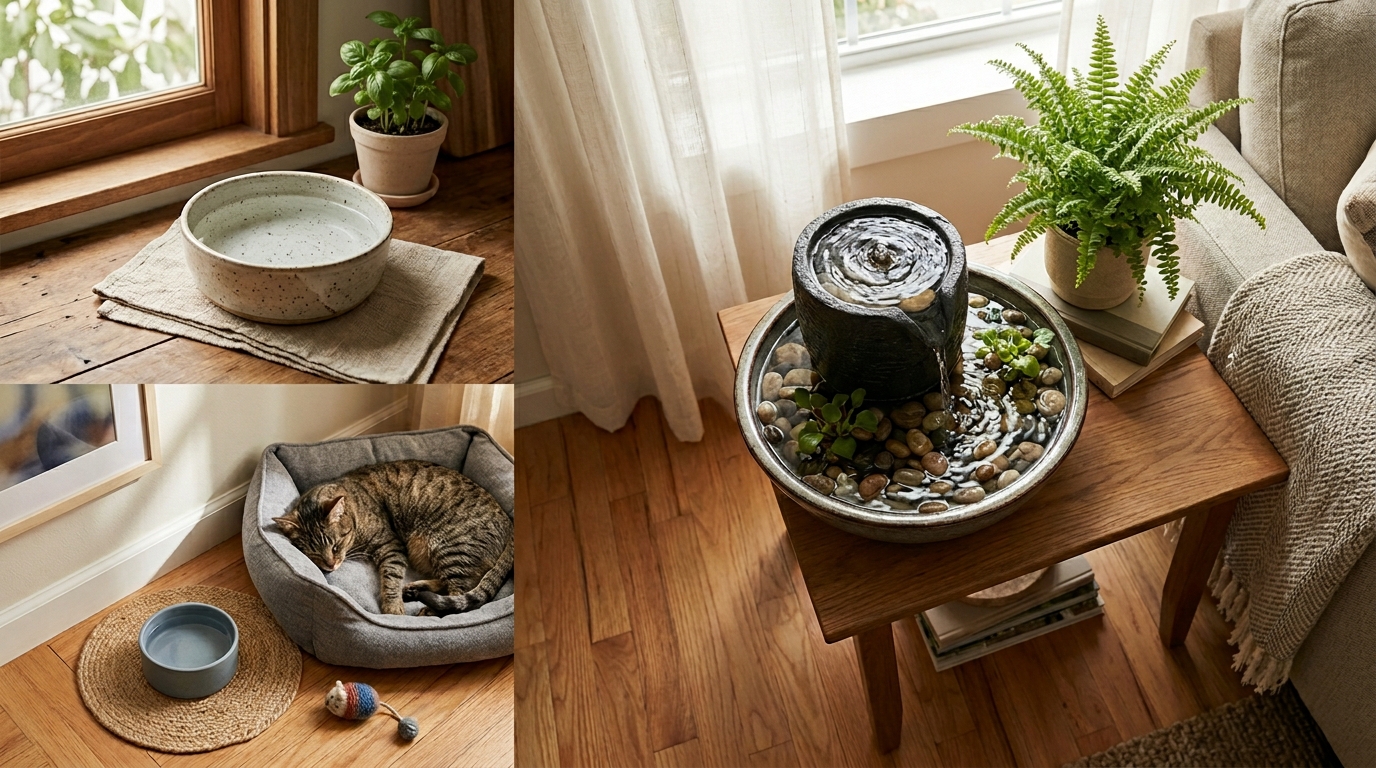
A cat's relationship with their food bowl is something they typically do many times a day. Getting this right has cumulative impact.
Bowl height
For most arthritic cats, slightly raised food and water bowls are kinder than floor-level ones. The reasoning is that a cat with cervical (neck) arthritis, thoracic spinal arthritis, or forelimb arthritis bending their head down to floor level repeatedly is putting stress on those compromised joints.
The right height is roughly chest height when the cat is standing comfortably. Not so high they have to reach up; high enough that they're not bending down significantly.
A small platform under the bowl (3-5cm) is often sufficient. Or you can use raised cat feeders designed for the purpose. Cost is modest (£10-25 for raised feeders, or free if you use a small box).
Multiple water sources
Hydration matters enormously for cats, particularly older ones and those with kidney disease (which often coexists with arthritis). A cat who needs to walk to a single water source across the house may not drink enough, particularly if they're less mobile.
Solutions:
Water bowls in multiple locations. Near the food, near the bed, perhaps in another room. The cat shouldn't have to make a journey to drink.
Water fountains. Many cats prefer running water. Fountains can encourage greater intake. Cost £20-50 for various designs. Worth considering for any older cat.
Wet food in the diet. Adds significant moisture intake. Particularly useful for cats with chronic kidney disease.
Access without obstacles
Don't put the food and water in a location that requires the cat to climb, jump, or navigate slippery floors to reach. The journey to dinner should be easy.
In multi-storey homes, consider food and water on every floor the cat uses. Particularly water; the inconvenience of going downstairs for water may mean they don't drink enough.
Slow feeders and puzzle bowls
For cats who eat too fast, or who could use more mental stimulation, slow feeders and puzzle bowls extend mealtime and provide engagement. Particularly useful for arthritic cats who can't get the physical stimulation they once did but still need mental enrichment.
Various designs exist, from simple ridged bowls to complex puzzle feeders. Choose based on your cat's interest in working for food. Cost £10-30.
Floor surfaces and traction
The same flooring principles that affect arthritic dogs affect arthritic cats. The impact is sometimes different because cats are smaller and more agile, but the principle is the same: slippery floors cause acute injury risk, gait alteration, and loss of confidence.
Where the trouble lies
Laminate, tile, polished wood, vinyl. All common in modern UK homes. All slippery, particularly when the cat tries to brake, turn quickly, or stop.
Polished concrete (some modern flooring choices) is even worse.
Wet patches anywhere, including around water bowls, are hazards.
Solutions
Runners and rugs along main routes. Identify the routes your cat uses regularly: bed to litter tray, food area to favourite resting place, hallway to other rooms. Lay non-slip backed runners or rugs along these routes.
You don't need to cover every floor. You need to create reliable grippy pathways for the cat's main movements. Cost £20-80 depending on coverage.
Make sure rugs themselves don't slip. Non-slip pads under rugs or rugs with rubber backing. A rug that slides when stepped on is worse than no rug.
Yoga mats or rubber mats in key spots. Around the litter tray, around food and water bowls, at the foot of pet steps or ramps. Targeted grip where it matters most.
Honeycomb litter mats outside the litter tray provide both grip and catch escaped litter.
Outdoor surfaces
For cats with garden access:
Decking becomes very slippery when wet. Many cat owners don't realise how hazardous garden decking can be in autumn and winter. Anti-slip strips or coverings help, or consider keeping the cat in when the deck is wet.
Paving slabs with moss or algae become treacherous. Power-washing routes the cat uses helps maintain grip.
Steep steps or stairs in the garden may need to be avoided through fencing or supervision. Cats can fall from heights they used to manage safely.
Garden access
For cats who go outdoors, the journey out and back is part of the management equation.
Cat flaps
The bending and pushing required to use a cat flap can be problematic for arthritic cats. The flexing through the flap, particularly through heavy magnetic or microchip flaps, may cause real discomfort.
Solutions:
Lighter flap mechanisms. Some flaps are easier to push through than others. Replace stiff or heavy ones.
Larger flaps. A flap designed for a larger cat that your cat can step through more easily, rather than having to crouch and push.
Removing the flap during the day if security allows. Leaving the door propped slightly open or removing the flap insert during hours when supervision is possible.
Switching to door access. Some owners simply accept that they'll let the cat in and out at intervals during the day, removing the flap entirely.
Steps and thresholds
Steps at doors can be challenging. A high step from the kitchen to the garden, or a deep step down from a back door, can be painful for an arthritic cat.
Add a small ramp from inside to outside. Even a simple wooden plank covered in carpet, gradually inclined, removes the step. Costs essentially nothing and dramatically improves access.
Garden modifications
Within the garden:
Steps and slopes can be modified with ramps or small platforms to create gentler transitions.
Toileting access matters. A cat who has been going outside to toilet but now finds it difficult may need indoor tray access as well. This isn't failure; it's accommodation.
Shelter from weather so the cat can pause if it starts to rain rather than rushing back.
Sheltered viewing spots where they can sit comfortably outside in mild weather.
Reducing surprise and stress
Beyond physical accessibility, an arthritic cat benefits from a predictable, low-stress environment.
Consistent routines. Cats with chronic pain seem to benefit from predictability. Feeding times, household rhythms, even the presence of family members. Major changes are stressful and can flare up pain.
Avoiding sudden changes. New furniture arrangements, new pets, new people in the household, building work. All of these create stress that can manifest as worsened pain expression.
Quiet retreat spaces. Places the cat can go to escape activity, noise, or other pets. Crucial for older cats living in busy households.
Gentle introductions to new things. When changes are necessary (new furniture, decorating, visitors), introducing them gradually rather than dramatically reduces stress impact.
For multi-cat households or households with dogs, ensuring the arthritic cat can access all their resources without competition or interference is important. Sometimes this means separate feeding stations, separate resting areas, or strategies to give the older cat priority access.
A practical assessment exercise
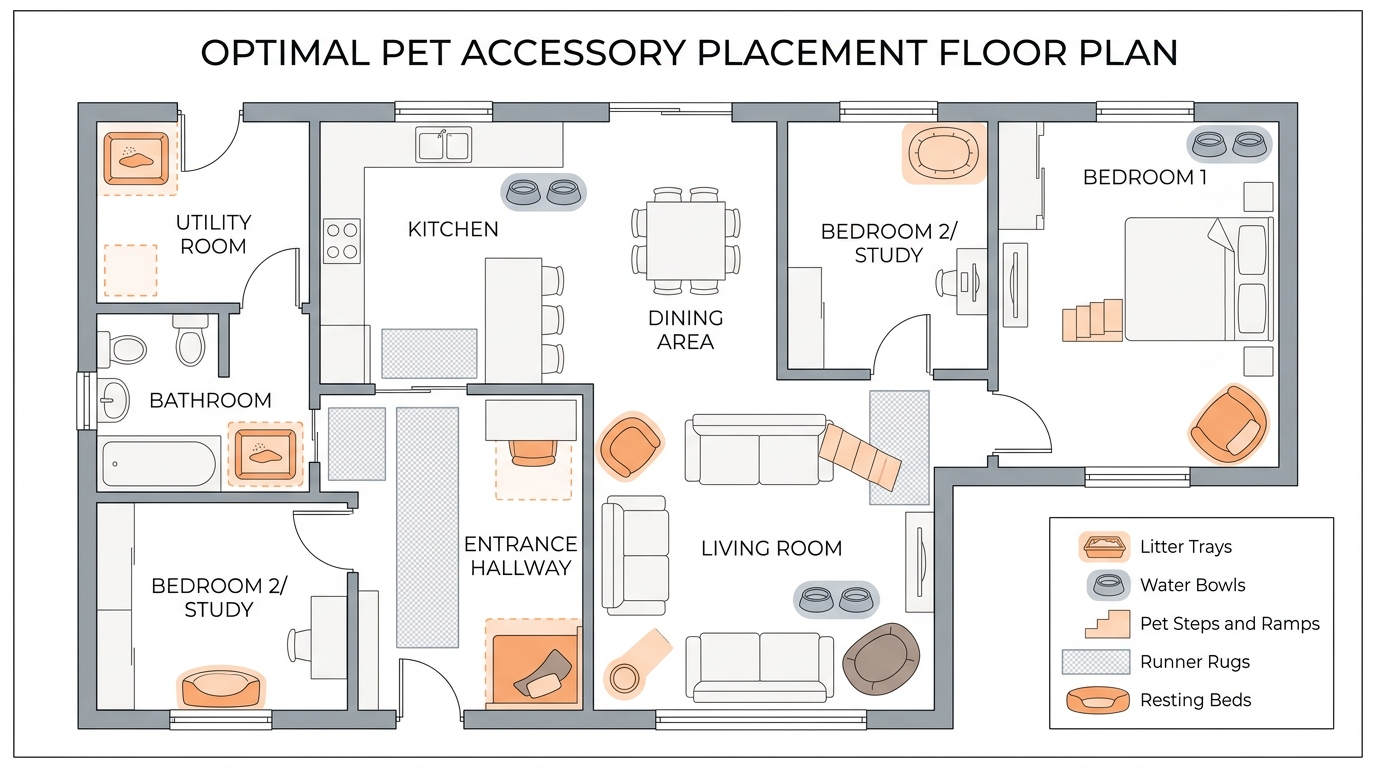
Walk through your home now, viewing it from your arthritic cat's perspective. For each location they regularly visit, ask:
- Can they get here without jumping anything significant?
- Is the surface they're standing on safe and comfortable?
- Is the temperature comfortable? Is it draughty?
- Are there alternative routes if their preferred path is blocked?
- If they need to use this resource (litter, food, water, rest), is access easy?
Make notes on issues you identify. Address them in priority order based on how often the cat uses each area and how serious the consequences of difficulty are.
What to do this week
If you've read this and want to take immediate action:
1. Sort out the litter tray situation. Either buy a low-entry tray (£15-30) or modify an existing one. Add a second tray if you only have one. This is the single highest-impact change for most arthritic cats.
2. Place water bowls in additional locations. If your cat has to walk far to drink, fix this today. Even a second water bowl costs nothing.
3. Add pet steps or a ramp to one significant high place. Their favourite chair, the bed, the windowsill. Whichever they used to access and have stopped using. Cost £20-80 depending on the height.
4. Address the bed situation. Is it warm, supportive, and easy to step into? If not, upgrade it. A good memory foam cat bed costs £25-50.
5. Look at the floors on main routes. If they're crossing slippery surfaces between key resources, add a runner or rug along that route. Cost £15-40.
These five changes can be implemented over a single weekend for under £150 total. The transformation in your cat's daily comfort is often visible within days.
A final thought
None of the modifications I've described here are dramatic. They're not expensive in the grand scheme of pet ownership. They don't require veterinary appointments or prescriptions. But the cumulative impact of getting them right is enormous.
Your arthritic cat spends their entire life in your home. Every step, every jump, every toilet visit, every meal, every rest. Every one of those events either supports them or stresses them. Modifying their environment so that more of those events are supported isn't optional comfort; it's one of the most powerful interventions you have available.
I see cat owners spend significant money on supplements and prescriptions while their cat continues to slip on laminate floors, fail to climb into a high-sided litter tray, and struggle to access their water bowl. Get the basics right first. Low-entry tray, multiple water sources, pet steps, soft warm bed, non-slip floors. Then build the medical management on top.
Your home should be working for your cat, not against them. With a few thoughtful changes, it can be.
Free downloads
Companion worksheets to put what you've read into practice. Free PDFs, print at home.
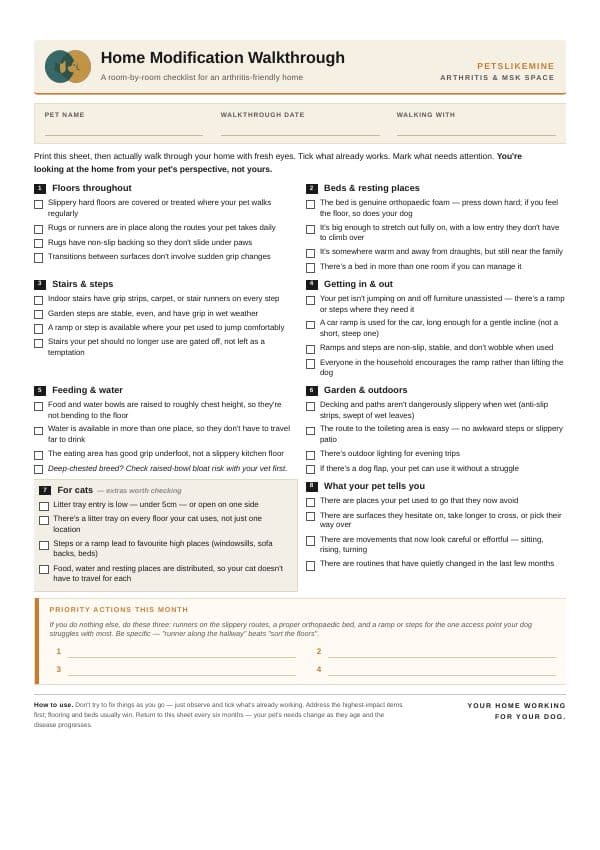
Home Modifications: Room-by-Room Walkthrough
PDF · 357 KBA room-by-room checklist for an arthritis-friendly home. The cheap wins, the bigger projects, and the small changes that matter most for an arthritic dog or cat.
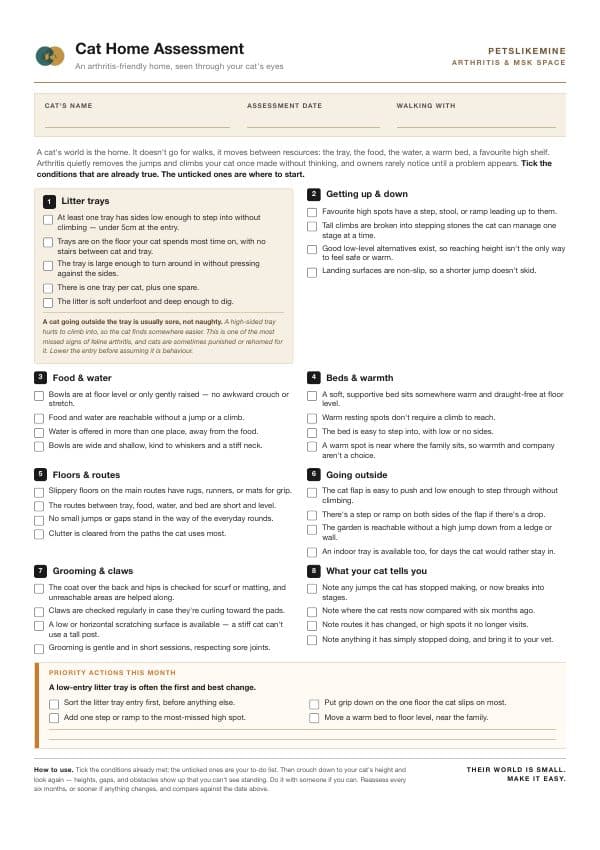
Cat Home Assessment Checklist
PDF · 127 KBA resource-by-resource home assessment for cats with arthritis. A cat's world is the home, and arthritis quietly removes the jumps and climbs between the litter tray, the food, the warm bed, and the favourite high shelf. Tick what's already easy; the rest becomes your plan, starting with the litter tray.
Sister tool · Sightline
Track whether treatment is working
Sightline, a separate ConciergeVet tool, runs a short weekly check-in built on validated pain and mobility instruments, turns it into a single Sightline Score you can watch trend over weeks rather than judge on one bad day, and produces a report you can bring to your vet.
A written log, or our printable trackers, does much the same job.
See how Sightline tracks treatmentSee where your pet stands today
Tracking is the other half of managing arthritis. Take the 2-minute Mobility Check to see your pet's stage, then watch it shift as treatment takes effect.
Take the Mobility CheckYou're not doing this alone
Compare treatment journeys and talk to owners managing arthritis. Free to join.
Join PetsLikeMine