

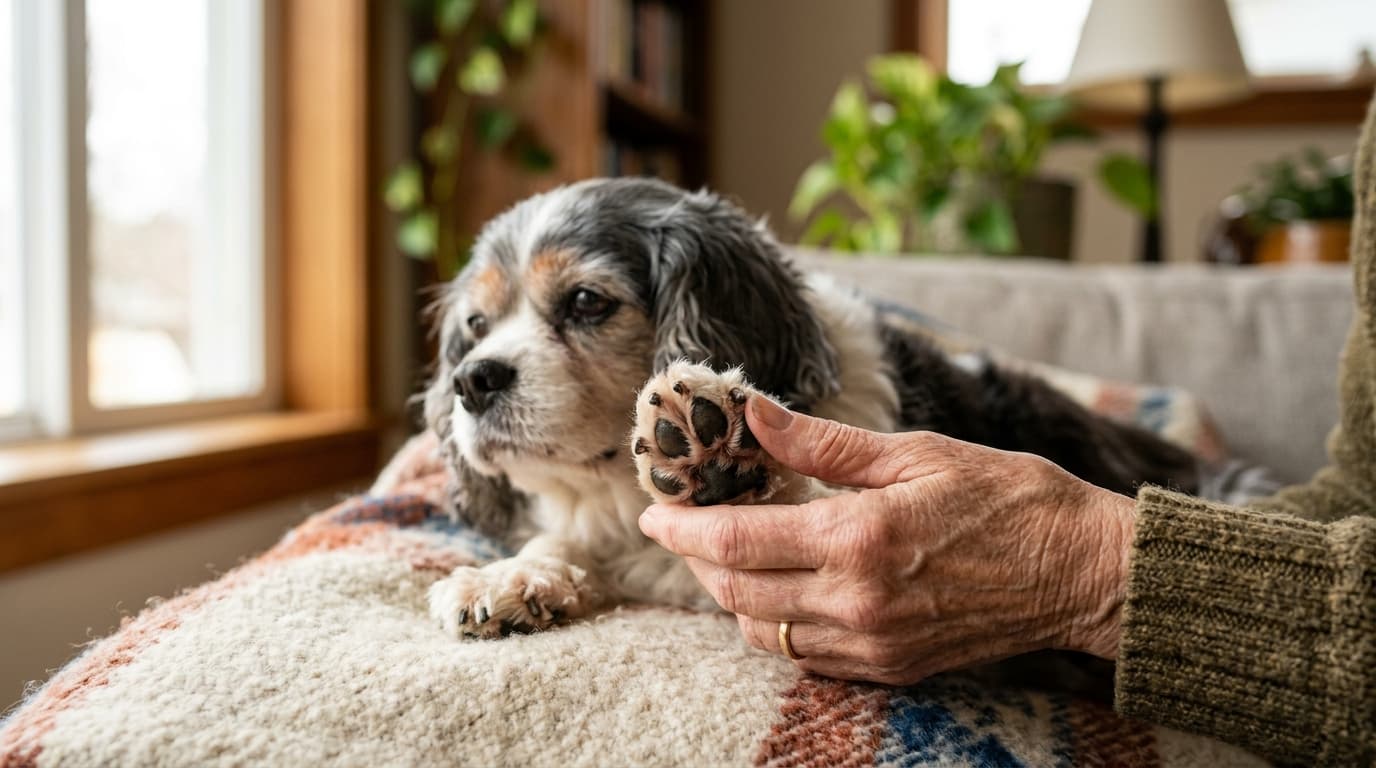
Grooming, Nail Care, and the Details That Matter
Alastair Greenway
BVM&S MRCVS
Plenty of owners file grooming, nail care and the rest under "nice to have" rather than serious arthritis management. They're wrong. The small details of daily grooming, nail care, paw maintenance and coat condition compound over time, and for an arthritic dog they make a measurable difference to comfort, mobility and quality of life.
None of this is about making your dog look pretty. It's about why long nails change how your dog walks, why a matted coat affects how an arthritic dog can rest, why the hair between paw pads turns hard floors into a hazard, and why grooming sessions themselves need a different approach for a dog who can't comfortably stand for an hour.
These are the practical, easily overlooked parts of daily care that separate owners who really understand arthritis management from owners who are doing the big things and missing the small ones.
Why nails matter so much
Nails are the single most undervalued part of routine care for arthritic dogs.
Long nails in an arthritic dog set off a cascade of problems that pile on top of the existing joint disease. Most owners, and even some vets, underestimate how much difference nail length makes. Once you start paying attention, you realise this is one of the simplest, cheapest interventions available, and one of the most consistently overlooked.
How long nails change the body's mechanics
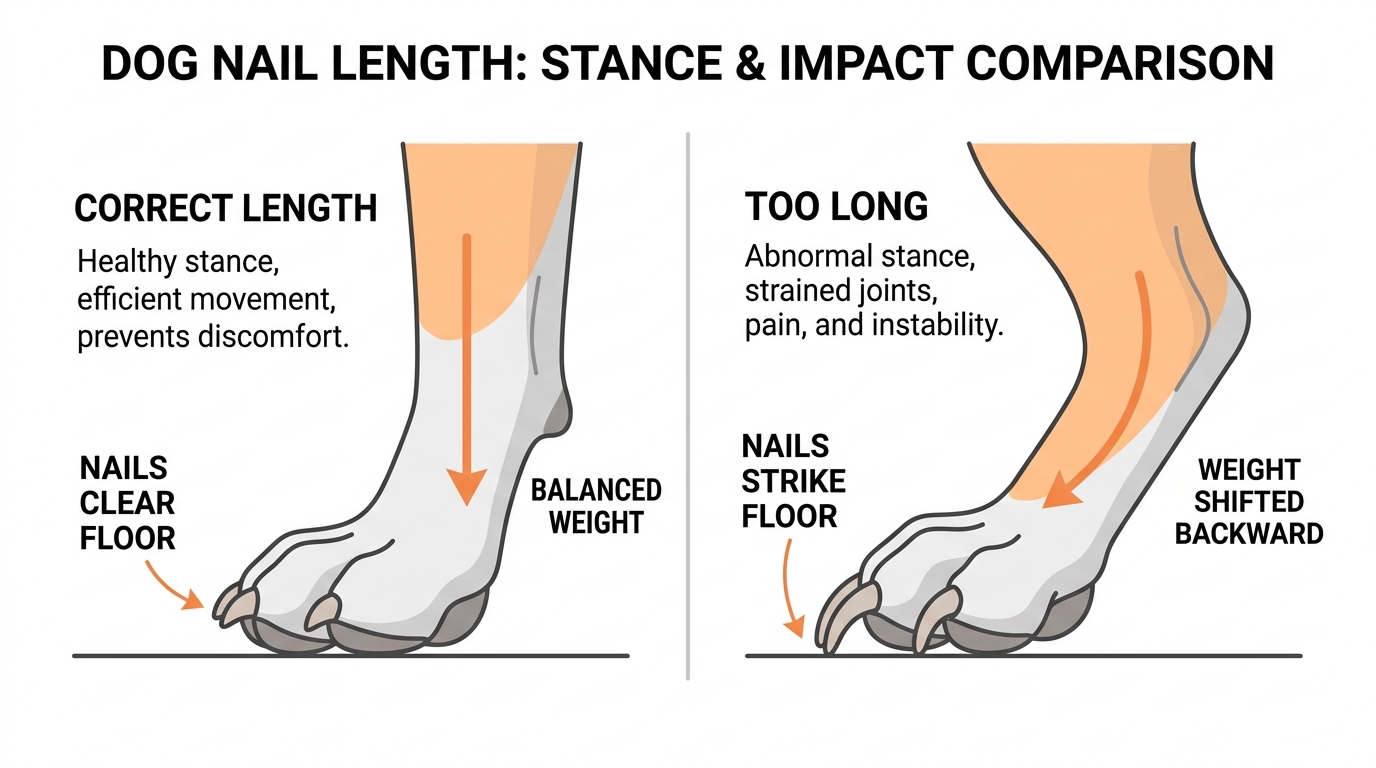
When a dog stands on a flat surface with normal-length nails, the paw sits in a relaxed, neutral position. The nails should just clear the floor when the dog is standing still, neither pressing into the ground nor lifting off it.
When nails are too long, the geometry changes. The nails contact the floor before the paw pad is properly loaded. The dog's natural response is to shift their weight backward to keep the toes from being pushed up by the nails. That shifts weight off the front legs and onto the hindquarters, into the dog's spine.
Over time, the toes splay outward to try to flatten the paw against this nail interference. The natural alignment of the digits is disrupted. The metacarpal and metatarsal bones load differently. Forces transmit up the legs in patterns the joints weren't designed for.
For a healthy dog, this is unhelpful but generally tolerable. The body compensates and life goes on. For an arthritic dog, it's adding insult to injury. Joints that are already inflamed and painful are now being loaded in awkward ways every single step. The compensation patterns needed to walk on long nails increase the workload on muscles and tendons throughout the legs and back. Subtle extra discomfort accumulates with every step.
What the research actually shows
There's an important nuance here. A 2026 Frontiers in Veterinary Science study by Häusler and Söhnel measured gait parameters in healthy dogs before and after nail trimming. Their headline finding was that, in clinically sound healthy dogs, longer claws didn't significantly change overall locomotor function in their measurements. They suggested that long nails may sometimes be a consequence of altered gait rather than a primary cause: dogs with biomechanical issues may wear their nails down less effectively because of how they move.
That's worth knowing, because it tempers some of the more dramatic claims you see online about how long nails inevitably destroy joints. The authors explicitly note that the long-nails-alter-kinematics hypothesis lacks robust objective evidence in healthy animals.
The practical picture in arthritic dogs is different from the experimental picture in healthy ones, though. The 2014 O'Neill VetCompass paper, looking at over 100,000 dogs in UK primary-care practice, found overgrown nails recorded in around 7% of dogs as a clinical health concern, ranking it among the most common disorders recorded. A 2025 follow-up by Ahmed and colleagues confirmed nail clipping problems sit in the top handful of issues seen in UK primary care.
So here's the position I'd take. For healthy adult dogs, long nails are probably less catastrophic than internet content sometimes suggests. For arthritic dogs, where every small biomechanical stress matters and where small additional sources of discomfort compound, keeping nails properly short remains a sensible, low-cost intervention that almost certainly does no harm and very plausibly helps.
How short is short enough?
When your dog stands on a flat hard surface, look at their nails from the side. The tips should clear the floor by a millimetre or two. They shouldn't be pressing into the floor. They shouldn't be lifting the toes.
When your dog walks across a hard floor (laminate, tile, hardwood), you shouldn't hear clicking. The clicking sound that many owners think is "just how dogs walk" is the sound of nails striking the floor first, before the paw pads. It's a sign that nails are too long.
The other sign is the natural angle of the digits. In a paw with appropriately short nails, the toes are relatively flat and forward-pointing. In a paw with long nails, the toes splay outward and may appear stretched. You can see this from above, looking down at your dog's paws when they're standing.
How often should you trim?
For most arthritic dogs, every 2-3 weeks. Possibly every week for dogs whose nails grow particularly quickly.
That's more often than most owners realise. The general advice you'll see suggests every 6-8 weeks, but that's for younger active dogs whose nails are being worn down by exercise on hard surfaces. An arthritic dog is exercising less, walking on softer surfaces more, and not wearing nails down naturally. They need more frequent maintenance.
Aim for short, frequent trims rather than rare, dramatic ones. Each trim removes a small amount, allows the quick (the blood vessel inside the nail) to gradually recede, and keeps nails consistently at the right length. That's far better than letting nails grow long, then attempting a major reduction that's painful and stressful.
Trimming nails when standing hurts
Here's where it gets tricky. Standard nail clipping asks the dog to stand for the procedure, hold their paws up to be examined, and tolerate the sensation. For arthritic dogs, all of that can be uncomfortable or impossible.
Some practical approaches:
Use a nail grinder rather than clippers. A Dremel-style rotary tool with a sanding head removes nail material gradually and never accidentally hits the quick. Many arthritic dogs tolerate grinders better than clippers because there's no pinching sensation. The noise can be off-putting initially, but most dogs adapt with patience and treats. Quality dog-specific grinders cost £30-80 and last for years.
Trim while the dog is lying down. Don't expect them to stand. A dog lying comfortably on their side, with their paws accessible, is far more relaxed than a dog being asked to stand on three legs while you lift the fourth. Approach this as you would lifting the paw for any other examination: gently, briefly at first, building tolerance over time.
Do one paw at a time, or even one nail at a time. You don't have to do all twenty nails in one session. If your dog gets uncomfortable after one paw, stop. Come back later or tomorrow. Frequent short sessions are kinder than rare long ones, and they keep the dog associating nail trimming with quick, manageable experiences rather than prolonged discomfort.
Use plenty of treats and breaks. Every nail clipped or ground deserves reinforcement. This isn't bribery; it's classical conditioning. The procedure becomes associated with rewards, and the dog cooperates better over time.
Don't worry about exact perfection. Trimming nails slightly less than optimal is far better than not trimming them at all because you can't manage a perfect job. Get them shorter than they were. That's success.
Consider professional help. If you really can't manage nails at home, regular grooming or vet appointments specifically for nail trims are worth the cost. Many UK practices offer nurse-led nail trim appointments at £10-20, which can be every 3-4 weeks for an arthritic dog. Some mobile groomers come to your home, which is gentler than transporting an arthritic dog to a salon.
The single biggest mistake I see is owners feeling overwhelmed by the whole process and letting nail care lapse entirely. Even imperfect, infrequent nail trimming is better than none. Don't let perfect be the enemy of good.
Paw and pad care
Beyond the nails, the rest of the paw deserves attention in an arthritic dog.
Hair between the pads
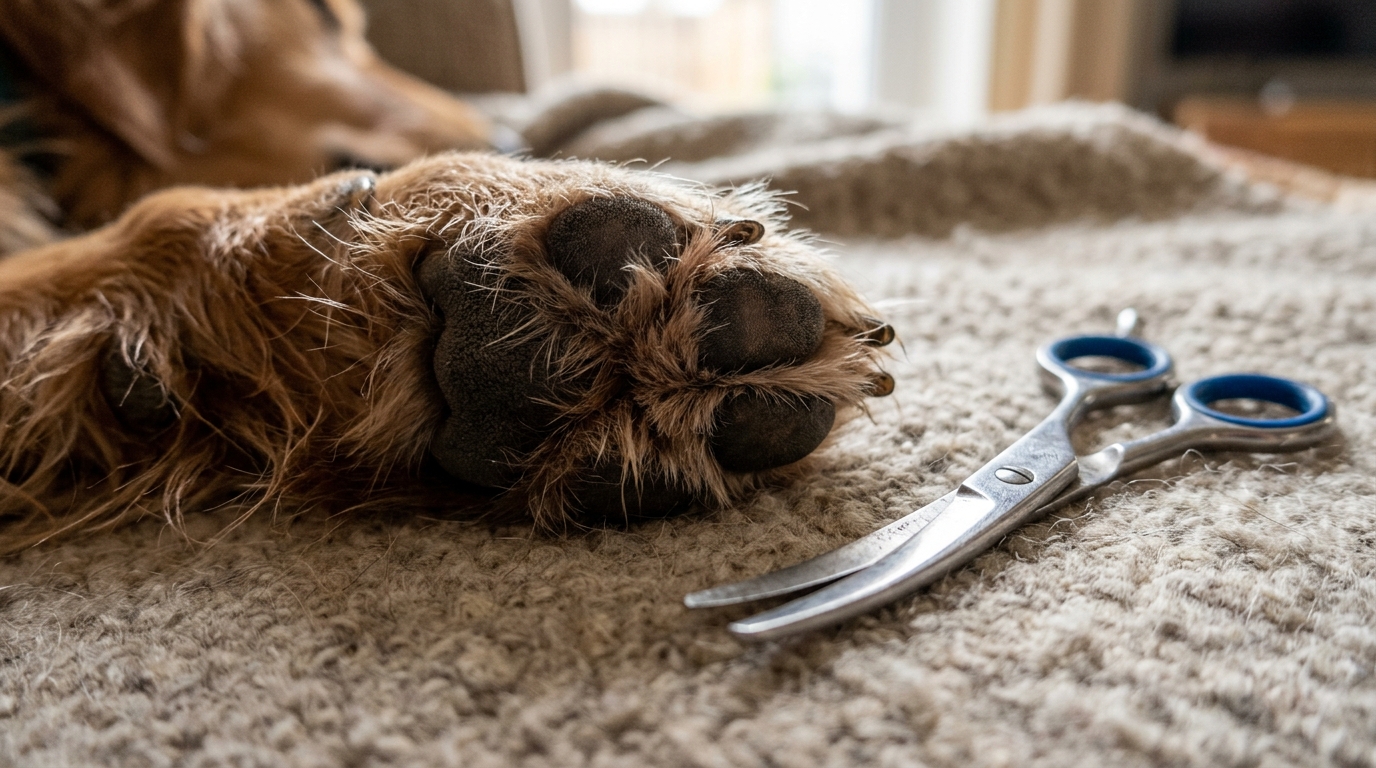
Most breeds grow hair between their paw pads. For active young dogs on outdoor terrain, this hair gets worn down naturally and isn't usually a problem. For arthritic dogs spending more time on smooth indoor surfaces, it becomes a major slip hazard.
When the hair between the pads grows long enough to reach beyond the pad surface, the dog is essentially walking on the hair rather than the pad. On laminate, tile or hardwood, that dramatically reduces traction. The dog who slipped before now slips more.
The hair between the pads should be trimmed flush with the pad surface. Curved blunt-tipped scissors are the safest tool. Have someone help if your dog is wriggly. Trim while the dog is lying comfortably. This needs doing roughly every 4-6 weeks for most breeds.
This single change, alongside non-slip flooring (covered in our home modifications article), can transform an arthritic dog's confidence in moving around the house.
Pad condition
Paw pads can become dry, cracked, or develop hyperkeratosis (thick, crusty pad surfaces) as dogs age. This is more than cosmetic. Cracked pads can be painful. Hyperkeratotic pads are slippery on smooth floors and may catch on rough surfaces in ways that cause discomfort.
Routine pad care for arthritic dogs:
Check pads weekly. Visually inspect for cracks, foreign material, or unusual texture. Run your finger gently across the pad surface.
Apply a dog-safe paw balm if pads are dry. Products like Musher's Secret, dog-specific paw balms, or even small amounts of unscented coconut oil applied once or twice weekly help keep pads supple. Don't use products designed for human skin; many contain ingredients dogs shouldn't lick.
Trim hyperkeratotic growth carefully. If your dog has the thick, crusty pad excess, your vet or groomer can trim this back. Don't attempt to peel or pull it off; this can cause pain and bleeding.
Watch for paw licking. A dog who's repeatedly licking specific paws may be telling you about an injury, foreign material, or pad discomfort. Investigate before assuming it's behavioural.
Foreign material between toes
Grass seeds, small stones, ice balls in winter, dried mud, and other material can get lodged between toes and become genuinely painful. Arthritic dogs may not communicate this clearly because they're already showing reduced enthusiasm for activity.
After walks on certain terrains (grass with seed heads in summer, wet muddy fields, snow), check between the toes systematically. Remove anything that's lodged. A quick paw wipe with a damp cloth after walks catches a lot of issues before they become problems.
Outdoor surfaces and paws
Some outdoor surfaces are particularly hard on arthritic dogs' paws:
Hot pavement in summer. Tarmac can reach temperatures that cause pad burns. The five-second rule: place the back of your hand on the surface for five seconds. If it's uncomfortable for you, it's too hot for your dog. Walk early morning or evening on hot days.
Cold and salted pavements in winter. Road salt and grit irritate pad surfaces. Some dogs develop genuinely sore paws from winter walks. Boots can help if your dog tolerates them; otherwise, wash paws thoroughly with warm water after walks in salted areas.
Rough terrain on already-painful joints. Long walks on gravel or rough paths cause additional small impacts through the limbs. For arthritic dogs, preferring softer surfaces (grass, forest floor, soft dirt paths) is kinder to both joints and pads.
Coat condition matters
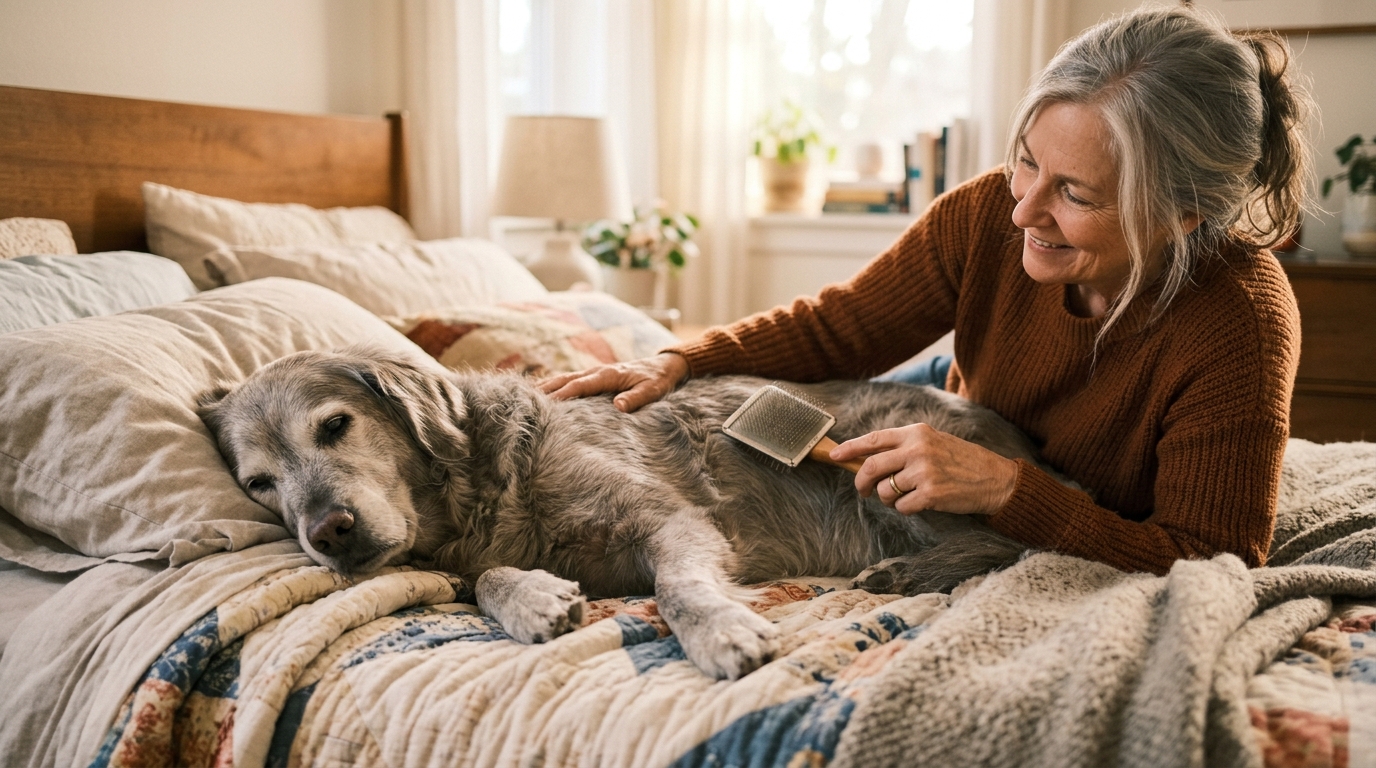
Many owners think coat care is purely aesthetic. For arthritic dogs, it isn't.
Why grooming matters more, not less
There's a common misconception that older or arthritic dogs need less grooming because they're moving less and getting less muddy. The opposite is often true. Arthritic dogs need more grooming attention, not less, for several reasons.
Self-grooming is reduced. A dog with hip, spinal, or neck arthritis can't twist and reach to clean themselves the way they used to. Areas they used to maintain (the lower back, hindquarters, base of tail, perineal area) often start showing signs of being uncared-for. Coat becomes matted or dirty.
Skin health depends on grooming. Regular brushing distributes the natural oils through the coat and stimulates circulation to the skin. A dog who isn't being brushed regularly often develops dry, flaky skin, more so if they're also less able to self-groom.
Matting causes real discomfort. When mats form, they pull on the skin every time the dog moves. For an arthritic dog already living with chronic discomfort, this is an extra unnecessary source of stress. In bad cases, mats can restrict movement, conceal skin infections, or cause sores beneath them.
Grooming is an opportunity to check the dog. Regular handling lets you spot lumps, sores, ear problems, eye issues, dental problems, and other changes early. The arthritic dog who isn't being touched and handled regularly is the dog whose secondary problems get missed.
A practical grooming routine
The right routine depends on the breed and coat type, but for most arthritic dogs:
Brush daily or every other day. Even a quick 5-minute brush makes a meaningful difference. Use brushes appropriate for the coat type (slicker brushes for medium coats, undercoat rakes for double coats, soft brushes for short coats).
Focus on the areas they can't reach. Lower back, hindquarters, base of tail, perineal area, behind the ears, armpits. These are where mats form and where dirt accumulates in dogs that can't self-groom adequately.
Pay attention to length around the eyes and bottom. Long hair in these areas can cause specific problems. Around the eyes, hair can grow into the eye itself, causing irritation. Around the bottom, long hair can become fouled. For breeds prone to either, regular careful trimming with blunt-tipped scissors is essential.
Bath only when necessary. Over-bathing strips the natural oils from the coat. Most dogs need bathing every 4-8 weeks at most, less for breeds with naturally weatherproof coats. Use dog-specific shampoos; human shampoos disrupt the skin's pH.
Bathing technique matters for arthritic dogs. Standing in a tub or shower can be genuinely difficult. Consider:
- A non-slip mat in the bath or shower
- Bathing on a level surface (no high step into a bath)
- Supporting the dog with one hand while washing with the other
- Keeping baths quick to minimise standing time
- Using lukewarm water; very hot or cold water can cause muscle tension in arthritic dogs
Professional grooming for arthritic dogs
Many owners use professional groomers, and good groomers can make a real difference for arthritic dogs. But not every grooming setup suits an arthritic dog.
Things to look for in a groomer for an arthritic dog:
Patience and willingness to work in shorter sessions. A dog who can't stand for two hours of grooming needs a groomer who'll work with that, taking breaks, doing what's needed and stopping.
Experience with senior or arthritic dogs. Some groomers specialise in this; others don't have the temperament for it. Ask about their experience.
Appropriate equipment. Hydraulic tables that can be raised and lowered (rather than the dog being lifted onto a high table). Grooming arms that the dog can lean into rather than being suspended from. Soft mats on grooming surfaces.
Calm environment. Some grooming salons are loud, busy, and stressful. An arthritic dog will be much more comfortable in a quieter, calmer environment, even if that means a more expensive home-visiting groomer.
Communication. A good groomer should tell you what they observed during grooming (any sore spots, new lumps, increased reluctance to be handled in certain areas). This is useful clinical information.
UK groomer costs for arthritic-friendly grooming: £30-60 for standard grooming, £40-80 for home visits, £50-100 for specialist mobility-friendly grooming services. Worth the cost for many dogs.
Ear care
Often overlooked. Dogs' ears need routine cleaning, and arthritic dogs are sometimes less likely to communicate that ear discomfort is developing.
Weekly check: look in each ear, smell the ear (a yeasty or foul smell suggests infection), note any unusual redness or discharge.
Clean weekly with a vet-recommended ear cleaner if needed (some dogs need it; some don't). Squirt a small amount into the ear, massage the base of the ear gently for 30 seconds, let the dog shake their head, then wipe out the visible part of the ear canal with cotton wool. Don't push anything into the ear.
For dogs with chronic ear conditions, your vet may recommend specific products and routines. For most dogs, simple weekly cleaning is sufficient.
Dental care
Dental disease is extremely common in dogs and is often missed. For arthritic dogs, dental disease creates additional inflammation and discomfort on top of existing problems.
Brush teeth if you can. Daily is ideal. Several times a week is fine. Use a dog-specific toothpaste; human toothpaste contains ingredients dogs shouldn't swallow.
Dental chews can supplement brushing. Look for VOHC (Veterinary Oral Health Council) approved products. Most "dental treats" sold in supermarkets don't have actual evidence behind them.
Watch for signs of dental disease. Bad breath, reluctance to eat hard food, pawing at the mouth, drooling, visible tartar or red gums. All of these warrant a vet check.
Professional cleaning under anaesthesia is sometimes needed and worthwhile. Yes, anaesthesia in an arthritic dog requires some additional consideration, but managing significant dental disease usually requires it. Modern anaesthesia in healthy older dogs is much safer than people sometimes assume.
For arthritic dogs particularly, the inflammation from chronic dental disease may make their arthritis pain worse. There's no direct evidence on this specifically, but the systemic inflammatory burden of bad dental disease likely doesn't help.
Eye care
Most dogs need minimal eye care. A wipe with a damp cotton wool ball to remove any discharge from the inner corner of each eye, daily or as needed. For breeds with prominent eyes or excess facial folds, more attention may be required.
Watch for:
- Increased discharge or redness
- Squinting or holding the eye partially closed
- Cloudiness in the eye itself
- Pawing at the eye
Older dogs commonly develop cataracts, lenticular sclerosis (a normal age-related cloudiness that doesn't affect vision), and sometimes other eye conditions. Regular vet checks include eye examination as standard.
Grooming doubles as a health check
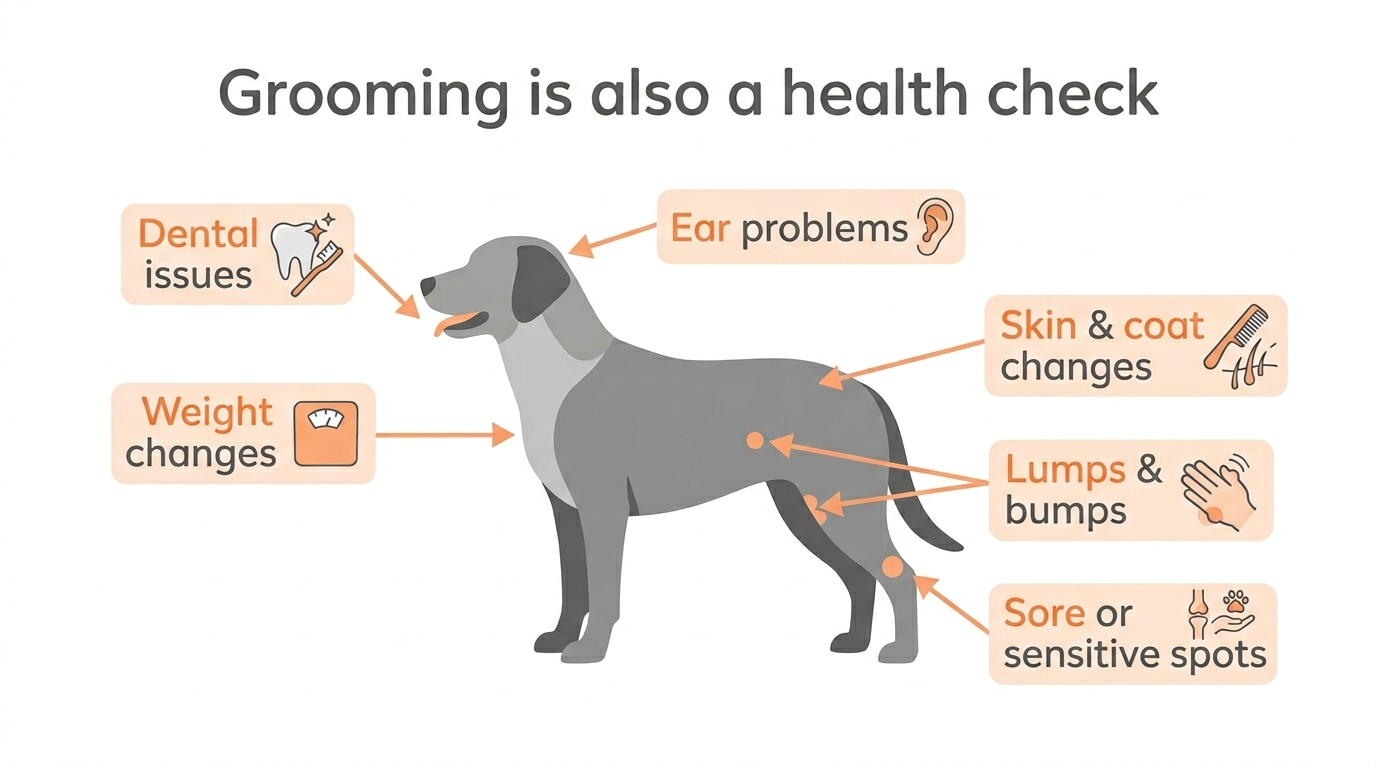
There's a hidden benefit to regular grooming for arthritic dogs that's worth being explicit about.
Grooming is hands-on contact. You're feeling your dog's body, looking at their coat and skin, examining their paws, checking their ears. Over time you build an intimate familiarity with how their body normally feels.
That's how you spot changes early. A new lump on the chest. A patch of thinning hair. An area that's tender to touch. A change in muscle mass. A new lump in a joint. Subtle things that wouldn't be noticed in passing become apparent during the careful contact of grooming.
This is one of the most valuable diagnostic processes available to you, and it costs nothing. Many serious conditions in older dogs are first noticed by owners during grooming. Cancers, skin infections, joint changes, dental issues, weight changes. All of these can be picked up earlier through regular hands-on care than through any other approach.
Treat grooming as a monitoring activity as well as a care activity. Note anything unusual. Mention it to your vet at the next visit. The dog whose owner is grooming them weekly is the dog whose problems get caught early.
Making grooming positive
For some arthritic dogs, grooming has become an unwelcome experience. They've learned that handling causes discomfort, the brush pulls on mats, the nail trim involves restraint, the bath involves wet cold standing on slippery surfaces.
If your dog now avoids grooming, you can rebuild the relationship:
Reduce session length. A 5-minute brush is better than no brush at all. Build up gradually.
Pair with treats consistently. Every grooming session, treats during. Make it the most rewarding part of the day.
Choose comfortable positions. Lying down on a soft bed, not standing on a slippery floor. Take grooming to the dog, not the dog to grooming.
Avoid handling in painful areas. If your dog has obvious sore spots, work around them rather than insisting. You don't have to brush every square inch every time.
End on a positive note. Stop while the dog is still tolerating it. Don't push to the point where they become distressed and learn that grooming gets worse the longer it goes on.
Talk to your dog through the session. Calm voice, regular verbal reinforcement, gentle touch. Make the whole experience low-stress.
For dogs who've become very reluctant, you may need to almost start from scratch with patience, gradually rebuilding tolerance through positive associations.
What to do this week
If you've read this and want to take immediate action:
1. Look at your dog's nails right now. Are they appropriate length? Can you hear clicking when they walk on hard floors? If yes to clicking, they're too long. Either trim them yourself or book a nail trim appointment this week.
2. Check the hair between their paw pads. If it's overgrown beyond the pad surface, trim it flush. This single change improves traction on slippery floors immediately.
3. Do a hands-on body check. Run your hands gently over their whole body, paying attention to areas you don't usually touch. Note anything unexpected.
4. Brush them, even briefly. If you haven't been brushing regularly, start with 5 minutes today. Make it pleasant.
5. Schedule one routine maintenance appointment if needed: groomer, vet for nail trim, vet for dental check. Something practical you've been putting off.
These five actions take less than an hour total and significantly improve your dog's daily comfort.
A final thought
These details don't sound dramatic. Nails. Pad hair. Coat brushing. Dental care. Set against the bigger interventions in arthritis management (medication, weight loss, home modifications), they seem minor.
But they aren't minor in aggregate. The dog who's getting all the big interventions and none of the small ones isn't getting complete care. They're still walking on long nails that change their gait. They're still slipping on smooth floors because of overgrown paw pad hair. They're still developing mats that cause daily discomfort. They're still building up dental inflammation that adds to their systemic problems.
A truly well-cared-for arthritic dog has the big stuff sorted and the small stuff attended to. Both matter. Both compound over time.
The reassuring part is that the small stuff doesn't require expensive treatments or complex interventions. It requires attention. A weekly look-over. A regular brush. A nail trim every 2-3 weeks. A periodic pad check. Small, routine, consistent care that adds up to a meaningful difference in your dog's daily experience.
Your arthritic dog deserves that attention. Give it to them, and you'll see the cumulative benefit in their comfort and engagement with life.
References
- Häusler K, Söhnel K. Trimming of nails in healthy dogs does not change gait parameters when comparing pre- and post-nail trim. Frontiers in Veterinary Science, 2026;13:1728382.
- O'Neill DG, Church DB, McGreevy PD, Thomson PC, Brodbelt DC. Prevalence of disorders recorded in dogs attending primary-care veterinary practices in England. PLoS ONE, 2014;9(3):e90501.
- Ahmed LA, Somarriba M, Brodbelt DC, Church DB, O'Neill DG. Epidemiology and clinical management of nail clipping in dogs under UK primary veterinary care. Journal of Small Animal Practice, 2025;66(12):925-933.
Sister tool · Sightline
Track whether treatment is working
Sightline, a separate ConciergeVet tool, runs a short weekly check-in built on validated pain and mobility instruments, turns it into a single Sightline Score you can watch trend over weeks rather than judge on one bad day, and produces a report you can bring to your vet.
A written log, or our printable trackers, does much the same job.
See how Sightline tracks treatmentSister directory · PetCare Atlas
See what a nail clip costs
PetCare Atlas, our sister directory, publishes an indicative UK price range for a nail clip at the vet. It is a guide for planning. Your own practice gives the real quote.
See nail clip prices on PetCare Atlas →See where your pet stands today
Tracking is the other half of managing arthritis. Take the 2-minute Mobility Check to see your pet's stage, then watch it shift as treatment takes effect.
Take the Mobility CheckYou're not doing this alone
Compare treatment journeys and talk to owners managing arthritis. Free to join.
Join PetsLikeMine