

Getting the Most From Your Vet Appointments
Alastair Greenway
BVM&S MRCVS
A useful vet appointment and a frustrating one usually don't differ on which vet you see. Twenty-five years in the consulting room have taught me they differ on how well prepared the owner is, and how clearly they can describe what they've actually seen at home.
A 15-minute consultation is short. In that time your vet needs to take a history, examine the dog or cat, form a clinical impression, talk you through the findings, agree a plan, and write it all up. Spend half of it piecing together vague observations or trying to recall when things started, and there's much less left for solving the problem.
The owners who get the most from their veterinary care aren't necessarily the ones with the best vets. They're the ones who've learned to make appointments productive. They prepare. They watch their dog or cat thoughtfully between visits. They bring specific information instead of vague impressions, ask focused questions, write things down, and follow up.
This article walks through how to do all of that.
I'll cover the standard arthritis follow-up, the appointment where something has changed, the new specialist referral, and the difficult appointment where harder conversations are needed. Each makes different demands and needs different preparation.
If you have a cat, much of this applies equally, with some specific considerations I'll flag throughout where the dynamics differ.
Preparation does most of the heavy lifting
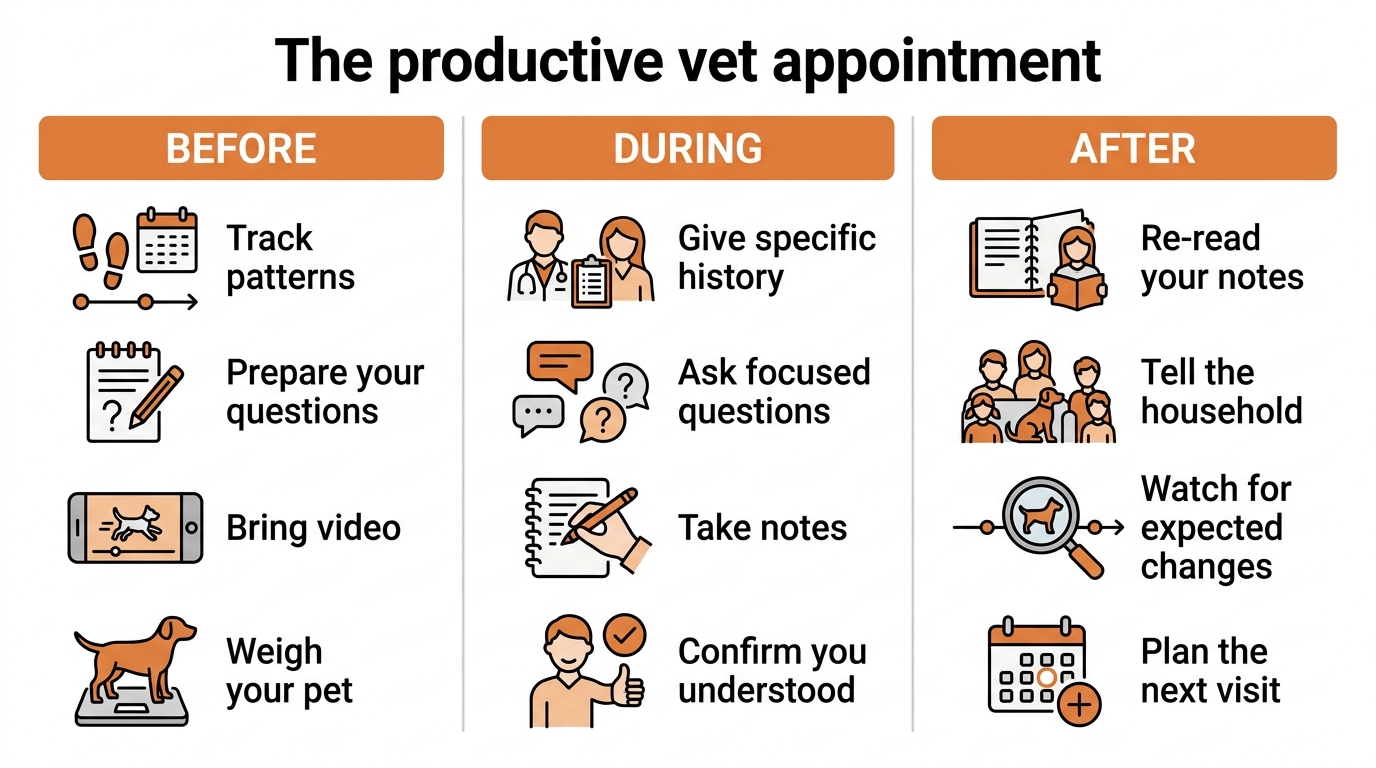
Preparation is the single biggest determinant of appointment quality. The two minutes you spend gathering your thoughts beforehand pay back many times over in the conversation that follows.
Two printable PDFs do most of this for you: our pre-appointment notes sheet (prepare before, take notes during, capture what's next after) and our vet questions checklist (questions worth asking, sorted by what kind of appointment you're having). Print whichever fits and bring it with you.
What to track between appointments
A dog or cat diagnosed with arthritis means years of veterinary conversations ahead. Information builds up if you capture it systematically rather than trying to remember it.
I'd suggest a simple ongoing record. Not elaborate. Not daily. Just enough that when you turn up at the vet, you can describe what's actually been happening.
The minimum useful information to track:
Pain and stiffness patterns. Roughly how stiff is your dog or cat day to day? Is the morning bad, the evening bad, both? Has this changed over the past month or three months?
Activity tolerance. How much exercise can your dog do without consequences? Has this changed? At what point do they show signs of having done too much?
Notable events. Flares, falls, sudden worsening, specific incidents. Date them.
Medication response. When you started or changed a medication, what happened? Better, worse, no change?
Other observations that might be relevant. Sleep changes, appetite changes, mood changes, behavioural changes, anything that doesn't fit other categories.
You don't need to do this daily. A quick note when something notable happens, plus a brief weekly mental check-in, is enough for most owners. A page in a notebook, a note in your phone, or our daily observation diary all work.
This is also part of what we built Sightline for. Sightline (sightline.vet) is a separate ConciergeVet tool that runs a short adaptive weekly assessment, tracks a composite score over time, and produces a Sightline Report PDF you can bring to the appointment. It does roughly what a disciplined notebook does, but the trajectory plot tends to be the bit that vets actually find most useful in the consult.
The point isn't the tool. The point is that you arrive with something. The notebook owners and the app owners both end up having better appointments than the owners who turn up empty-handed and try to remember.
None of this is about creating homework. It's about giving your future self something useful when you're sitting in the consulting room.
The week before a routine follow-up
In the few days before a routine arthritis follow-up:
Take some video. A short clip of your dog walking. Another of them rising from rest. Another going up a step if relevant. Date the clips. Bring them on your phone.
This is genuinely valuable. Your vet sees your dog for a few minutes in an unfamiliar environment where the dog may be stressed, may have masked their normal signs, and is rarely walking around freely. Video of how the dog actually moves at home is some of the most useful clinical information available.
Check the medication situation. Do you know exactly what your dog is on? Doses? How often? Are you running short? Does anything need refilling? Have you missed any doses recently? Be straight with yourself about this.
Make a brief list. What do you want to discuss? What's gone well? What hasn't? What questions do you have? Three or four bullet points is usually enough.
For cats, add: are they still using the litter tray normally? Still grooming? Still jumping where they used to? Still engaging with the household?
On the day itself
A few practical points:
For dogs: Don't feed them right before unless your vet has said it's fine. Some assessments work better on an empty stomach. Walk them briefly so they're relaxed but not exhausted.
For cats: Get the carrier out the day before, ideally with treats inside, so the carrier isn't itself a stressor. Bring a familiar blanket or toy if helpful. Consider whether your vet has any pre-visit anxiety medication (gabapentin is widely used for this; ask if your cat finds visits very stressful).
Bring the notes. Don't try to remember everything. Bring your list, your diary, your videos.
Arrive on time but not too early. Sitting in a waiting room with other animals for 30 minutes can stress your pet considerably, making the consultation less useful. Five to ten minutes early is enough.
During the appointment: making the time count
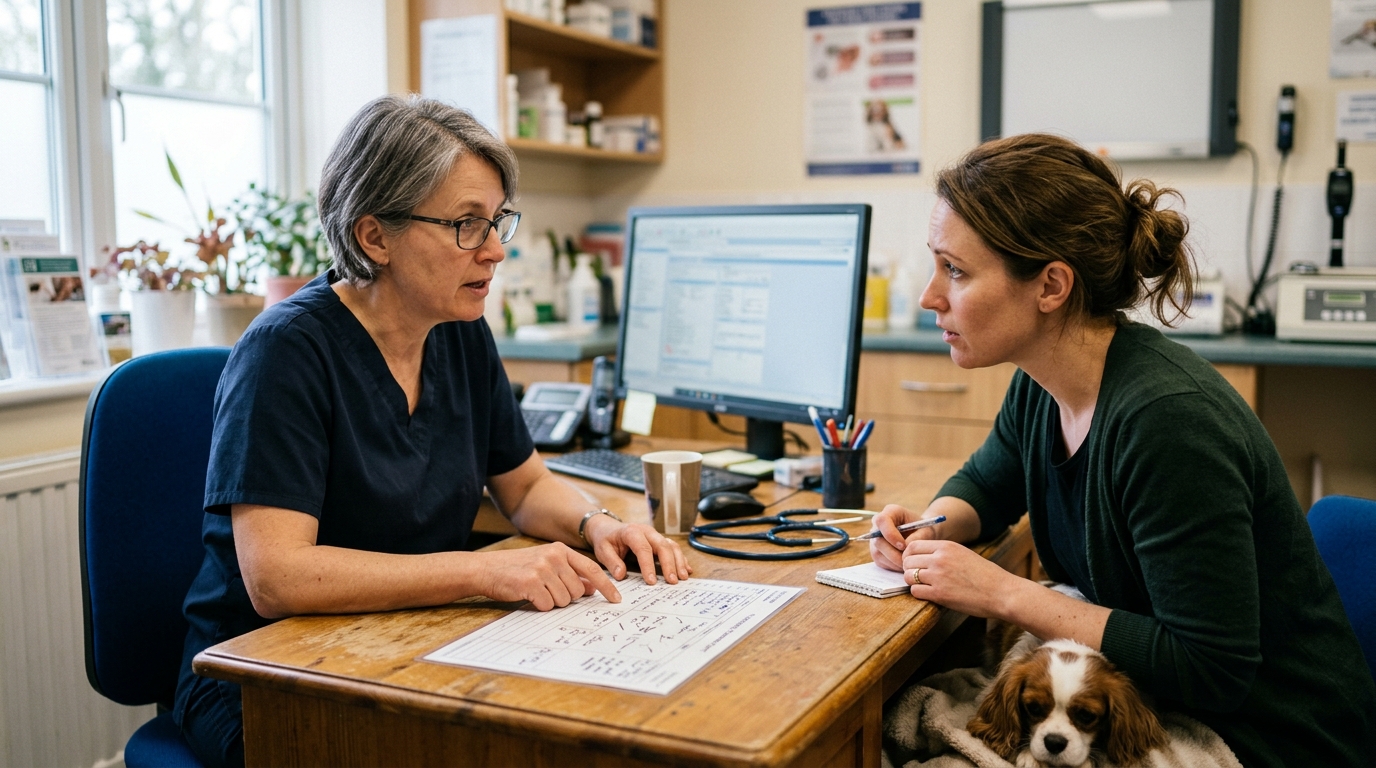
A standard small animal consultation in the UK is typically scheduled for 10-15 minutes. Some practices offer longer appointments for specific situations including chronic disease reviews. A 20-30 minute slot is often genuinely warranted for arthritis follow-ups; ask whether this is available.
How a useful appointment is built
Most consultations naturally follow a structure:
- History taking (what's been happening since last time)
- Examination of the patient
- Discussion of findings
- Plan agreement
- Documentation and next steps
You influence each phase by what you bring to it.
Giving useful history
The "what's been happening?" question is the most important moment of the consultation. How you answer determines what comes next.
The unhelpful answer: "She's been about the same really. Maybe a bit slower? I'm not sure."
The useful answer: "Compared to last visit, she's stiffer in the morning, taking longer to get going. She's been doing the same walks but seems more tired afterwards. We've had two days where she didn't want to come downstairs. Otherwise she's been settled and eating well. The medication seems to have been working but maybe less so over the past month."
Specific. Comparative. Time-bounded. That is what your vet can actually use.
If you've kept any notes, refer to them. If you have video, offer it. Don't worry about being verbose; useful detail is what your vet wants.
A few specific things worth describing in chronic disease follow-ups:
Quantify where you can. Not "she's slower" but "she's stopping to rest on our usual walk, which she wasn't doing before." Not "he seems more tired" but "he's sleeping more during the day, particularly after morning walks."
Be candid about compliance. If you've been forgetting medication doses, missed appointments, fed them treats outside the plan, or done anything else differently from what was agreed, say so. Your vet can't optimise treatment without accurate information about what's actually been happening.
Mention things you're not sure are relevant. New behaviours, changes in habits, things that seem off in ways you can't quite articulate. These are often the most clinically useful pieces of information.
Don't hide concerns to be polite. Some owners minimise problems to avoid feeling like they're complaining. Your vet wants the real picture. Tell them what you're actually worried about.
Asking questions effectively
Good questions get you better answers. Some frameworks for the chronic arthritis context:
For new diagnosis or new prescription:
- What exactly are we treating?
- What should I expect to see in the next 2-4 weeks?
- What side effects should I watch for?
- When should I get in touch if I'm worried?
- When is the next appointment?
- What can I do at home alongside the medication?
For follow-up appointments:
- How is the management going from your perspective?
- Are there changes you'd recommend?
- What should I be watching for over the next 3-6 months?
- Should we be considering anything new?
- When's the next review?
When something has changed:
- What might be causing this change?
- What investigations would help us understand?
- What are the next steps?
- What should I do at home meanwhile?
- When should I be worried enough to come back urgently?
For cost-sensitive conversations:
- What are the options at different price points?
- What's the cheapest reasonable approach?
- What would you do if this were your dog?
- What can wait and what can't?
For complex decisions:
- What are the realistic outcomes of each option?
- What evidence supports each approach?
- Would specialist input help?
- Should I be considering a second opinion?
Don't ask everything every time. Pick the questions that matter for this particular appointment. Two or three good questions beat ten generic ones.
What to write down
Take notes during the consultation. This isn't insulting to your vet; it's responsible. They'll appreciate it more than you fumbling to remember everything later.
Specifically, write down:
- Any new medications and exact doses
- Specific instructions about administration
- Side effects to watch for
- When to come back
- Anything you're meant to do at home
- Any phone numbers for out-of-hours contact
- Cost estimates if discussed
- Any tests being arranged and when results will be ready
If your vet uses a print-out at the end of the consultation, brilliant. Many practices now provide written summaries. If yours doesn't, ask whether you can have one or whether you can take a photo of any notes on screen.
Don't leave with unresolved confusion
If you don't understand something at the end of the appointment, ask. Even if you think you should understand. Even if you feel time pressure. Even if the vet seems busy.
"Sorry, can I just check I've understood that?" is a perfectly acceptable thing to say. Better to take an extra two minutes now than to leave confused and either misadminister medication or worry unnecessarily for days.
Common things owners later realise they didn't fully understand:
- How exactly to give a new medication (with or without food, how to handle missed doses, whether the dose adjusts)
- What constitutes a side effect worth phoning about vs one to monitor
- What the diagnosis actually means in plain terms
- What the realistic expected outcome is
- What the next decision point would be
Ask. Better now than later.
After the appointment: closing the loop
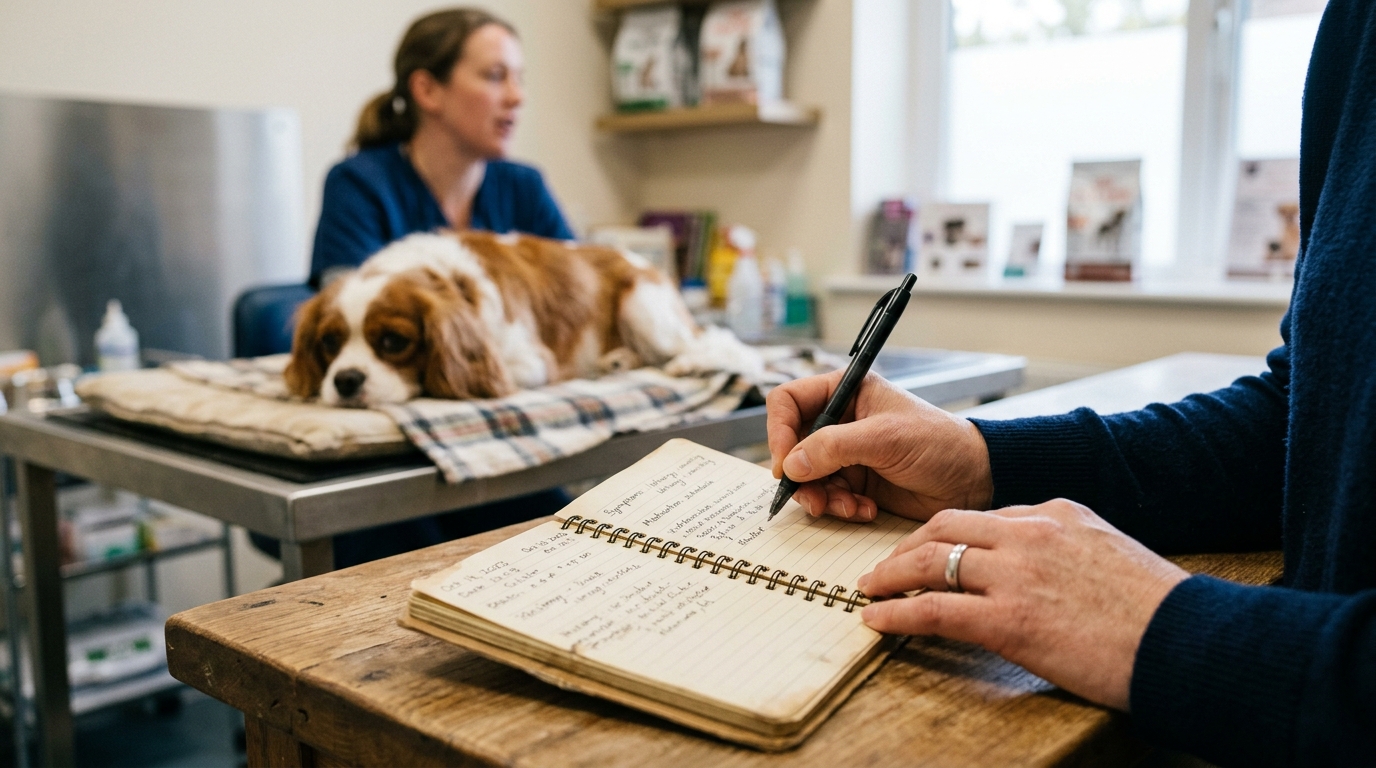
Most owners walk out of consultations and forget half of what was said within the hour. A bit of structured follow-through dramatically improves what you actually get from the appointment.
Within 24 hours
Re-read your notes. Make sure they still make sense. Add detail while it's fresh.
Confirm the practical bits. Has the medication been prescribed correctly? Picked up? Started? Are appointments booked?
Tell other household members what was discussed. Anyone else involved in the dog's care needs to know the plan. Confused households produce inconsistent management.
Note anything you want to ask next time. Things that occur to you in the hours after the appointment often get forgotten by the time the next visit comes around. Capture them now.
Over the next few weeks
Watch for the changes you discussed. If a new medication was started, you should see signs of effect or side effect within a defined window. If you're not seeing what you expected, that's information.
Don't be reluctant to phone with concerns. Many practices have nurse-led follow-up systems or are happy to take quick phone queries. If something doesn't seem right, ask. Phoning early about something minor is much better than phoning late about something major.
Update your notes. Continue the simple tracking habit. The accumulated record over months becomes increasingly valuable.
Before the next appointment
Repeat the preparation. Each cycle makes the next appointment more productive. Over months and years, your appointments become more efficient and more useful because you've built the habits that support good information exchange.
Different appointments, different demands
Different types of appointment need different preparation.
The new diagnosis appointment
This is the consultation where arthritis has just been diagnosed or strongly suspected. You may be reeling. Information overload is common.
Specific tips:
Bring someone else if you can. A second pair of ears catches things you'll miss when emotionally overwhelmed.
Ask the vet to write things down. Specific plans, names of medications, what to expect. The verbal explanations won't all stick at this moment.
Don't try to decide everything in the appointment. Some decisions can wait until you've processed the information and read up. Ask which decisions are urgent and which can be considered.
Ask about resources. PetsLikeMine, written information, support resources. Vets can't tell you everything in one appointment.
Book a follow-up soon. A second appointment 1-2 weeks after the initial diagnosis often catches questions that emerge as the information sinks in.
The routine arthritis follow-up
These are typically 3-6 months apart for stable patients, more frequent for changes.
Specific tips:
Compare to last visit, not to the start of treatment. Your vet wants to know what's changed since last time. Earlier baseline data is useful but the recent comparison matters most.
Bring updated weight if possible. Weigh your dog before the appointment if possible (or arrive a bit early and use the practice scales). Weight tracking over time is one of the most useful clinical metrics.
Discuss whether current medication is still appropriate. Doses may need adjusting. Some dogs need additions. Some may be able to reduce. The plan from a year ago may not be the plan for now.
Plan ahead. What's the schedule for the next 6 months? When are blood tests due? What about supplement reviews? Set the framework now.
When something has changed
When you're booking because something concerning has happened (sudden worsening, new symptoms, suspected adverse drug effect).
Specific tips:
Describe the change precisely. When did it start? How sudden? What does it look like? What have you observed?
Bring video if at all possible. Acute changes are often masked in the consulting room. Video from when the problem was occurring is invaluable.
Note any context. Recent activities, weather changes, missed medication, household changes, anything else that might be relevant.
Be specific about urgency. If you're worried this might be serious, say so. Don't downplay because you don't want to be a fusspot.
Ask about what's happening in the meantime. If investigation is needed and results will take days, what should you do now? Continue normal management? Modify activity? Add or change medication?
The specialist referral consultation
When you've been referred to an orthopaedic specialist, internal medicine specialist, or other referral service.
Specific tips:
The referral letter matters. Make sure your primary vet has provided complete background. If you can see the referral letter before the visit, read it.
Bring all imaging and records. Don't assume the specialist has them. Email forwarding sometimes fails. Print or download anything that's been done elsewhere.
Allow more time. Specialist consultations are typically 30-60 minutes and may include additional investigation on the day. Don't book the rest of the day tightly.
Be prepared for new information. Specialists often bring perspectives the primary vet hasn't suggested. Be open to revising your mental model.
Take notes carefully. Specialist consultations cover ground rapidly. Written notes are particularly important.
Discuss communication with your primary vet. How will the specialist communicate back? Who manages what going forward? Don't leave with ambiguous responsibilities.
One practical note on referrals generally. Knowing what kinds of specialist exist for the problem your dog has is often the most useful preparation, and the territory isn't always obvious. Part of why we built PetCare Atlas was to make this navigable. PetCare Atlas (petcareatlas.co.uk) is a separate ConciergeVet tool: a structured UK directory of vet practices, RCVS specialists and advanced practitioners, accredited physiotherapists and hydrotherapists, and similar, navigable by region, symptom, or pre-mapped care pathway (including a musculoskeletal pathway running from primary vet through specialist, physio, hydrotherapy, and beyond).
Your primary vet should be your first port of call on referral choice; they know your dog and they know the local relationships. But if you want a clearer view of what's available beyond their immediate suggestions, particularly for second opinions or for the longer-term care team, a structured directory beats a Google search.
The difficult conversation appointment
The harder appointments where you're discussing significant decline, quality of life questions, or end-of-life considerations.
Specific tips:
Take someone with you. Genuinely important. Emotional appointments need support.
Book a longer slot. Ask the practice when booking. These conversations need time.
Be truthful with yourself about what you're seeing. Sometimes owners delay these conversations because they're not ready. The conversation itself often helps clarify things.
Ask the questions directly. "What does quality of life look like for her?" "When would you think about euthanasia?" "What would you do if this were your dog?" Difficult questions but legitimate.
Discuss timing if relevant. Some practices offer home euthanasia. Some have specific quiet rooms. Some prefer certain times. If you're approaching end-of-life decisions, knowing the practical options matters.
Allow space for emotion. It's appropriate to cry in these appointments. Your vet has had these conversations many times before.
When your patient is a cat
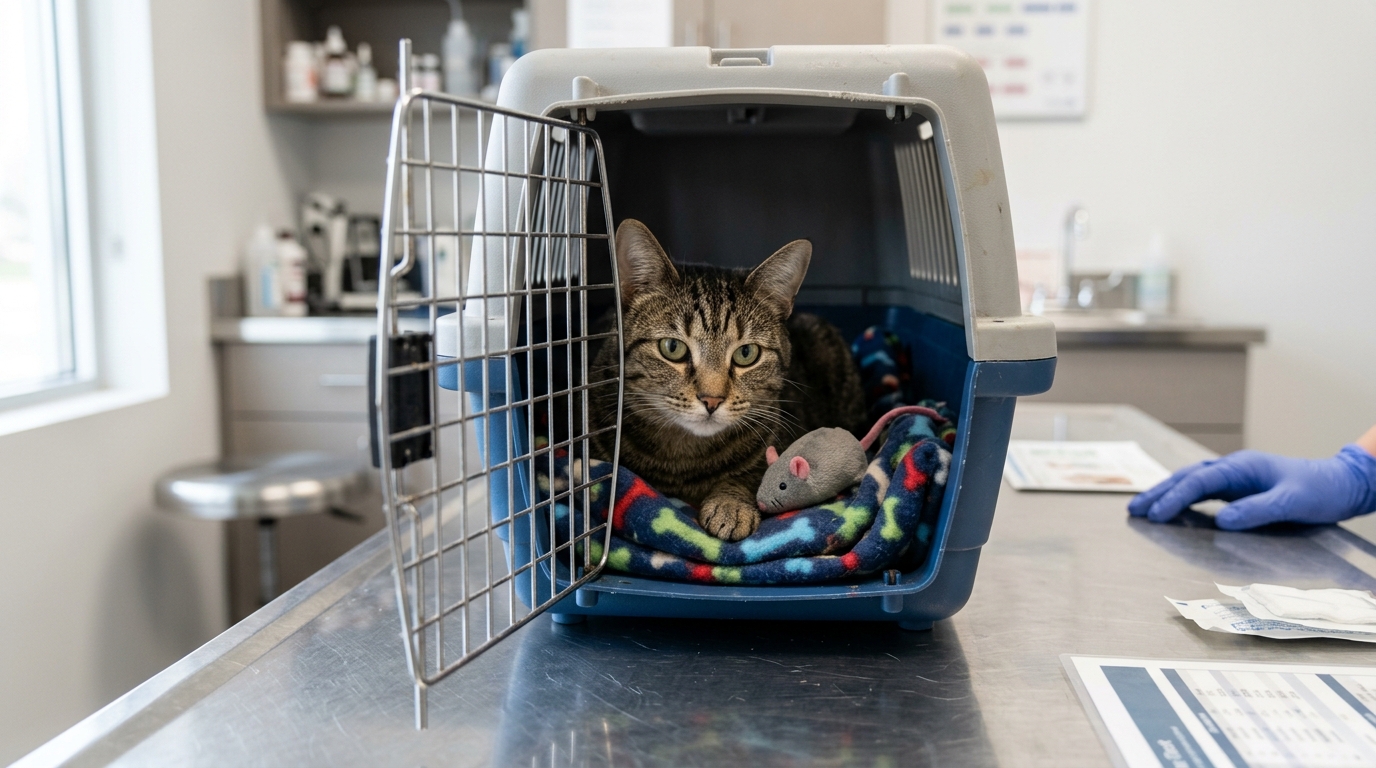
Cat veterinary appointments have particular dynamics worth understanding.
Cats hide signs in the consultation
Cats are extraordinarily good at masking discomfort in stressful environments. The dog with arthritis who's stiff at home often shows it in the consulting room. The cat with arthritis often appears completely normal during examination, even when significant problems exist at home.
This means your home observations matter even more for cats. The vet may not see what you've described. Don't be deterred. Insist on what you've observed. Bring video. Trust your knowledge of your cat.
Transport stress affects assessment
Many cats are significantly stressed by carriers, car journeys, and waiting rooms. Their physical examination shows tense muscles, elevated heart rate, suppressed normal behaviour. This compromises some aspects of assessment.
Some strategies:
- Pre-visit anxiety medication (gabapentin is widely used and effective)
- Familiar carrier left out at home for days before visits
- Carrier sprayed with synthetic feline pheromone (Feliway and similar)
- Familiar blanket or toy inside
- Calm transport with carrier covered
- Arriving with minimal waiting room time
These don't eliminate stress but reduce it meaningfully.
Home-visit options
For some cats with chronic conditions, home veterinary visits genuinely improve care. Stressed cats give less reliable assessments. Cats whose condition is worsened by veterinary visits are sometimes better seen at home.
This isn't always available and costs more. But for severely affected or chronically stressed cats, it's worth asking about.
Questions made for cats
When discussing arthritis or chronic pain in cats:
- Are they still using the litter tray normally?
- Are they still grooming themselves properly?
- Are they still jumping where they used to?
- Are they still engaging with the household?
- Have they had any flare-ups?
- Any changes in eating or drinking?
These domain-specific questions for cats are more useful than the generic "how have they been?"
Building a long-term relationship with your vet
Beyond individual appointments, the cumulative relationship matters.
What good chronic disease care looks like
For chronic conditions like arthritis, the best care comes from:
- Continuity with one or two specific vets in the practice
- Detailed records that build over time
- A vet who knows your individual dog or cat
- Clear communication about who's managing what
- Mutual understanding of treatment philosophy and goals
- Willingness to adapt as the condition evolves
This is different from acute disease management where any competent vet can usually handle the situation. Chronic disease benefits from sustained relationship.
How to build this
Try to see the same vet for arthritis appointments where possible. Continuity of clinician improves chronic disease management. Most UK practices will accommodate requests to see the same vet.
Stay engaged between appointments. Quick phone queries, nurse consultations for weight checks, follow-up on test results. The practice gets to know you and your dog or cat.
Be reliable. Turn up on time. Follow agreed plans. Communicate when things change. These small habits build trust.
Be upfront. Including about things that haven't gone well. Vets work better with accurate information than with edited versions.
Express appreciation when things go well. Not in a sycophantic way, but genuine thanks for good care matters. Vet practice is hard work, often emotionally taxing, and good outcomes are worth acknowledging.
Be willing to challenge respectfully. If you disagree with something or don't understand a recommendation, ask. Good vets welcome the conversation.
When the relationship isn't working
Sometimes the vet relationship isn't optimal. The vet seems too rushed for chronic conditions. Communication isn't clear. You don't feel heard. The clinical approach doesn't seem right to you.
This is uncomfortable to acknowledge but worth thinking about. Options include:
Try a different vet in the same practice. If you've been seeing one vet, asking to see another may give you a different relationship.
Talk to the practice manager. If there are specific issues with how appointments are run or communication is happening, the practice manager may be able to help.
Consider changing practice. A bigger step but sometimes appropriate. We cover this in more detail in our companion article on building your dog's care team.
Seek specialist referral. If the issue is the complexity of your dog's case exceeding the general practice's capacity, referral to specialists may be the answer rather than changing the primary vet.
Changing vet relationships isn't a small thing, but sometimes it's the right thing for your animal.
A practical example
To pull everything above together, let me walk through what a well-prepared follow-up appointment looks like.
The dog: 10-year-old Labrador, diagnosed with bilateral hip arthritis 18 months ago. On daily meloxicam and weekly hydrotherapy. Routine 6-month review.
The owner's preparation:
- Brief weekly notes over the past 6 months including two minor flares
- Brought updated weight (he's lost 2kg since last visit, deliberately)
- Brought 30-second video of him rising from rest this morning
- List of three questions: whether to consider adding gabapentin given some breakthrough discomfort, whether to step down to fortnightly hydrotherapy, and whether the next blood test is due
- Knows medication needs refilling
The appointment runs like this:
The vet asks how he's been. The owner gives a clear summary: generally stable, comfortable on current management, two flares both following longer-than-usual walks, weight trending down as planned. She shows the video and the recent notes.
The vet examines the dog, notes that he's lost weight successfully, palpates the hips and finds them comfortable today. Discusses the flares: minor enough to manage at home, but the pattern suggests the current management has limits.
The owner asks her questions. They discuss gabapentin: probably worth trying at low dose for flare management rather than daily. They agree to continue hydrotherapy weekly given the dog's response. Blood test is due next month; she can drop in for that without needing a full consultation.
The vet writes a brief plan: continue current meloxicam, add gabapentin to be used as needed for flares (specific dose explained), continue weekly hydrotherapy, blood test in 4 weeks, full review in 6 months unless concerns arise.
The owner takes notes, picks up the gabapentin prescription, and leaves with clear next steps.
Total appointment time: 18 minutes. High value delivered.
That is what good chronic disease management looks like in practice. The preparation lets the appointment do its job efficiently. The vet's clinical expertise combines with the owner's home observations and adherence to produce useful decisions.
A final thought
Your vet wants to help your dog or cat. Almost certainly. Whatever frustrations exist in any specific consultation, the underlying motivation is shared.
You enable that help by being a good clinical partner. Bringing accurate information. Asking focused questions. Following agreed plans. Communicating about what's working and what isn't. Keeping continuity over time.
None of this is about being deferential or hiding concerns. It's about being effective. The owners who get the best chronic disease outcomes are usually the ones who've learned how to work with their veterinary team productively.
Twenty-five years of practice have shown me that the best results come from collaborative relationships where the owner does the day-to-day work and the vet does the clinical decision-making, with information flowing clearly between them. That partnership is something you can build deliberately.
The next appointment is your opportunity to start. Prepare a bit more carefully than you usually would. Bring video. Ask focused questions. Take notes. Follow up. See what difference it makes.
Your arthritic dog or cat is worth that small investment of time and attention. Over years of chronic disease management, the cumulative improvement in their care is genuinely significant.
Free downloads
Companion worksheets to put what you've read into practice. Free PDFs, print at home.
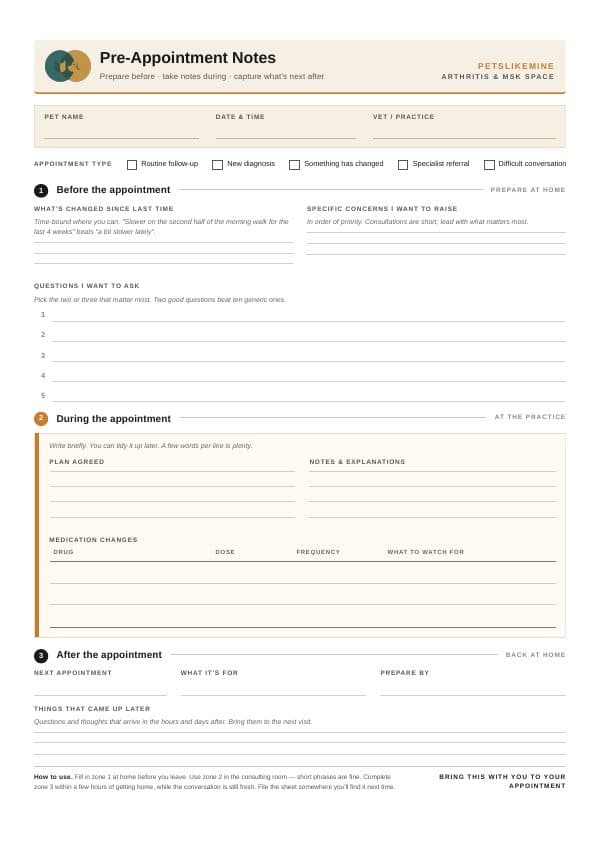
Pre-Appointment Notes
PDF · 352 KBPrepare before, take notes during, capture what's next after. A single sheet that turns a ten-minute vet appointment into one you'll actually remember properly a week later.
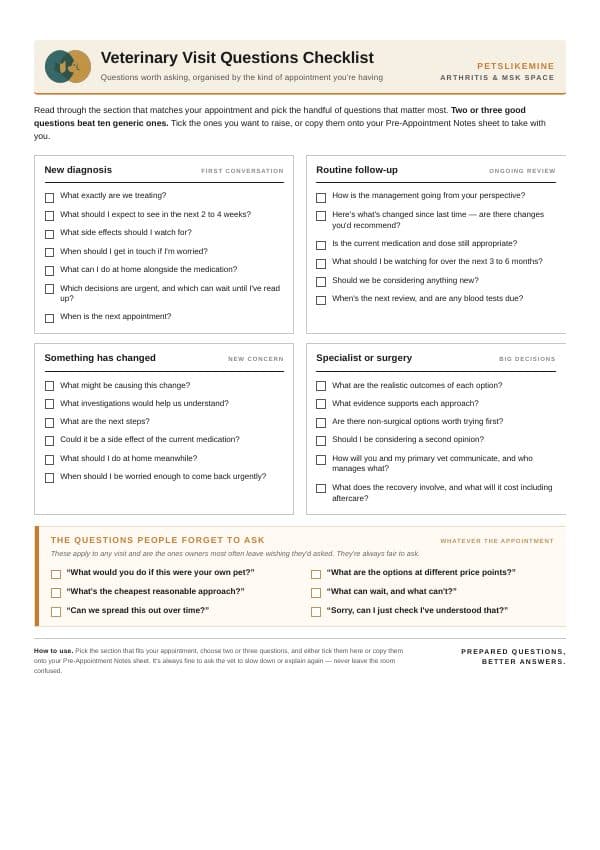
Vet Questions Checklist
PDF · 348 KBQuestions worth asking, organised by the kind of appointment you're having: diagnosis, treatment review, surgical consult, end-of-life conversation. Pick what fits and bring it with you.
Sister tool · Sightline
Track whether treatment is working
Sightline, a separate ConciergeVet tool, runs a short weekly check-in built on validated pain and mobility instruments, turns it into a single Sightline Score you can watch trend over weeks rather than judge on one bad day, and produces a report you can bring to your vet.
A written log, or our printable trackers, does much the same job.
See how Sightline tracks treatmentSee where your pet stands today
Tracking is the other half of managing arthritis. Take the 2-minute Mobility Check to see your pet's stage, then watch it shift as treatment takes effect.
Take the Mobility CheckYou're not doing this alone
Compare treatment journeys and talk to owners managing arthritis. Free to join.
Join PetsLikeMine