

Exercise and Arthritis: The Complete Guide
Alastair Greenway
BVM&S MRCVS
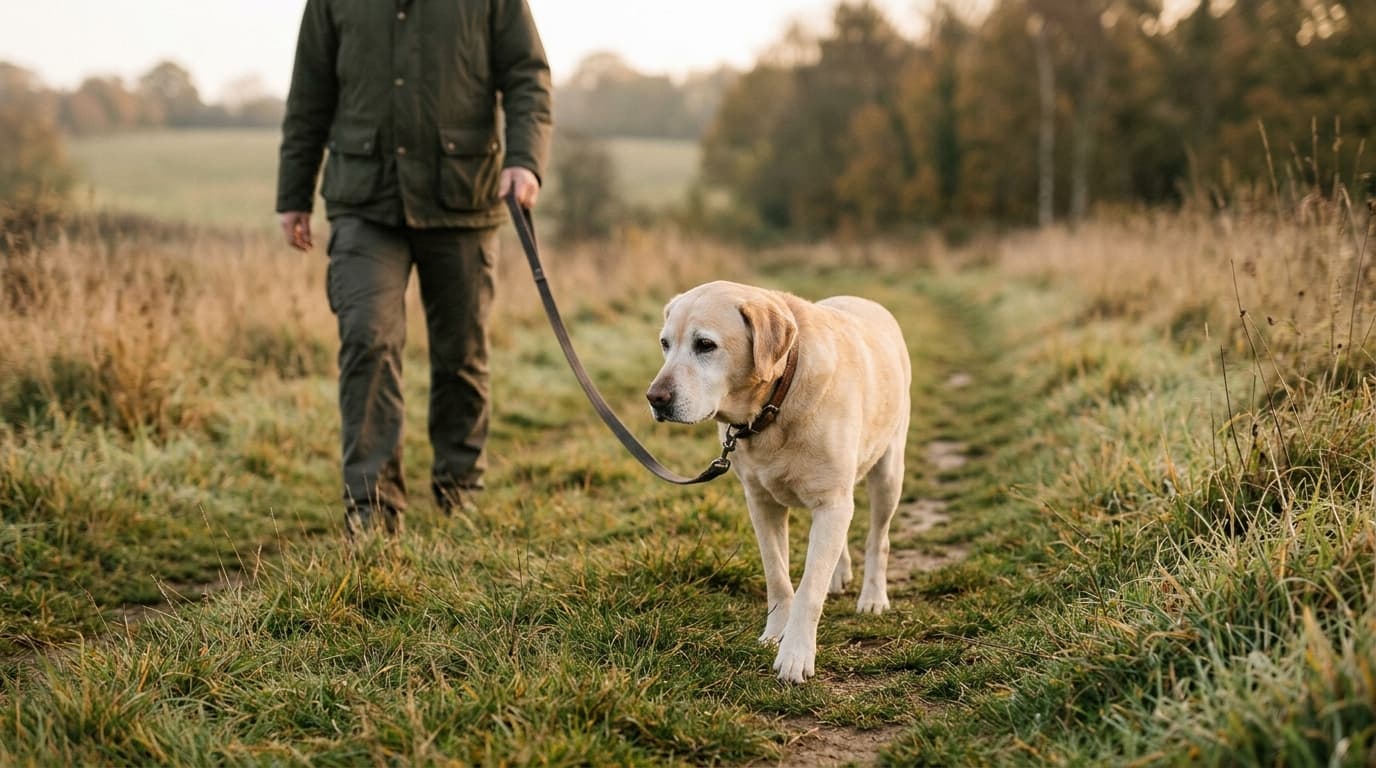
Exercise is one of the most powerful things you can do for your arthritic dog. It's also one of the easiest things to get wrong.
The owners I see in practice fall, almost without exception, into two groups. The first group believes their arthritic dog should be wrapped in cotton wool. They cut walks dramatically. They stop the dog from running, jumping, or playing. They mean well, but they're actually accelerating their dog's decline. Muscles waste. Joints stiffen. The dog gets weaker, sadder, and ultimately more painful.
The second group either doesn't realise their dog is in pain, or thinks the dog will tell them when something's too much. They carry on with the long hikes, the ball chasing in the park, the agility class, the family beach holiday. Their dogs limp home stiff and sore, recover overnight, and do it all again the next day. The disease progresses faster than it should.
The right approach sits somewhere in between, and it's far more specific than "moderate exercise." This article tells you exactly what your arthritic dog needs, how to structure it, what to avoid, and how to adjust as their condition changes over time.
Encouragingly, getting this right doesn't require expert knowledge. It needs a clear framework, a bit of attention, and a willingness to put the work in consistently rather than dramatically.
Why it matters so much
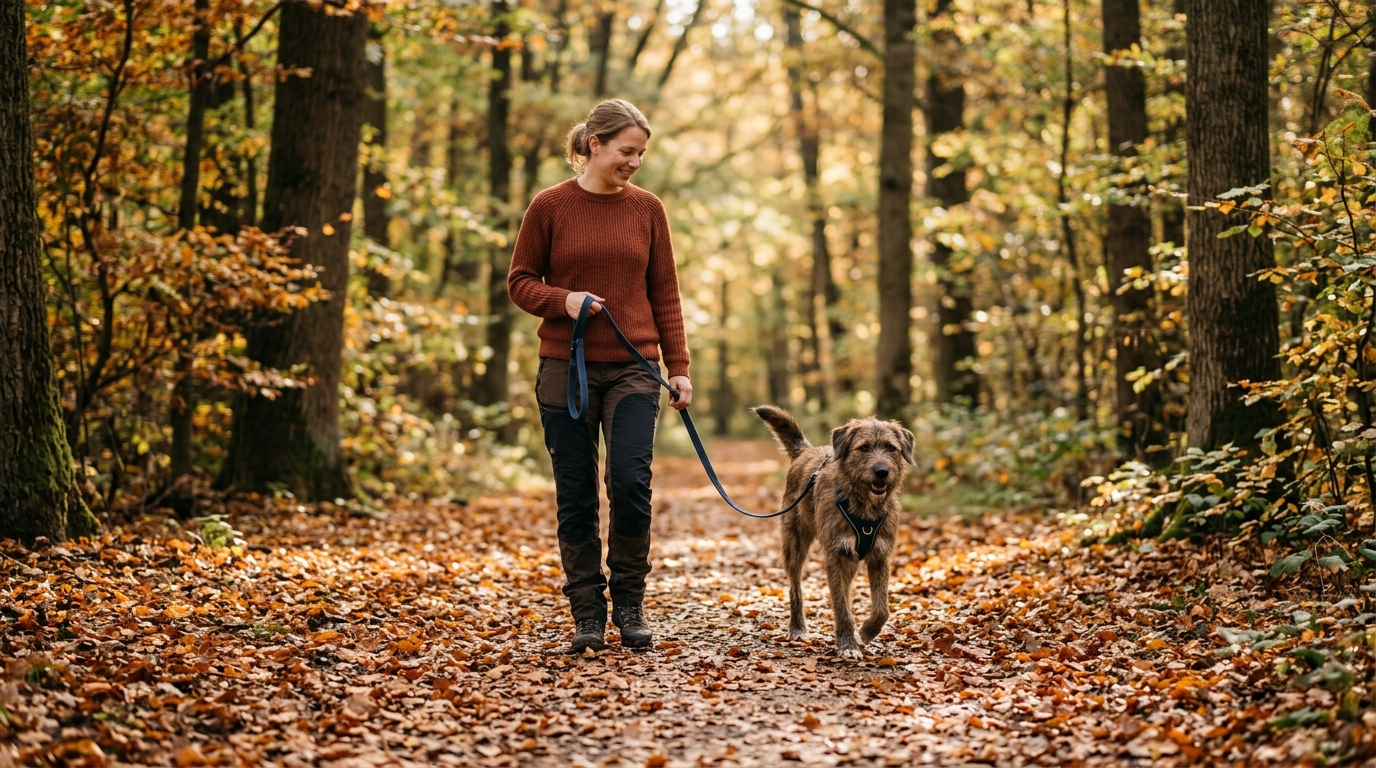
Before we get into what to do, it's worth understanding why exercise matters. This isn't just a "nice to have." For an arthritic dog, exercise is medicine. The evidence base for it is strong, and the consequences of getting it wrong are real.
A 2013 JAVMA study by Greene, Marcellin-Little and Lascelles, looking at Labrador Retrievers with hip dysplasia, found that exercise was associated with reduced severity of lameness, and that the strength of this inverse relationship grew with longer exercise duration. In plain language: the more active dogs simply moved better.
That finding has been quoted at me by enthusiastic owners to justify pushing their dogs harder than they should, so let me put it in context. The dogs in that study were doing controlled, sensible exercise across the day, not high-impact athletic activity. And the result doesn't apply equally to every dog at every stage of disease. But the underlying message is clear: arthritic dogs benefit from regular, well-structured activity.
The specific benefits of appropriate exercise include:
Maintaining muscle mass. This is the single most important reason to keep your dog active. The muscles around the joints absorb forces that would otherwise pass through the cartilage. A dog with strong gluteal, quadriceps, and core muscles protects their joints with every step. A dog who has been allowed to lose muscle mass through inactivity has joints that bear forces they shouldn't have to bear, accelerating damage.
Preserving joint range of motion. A joint that doesn't move stiffens. The capsule contracts, the surrounding soft tissues lose their elasticity, and the dog's effective range becomes smaller. Regular gentle movement keeps the joint capsule mobile and the soft tissues working through their full range.
Maintaining joint nutrition. Cartilage is unusual tissue. It has no blood supply. It receives its nutrients through the synovial fluid that's pumped through the joint by movement. A joint that isn't moving regularly is a joint that isn't being properly nourished. Movement, even gentle movement, is essential for cartilage health.
Weight management. Exercise burns calories. An arthritic dog who stops exercising tends to gain weight, which then worsens the arthritis, which then reduces movement further. Breaking this cycle is critical, and exercise is one of the levers.
Mood and engagement. Dogs in chronic pain often become withdrawn, less playful, and less engaged with their lives. Regular outdoor exercise is one of the most reliable ways to maintain quality of life. The mental benefit may be as important as the physical.
Mental stimulation. A walk isn't just exercise. It's sniffing, exploring, processing the world. For dogs, this is enormously important psychologically. A bored arthritic dog declines in many ways beyond just the physical.
Cardiovascular health. Like humans, dogs benefit from cardiovascular fitness. The heart and lungs work better with regular use, and a dog with good baseline fitness copes with everything else life throws at them better than one who's deconditioned.
The point isn't just that exercise is "good." It's that withholding appropriate exercise from an arthritic dog is actively harmful. We don't help our dogs by letting them become couch potatoes.
What "controlled exercise" actually means
The phrase you'll hear most often in veterinary discussions of arthritic exercise is "controlled exercise." It's a useful phrase but easy to misunderstand. Let me unpack what it actually means.
Regular, not occasional. Arthritic dogs do best with daily exercise, not big sessions on the weekend. Joints that have been moving consistently are warmer, looser, and more comfortable than joints that have stiffened over several days of rest. A dog who exercises moderately every day will almost always do better than a dog who has two huge walks per week and stiffens between them.
Low-impact, not no-impact. The goal is to maintain movement and strength without loading the joints in damaging ways. This means walking and gentle movement, ideally on softer surfaces. It doesn't mean keeping the dog still.
Sustained moderate, not peak intensity. A 30-minute steady walk is dramatically better than a 5-minute manic burst followed by 25 minutes of rest. Arthritic joints handle steady continuous movement better than start-stop high-intensity activity. This is why ball chasing is so problematic. The peak forces during the rapid acceleration, deceleration, and sudden turns are exactly what arthritic joints can't tolerate.
Predictable, not surprising. Sudden bursts of intense activity (a deer running across the path, a friendly off-lead dog bouncing in for a play, a squirrel up a tree) cause the kind of high-force movements that flare up arthritic joints. A controlled walking environment minimises these surprises.
Built on consistency, not intensity. Improvement comes from doing the right amount, day after day, week after week, not from heroic individual sessions. The dog who walks for 30 minutes every day for a year is far better off than the dog who attempts 90 minutes once a week.
When I say "controlled exercise," all of this is what I mean. It's a particular kind of activity, structured deliberately for an arthritic dog.
How much does an arthritic dog need?
This is the question every owner wants answered, and the answer is that it depends. But I can give you a useful framework.
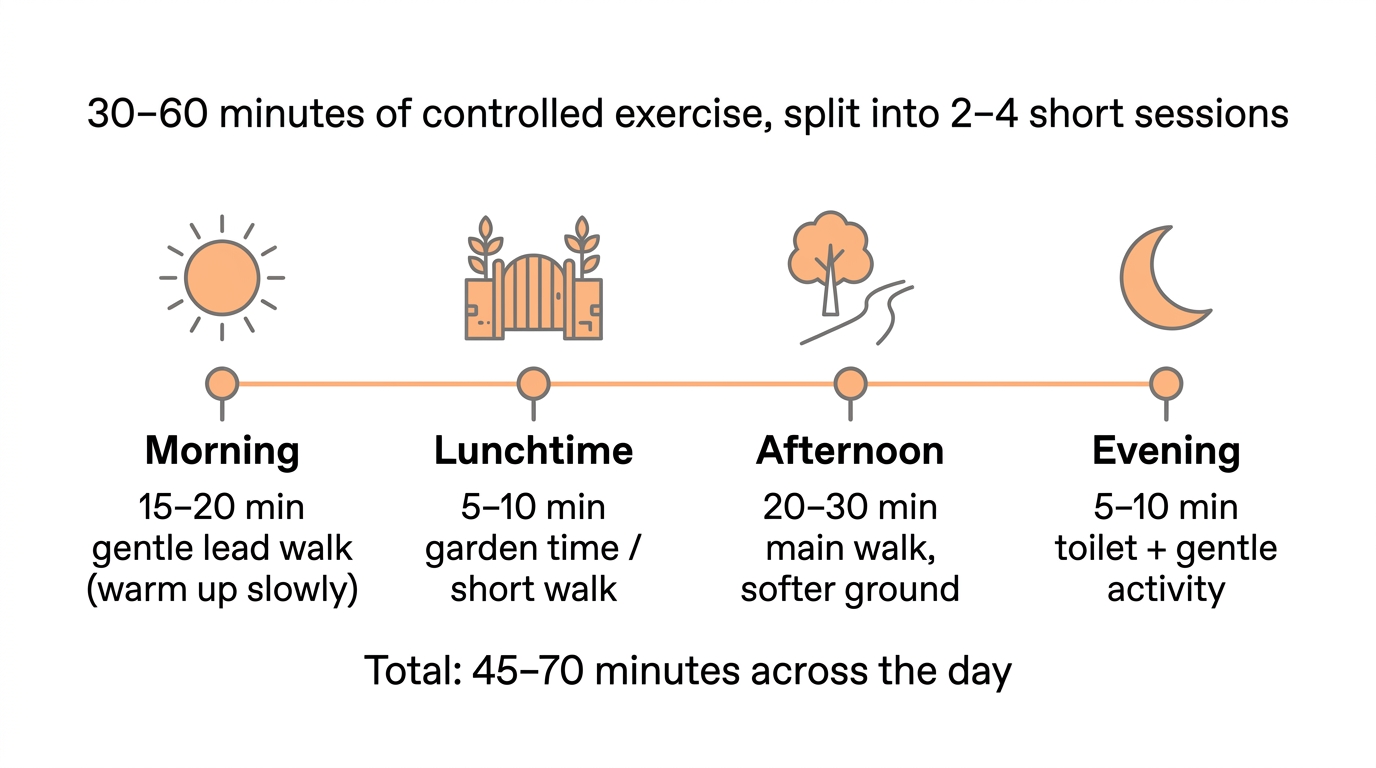
The starting point for most arthritic dogs is 30 to 60 minutes of controlled exercise per day, broken into 2-4 sessions. That's the broad range I'd aim for based on the evidence and clinical experience.
A typical schedule for a moderately affected medium-sized dog might look like:
- Morning: 15-20 minutes of gentle lead walking, starting slowly to allow joints to warm up
- Lunchtime: 5-10 minutes of garden time, gentle interaction, perhaps a short walk
- Afternoon: 20-30 minutes of the day's main walk, on softer ground if possible
- Evening: 5-10 minutes of toilet break and gentle activity
Total: roughly 45-70 minutes spread across the day.
This isn't a prescription. It's a starting point you adjust based on your individual dog.
For dogs with mild arthritis or those new to controlled exercise, start lower (10-15 minutes of walking 3 times a day) and build up gradually over weeks. The principle is similar to humans starting an exercise programme: too much too soon causes flare-ups; gradual progression is the way to durable improvement.
For dogs with more advanced arthritis, the same principles apply but with shorter individual sessions. A dog with significant disease might benefit from 5-10 minute walks, 4-6 times a day, totalling 30-60 minutes spread very thinly. The frequency keeps the joints warm and moving without overloading them in any single session.
For dogs who are highly compromised or in significant pain that isn't yet well controlled, the priority is getting pain control right before pushing exercise. A dog in severe pain shouldn't be forced to walk; that's not therapy, that's torture. Start by fixing the pain, then introduce exercise as comfort improves.
For working or sporting dogs whose previous activity level was very high, the adjustment can be psychologically hard for the dog as well as the owner. These dogs are used to intense activity and don't naturally settle for less. They often need careful management to prevent them from overdoing it on their own, while still giving them enough physical and mental stimulation to remain happy.
Read the day after
The single most useful indicator of whether you're getting the exercise level right is how your dog is the day after.
A dog who's done the right amount of exercise is comfortable, settled, and ready for similar activity the next day. They may sleep well, recover normally, and show no signs of additional stiffness.
A dog who's done too much is stiff in the morning, slow to rise, reluctant to engage, possibly limping more than usual. Even if they seemed fine at the time. This is often the most telling sign, because arthritic dogs frequently mask their discomfort during enjoyable activity and only show it once the adrenaline fades.
That day-after picture is your real guide. If your dog is consistently stiffer or sorer the morning after walks, you're doing too much. Pull it back. Try a slightly shorter or gentler version. See if the day-after picture improves.
The real difficulty with day-after assessment is that mild stiffness is exactly the sort of thing the eye stops noticing after a few weeks of looking at the same dog. That's part of what we built PAWSCHECK for. PAWSCHECK (pawscheck.co.uk) is a separate ConciergeVet tool that uses AI to detect gait changes from a short smartphone video, including small asymmetries that aren't obvious by eye, with each report reviewed by a UK RCVS vet.
I mention this not to suggest you need a piece of software to walk your dog properly. A morning glance as they rise from rest will tell you most of what you need, most of the time. But for owners who want to put numbers behind the day-after picture, particularly when you're testing whether a longer walk or a new activity is actually being tolerated, an objective gait measurement closes the gap between "she looked fine" and "she actually moved well."
This applies to total weekly volume too. A dog who's been doing well for weeks and suddenly seems off-colour may be telling you that the cumulative load has crept up beyond what they can sustainably manage. Reducing for a few days and then rebuilding gradually is usually the answer.
Exercise types: what works and what doesn't
Not all exercise is equal for an arthritic dog. Here's a clear-eyed look at the main types.
Lead walking
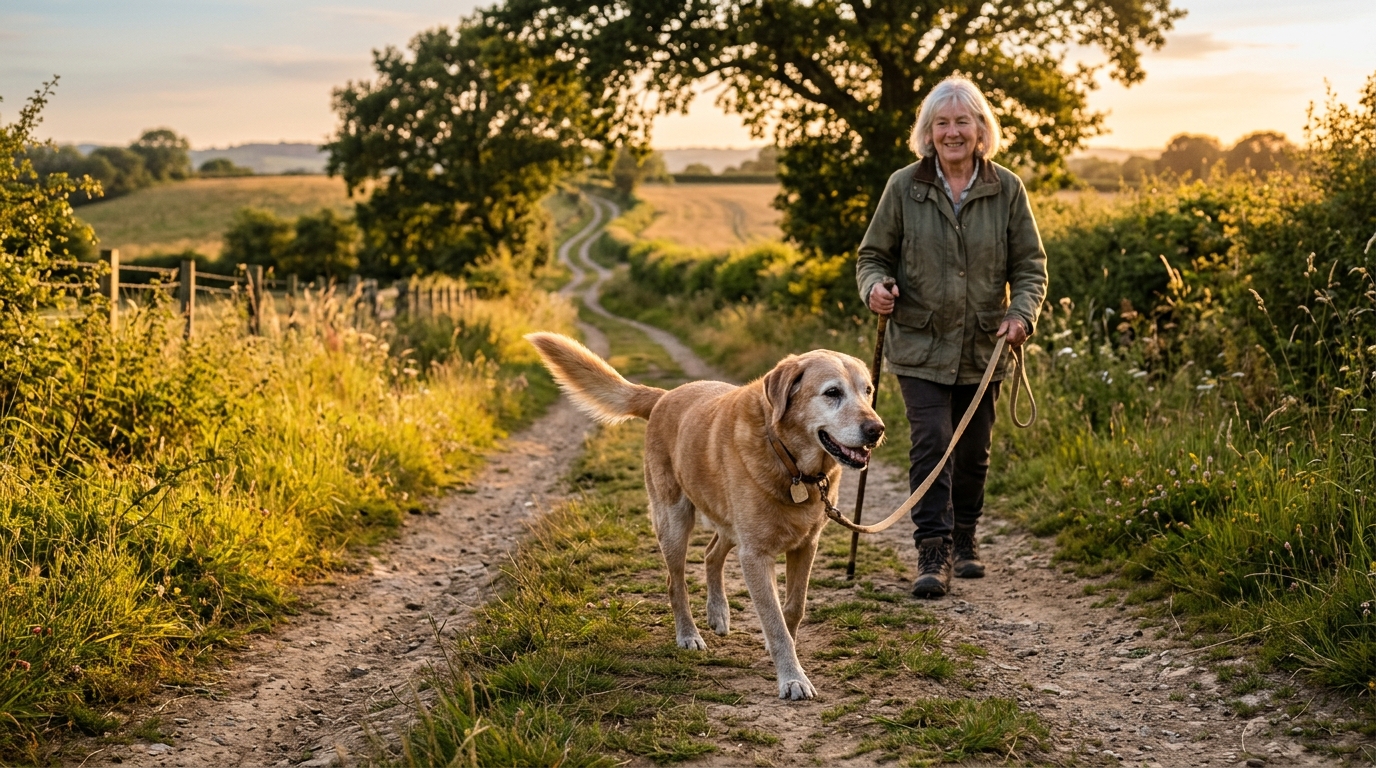
The foundation of any arthritic dog's exercise programme. Steady, controlled, predictable. You set the pace and the direction. There are no surprises. The dog can't suddenly turn at speed to chase something. The forces through the joints are smooth and consistent.
Lead walking on varied terrain (gentle hills, slight slopes, soft surfaces) is particularly good because it works different muscle groups and provides natural strength-building stimulus without being high-impact.
Pace matters. A relaxed, comfortable walking pace is what you want, not a brisk power-walk where you're dragging the dog along. The dog should be able to sniff, look around, and engage with their environment. It's their walk, not yours.
Most arthritic dogs benefit from being on lead for most of their walks, particularly during the initial settling phase after diagnosis. Once their condition is stable and you have a good sense of what they can handle, you may reintroduce some off-lead time in controlled environments.
Off-lead time
Off-lead walking has both benefits and risks for arthritic dogs. The benefits include allowing the dog to choose their own pace, providing more mental stimulation, and giving them autonomy. The risks are mainly around surprise high-impact movements: sudden running after a smell, fast turns, jumping over obstacles, encountering other dogs and engaging in rough play.
Whether off-lead is appropriate depends on:
- The individual dog's tendency to self-regulate (some arthritic dogs sensibly potter; others go from zero to sixty whenever excited)
- The environment (a quiet field is different from a busy park)
- The current pain control level (a comfortable, well-medicated dog handles more than one who's still struggling)
- The disease stage (early-stage dogs handle off-lead better than advanced cases)
If you do off-lead time, consider mixed walks where the dog spends most of the time on lead and gets short controlled off-lead periods in safer areas.
Swimming and hydrotherapy
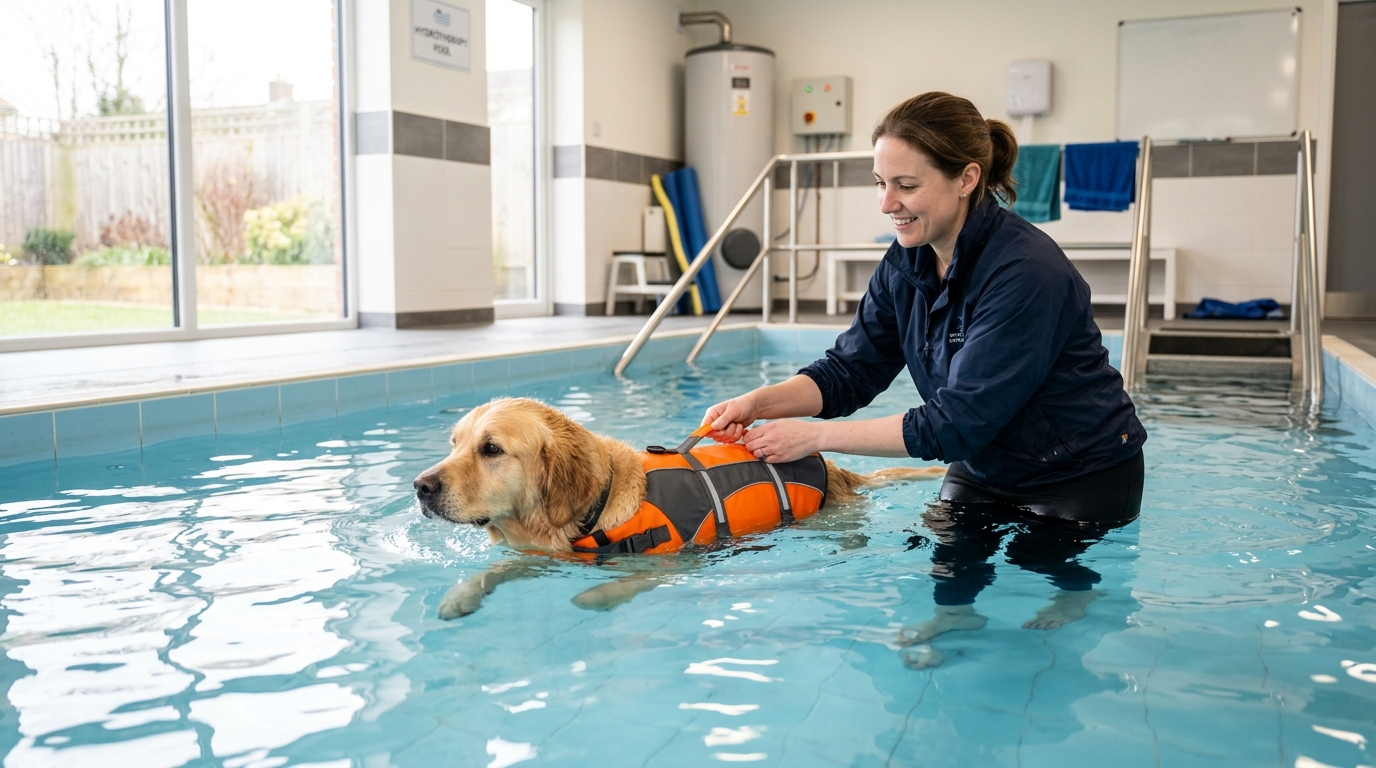
Swimming is one of the best exercises for an arthritic dog. The water supports their body weight, removing the load on painful joints. The resistance of the water builds muscle. The movement is naturally controlled. The benefits without the impact.
Hydrotherapy under professional supervision is a structured form of this. Most arthritic dogs benefit from a course of hydrotherapy at some point. It's particularly valuable for building strength after a flare-up, for very advanced cases where land exercise is limited, and for dogs who need help losing weight without being able to walk far.
If your dog is a natural swimmer, swimming in safe environments (calm water, gradual entry and exit, lifejacket if needed) is excellent ongoing exercise. The water temperature matters too: cold water can cause muscle tension and exacerbate stiffness, so warmer water (heated pools or warm sea/lake water in summer) is ideal.
Caveats: not every dog swims. Some find it stressful. Some have skin issues that make wet activity problematic. Some have ear conformation that predisposes to ear infections with water exposure. And entering or exiting the water needs care: scrambling up a steep bank or jumping into a deep pool can cause exactly the kind of acute injury you're trying to avoid.
Garden time
Gentle pottering in the garden is genuinely useful exercise, particularly for breaking up sedentary periods. A dog who goes outside several times a day for short bouts of mooching, sniffing, and gentle wandering is doing more than a dog who has one walk and lies still for the rest of the day.
For dogs in flares or recovering from worse periods, garden time can be the entire exercise programme. Build back up to walks once they're more comfortable.
Ball chasing, frisbee, and high-impact play
These need a frank conversation, because most owners of arthritic dogs are reluctant to give them up.
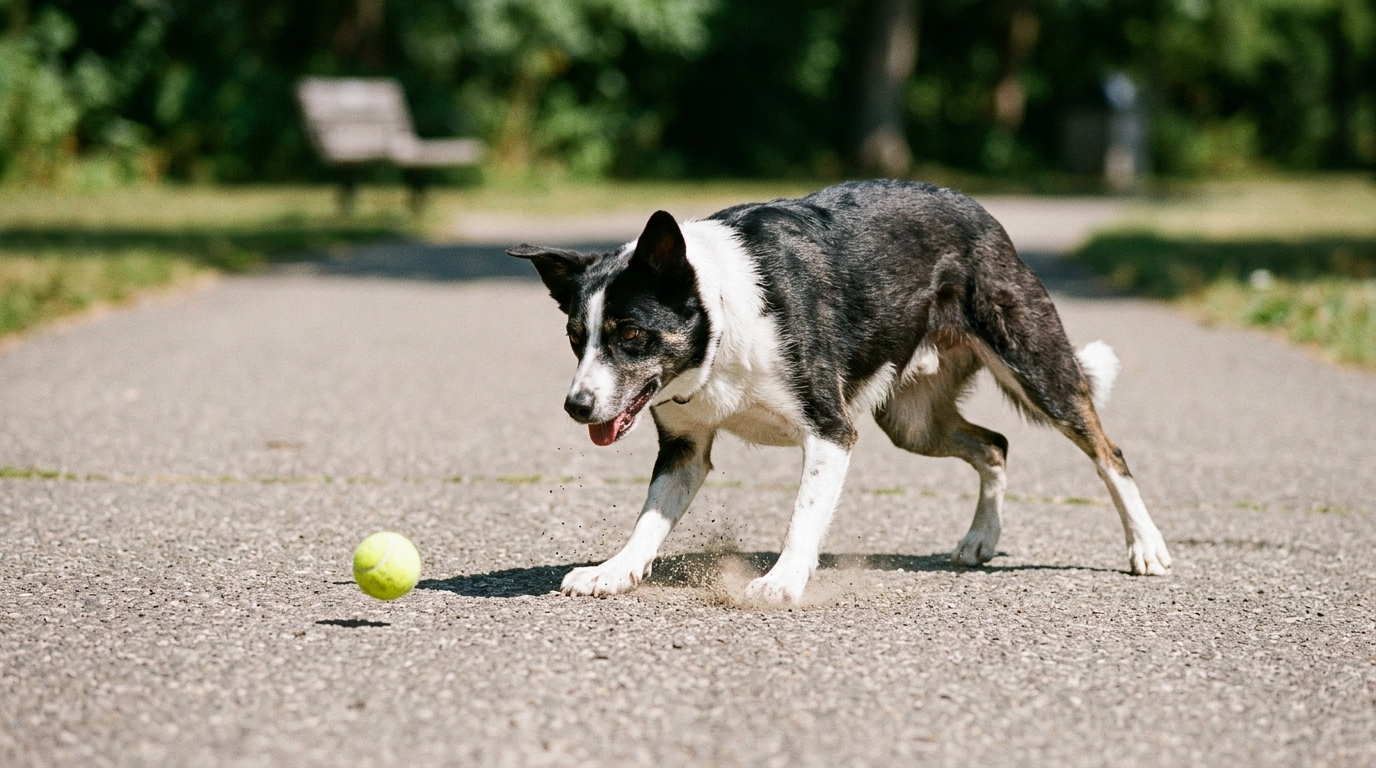
Ball chasing is one of the worst activities for an arthritic dog. It involves:
- High-speed acceleration from a stationary position
- Hard deceleration at the ball
- Sudden turns and changes of direction
- Repeated jumping and landing
- Sustained adrenaline that masks pain in the moment
Every single one of these is harmful to an arthritic joint. Dogs who love ball chasing often appear to be having a fantastic time and seem fine afterwards, only to be stiff and sore the next morning. The peak forces during the activity are doing real damage that the dog isn't communicating.
Frisbee involves all the same problems plus jumping at height with twisting in the air, which is even worse for joints.
I'm not going to tell you to ban ball games entirely. But for an arthritic dog, I'd strongly encourage you to:
- Stop high-speed fetch on hard surfaces
- Replace the ball with a slow-rolling alternative (a snuffle ball or weighted ball that rolls slowly)
- Use a flirt pole at low intensity instead of throwing
- Keep any ball play very brief
- Watch carefully for the day-after consequences
For dogs whose lives revolve around ball games, this is genuinely difficult. They've often had a relationship with a particular toy for years. The plain truth is that this needs to change, and substituting other activities (sniff walks, gentle training, food puzzles, scent work) is the way to maintain the dog's mental engagement without continuing to damage their joints.
Off-lead group play
Two arthritic dogs gently pottering together is fine. An arthritic dog being repeatedly bumped, chased, or wrestled by a young energetic dog is not. These interactions cause exactly the kinds of unpredictable high-impact movements that arthritic joints can't tolerate.
If your dog used to enjoy social play but is now arthritic, you need to be selective about playmates. Quiet older dogs and gentle introductions are fine. Boisterous young Labradors bouncing in unannounced are a problem.
Running with the owner
Running, jogging, and cycling with an arthritic dog on lead is generally not appropriate. The sustained high-impact loading is too much for arthritic joints, even at moderate human jogging pace which is a fast trot for many dogs.
If you've previously run with your dog, this is one of the harder conversations. Substituting with longer walks (often more enjoyable for the dog anyway) is the answer.
Stairs
Stairs deserve a specific mention because they're a feature of so many homes and can be a real problem.
Going up stairs requires significant hindlimb strength and uses the hip and stifle joints in a way that arthritic dogs often find difficult. Coming down stairs loads the forelimbs heavily and is often harder for dogs with elbow or shoulder arthritis.
For mildly affected dogs, normal stair use is usually fine, particularly if the dog can take their time and the stairs have good grip. For more affected dogs, restricting or eliminating stair use can be beneficial. This might mean keeping the dog on one level of the house, using a ramp or stair-lift sling for assistance, or carrying smaller dogs.
Building the plan: a practical guide
Here's how I'd actually go about building an exercise plan for your arthritic dog.
Step 1: Assess the starting point
Be realistic about where your dog is right now. Are they walking comfortably for an hour at a moderate pace? Do they struggle with twenty minutes? Are they reluctant to leave the house? Their current capacity is your baseline.
If you're not sure, watch for the day-after picture. If they're stiff or sore the day after their current exercise, even at their current level, it's too much. Pull back to whatever level they can do without being stiff the next day, and use that as your baseline.
Step 2: Get pain control right first
There's no point building an exercise plan around a dog who's in significant pain. The pain itself will limit progress, and the exercise may flare things up. If your dog isn't comfortable on their current pain medication, sort that out first (in conversation with your vet) before pushing the exercise plan.
A comfortable dog on appropriate medication can build their exercise tolerance steadily. A dog in pain will hit a ceiling quickly and probably regress.
Step 3: Structure the day
Look at your existing routine and identify when you can fit in 2-4 sessions of controlled exercise per day. For most owners, this means:
- A morning walk before work or after breakfast
- A short midday garden break or short walk
- A main afternoon or evening walk
- A short evening garden break
You don't need to be heroic. You need to be consistent. Better to do four 10-minute walks reliably every day than to plan a 60-minute walk you only manage three days a week.
Step 4: Pick the right environments
Identify routes that work for your dog:
- Soft surfaces (grass, dirt paths, forest floor) are kinder than tarmac
- Gentle gradients are useful for strength building; steep hills are often too much
- Quiet routes minimise the risk of surprise encounters with other dogs
- Routes you can shorten flexibly if needed (loop systems rather than out-and-back where you're committed to the full distance)
A mix of routes is better than the same one every day. Variety provides mental stimulation and works slightly different muscles.
Step 5: Add gentle activities at home
Beyond walks, build in low-key activity throughout the day:
- Gentle play with appropriate toys (puzzle feeders, snuffle mats, slow-roll balls)
- Short training sessions (mental stimulation that's physically undemanding)
- Position changes (encouraging the dog to get up and move from their bed periodically rather than lying still for hours)
- Range of motion exercises
Lots of small bouts of activity through the day add up to significant total movement without ever being overwhelming.
Step 6: Monitor and adjust
Once you have a routine going for 2-3 weeks, assess whether it's working:
- Is your dog comfortable the day after exercise?
- Are they engaged and enthusiastic about going out, or reluctant?
- Are they maintaining or improving their condition?
- Are you able to sustain the routine, or is it falling apart?
Adjust based on what you're seeing. If everything looks good, you might be able to gradually increase. If they're consistently sore, dial it back. If you can't sustain it practically, find something simpler that works for your life.
The plan only works if it's sustainable. A theoretically perfect plan you can't maintain is worse than a slightly imperfect plan you can do every day.
Adjusting through seasons and flares
Exercise needs change with the seasons and with the natural fluctuations of arthritis.
Winter is harder for most arthritic dogs. Cold weather causes muscle tension and exacerbates joint stiffness. Wet, slippery ground increases the risk of slips. Shorter days reduce the available daylight for walks. Adjustments include:
- A proper warm-up before going out (a few minutes of gentle indoor movement first)
- A coat for dogs who feel the cold (many arthritic dogs benefit from this regardless of their breed or normal cold tolerance)
- Choosing routes that avoid the worst surfaces (icy paths, muddy fields)
- Shorter, more frequent walks rather than long ones in cold conditions
- Indoor activities to maintain movement on the days when going out is genuinely difficult
Summer brings different challenges, particularly heat. Arthritic dogs often struggle with heat regulation because they're often older and may have reduced fitness. Modifications include:
- Walking in the cool of early morning or late evening
- Avoiding hot tarmac
- Carrying water on walks
- Taking advantage of swimming opportunities
- Keeping walks shorter on the hottest days
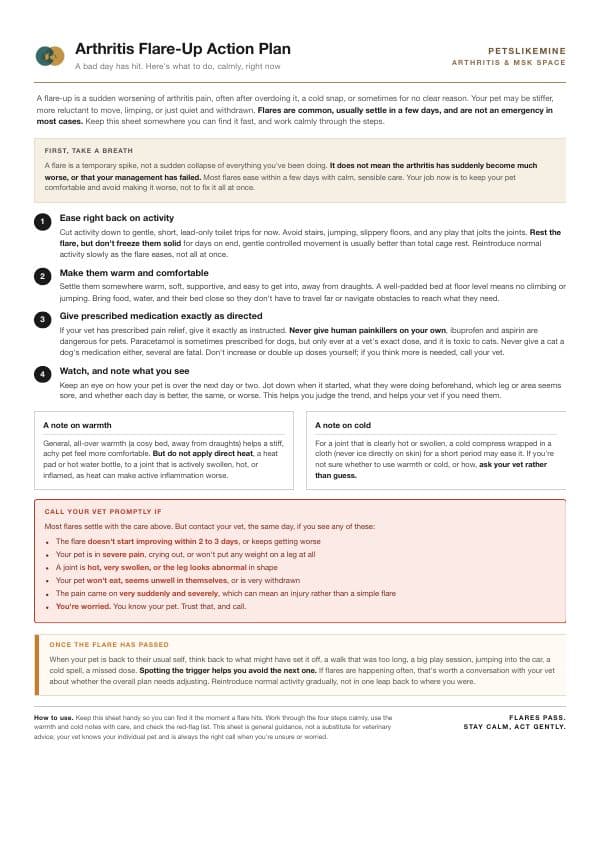
During flare-ups, the exercise plan needs to change. A flare is a temporary worsening of arthritic pain, often triggered by overexertion, a change in weather, or sometimes for no obvious reason. During a flare:
- Reduce exercise to the minimum (toilet breaks and short gentle pottering only)
- Speak to your vet about temporary additional pain control if the flare is significant
- Rebuild gradually once the flare settles, rather than jumping straight back to full activity
- Use the flare as information about what triggered it, so you can avoid repeating the cause
Flares are part of the disease course for most arthritic dogs. They're not failures. They're signals to adjust temporarily.
When to push and when to pull back
One of the harder judgements is when to encourage your dog to do more versus when to dial back.
Encourage more when:
- Your dog is recovering well between sessions
- They're enthusiastic about going out
- Their muscle mass is maintained or improving
- They're at or above their stable baseline
- They've been stable for several weeks and you want to see if a small increase is sustainable
Pull back when:
- They're consistently stiffer or sorer the day after exercise
- Their enthusiasm is dropping
- You notice muscle wasting starting
- They've had a recent flare-up
- The weather or environmental conditions are unfavourable
- They're recovering from any concurrent illness
The dog who used to manage an hour might need 45 minutes for a few months, then come back up to an hour as they stabilise on better treatment. The dog who used to need only 20 minutes might benefit from gradually building up to 40 over the course of a year. Arthritis isn't static, and neither is your exercise plan.
What success looks like
Six months into a good exercise programme for an arthritic dog, you should see:
- A dog who's settled into a consistent routine they can sustain
- Stable or improved muscle mass on the affected legs
- Reasonable comfort the day after typical exercise
- Engagement and enthusiasm about going out
- Maintenance or improvement in their general activity level
- Better sleep quality
- A dog who looks like they're living a normal life, just at slightly modified intensity
Notice what's not on this list. You're not aiming to make the arthritis disappear. You're not aiming to return to pre-diagnosis activity levels. You're aiming to maintain a good quality of life through movement, and to slow the progression of decline that would otherwise occur if your dog became sedentary.
This is a long game. Consistency over years matters more than perfection in any given week.
A final thought
Twenty-five years of veterinary practice has shown me one consistent pattern with exercise. The dogs who do best are the ones whose owners settled into a sustainable rhythm of daily walks. Not the most ambitious plans. Not the most expensive equipment. The owners who quietly took their dogs out, every day, for the rest of their lives, modifying gently as needs changed.
That's what you're aiming for. Not heroism. Not perfection. Just consistent, thoughtful movement, day after day, year after year.
Your arthritic dog is still your dog. They still want to go out. They still want to engage with the world. The exercise plan you build for them is what allows that to continue, in a modified form, for as long as possible.
That's not a small thing. For your dog, walks are often the highlight of the day. Keeping them in their life is one of the most meaningful things you can do.
References
Free downloads
Companion worksheets to put what you've read into practice. Free PDFs, print at home.
Sister tool · Sightline
Track whether treatment is working
Sightline, a separate ConciergeVet tool, runs a short weekly check-in built on validated pain and mobility instruments, turns it into a single Sightline Score you can watch trend over weeks rather than judge on one bad day, and produces a report you can bring to your vet.
A written log, or our printable trackers, does much the same job.
See how Sightline tracks treatmentSee where your pet stands today
Tracking is the other half of managing arthritis. Take the 2-minute Mobility Check to see your pet's stage, then watch it shift as treatment takes effect.
Take the Mobility CheckYou're not doing this alone
Compare treatment journeys and talk to owners managing arthritis. Free to join.
Join PetsLikeMine