


CBD and Cannabis for Pet Arthritis: What the Evidence Actually Says
Alastair Greenway
BVM&S MRCVS
A note on transparency before we start: I am a veterinary surgeon, and I also founded a CBD brand, Aponia. That gives me a genuine interest to declare, and I declare it openly here. This article is informational, not a product promotion, and I have written it to be candid about the unglamorous parts, the modest evidence, the safety signals, and the legal mess. Where I point to further reading from Aponia, it is because the detail there is useful, not to sell you anything.
CBD is the most-asked-about "natural" option for arthritic pets, and the marketing is everywhere. So what does the evidence actually show, is it safe, and is it even legal to give your pet in the UK? A clear, hype-free look at cannabinoids for dogs and cats with arthritis.
Let me give you the bottom line up front and then explain it: the evidence for CBD in canine arthritis is promising but genuinely limited, there is a real safety signal worth knowing about, and the legal position in the UK is far more restrictive than the busy marketplace would lead you to believe. None of that means CBD is worthless. It means it deserves a clear-eyed look, with your vet, rather than a leap based on packaging.
Why so many owners are asking
It is easy to see the appeal. CBD is marketed as a natural, gentle alternative, the shelves and the internet are full of pet CBD products, and owners understandably want something that might help their arthritic pet, especially if conventional options have downsides. There is nothing foolish about asking the question; it is one of the most common ones I get. So this is not a lecture against CBD. It is an attempt to give you the full information the marketing tends to skip, so you can make a sensible decision.
CBD, THC and where they part company
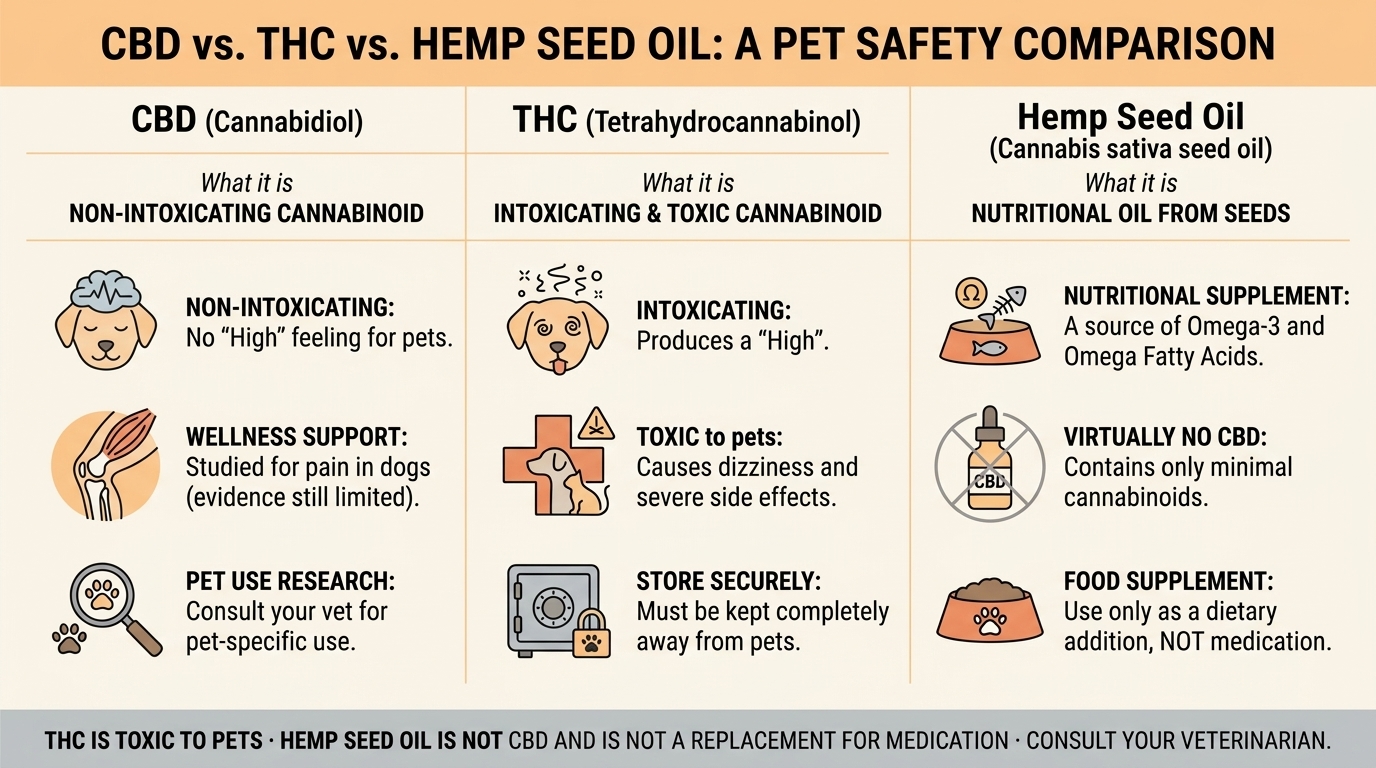
First, some clarity, because the terms get muddled and the difference genuinely matters for safety. Cannabidiol, CBD, and tetrahydrocannabinol, THC, are two different compounds from the cannabis plant. THC is the psychoactive component, the one that produces a "high"; CBD is not psychoactive in that way. Products marketed for pets are CBD, usually derived from hemp: the same plant species, Cannabis sativa, legally classed as hemp because it is bred and selected to contain only a tiny amount of THC.
One source of confusion is worth clearing up early, because it costs owners money for nothing: "hemp oil" is not the same as CBD. Hemp seed oil, pressed from the seeds and often sold as "hemp oil", "hemp extract", or "Cannabis sativa seed oil", is a perfectly decent nutritional oil rich in omega fatty acids, but it contains virtually no CBD. Products that trade on the word "hemp" to imply CBD benefits, common on the online marketplaces that ban CBD outright, are generally useless for the pain relief people are actually buying them for. The simple protection is this: if a product does not state a clear CBD content backed by a Certificate of Analysis, assume it has little or none.
Now the safety point that matters most: THC is toxic to pets. Human cannabis products, including recreational cannabis and, very commonly, THC-containing edibles, are a serious and increasingly frequent cause of poisoning in dogs especially. So whatever you conclude about CBD, never give your pet a human cannabis product, and keep any such products well out of reach. A dog that gets into a stash of edibles is a genuine emergency. Pet CBD and human cannabis are not the same thing, and confusing them is dangerous.
What the studies actually show
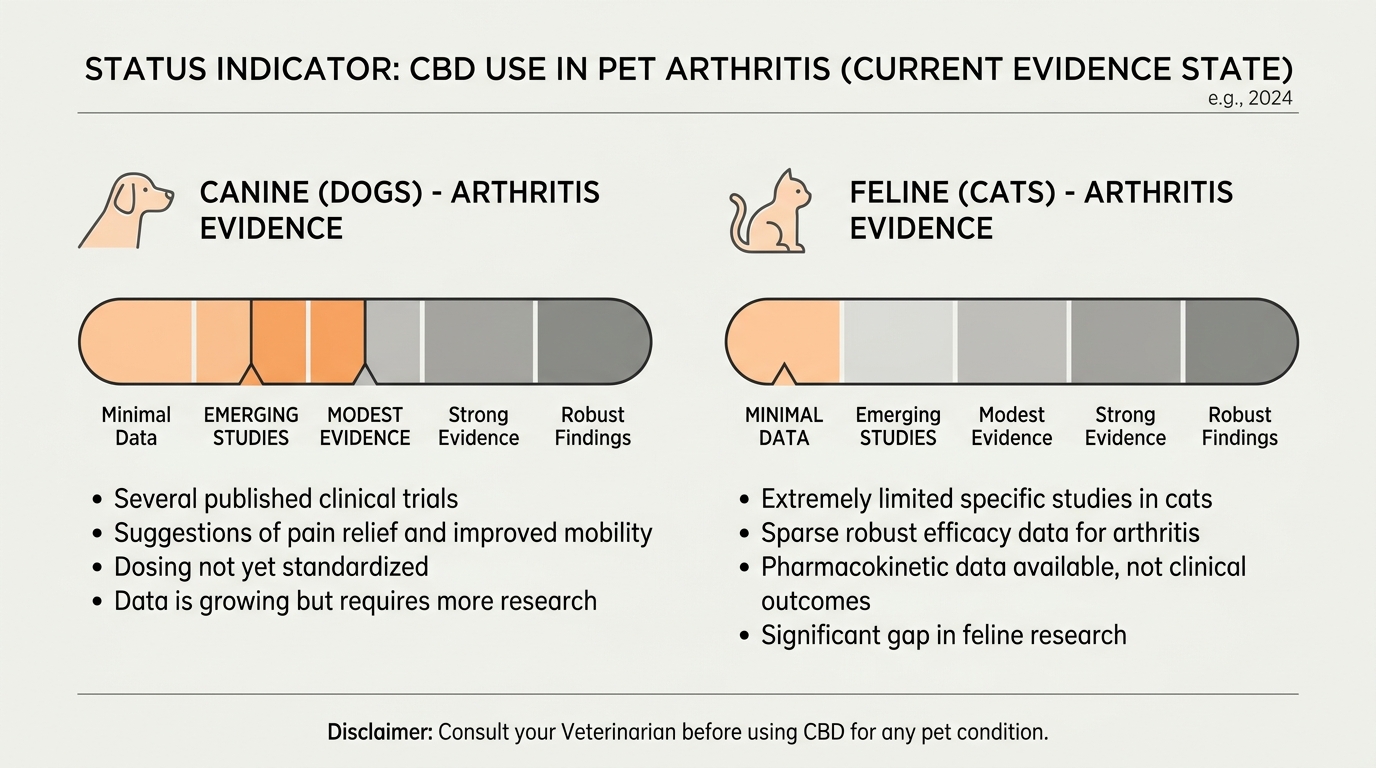
So does CBD help arthritic pets? There is a small but real body of research, almost all of it in dogs.
A handful of studies, including randomised, placebo-controlled trials, have looked at CBD for canine osteoarthritis, and several of them found modest improvements in comfort and activity, as judged by owners and some objective measures. That is genuinely encouraging, and it is more than can be said for many heavily marketed "natural" products. But the candour has to extend to the limitations, and they are significant. A 2023 systematic review that pooled the available canine studies found only a small number of trials, in relatively few dogs in total, and judged all of them to be at high risk of bias. The studies are small, often short, the products and doses vary, and some research is industry-funded. And evidence specifically in cats is almost absent.
So the fair verdict is "promising and emerging, not proven." There is a real signal that CBD may help some arthritic dogs, enough to take it seriously and to justify more and better research, but not enough to call it an established treatment, and certainly not enough in cats. Anyone presenting it as a proven miracle is going beyond the evidence.
How safe is it?
On safety, the studies are broadly reassuring with one consistent caveat. CBD has generally been reasonably well tolerated in the canine trials, without major adverse effects in the short term. The notable and repeated finding, though, is an increase in a liver enzyme called ALP in a proportion of treated dogs. The significance of this is still debated, it may reflect the liver's processing of the compound rather than damage as such, but it is a real signal, and it is why monitoring liver values is sensibly advised for pets on CBD.
There is also a theoretical and practical concern about interactions: CBD is processed by the same liver pathways as many other medicines, so it can potentially affect how other drugs your pet is taking are metabolised. For an arthritic pet often on other medication, that interaction question is one for your vet, not something to navigate alone. And, to repeat the point that overrides everything: none of this tolerability applies to THC or human cannabis products, which remain toxic.
The UK legal and quality picture
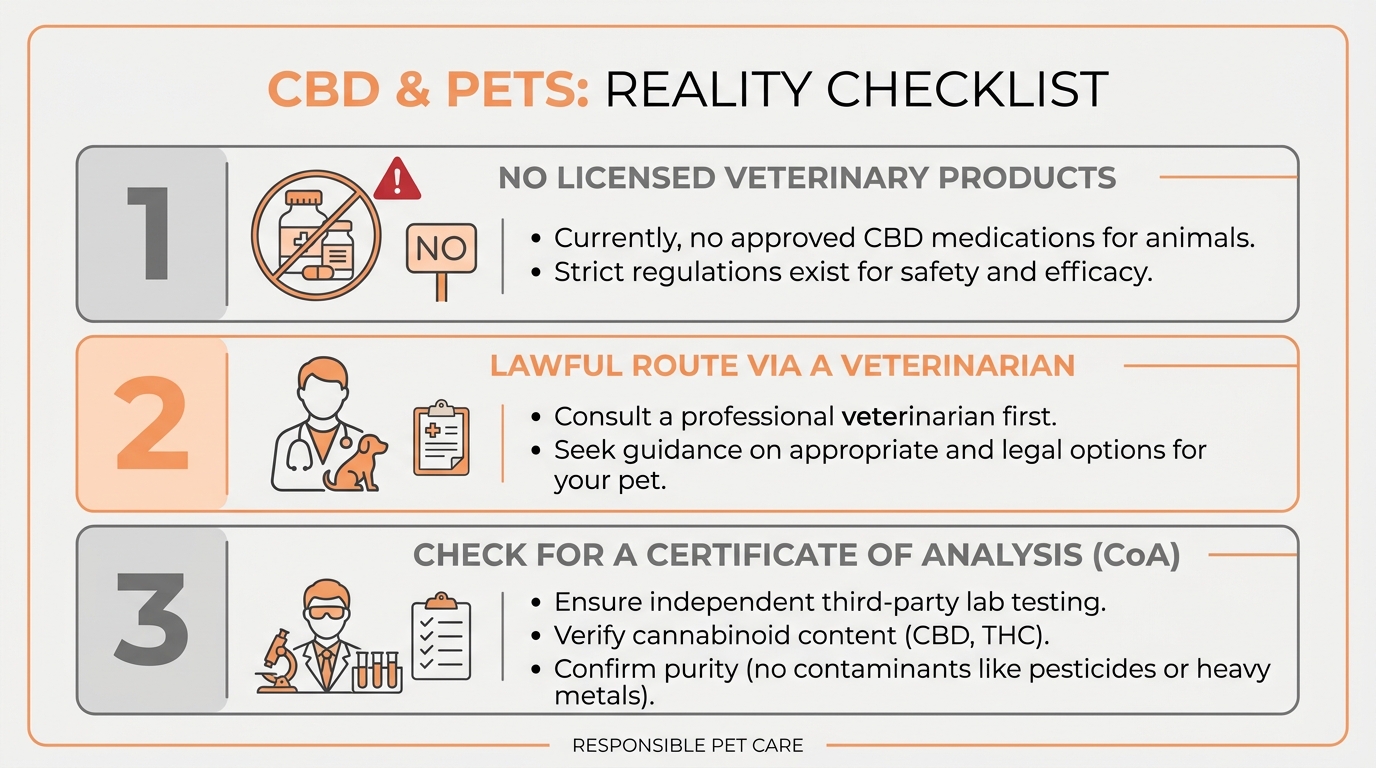
This is the part the marketing never tells you, and it is genuinely important, so I want to be precise about the UK position, because it is far more restrictive than the crowded marketplace implies.
In 2018 the UK's Veterinary Medicines Directorate, the VMD, determined that a CBD product intended for an animal is, by law, a veterinary medicine. The consequence of that is significant: a veterinary medicine must be authorised, and there are currently no CBD products with a UK veterinary marketing authorisation. So the only lawful route to giving your pet CBD is through a registered vet, who may prescribe a legally obtained product under the prescribing cascade, the system that lets vets reach for unlicensed options when no authorised veterinary medicine exists, on the basis of a genuine clinical relationship and justification. Supplying or giving an animal a CBD product without that veterinary route is an offence under the Veterinary Medicines Regulations, and the liability falls on the owner.
In plain terms: the pet CBD you can readily buy online or off a shelf is, in the UK, not a lawful way to give CBD to your animal, however normal the marketplace makes it look. The lawful path runs through your vet. (The picture is evolving, there have been moves toward UK-manufactured veterinary "specials" formulations, so it is worth asking your vet what is currently available and lawful rather than relying on this article alone.)
On top of the legal position, there is a quality problem. The CBD market is poorly regulated, and independent testing has repeatedly found products that are mislabelled, containing far less, or occasionally more, CBD than the label claims, or contaminants. This is why a Certificate of Analysis, an independent lab report on what a product actually contains, matters so much, and why "it says CBD on the bottle" tells you very little about what is really in it.
Working through it with your vet
So where does this leave a sensible owner? Not with a flat no, but with a clear framework. CBD is not a first-line treatment for arthritis and is not a replacement for the pain relief and management we know works. If you are interested in it, the right approach is to discuss it with your vet, who can consider whether it is appropriate for your individual pet, address the lawful route, prioritise a quality product, monitor for effects including liver values, and watch for interactions with your pet's other medicines. That is a very different thing from buying a bottle online and hoping.
And it bears repeating: do not let an interest in CBD displace treatment that is known to work. The real risk I see is not usually CBD itself; it is an owner quietly dropping proven pain relief in favour of an unproven product, and leaving their pet less comfortable as a result.
Where this leaves you
CBD for arthritic pets is promising but unproven, reasonably tolerated but with a liver signal worth monitoring, and, in the UK, far more legally restricted than the marketplace suggests. The evidence in dogs is real but limited; in cats it is barely there. The lawful route runs through your vet, not the shelf. And whatever you do, never give a pet human cannabis or any THC-containing product.
If you want to explore CBD for your arthritic pet, do it the considered way: talk to your vet, insist on quality and the lawful route, keep proven treatment in place, and treat CBD as a possible adjunct under supervision, not a miracle to chase. Approached with clear eyes, it is one more option to weigh; approached on the strength of the marketing, it is a way to waste money, fall foul of the law, or, at worst, leave your pet less well treated than they were.
For further reading on the detail behind this article, my Aponia journal covers the UK legal position, the science of the endocannabinoid system, and how to read a Certificate of Analysis in more depth. I link those as further reading, with the same disclosure as above: I founded that brand, and these are offered for information, not as a recommendation to buy.
References
- Gamble LJ, Boesch JM, Frye CW, et al. Pharmacokinetics, safety, and clinical efficacy of cannabidiol treatment in osteoarthritic dogs. Frontiers in Veterinary Science, 2018.
- Verrico CD, Wesson S, Konduri V, et al. A randomised, double-blind, placebo-controlled study of daily cannabidiol for the treatment of canine osteoarthritis pain. Pain, 2020.
- Patikorn C, et al. Efficacy and safety of cannabidiol for the treatment of osteoarthritis in dogs: a systematic review. Frontiers in Veterinary Science, 2023.
- UK Veterinary Medicines Directorate (VMD), 2018 position that CBD for animals is a veterinary medicine; Veterinary Medicines Regulations 2013.
- Aponia journal (authored by the same veterinary surgeon; relationship disclosed): CBD and Your Pet: What the Law Actually Says.
- Monteiro BP, Lascelles BDX, et al. 2022 WSAVA guidelines for the recognition, assessment and treatment of pain. Journal of Small Animal Practice, 2023.
Sister tool · Sightline
Track whether treatment is working
Sightline, a separate ConciergeVet tool, runs a short weekly check-in built on validated pain and mobility instruments, turns it into a single Sightline Score you can watch trend over weeks rather than judge on one bad day, and produces a report you can bring to your vet.
A written log, or our printable trackers, does much the same job.
See how Sightline tracks treatmentSee where your pet stands today
Tracking is the other half of managing arthritis. Take the 2-minute Mobility Check to see your pet's stage, then watch it shift as treatment takes effect.
Take the Mobility CheckYou're not doing this alone
Compare treatment journeys and talk to owners managing arthritis. Free to join.
Join PetsLikeMine