

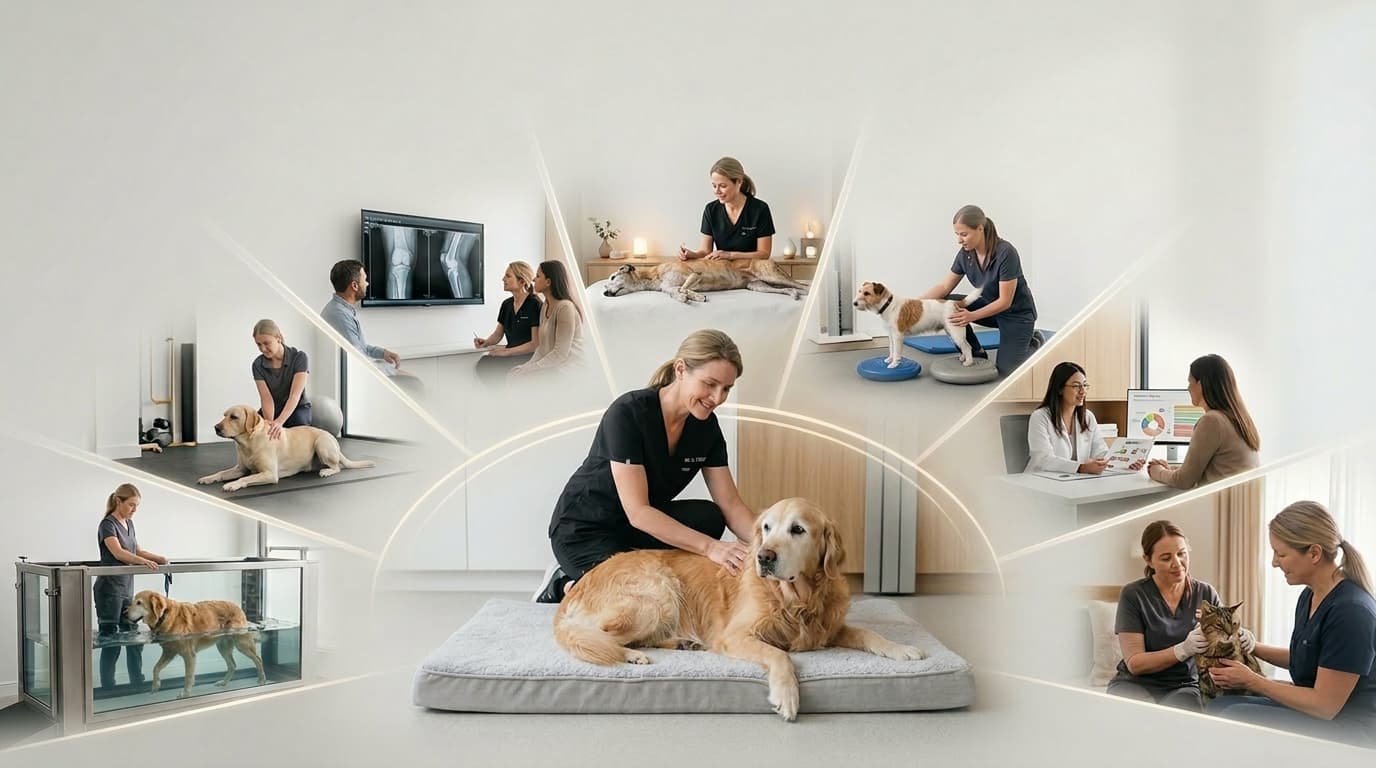
Building Your Dog's Care Team
Alastair Greenway
BVM&S MRCVS
Ask most owners who looks after their pet's health and the answer is one word: "the vet." That model works fine for routine care, vaccinations and the occasional bout of illness. For a chronic condition like arthritis, though, it's too narrow. Managing arthritis well across the years of your dog's life takes a team of practitioners working together, not a single person.
Your primary vet is the hub. Around them, depending on what your dog needs, sit specialists, physiotherapists, hydrotherapists, acupuncturists, manual therapists, nutritionists, rehabilitation centres and, when the time comes, end-of-life care providers. Each plays a different role. Each carries different training and accreditation. Each matters more, or less, at different stages of the journey.
This article maps that team: who each player is, when they matter, how to find a qualified one, and how to coordinate their input so your dog's care is genuinely joined up rather than scattered.
One thing to settle before we start. You don't usually build a care team all at once. For many dogs with mild to moderate arthritis, the primary vet plus perhaps a hydrotherapist is the whole team. For dogs with more complex situations, or as the condition progresses over years, the team grows. So don't feel you need to assemble all of these people tomorrow. The point is to know who's out there, so you know who to add when the moment is right.
I'm writing this mostly for dog owners, but most of the principles carry over to cats too. The team dynamics do shift a little for cats (fewer cat-experienced practitioners in some disciplines, more emphasis on home visits, particular care over transport stress), and I'll flag those points where they come up.
Your primary vet, the hub of it all
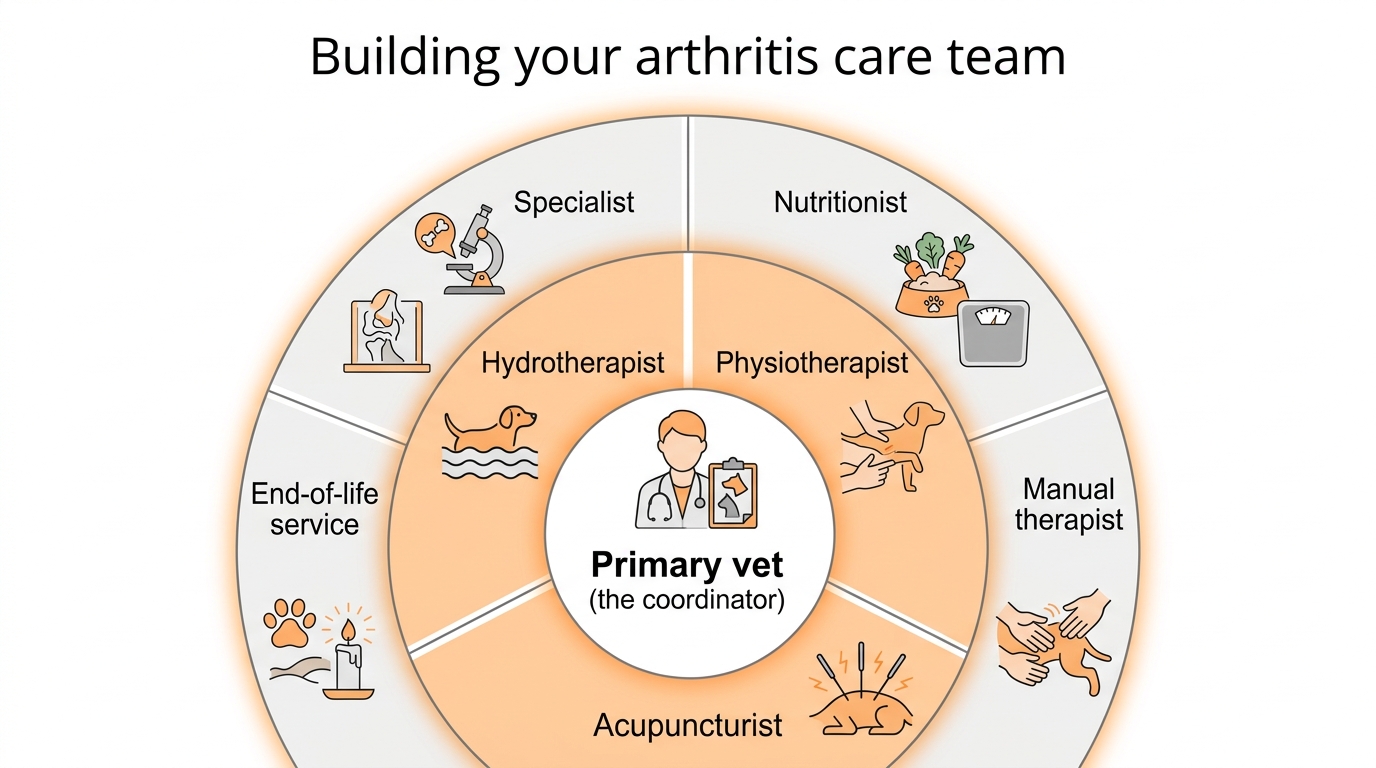
Your primary care vet is the most important member of your dog's care team. Not because they do the most hands-on clinical work, but because they're the coordinator. They know your dog. They hold the medical history. They prescribe the medications. They watch for changes. They arrange referrals when those are needed.
Chronic disease management only works well on top of a good primary care relationship. This is the foundation everything else builds on.
So what do you want from a primary vet for chronic disease care?
Continuity. Seeing the same vet, or two specific vets within a practice, for ongoing care. Continuity lifts chronic disease outcomes dramatically, because the vet builds up knowledge of your individual dog over time.
Interest in chronic disease. Some vets are particularly drawn to chronic conditions; others are more at home with acute medicine. For an arthritic dog, a vet who genuinely enjoys long-term management is worth a great deal.
Willingness to coordinate. A good primary vet welcomes input from the rest of the team. They talk to specialists, take in reports from physiotherapists, and fold the wider picture into your dog's management plan.
Realistic time allocation. Chronic disease appointments often need more than the standard 10-15 minutes. A practice that can make room for this, whether through longer appointment slots or nurse-led follow-up consultations, serves chronic patients better.
Clear communication. You should leave a consultation knowing what was discussed and what comes next.
If your current primary vet relationship isn't delivering these things, it's worth thinking about how to put that right. We covered this in our companion article on getting the most from vet appointments.
When specialist input earns its place
For arthritis specifically, specialist referral becomes appropriate in situations like these:
- Diagnostic uncertainty (when the underlying structural problem isn't clear)
- Surgical decision-making (when a specific orthopaedic procedure is on the table)
- Pain management that isn't working well enough on standard approaches
- Complex cases with multiple joints involved
- Atypical presentations that don't fit the usual patterns
- A second opinion when significant decisions are being made
Orthopaedic surgery is the main specialty relevant to arthritis, but pain management specialists, internal medicine specialists and rehabilitation specialists all contribute at times.
How specialist referral works
Specialist veterinary care in the UK runs through a referral system. Your primary vet sends a referral letter to a specialist or referral centre with the relevant history, examination findings and imaging. The specialist arranges an appointment, carries out their assessment, and feeds recommendations back both to you and to your primary vet.
Most pet insurance policies cover specialist referrals when they're properly initiated by a primary vet. Pre-authorisation is often available and worth using for higher-cost procedures.
Finding the right specialist
The UK has a good number of qualified orthopaedic specialists, both at university teaching hospitals (RVC, Cambridge, Edinburgh, Liverpool, Glasgow) and at private referral centres (Fitzpatrick Referrals, Davies, Eastcott, Anderson Moores, North Downs, and many regional centres).
What to look for in a specialist:
Recognised qualifications. RCVS Recognised Specialist in Small Animal Surgery (Orthopaedics), EBVS European Specialist, ACVS Diplomate, or equivalent. The terms "specialist" and "orthopaedic surgeon" aren't legally protected; specific qualifications are.
Volume of practice. Specialists who perform high volumes of a specific procedure tend to get better outcomes. A surgeon who does 200 TPLOs per year is a different proposition from one who does 20.
Geographic accessibility. Recovery means multiple appointments. A centre several hours away may not be practical for ongoing care.
Insurance compatibility. Some centres have direct claim arrangements with major insurers, which eases cash flow considerably.
Multidisciplinary support. Centres with in-house anaesthesia specialists, rehabilitation services and imaging facilities offer more rounded care than standalone services.
Communication. A good specialist talks clearly to both owners and referring vets, supports continuity of care after the procedure, and stays available for follow-up questions.
The PetCare Atlas catalogues UK referral hospitals, specialist practices, RCVS specialists and advanced practitioners with their specialisations and locations.
The veterinary physiotherapist
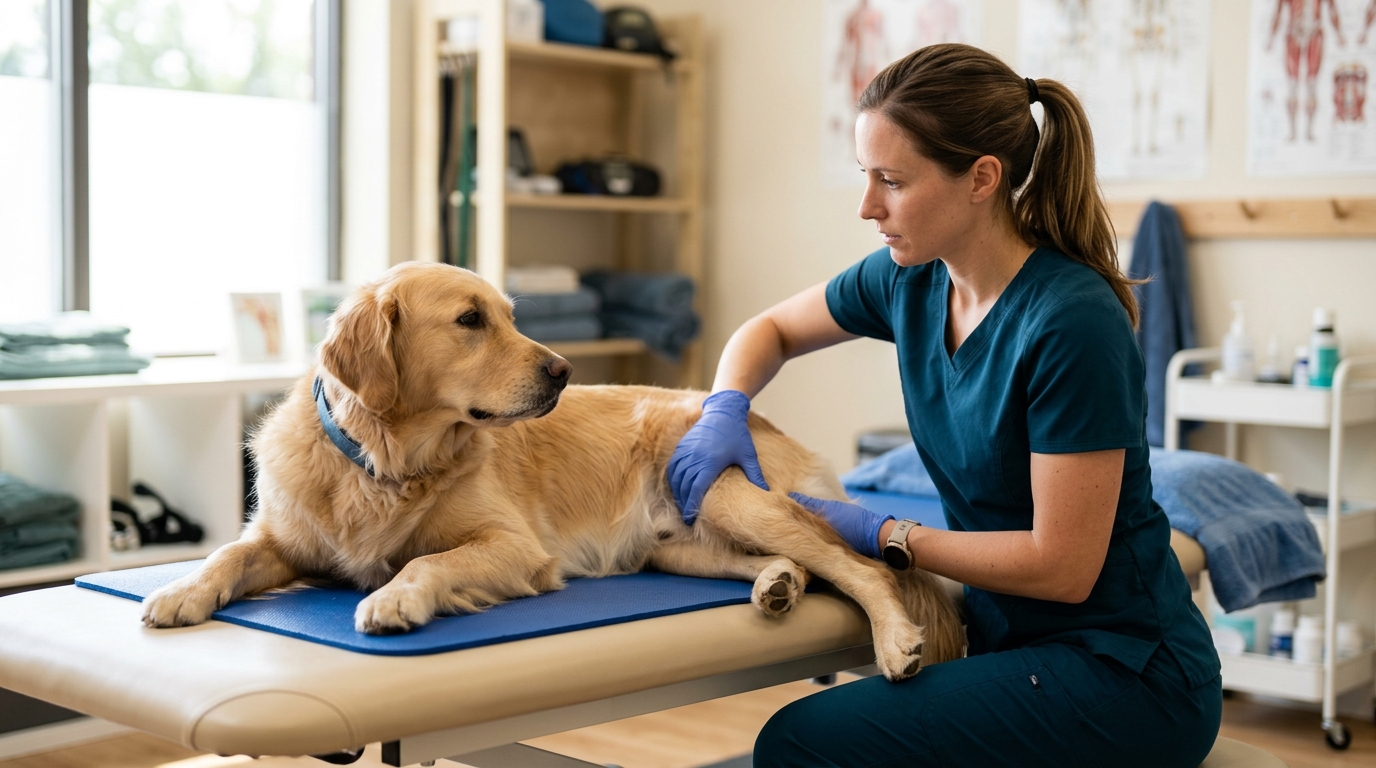
Veterinary physiotherapy is one of the most underused resources for arthritic dogs. A qualified veterinary physiotherapist assesses your dog's movement, picks out areas of muscle tension, compensation and dysfunction, and treats them. They earn their keep with arthritic dogs because arthritis sets off secondary compensation right through the musculoskeletal system, and that's easy to miss in a standard veterinary examination.
What they do
Veterinary physiotherapists provide hands-on treatment including manual therapy, massage, soft tissue work, joint mobilisation and therapeutic exercise prescription. Many also offer modalities like laser therapy and therapeutic ultrasound. They typically work on veterinary referral and report back to your primary vet.
A typical physiotherapy session lasts 45-60 minutes. The initial assessment is usually longer. Later sessions zero in on specific treatment based on what the assessment turned up.
When they matter
For arthritic dogs, physiotherapy is particularly valuable:
- After diagnosis, to assess movement patterns and set a baseline
- Following any acute flare-up or sudden worsening
- After orthopaedic surgery, as part of structured rehabilitation
- For ongoing maintenance, to manage secondary muscle compensation
- When home exercise programmes need designing for a specific dog
Qualifications
In the UK, look for:
ACPAT (Association of Chartered Physiotherapists in Animal Therapy). Chartered Physiotherapists who've completed specific animal physiotherapy training. The highest qualification level, requiring HCPC registration as a human physiotherapist plus additional specialist training in animal work.
IRVAP (Institute of Registered Veterinary and Animal Physiotherapists). Another recognised register with specific animal physiotherapy qualifications.
NAVP (National Association of Veterinary Physiotherapists). A smaller register with specific qualifications.
Roughly 1,047 veterinary physiotherapists are catalogued across the UK in the PetCare Atlas, which makes this one of the more accessible parts of the care team for most owners.
Realistic costs
UK veterinary physiotherapy typically runs £45-80 per session, with initial assessments often £60-100. A typical course of 4-6 sessions costs £200-400 in total. Insurance coverage varies; many policies include physiotherapy when it's veterinary-referred.
For cats
Veterinary physiotherapy for cats is less common but increasingly available. Some physiotherapists specialise in feline patients. Home visits are often kinder than clinic visits for cats, given transport stress. If your cat would benefit from physiotherapy, ask specifically for cat-experienced practitioners; not all dog physiotherapists are equally comfortable with feline patients.
The hydrotherapist
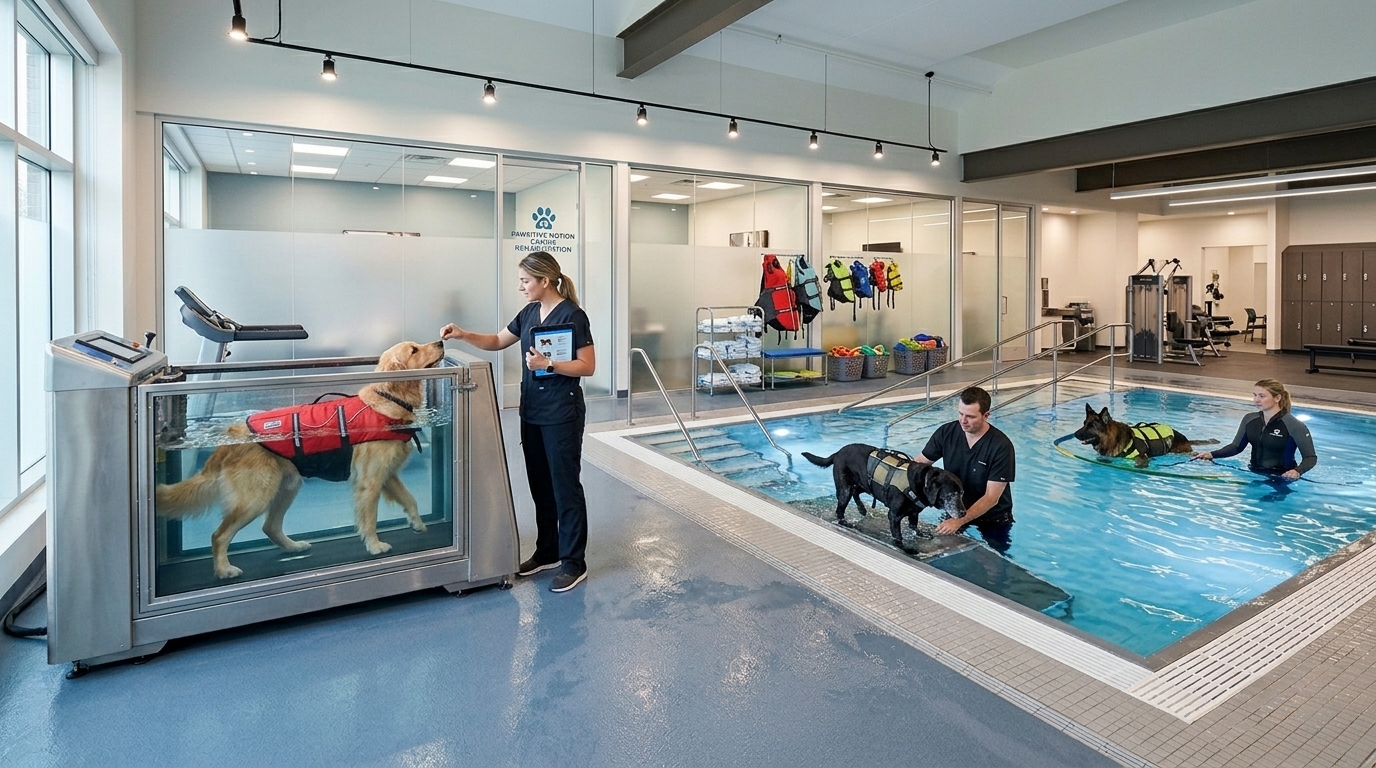
We've covered hydrotherapy in detail in its own dedicated article. In short: hydrotherapy is one of the most evidence-supported complementary interventions for canine arthritis, offering controlled exercise with reduced joint loading through either a pool or an underwater treadmill.
For care team purposes, hydrotherapy practitioners are:
Qualified hydrotherapists with a minimum Level 3 Certificate in Canine Hydrotherapy, ideally with additional Level 4 qualification for underwater treadmill work.
Members of professional bodies including CHA (Canine Hydrotherapy Association), NARCH (National Association of Registered Canine Hydrotherapists), or ICH (Institute of Canine Hydrotherapists).
Often combined with physiotherapy at rehabilitation centres that offer integrated care.
The PetCare Atlas catalogues roughly 412 hydrotherapy providers across the UK, including hydrotherapists, hydrotherapy centres and rehabilitation centres.
How they fit with the rest of the team
Hydrotherapy slots in well alongside other team members. Sessions usually run weekly or fortnightly during active rehabilitation, monthly for maintenance. Reports back to the primary vet keep progress documented. Combined with veterinary physiotherapy, often at the same centre, you get comprehensive movement-focused care.
For cats, dedicated feline hydrotherapy is rare. Most centres work exclusively with dogs. A few progressive centres are exploring cat-specific hydrotherapy, but it remains a niche service.
The veterinary acupuncturist
Acupuncture has become one of the most valuable additions to the chronic pain care team. The mechanisms are well characterised, and the response rate in arthritic dogs is around 80%. We covered this in detail in our complementary therapies overview.
For care team purposes, acupuncture practitioners must be:
Veterinary surgeons with specific acupuncture training. UK law restricts veterinary acupuncture to qualified veterinarians.
Members of ABVA (Association of British Veterinary Acupuncturists) or holders of equivalent qualifications.
The ABVA directory at abva.co.uk lists qualified members across the UK.
When they matter
Acupuncture is particularly valuable for:
- Dogs whose pain isn't fully controlled by standard medications
- Dogs unable to take NSAIDs (kidney disease, GI sensitivity)
- Dogs with central sensitisation features (chronic pain that's become entrenched)
- Multi-joint or spinal involvement
- Older dogs with concurrent conditions that complicate medication choices
Coordination
Veterinary acupuncturists usually work hand in hand with primary vets. They talk through treatment plans, medication adjustments and progress together. Some primary vets practise acupuncture themselves, which simplifies coordination considerably.
For cats, veterinary acupuncture is offered by some practitioners and increasingly recognised as useful for chronic pain. The handling considerations differ (cats need particularly gentle technique), and some acupuncture practitioners specialise in feline patients.
Manual therapy practitioners: massage, chiropractic, osteopathy
The PetCare Atlas catalogues roughly 624 manual therapy practitioners across the UK, including massage therapists, chiropractors, osteopaths and acupuncturists. This is a category where I want to be straight with you about a divergence between PetCare Atlas (which lists what's available) and PetsLikeMine's editorial stance (which weighs evidence quality).
The Atlas is a comprehensive directory of which UK practitioners exist and are accredited. PetsLikeMine's role is to give evidence-weighted guidance about which interventions are most worth your time and money.
Therapeutic massage
Massage is the manual therapy with the most plausible mechanism and the least controversy. Therapeutic massage can ease secondary muscle tension and compensation, common in arthritic dogs, supports circulation, and gives the kind of positive physical contact that many dogs enjoy.
The evidence base for therapeutic massage as a standalone arthritis intervention is weaker than for hydrotherapy, physiotherapy or acupuncture, but the safety is excellent and many dogs benefit visibly.
UK costs: £35-65 per session typically. Look for practitioners certified by the Canine Massage Therapy Centre, the Canine Massage Guild, or a similar recognised body.
Chiropractic and osteopathy
These are more contested. The evidence base in canine arthritis specifically is weak. The risks are real if the treatment is performed by an unqualified practitioner. Many of the benefits people credit to these therapies (improved range of motion, reduced muscle tension, pain relief) can be reached through safer, better-evidenced modalities like physiotherapy or acupuncture.
That said, some dogs do seem to respond well to chiropractic or osteopathic treatment, and for owners with access to a genuinely qualified practitioner working alongside veterinary care, it can have a place.
If you're considering these modalities, the practical guidance is:
- Use practitioners with recognised qualifications (McTimoney, the Royal College of Chiropractors animal certification, registered osteopaths with animal training)
- Insist on veterinary diagnosis before treatment begins
- The practitioner should communicate with your primary vet
- Steer clear of practitioners making strong claims about treating systemic disease through manipulation
My frank editorial position: I wouldn't make chiropractic or osteopathy the centrepiece of arthritis management for most dogs. The evidence-based pathway (medication, weight, exercise, environmental modification, hydrotherapy, physiotherapy, acupuncture) generally serves dogs better. But if you have access to a well-qualified practitioner and your dog clearly responds, it can be a reasonable adjunct.
The pet nutritionist
For dogs whose weight management isn't progressing despite real owner effort and standard veterinary support, a pet nutritionist can add genuine value. Qualified pet nutritionists build tailored feeding plans around the individual dog's situation, calorie requirements, body condition goals and any concurrent conditions.
In the UK, qualified pet nutritionists are uncommon (the PetCare Atlas lists around 78), partly because the qualification standards are still evolving. Look for:
- BSc or MSc in animal nutrition
- Veterinary nutrition certifications (residency-trained veterinary nutritionists are the gold standard but rare)
- Working with veterinary input rather than in isolation
- An evidence-based approach rather than a fashion-driven one (raw versus kibble crusades often signal a less rigorous practitioner)
For most arthritic dogs, the standard approach (calculating calorie needs, using therapeutic joint diets, working with the primary vet on weight management) is enough without specialist nutrition input. Where weight loss has stalled despite genuine effort, or where complex multi-condition feeding plans are needed, specialist input adds value.
End-of-life care providers
For dogs whose arthritis progression eventually feeds into end-of-life decisions, dedicated end-of-life care services have grown a great deal in recent years. These services include:
Home euthanasia services. Veterinary professionals who provide euthanasia at home in familiar surroundings rather than at the clinic. For arthritic dogs whose travel is difficult and stressful, this is often the kinder option. UK costs typically £200-400 plus aftercare costs.
Hospice and palliative care services. Dedicated services focused on comfort and quality of life in the final stages of chronic disease.
Quality of life assessment services. Professional input on quality of life evaluation when decisions are being weighed.
The PetCare Atlas catalogues end-of-life service providers across the UK. We have a dedicated article on the quality of life conversation in our Stage 6 cluster.
How the team coordinates

A common worry about building a care team is communication. How do all these practitioners stay informed about each other's input? Who's coordinating? How do you stop your dog being managed by separate practitioners all working in their own silo?
The primary vet as coordinator
Most well-functioning care teams keep the primary vet at the centre as coordinator. Specialists, physiotherapists, hydrotherapists and others communicate with the primary vet through reports and letters. The primary vet holds the overall view of the case and adjusts the management plan accordingly.
This works best when:
- All practitioners agree on the coordinator role
- Communication is timely (reports within 2 weeks of appointments)
- The primary vet has the capacity to integrate the information
- The owner helps by making sure their primary vet actually receives the reports
When you need to coordinate yourself
Sometimes the formal coordination doesn't run as smoothly as it should. Reports get delayed. Information falls through gaps. The primary vet doesn't always have time to actively integrate input from several sources.
When that happens, the owner becomes the practical coordinator. In practice that means:
- Keeping copies of all reports and bringing them to each appointment
- Telling each practitioner what the others are doing
- Asking each practitioner whether they need information from another
- Following up when reports haven't arrived
- Being the consistent thread that holds the picture together
It isn't ideal, but it's often realistic. A well-organised owner with a folder of reports and a clear grasp of their dog's overall management plan is sometimes the best coordinator the team has.
The PetsLikeMine pet card
For platform members, the pet profile within PetsLikeMine helps pull this picture together. Treatment history, current medications, care team contacts, recent observations and shared discussions all live in one place you can refer to across practitioners. That's particularly handy when you're seeing several team members at different times.
Second opinions and changing vets
Sometimes the care team you have isn't the team you need. Two specific situations come up.
When a second opinion is appropriate
Second opinions are reasonable in plenty of situations:
- Major surgical decisions
- Significant cost decisions
- Cases where the clinical picture seems borderline
- Diagnosis uncertainty
- Treatment not producing the expected response
- When you felt rushed in the original consultation
Reputable veterinary professionals welcome second opinions. If your vet seems threatened by the suggestion, that's information worth noting.
How to seek a second opinion:
- Ask your primary vet to refer you specifically for a second opinion (most will support this)
- Request that records and imaging are forwarded to the second opinion provider
- Bring your own notes about what you've observed
- Stay open to either confirmation of the original plan or a different recommendation
Two professional opinions in agreement give you more confidence. Two professional opinions in disagreement tell you which approach is more contested and worth thinking about further.
When to change vets
Sometimes the primary vet relationship isn't working. That can happen for all sorts of reasons:
- Communication has broken down
- The vet seems too rushed for chronic disease management
- You don't feel your concerns are being heard
- Clinical approaches don't match what you're learning elsewhere
- The practice has changed (different ownership, staff turnover, service quality)
Changing vets is a significant step, but sometimes the right one. Practical considerations:
Start by trying a different vet in the same practice. If your concern is about a specific clinician rather than the practice as a whole, this often solves it with less disruption.
Talk to the practice manager. Practice management can sometimes address specific issues you've identified.
Work out whether the issue is the practice or the specialty. Some general practices struggle with complex chronic disease cases. Referral to a specialist may be the answer rather than changing the primary vet.
If you decide to change practices, request that your records be transferred. This is your right, though there may be a small administrative fee. The new practice handles much of the practical work of obtaining records.
Don't burn bridges. Even when changing practices, courteous communication serves you better than expressed grievance. You may need to return for emergencies; veterinary networks are smaller than you might think.
Changing vets isn't a failure on anyone's part. Sometimes the fit just isn't right for the long-term partnership that chronic disease asks for.
The PetCare Atlas

The PetCare Atlas is a comprehensive UK directory of veterinary and allied pet care providers, available at petcareatlas.co.uk. Here is how to use it as part of building your team.
The Atlas catalogues:
- 5,700+ vet practices
- 247 referral hospitals and specialist practices
- 1,583 RCVS specialists and advanced practitioners
- 1,047 veterinary physiotherapists (ACPAT, IRVAP, NAVP accredited)
- 412 hydrotherapy providers (CHA, NARCH, ICH accredited)
- 624 manual therapy practitioners (massage, chiropractic, osteopathy, acupuncture)
- 218 clinical animal behaviourists
- 1,432 dog trainers
- 78 pet nutritionists
- 53 end-of-life care services
Total: over 12,000 UK pet care providers, structured and updated weekly.
Two ways to navigate
The Atlas offers two main lenses:
Grid view. Every provider catalogued, filterable by type, accreditation and geography. Useful when you know what kind of practitioner you're after and want to find one near you.
Map view. A geographic picture of provider density and specialisation across the UK. Useful for understanding what's available in your area, or when planning travel for specialist appointments.
Three entry points
You can also come at the Atlas three ways, depending on what you're starting with:
By symptom. If you've noticed something specific (limping, drinking more, a lump, a behaviour change, coughing), the Atlas can steer you to the right care pathway. Useful when you're not sure what kind of practitioner you need.
By pathway. If you're managing a known condition, the Atlas's care pathways lay out the typical journey across multiple practitioners. The musculoskeletal pathway (relevant for arthritis) maps the route through GP vet, specialist referral, physiotherapy, hydrotherapy, chiropractic/osteopathy and ongoing maintenance.
By practitioner type. If you know exactly what kind of help you need (a hydrotherapist within 30 miles, an orthopaedic specialist for a second opinion, an ABVA-registered acupuncturist), filter straight to it.
Why this matters
The basic problem in chronic disease management is that the right care isn't all in one place. Your primary vet may not know which hydrotherapy centre 20 miles away has Level 4 underwater treadmill qualification. Your physiotherapist may not know which orthopaedic specialist takes your insurance. The information that joins these pieces up lives across multiple registers, websites, professional bodies and informal recommendations.
The Atlas brings it together. For complex chronic disease management, having one structured map of UK pet care provision is a meaningful resource. We use it ourselves in clinical practice when making referrals, and we'd encourage you to use it for building your dog's care team.
A typical arthritis journey across the team
Here's what a real care team can look like over the years of an arthritic dog's life.
Year one of diagnosis. Primary vet manages diagnosis, starts NSAIDs, agrees a weight management plan. Refers to a hydrotherapist for initial assessment and weekly sessions. Owner does home physiotherapy and environmental modification independently. Total care team: 2 active practitioners.
Year two. Pain control needs strengthening. Primary vet adds acupuncture to the plan, referring to an ABVA-qualified veterinary acupuncturist for monthly sessions. Hydrotherapy drops to fortnightly maintenance. Total care team: 3 active practitioners.
Year three. Acute deterioration. Primary vet refers to an orthopaedic specialist for assessment. The specialist confirms progression but recommends conservative management given the dog's age. Care returns to the primary vet with an adjusted medication regime. A veterinary physiotherapist joins for soft tissue work. Total care team: 4 active practitioners.
Year four and beyond. Stable management. Primary vet for routine reviews and medication adjustments, hydrotherapist for maintenance sessions, acupuncturist for periodic treatment, physiotherapist as needed for flares. The team has settled.
End-of-life stage. Quality of life conversations. The decision is made for home euthanasia, given the dog's mobility difficulties. A local home euthanasia service is contacted through Atlas listings. Primary vet, hydrotherapist and acupuncturist are all informed and able to support the family through the transition.
That's what good chronic disease care looks like over years. Not five practitioners at once from day one, but a thoughtfully built team that grows and adjusts as needs change.
Practical first steps
If you're a new arthritis owner thinking about your care team:
-
Make sure your primary vet relationship is solid. Continuity, communication, capacity for chronic disease care. If it isn't there, think about addressing this first.
-
Consider hydrotherapy referral within the first 3-6 months. Most arthritic dogs benefit, and adding this practitioner early sets the team mentality in place.
-
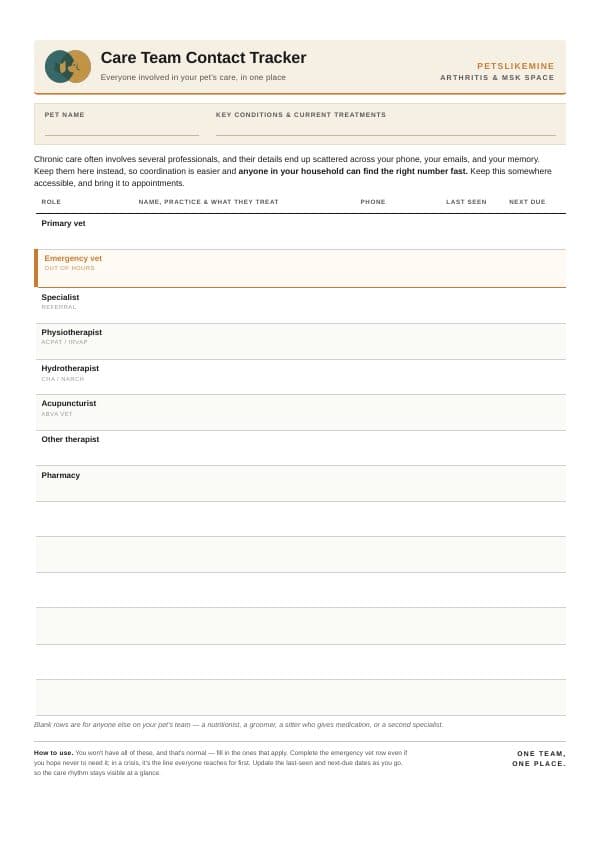
Keep a record of practitioner contacts. Names, addresses, phone numbers, what each has done. Our care team tracker is a printable one-pager built for exactly this.
-
Bookmark the PetCare Atlas. You'll likely need it as the journey develops.
-
Build the team gradually. You don't need every practitioner from day one. Add them as needs emerge.
-
Keep the coordination going. Whether your primary vet does it actively or you do it practically, someone needs to hold the picture together.
A final thought
The owners whose arthritic dogs do best over many years aren't the ones with the most expensive care or the most famous specialists. They're the ones who've built a thoughtful team of practitioners around their dog, with good communication, mutual respect and a clear sense of who does what.
Your primary vet is the foundation. Beyond them, the team grows organically as needs emerge. The hydrotherapist who knows your dog's normal water tolerance. The physiotherapist who notices small changes month to month. The acupuncturist who's been treating them for three years. The orthopaedic specialist there when bigger decisions arise.
This is what professional chronic disease care looks like. It's collaborative rather than centralised, distributed rather than concentrated, and built around the individual animal rather than the particular practitioner.
Your arthritic dog deserves the benefit of that kind of team approach. With deliberate effort, supported by tools like PetCare Atlas to find the right practitioners, you can build it.
Free downloads
Companion worksheets to put what you've read into practice. Free PDFs, print at home.
Sister tool · Sightline
Track whether treatment is working
Sightline, a separate ConciergeVet tool, runs a short weekly check-in built on validated pain and mobility instruments, turns it into a single Sightline Score you can watch trend over weeks rather than judge on one bad day, and produces a report you can bring to your vet.
A written log, or our printable trackers, does much the same job.
See how Sightline tracks treatmentSee where your pet stands today
Tracking is the other half of managing arthritis. Take the 2-minute Mobility Check to see your pet's stage, then watch it shift as treatment takes effect.
Take the Mobility CheckYou're not doing this alone
Compare treatment journeys and talk to owners managing arthritis. Free to join.
Join PetsLikeMine