

Beyond Medication: Physiotherapy, Laser and Acupuncture for Cats
Alastair Greenway
BVM&S MRCVS
Medication is the backbone of feline arthritis care, but it is not the whole story. Physiotherapy, laser, acupuncture and gentle home movement all get asked about. Here is a clear, evidence-weighted look at what actually helps a cat, what the dog playbook gets wrong for cats, and why surgery is rarely the answer.
This is an area where it is easy to be sold things. The non-drug therapies for feline arthritis range from genuinely useful to barely evidenced, and the plain truth is that the evidence base in cats specifically is thin for most of them. That does not mean none of them help. It means you should approach them with realistic expectations, a willingness to trial and to drop what does not earn its place, and a healthy scepticism toward anyone promising dramatic results.
Start with medication and the basics
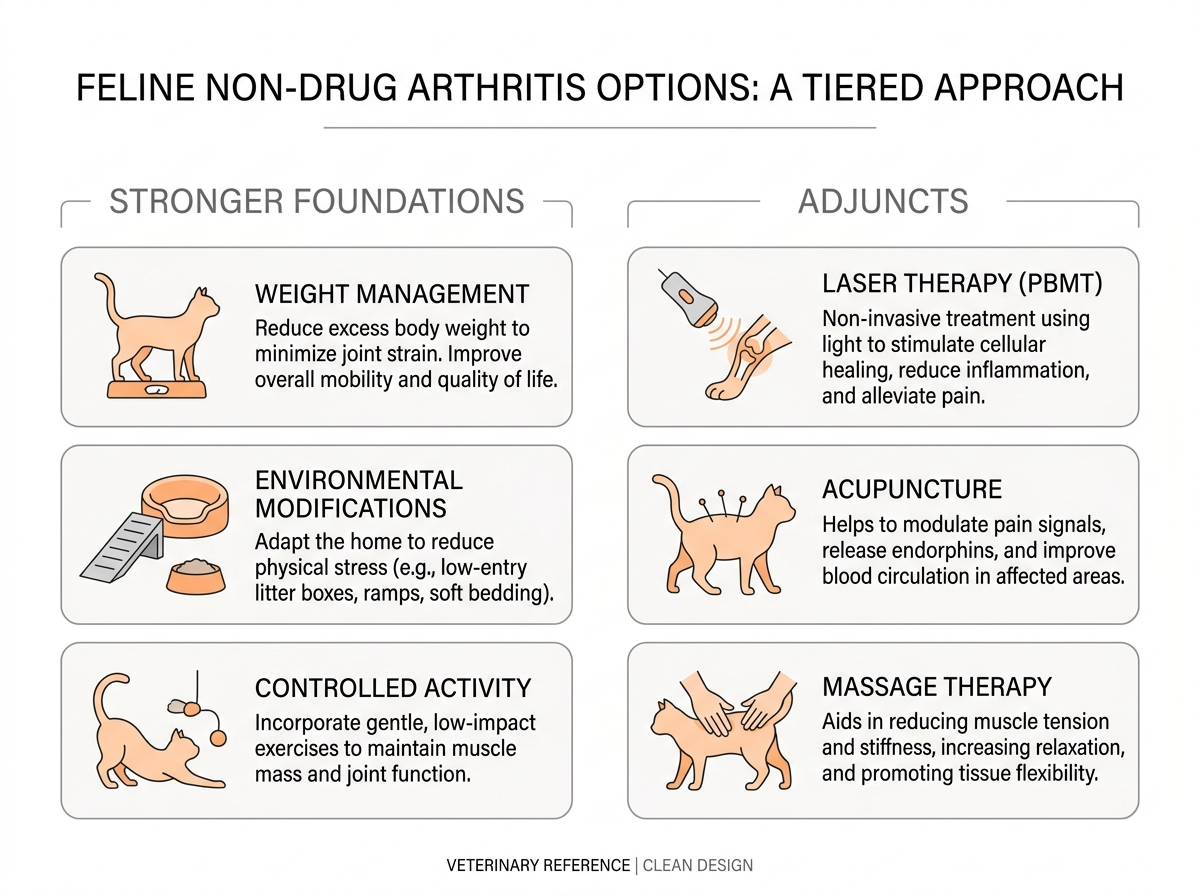
Everything in this article is an adjunct. These therapies sit on top of good pain control, a healthy weight, and a well-adapted home; they do not replace them. If a cat's pain relief is not yet right, or they are overweight, or the home is full of obstacles, those are the things to fix first, because they do far more than any add-on therapy.
So please read what follows as the extras worth considering once the foundations are solid, not as alternatives to medication. A cat whose pain is well managed, who is lean, and whose world is easy to navigate has the basics covered. The therapies below are about what, if anything, to add.
Where the dog playbook does not transfer
If you have read about arthritis in dogs, or have a dog as well, you will have encountered hydrotherapy, underwater treadmills, structured physiotherapy programmes, all the rehabilitation machinery of canine joint care. It is natural to assume the same applies to cats. Largely, it does not, and the most important example is hydrotherapy.
Hydrotherapy is not a routine tool for feline arthritis the way it is for dogs. It can be used in carefully selected cats in specialist referral settings, for instance after certain surgeries, but most cats simply do not tolerate it. Cats are, as a rule, water-averse, easily stressed by handling and novel environments, and the stress cost of getting a cat into a water treadmill often outweighs any benefit to the joints. So if you have been picturing your arthritic cat doing pool sessions like a Labrador, let that go. It is not the feline path, and you are not failing your cat by not pursuing it.
The general lesson: cats dictate the terms. A therapy that a dog will patiently tolerate may be intolerable, and therefore useless or even harmful, to a cat, because the stress undoes the good. Feline therapy has to be calibrated to feline temperament, not borrowed wholesale from dogs.
Home physiotherapy, cat-style
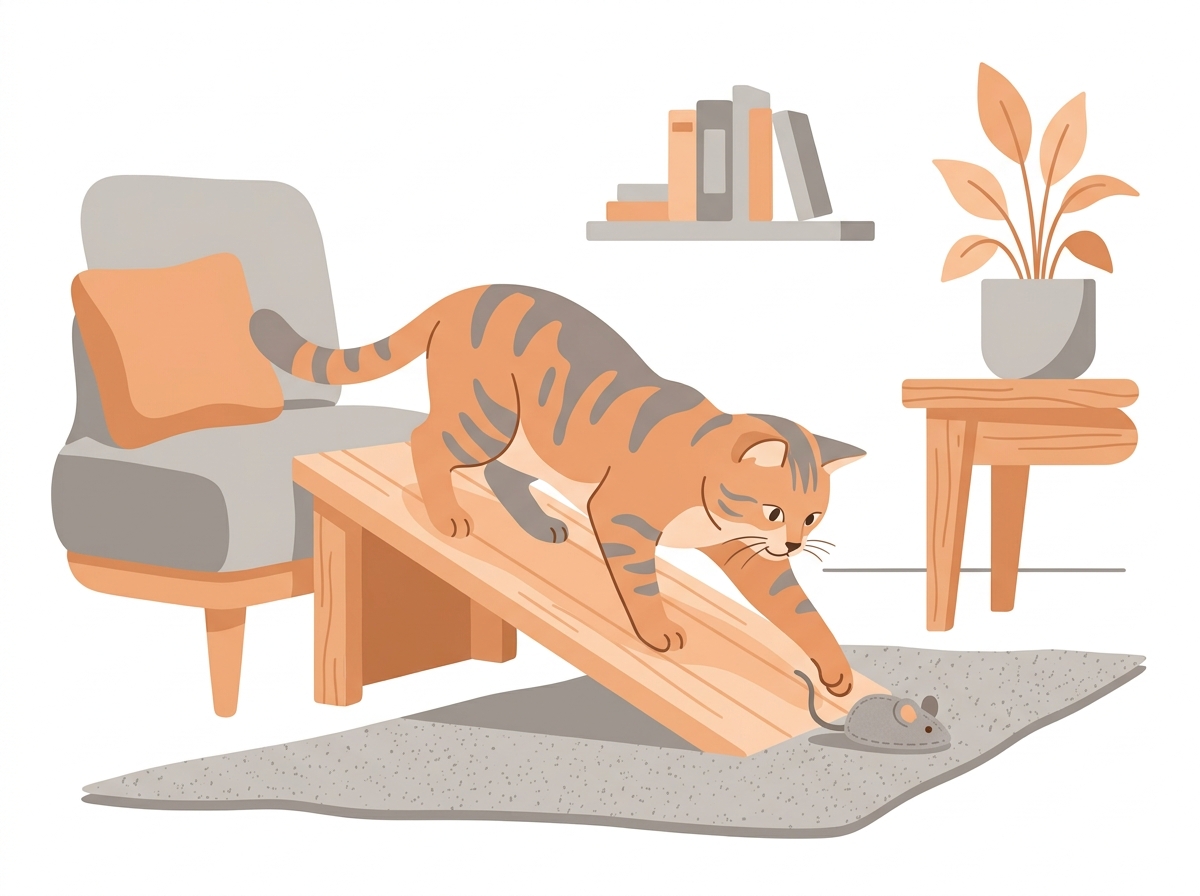
Physiotherapy for cats exists, but it looks very different from the canine version, and the most realistic form of it for most owners happens at home, gently, on the cat's terms.
The single most valuable physiotherapy for an arthritic cat is simply encouraging natural movement: keeping them gently active and mobile through low play and reachable perches, which we cover in our article on keeping an arthritic cat active. Beyond that, some cats will accept gentle passive movement of their joints, where you carefully and slowly move a limb through its comfortable range, but only where the cat genuinely tolerates it, and never forced. Done into resistance or against a struggling cat, it is counterproductive and erodes trust.
If you want to try gentle home movement work, the guidance is simple: keep it slow and brief, do it when the cat is relaxed, stop the moment they object, and treat their tolerance as the limit. A qualified veterinary physiotherapist can show you what is appropriate for your individual cat and whether it is worth doing at all. But the realistic backbone of feline physio for most cats is encouraging them to move naturally, not putting them through exercises.
Laser (photobiomodulation)
Laser therapy, also called photobiomodulation or low-level laser therapy, involves applying particular wavelengths of light to tissues, with the aim of reducing pain and inflammation and supporting healing. It is offered by many practices for arthritis.
Two things to say about it for cats, plainly. First, the evidence specifically in cats is limited and of low certainty; much of what is claimed is extrapolated from other species or from laboratory work rather than proven in feline arthritis trials. Second, and more positively, it is generally well tolerated by cats, being non-invasive and painless, which matters a great deal given how much the stress cost weighs in the feline calculation.
So how should you judge it? As a low-risk, well-tolerated option that may help some cats, tried fairly and kept only if it seems to make a real difference, rather than as a proven therapy worth large sums or high hopes. Be wary of strong promises. The reality is that it is plausible, well tolerated, and not well proven in cats.
Acupuncture
Acupuncture involves placing fine needles at specific points, and is offered for arthritis pain by some veterinary practices, often by vets with additional training in it. Various mechanisms are proposed, including effects on pain signalling and local circulation.
The evidence picture is similar to laser: the feline-specific evidence is modest and uncertain, and much of the support is extrapolated or based on small studies. Tolerance varies; some cats accept it surprisingly well, others will not settle for it, and as with everything feline, a treatment the cat will not tolerate is not a treatment.
The reasonable framing is the same: an adjunct that some cats accept and that may help, worth a properly conducted trial with a suitably qualified practitioner if you are interested, judged on whether your individual cat benefits, and dropped without guilt if they do not tolerate it or it makes no difference.
Other adjuncts owners ask about
A few others come up, and plain speaking is the kindest guide.
Massage and gentle touch can be soothing for cats that enjoy being handled, and there is little to lose in gentle, welcome contact, though you should not expect it to be a major treatment. Therapeutic ultrasound is sometimes mentioned, but it often requires clipping the fur, which many owners decline, and the feline evidence is thin. Joint supplements are a separate topic with their own evidence discussion, which we cover in our supplements article rather than here.
The through-line: for most of these physical adjuncts, the feline-specific evidence is weak or absent, and that is simply where the science currently stands. That does not forbid trying a low-risk, well-tolerated option, but it should keep your expectations and your spending sensible.
Is surgery ever the answer for an arthritic cat?
Owners who know the dog world sometimes ask about surgery, because dogs with arthritis-related conditions often have surgical options. For cats, the answer is usually no, and this is an important expectation to set.
Feline arthritis is overwhelmingly a medical and environmental condition, not a surgical one. Joint replacement, common for dogs' hips, is uncommon in cats, and while a few specific procedures have niche roles in particular cases, they are the exception rather than any kind of routine path. Unlike dogs, where surgery is a major branch of arthritis care, the cat path runs almost entirely through medication, weight, environment, and the gentle adjuncts above. If surgery is ever raised for your cat, it will be a specific, individual recommendation for an unusual situation, not the norm.
Building a realistic non-drug plan
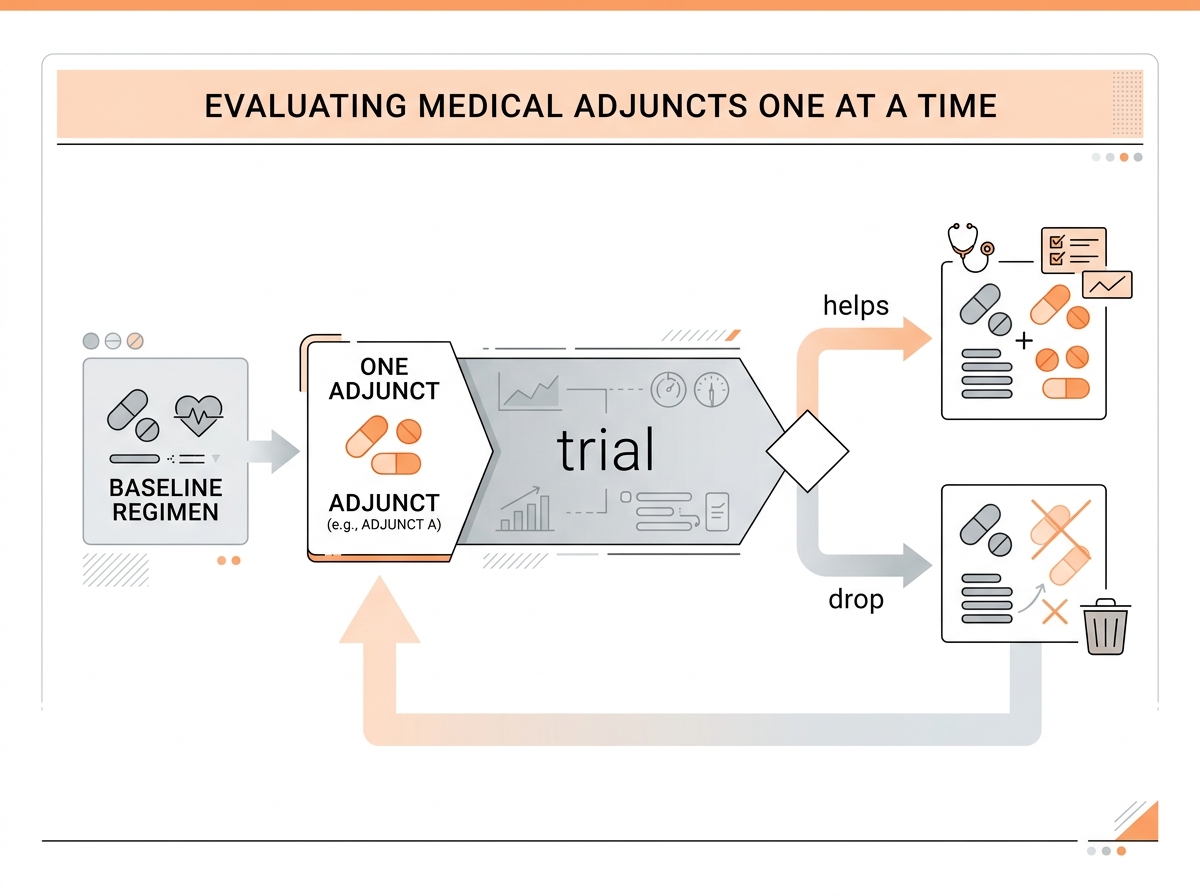
So how do you actually use all this? With a simple, clear-eyed method.
Get the foundations right first: pain control, weight, environment. Then, if you want to add an adjunct, try one thing at a time, so you can actually tell whether it helps, and judge it against a baseline of how your cat was beforehand, ideally using the home tracking we describe in our monitoring article. Give it a fair trial, then weigh it squarely: if it is clearly helping, keep it; if it is making no real difference, or your cat finds it stressful, drop it without guilt. The stress cost is a genuine part of the calculation for cats in a way it is not for most dogs, so a therapy your cat hates is not worth a marginal benefit.
That is the whole approach: foundations first, adjuncts second, one change at a time, judged against a baseline, kept only if they earn their place. Approached that way, the non-drug therapies can add something useful for some cats, without false hope, wasted money, or stress your cat does not need.
References
- Bennett D, Zainal Ariffin SM, Johnston P. Osteoarthritis in the cat: 2. how should it be managed and treated? Journal of Feline Medicine and Surgery, 2012.
- Gruen ME, Lascelles BDX, Colleran E, et al. 2022 AAHA Pain Management Guidelines for Dogs and Cats. Journal of the American Animal Hospital Association, 2022.
- Monteiro BP, Lascelles BDX, et al. 2022 WSAVA guidelines for the recognition, assessment and treatment of pain. Journal of Small Animal Practice, 2023.
- Corral M, Drum MG, et al. Feline rehabilitation. Veterinary Clinics of North America: Small Animal Practice, 2015.
Sister tool · Sightline
Track whether treatment is working
Sightline, a separate ConciergeVet tool, runs a short weekly check-in built on validated pain and mobility instruments, turns it into a single Sightline Score you can watch trend over weeks rather than judge on one bad day, and produces a report you can bring to your vet.
A written log, or our printable trackers, does much the same job.
See how Sightline tracks treatmentSee where your pet stands today
Tracking is the other half of managing arthritis. Take the 2-minute Mobility Check to see your pet's stage, then watch it shift as treatment takes effect.
Take the Mobility CheckYou're not doing this alone
Compare treatment journeys and talk to owners managing arthritis. Free to join.
Join PetsLikeMine