

Arthritis and Kidney Disease: Treating Pain When the Kidneys Are Struggling
Alastair Greenway
BVM&S MRCVS
Chronic kidney disease and arthritis are the two most common conditions of older cats, and they very often arrive together. That combination is the single hardest balancing act in feline pain management, because the safest painkillers for the joints are the ones the kidneys like least. Here is how vets weigh that trade-off, and what it means for your cat.
If your cat has both arthritis and kidney disease, you may have been left with the impression that you have to choose between treating the pain and protecting the kidneys, and that choosing to treat the pain means doing your cat harm. That fear is understandable, and it leads a lot of owners to leave their cats in pain unnecessarily. The reality is more hopeful and more nuanced than that, and the aim here is to replace fear-driven undertreatment with an informed plan, made with your own vet, who has your cat's bloods in front of them. This article informs that conversation. It does not replace it, and nothing here is a reason to start, stop, or change a medication on your own.
Why these two conditions travel together
Both arthritis and chronic kidney disease, or CKD, are diseases of the older cat, and both are extremely common. Chronic kidney disease affects a large proportion of senior cats, with prevalence rising steeply with age, and degenerative joint disease is now understood to be present in the majority of older cats too. It is no surprise, then, that the two frequently coexist; a significant share of cats with kidney disease also have arthritis, and vice versa.
There is also a possible link beyond mere coincidence of age. A cat in joint pain moves less, and may drink less and become mildly dehydrated, which is exactly the kind of thing that can nudge struggling kidneys in the wrong direction. The practical upshot is simple: an arthritis diagnosis in an older cat should prompt a look at the kidneys, and a kidney diagnosis should prompt a look for arthritis. Each makes the other more likely, and managing one well can help the other.
Where the two pull against each other
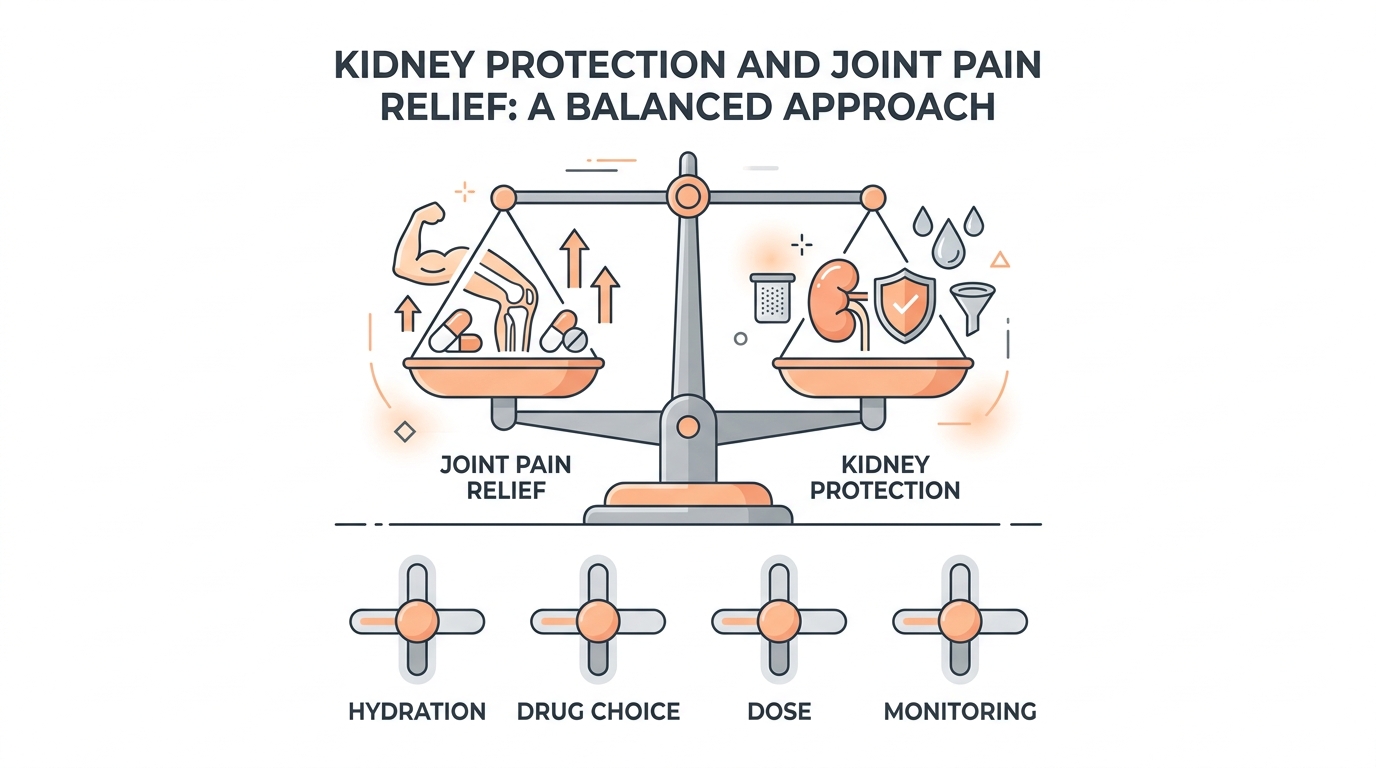
Here is the heart of the problem. Non-steroidal anti-inflammatory drugs, the NSAIDs, are the long-standing workhorse of arthritis pain relief, and in cats the two used for long-term joint pain are meloxicam and robenacoxib. They work by blocking the COX enzymes that drive inflammation. The difficulty is that those same enzymes, and the prostaglandins they produce, also help regulate blood flow through the kidney. In a healthy, well-hydrated cat with good blood pressure, this matters little. But when the kidney is already under strain, prostaglandins become much more important in maintaining its blood supply, and an NSAID can tip the balance.
So the organ that an NSAID can put under pressure is precisely the organ that is already compromised in a cat with CKD. That is the genuine tension, and it is why NSAIDs in kidney-compromised cats were, for a long time, treated with great caution or avoided altogether.
I am not going to pretend that tension away. But the modern understanding of it is considerably more nuanced than the old blanket rule, and that nuance is good news for cats in pain.
What changed: NSAIDs are no longer simply banned in kidney cats
For years, the working assumption was that NSAIDs and kidney disease simply did not mix, and that any cat with CKD should not have them. That position has shifted, and the shift is based on real evidence.
Several studies have now looked specifically at long-term NSAID use in older cats, including cats with stable kidney disease. The picture that has emerged, and which is reflected in the international consensus guidelines on long-term NSAID use in cats, is that meloxicam or robenacoxib can be used in cats with stable, well-managed early-stage CKD, at the lowest effective dose, as part of a broader pain-management plan, with proper monitoring. One body of work followed cats given a low maintenance dose of meloxicam over many months and found no greater progression of kidney disease in the treated cats than in matched untreated ones.
Two words in that sentence are carrying enormous weight, and they are the whole point: stable and monitored. The evidence supports cautious use in cats whose kidney disease is stable and whose treatment is being watched with regular bloods and urine tests. It does not support reaching for an NSAID in a cat whose kidneys are unstable, who is dehydrated, or who is not being monitored, and it is emphatically not a green light for an owner to medicate a kidney cat without veterinary direction. The newer guidance has also drawn attention to watching the urine for protein, not just the usual kidney values, as part of careful monitoring.
The plain summary is this: the door that was once closed is now open a careful crack, for the right cat, with the right oversight. That is a meaningful change, because it means a stable kidney cat in joint pain no longer has to simply suffer.
Why your vet talks about IRIS staging
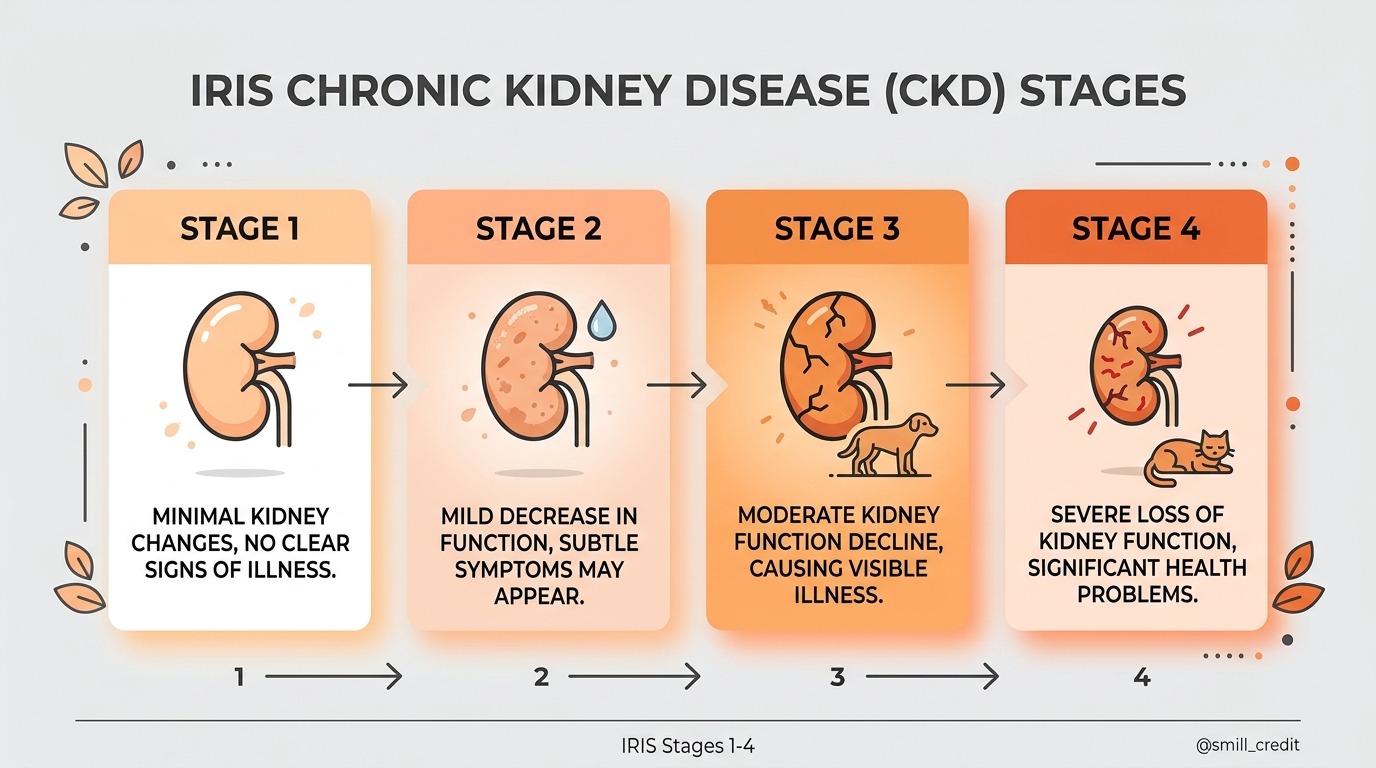
When vets discuss kidney disease, they often refer to its stage, using a system from the International Renal Interest Society, or IRIS. In plain terms, CKD is graded from stage 1 (earliest, mildest) through to stage 4 (most advanced), based mainly on blood markers of kidney function, with further sub-staging for blood pressure and protein in the urine.
The stage matters because it changes the risk calculation. The evidence for cautious NSAID use is strongest in cats with stable early-stage disease, stages 1 and 2; cats in the more advanced stages 3 and 4 have generally not been part of the reassuring studies, and the calculus there is different and more cautious. But, and this is the important nuance, the stage label alone is not the whole story. What tends to tip the balance toward harm is instability, dehydration, and low blood pressure, rather than simply the existence of a diagnosis. A stable stage 2 cat and an unstable, dehydrated stage 2 cat are very different propositions, even though they carry the same label. Your vet is weighing the whole picture, not just the number.
A toolbox that goes easier on the kidneys
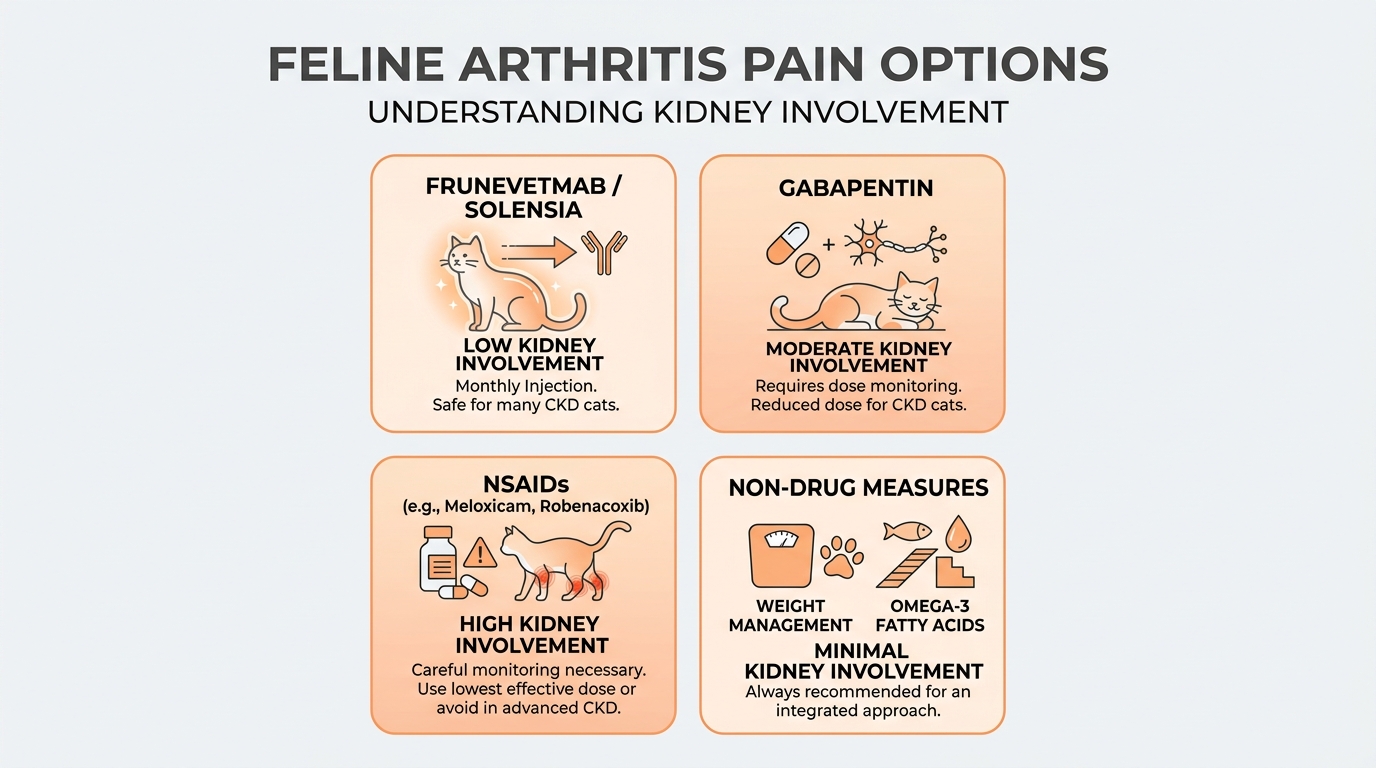
The genuinely encouraging part of all this is that NSAIDs are no longer the only meaningful option for joint pain in cats. The toolbox has grown, and several of the tools sidestep the kidney problem to varying degrees.
Frunevetmab (Solensia) is the option that has changed this conversation most. It is a monthly injection, a cat-specific monoclonal antibody that mops up nerve growth factor, the messenger that drives much of arthritis pain. Crucially, because it is a biological protein cleared by the body the way other proteins are, it does not depend on the kidneys the way NSAIDs do, which makes it a logical first-choice option when kidney function is a concern. It is not, however, completely without a kidney footprint to keep an eye on: the field studies, conducted largely in older cats, included some with kidney values that shifted during treatment, so it still requires the standard pre-treatment work-up and ongoing monitoring like any other option. We cover how it works in detail in our Solensia article; the point here is simply that, for a kidney cat, it is often where the conversation now starts.
Gabapentin is widely used in cats for chronic and nerve-related pain, and it can be valuable as part of the plan. The kidney-relevant fact is that it is cleared by the kidneys, so in a cat with CKD the dose usually needs reducing or the interval extending; given sensibly with that adjustment, it is used very commonly. The main thing to expect is some sedation, particularly early on.
Amantadine and buprenorphine have their places too, as adjuncts within a combination rather than standalone solutions, and where they fit is a matter for your vet's judgement in the individual cat.
Non-drug load reduction is the quiet foundation under all of this, and it matters even more when the drug options are constrained. Keeping the cat lean takes load off the joints; a warm, easy, well-arranged home reduces the demands on a stiff body; and omega-3 fatty acids have a place in joint support. One important caution on diet, which deserves its own section.
When the food bowl pulls two ways
Cats with both conditions run into a genuine dilemma at the food bowl. There are therapeutic diets formulated for kidney disease, which are typically lower in phosphorus and protein, and there are therapeutic diets formulated for joint health, which are often enriched with higher levels of omega-3 fatty acids and other joint-supporting ingredients. These two aims can pull in different directions, and you usually cannot fully serve both with a single bowl of food.
When the two collide, the kidney diet generally takes priority, because dietary management is one of the most powerful levers in slowing kidney disease, more powerful than the dietary contribution to joint health. That does not mean the joints are abandoned. Joint support can still be provided in kidney-friendly ways, for example through carefully chosen omega-3 supplementation that does not bring a high phosphorus load, discussed with your vet so the renal goals are not undermined. The key is that this is a balance struck deliberately with your vet, not a guess made at the pet-shop shelf.
Monitoring is what makes it all possible
Everything above rests on one foundation: monitoring. Cautious NSAID use in a kidney cat is only reasonable because it is watched, and the watching is what keeps it safe.
In practice, that means baseline blood and urine tests before starting or changing treatment, and regular checks afterwards, looking at kidney values, protein in the urine, blood pressure, hydration, weight, and appetite. Your vet will set a schedule of "let's check before we continue" points, more frequent at first and when anything changes. Your part in this matters enormously: you are the one watching the cat day to day, and changes in drinking, appetite, weight, energy, or litter-tray habits are exactly the early signals that should prompt a call. Home monitoring and clinic monitoring work together, and we cover the home side in detail in our article on monitoring your cat at home.
If at any point the kidneys show signs of strain, the plan is adjusted, the dose lowered, the drug changed, or the approach rethought. That responsiveness is the whole safety mechanism. It is why this cannot be a fixed prescription handed over once and forgotten, and why it cannot be done without the vet who holds the test results.
Two cats, two answers
To show how this works in practice, picture two cats whose owners ask the same question, "can my arthritic cat have something for the pain?"
The first is a stable cat with early, IRIS stage 2 kidney disease, well hydrated, eating well, a steady weight, kidney values that have held constant for months, and no other complications. For this cat, the modern answer is encouraging: there are several reasonable options. Frunevetmab is a logical place to start given the kidneys; a carefully monitored low dose of an appropriate NSAID may also be on the table; gabapentin can be added with a dose adjustment; and the whole plan sits on lean body weight, a comfortable home, and regular checks. This cat does not have to live in pain.
The second cat is also stage 2 by label, but is unstable, recently dehydrated, has lost weight, and has kidney values that have been creeping upward. Here the same question gets a more cautious answer. The priority is first to stabilise the kidneys and the hydration; an NSAID would carry more risk in this less stable state; the kidney-independent options and the non-drug measures move to the front; and any pharmacological pain relief is approached more carefully and monitored more closely. The label is the same, but the cat is different, and so is the answer.
That contrast is the real lesson. There is no single rule that covers every kidney cat with arthritis. There is a careful, individual judgement, made by your vet with your cat's actual results in hand, and revisited as things change. What there no longer is, thankfully, is a blanket rule that a kidney cat must simply endure joint pain. For the right cat, well managed and well monitored, comfort and kidney protection are not the impossible choice they once seemed.
If your cat has both conditions, the most useful thing you can do is have exactly this conversation with your vet: what stage is the kidney disease, how stable is it, which pain options suit this cat, and what monitoring will keep it safe. Go in informed, ask those questions, and you and your vet can usually find a way to keep your cat both comfortable and protected.
References
- Taylor S, et al. 2024 ISFM and AAFP consensus guidelines on the long-term use of NSAIDs in cats. Journal of Feline Medicine and Surgery, 2024.
- Sparkes AH, Heiene R, Lascelles BDX, et al. ISFM and AAFP consensus guidelines: long-term use of NSAIDs in cats. Journal of Feline Medicine and Surgery, 2010.
- Monteiro BP, Steagall PV. Chronic pain in cats: recent advances in clinical assessment. Journal of Feline Medicine and Surgery, 2019.
- Gruen ME, Lascelles BDX, Colleran E, et al. 2022 AAHA Pain Management Guidelines for Dogs and Cats. Journal of the American Animal Hospital Association, 2022.
- International Renal Interest Society (IRIS). IRIS Staging of CKD.
- Gruen ME, Myers JAE, Tena JKS, et al. Frunevetmab for the treatment of degenerative joint disease-associated pain in cats: a multisite pilot field study. Journal of Veterinary Internal Medicine, 2021.
Sister tool · Sightline
Track whether treatment is working
Sightline, a separate ConciergeVet tool, runs a short weekly check-in built on validated pain and mobility instruments, turns it into a single Sightline Score you can watch trend over weeks rather than judge on one bad day, and produces a report you can bring to your vet.
A written log, or our printable trackers, does much the same job.
See how Sightline tracks treatmentSee where your pet stands today
Tracking is the other half of managing arthritis. Take the 2-minute Mobility Check to see your pet's stage, then watch it shift as treatment takes effect.
Take the Mobility CheckYou're not doing this alone
Compare treatment journeys and talk to owners managing arthritis. Free to join.
Join PetsLikeMine