

Which Breeds Get Chronic Hepatitis, and Why It Matters
Alastair Greenway
BVM&S MRCVS
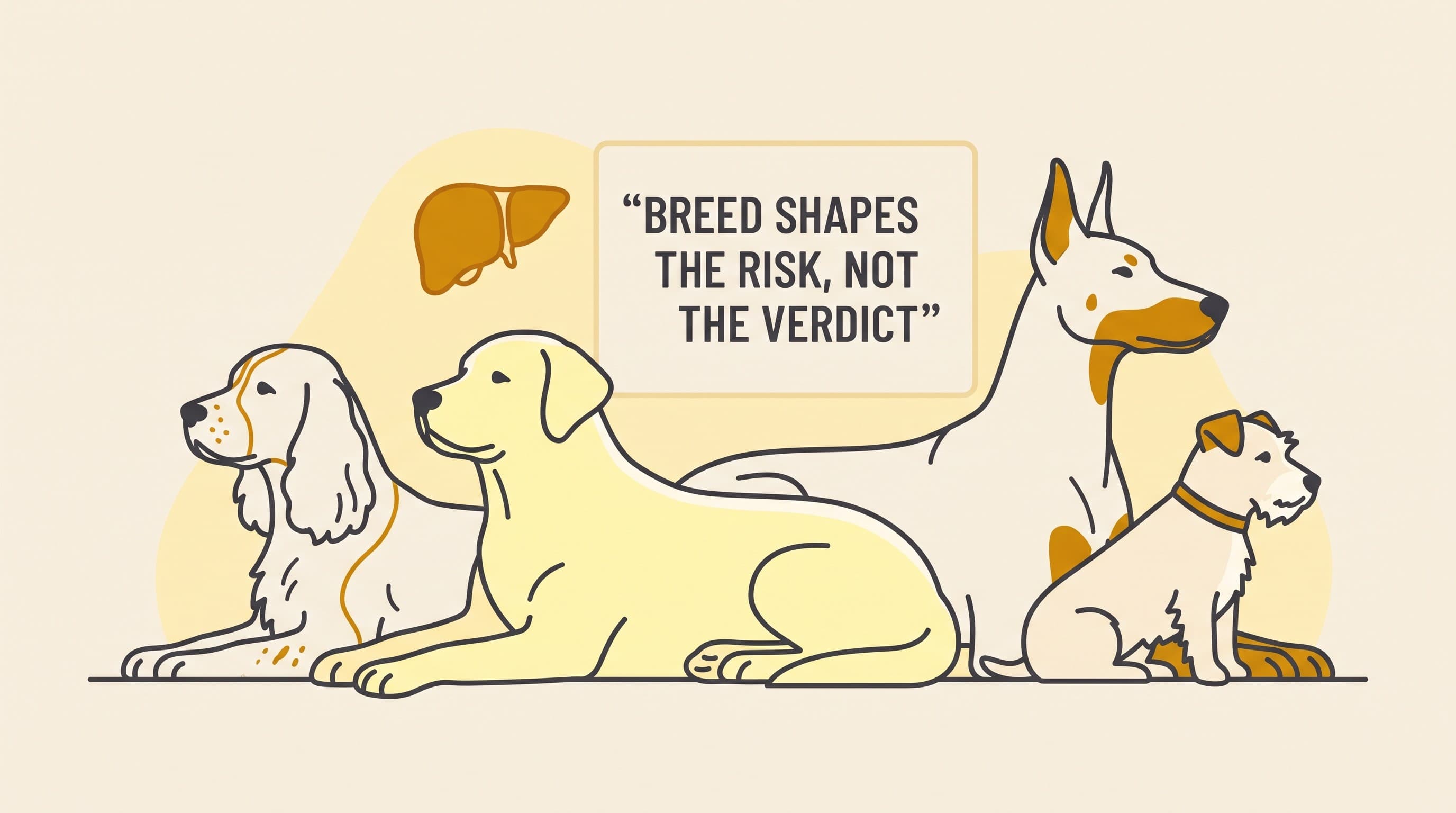
If you own a Springer Spaniel, a Labrador, a Dobermann, a Cocker or a Bedlington Terrier, and someone has mentioned chronic hepatitis, or you have simply gone looking because a routine blood test flagged a liver value, you are asking a sensible question: does my dog's breed put them at risk? The answer is a careful yes for some breeds, and understanding it does real work, because breed changes which disease is most likely, which test your vet should reach for, and, in some cases, what you can do before your dog is ever ill.
Let's be clear about one thing first, so it does not hang over the rest. Owning a predisposed breed does not mean your dog will get chronic hepatitis. It means the odds are higher than average, which is a reason to be informed and to test appropriately, not a reason to assume the worst about a healthy dog. Plenty of Springers and Labradors live long lives with entirely normal livers. What breed gives you is a head start on knowing what to look for and what to ask.
Why breed matters at all
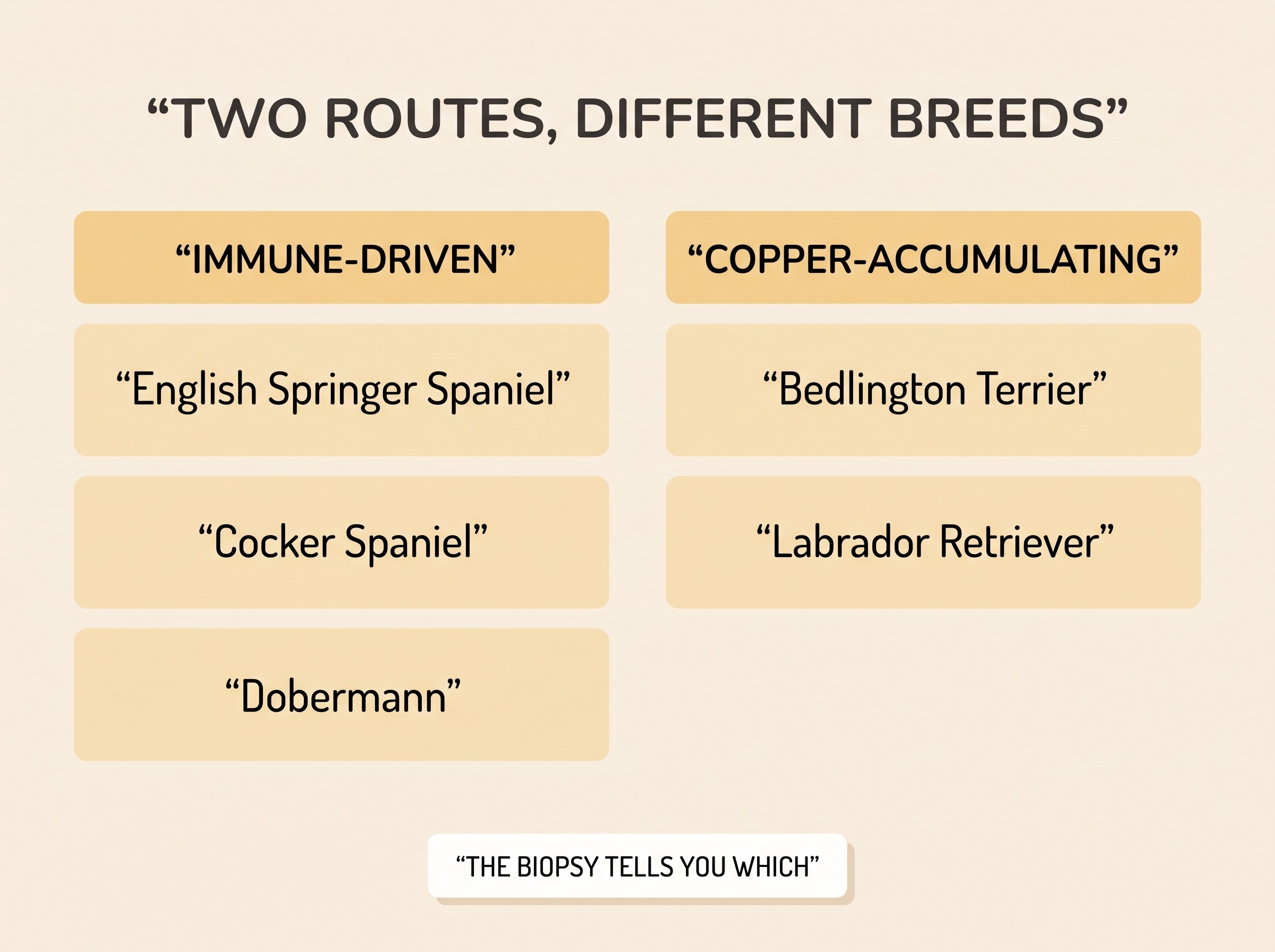
Chronic hepatitis is not one single disease with one single cause. It is a pattern, ongoing liver inflammation leading to scarring, that can be arrived at by different routes. In some dogs the immune system is the driver. In others, copper accumulates in the liver and damages it. Breed is the clue that points towards which route is most likely, because these tendencies are inherited.
That is why breed is not just trivia. If your vet knows they are looking at a breed prone to copper accumulation, they will make sure copper is measured on any biopsy. If they know they are looking at a breed prone to immune-mediated disease, the workup and the eventual treatment lean in a different direction. Getting the route right is the difference between treatment that helps and treatment that either does nothing or does harm. This is also, incidentally, why chronic hepatitis is diagnosed on a biopsy rather than on blood enzymes alone, because the biopsy is what tells you which route your particular dog is on (the chronic hepatitis UK picture piece goes into that in depth).
The immune-driven breeds
For many UK dogs, chronic hepatitis is idiopathic and appears to be immune-mediated, where the dog's own immune system attacks the liver. The clearest and best-studied example is the English Springer Spaniel.
Chronic hepatitis in Springers has been linked to particular DLA haplotypes, which are the canine equivalent of the human immune-system genes (the MHC) that predispose people to autoimmune conditions. In plain terms, some Springers inherit an immune-system configuration that makes their liver more likely to become a target. Springer chronic hepatitis also tends to be recognised in middle-aged dogs and, in some studies, more often in females, though you should treat that as a tendency rather than a rule.
This immune, breed-linked picture is a large part of why the UK story differs from the copper-dominated framing you will read on North American forums. Bexfield's UK work found that copper was not the main driver of most British chronic hepatitis, and the Springer is the emblem of that finding. The Cocker Spaniel, particularly males in some reports, is another breed in which chronic hepatitis is recognised, again with an immune flavour rather than a primarily copper one.
Dobermanns deserve their own mention because their chronic hepatitis has a reputation for being aggressive. It has historically been described more often in middle-aged female Dobermanns, and it can progress before it is obvious, which is exactly the argument for taking any persistent liver enzyme elevation in a Dobermann seriously rather than waiting. There has long been debate about whether copper plays a role in the Dobermann's disease as well, which is a reminder that these categories are not watertight and that measuring copper on the biopsy settles the question for the individual dog.
The copper-accumulating breeds
The other major route into chronic hepatitis is copper, and here breed is even more directly relevant, because in some breeds the tendency to store copper in the liver is a specific inherited trait.
The Bedlington Terrier is the textbook case. Bedlingtons can carry a mutation in a gene called COMMD1 that impairs the liver's ability to excrete copper into the bile, so copper builds up and eventually damages the liver. This is genuinely inherited and there is DNA testing available for it, which is why responsible Bedlington breeding has changed the picture over the years. If you own a Bedlington, this is a concrete, testable thing rather than a vague worry.
The Labrador Retriever is the more common and more clinically important copper-associated breed for most owners, simply because there are so many Labradors. Copper-associated hepatopathy is well recognised in Labradors, and it is one of the breeds most often cited in the discussion about whether dietary copper has been climbing over recent decades. A Labrador with persistent liver enzyme elevation is a dog in whom copper genuinely needs to be on the list and, if a biopsy is done, measured.
Because the copper story is large, contested and often oversimplified in both directions, it has its own dedicated pieces. If your dog is one of these breeds, it is well worth reading the honest account of the dog-food copper debate and the detailed guide to the copper-storage breeds, which covers the Bedlington, Labrador, Dobermann and others in the depth they deserve.
What breed knowledge actually changes for you
Knowing your dog's breed risk is only useful if it changes what you do, so here is how it translates into action.
It changes how seriously you take a raised enzyme. A mildly raised liver enzyme in a well dog is often a "recheck in a few weeks" situation rather than an emergency. But a persistent or rising enzyme in a predisposed breed, a Springer, a Dobermann, a Labrador, a Bedlington, is a stronger reason to work it up properly rather than to keep watching indefinitely. Breed lowers the threshold at which investigation becomes worthwhile.
It changes which test is done. If a biopsy is on the table, breed should prompt your vet to make sure copper is quantified on the sample in a copper-accumulating breed, and to interpret the histology with the breed's typical pattern in mind. It is entirely reasonable to ask, "Given the breed, will you be measuring copper on the biopsy?"
For some breeds, it enables prevention. The Bedlington is the clearest example: DNA testing for the COMMD1 mutation means the disease can be identified, and breeding decisions made, before any dog is ill. That is genuine prevention rather than early detection.
It does not change your dog into a patient. This is worth repeating because breed anxiety is real. A healthy dog of a predisposed breed, with normal blood tests, is a healthy dog. The right response to breed risk is sensible screening as your vet advises, not treating a well animal as though they are ill.
What to watch for, without watching anxiously
Because chronic hepatitis is quiet in its early stages, there is no dramatic symptom to catch it, which is precisely why it is so easy to miss and why breed-aware blood testing does the real work. That said, it is worth knowing the changes that should prompt a vet visit rather than a wait, especially in a predisposed dog. A gradual drop in appetite or energy, weight loss you cannot explain, increased drinking and urinating, or intermittent vomiting are all soft signs that deserve a check. The louder signs, which mean the liver is genuinely struggling and warrant same-day attention, are yellowing of the gums or the whites of the eyes (jaundice), a swelling or fluid build-up in the abdomen, unexplained bruising or bleeding, and any confusion, staring or circling (see the liver red flags piece for the full list).
The point is not to hover over your dog looking for disease. It is that if you own a Springer, a Dobermann, a Labrador or a Bedlington, you keep the routine bloods going and you do not brush off a flagged liver value, because in these breeds the odds that it means something are higher than average. Catching chronic hepatitis before the liver decompensates is what most improves the outlook, and in a predisposed breed you are simply better placed to catch it early.
A sensible plan if you own a predisposed breed
You do not need to do anything dramatic, but a few habits are worth adopting. Keep up with the routine blood tests your vet recommends, and do not dismiss a flagged liver value just because your dog seems fine, particularly in the breeds above. If a liver enzyme is raised and stays raised, take the workup seriously rather than repeatedly re-checking and hoping. If a biopsy happens, ask whether copper is being measured. And keep the results, because in a condition that is all about the trend over time, having your dog's liver values plotted across visits, which the Liver Values Tracker on PetsLikeMine is built to do, turns a scattered history into something you and your vet can actually read.
Breed is a starting point, not a sentence. It tells you where to look and what to ask, and in the best cases it tells you how to act before your dog is ever unwell. The next useful reading, if copper is on your mind because of your dog's breed, is the honest guide to the dog-food copper debate, so that you can separate the genuine science from the online panic.
References
- Webster CRL, Center SA, Cullen JM, et al. ACVIM Consensus Statement on the diagnosis and treatment of chronic hepatitis in dogs. *Journal of Veterinary Internal Medicine* 2019;33(3):1173-1200.
- Bexfield NH. Canine chronic hepatitis: UK breed and signalment study. 2012.
- English Springer Spaniel chronic hepatitis and DLA-haplotype association (Bexfield / Watson / Dyggve et al.).
- Bedlington Terrier copper toxicosis and the COMMD1 gene.
- Labrador Retriever copper-associated hepatopathy.
- Dobermann chronic hepatitis signalment and copper debate.
Keep track of how your pet is doing
The owners who cope best are the ones who notice changes early. A simple health log shows you what is working, and what is not, before the next vet visit.
Start tracking, freeYou're not doing this alone
Compare treatment journeys and talk to owners managing liver & gallbladder. Free to join.
Join PetsLikeMine