

What should my pet actually weigh? Finding the ideal
Alastair Greenway
BVM&S MRCVS
"What should she weigh?" isn't a number off a chart
So your pet is carrying a bit too much, whether you've worked that out yourself or your vet has told you. The very next question is the obvious one: OK, but what should she actually weigh? Most owners reach for a breed chart at this point, or Google "ideal weight for a Labrador", and get back a wide, contradictory range that somehow includes both your pet and a dog half her size. It's frustrating, and it's the wrong tool for the job.
The real answer is better than that, and it's good news. There isn't a single right number for your pet the way there's a target on a chart. Two dogs of the same breed and the same weight can be in completely different shape, one lean and athletic, the other clearly overweight. So the useful question isn't "what number should the scale read", it's "what does a healthy body shape look like on my pet", which you then turn into a weight to aim for. That weight is personal to your pet, and it's something you can actually work out.
And if it helps to hear it: over half of pets are above their ideal weight, so you're in very normal company, and you're asking exactly the right question. Wanting a real number to aim at is the start of getting there.
Why the breed number misleads (especially crossbreeds)
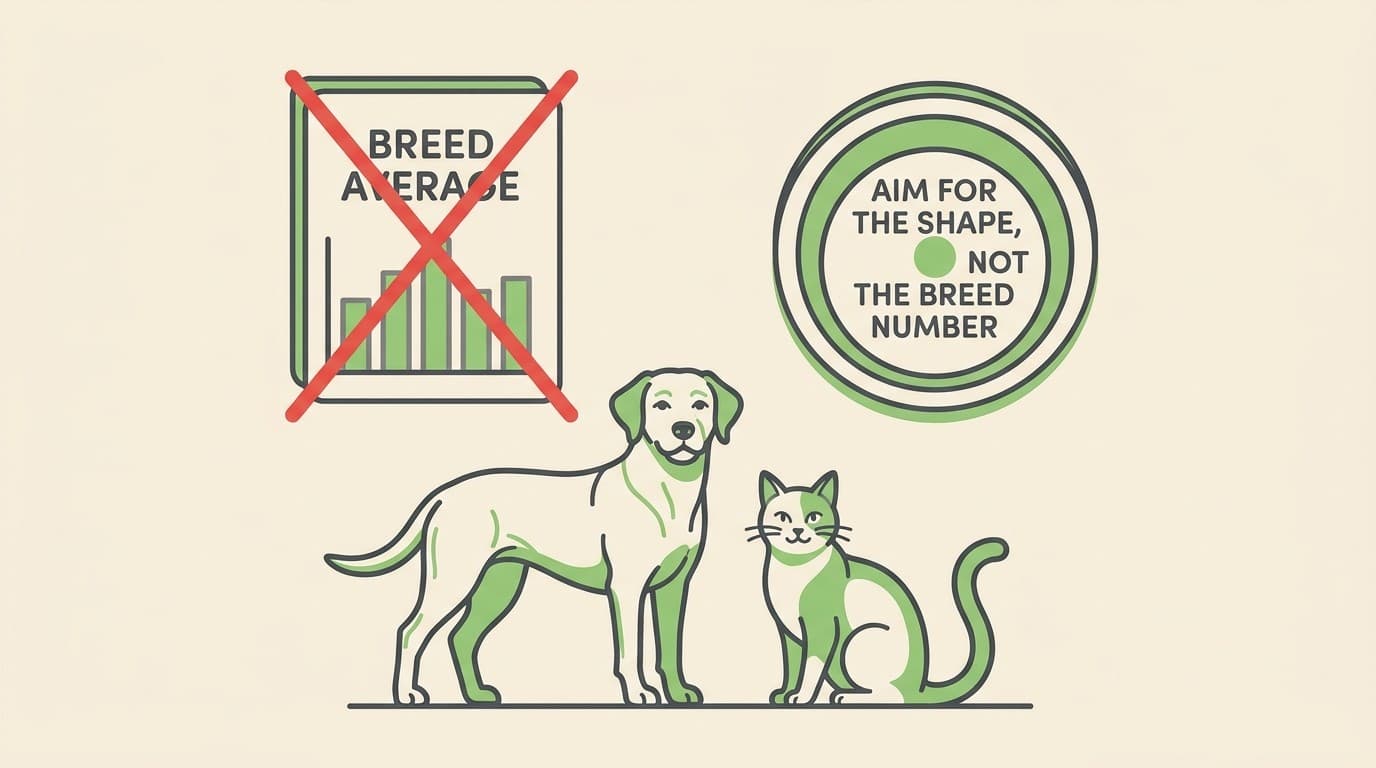
The breed-standard figure, the "ideal weight for a [breed]" you find online, is a population average. It describes a whole breed, not your individual dog, and the spread inside that average is huge. Your pet can sit bang in the middle of the published band and still be in poor body condition.
This isn't a hunch. When researchers checked 140 pedigree dogs against their breeds' recommended weight ranges, they found those ranges simply weren't a good predictor of an ideal body condition score (Smith et al., 2018). A dog can be a textbook weight for its breed on paper and still be overweight in the flesh. The breed band tells you what's typical, not what's right for the animal in front of you.
Frame is part of the reason. Within any one breed, build varies a lot, the same way two people of the same height can be small-framed or broad and carry very different healthy weights. A big-boned dog and a fine-boned one of the same breed should not weigh the same. The breed number can't see your pet's frame, so it can't tell you their target.
Crossbreeds make the point sharpest of all. A Labrador-collie cross, or a moggy, or a "we think there's some spaniel in there" rescue has no meaningful breed number at all. There's nothing to look up. Which is fine, because the breed number was never the right answer anyway. The scale on its own, judged against a breed chart, just doesn't tell you what you need to know.
The right way to set the target: body condition, not breed
Vets set the target a different way, and you can do the same thing at home. You score the body condition rather than guessing from the breed.
Body condition score is a structured way of reading your pet's shape from the ribs, the waist and the tummy tuck, on a 1-to-9 scale where 1 is emaciated, 9 is grossly obese, and 4 to 5 is the ideal. (The full how-to, the hands-on rib-waist-profile check, is in our guide on how to body condition score your dog or cat at home. That's the companion piece to this one, so do that first if you haven't.)
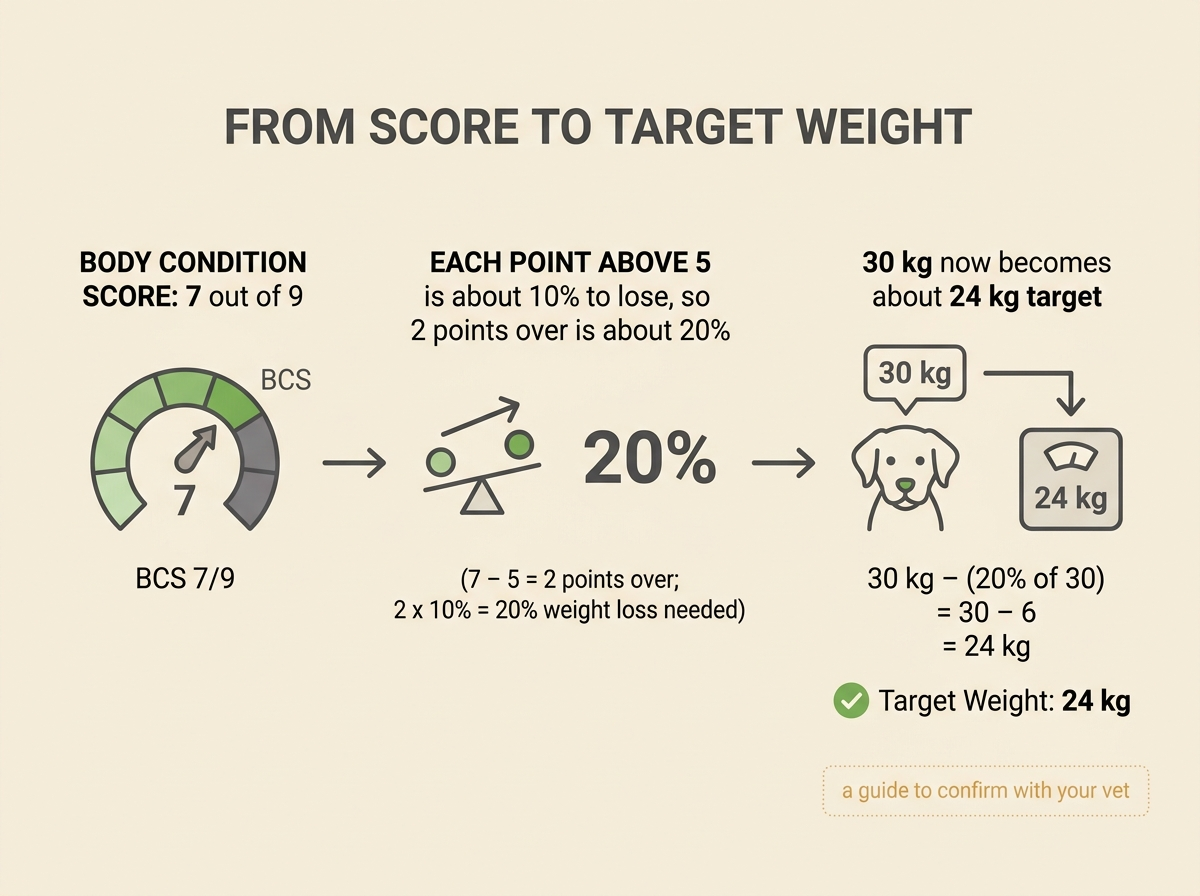
Once you have the score, you can read the target off it. The working rule is that each point above the ideal is roughly 10% over ideal weight. That gives you a simple sum, and it's exactly the sum our Healthy Weight Tracker does for you.
Take a dog who weighs 30 kg today and scores 7 out of 9. That's two points over the ideal of 5, so roughly 20% over. Divide the current weight by 1.2 and you get about 25 kg as the estimated target. For a cat who weighs 6 kg at a body condition of 8, that's three points over, roughly 30% over, so 6 divided by 1.3 gives about 4.6 kg to aim for. The maths is deliberately rough, and that's fine. You're after a sensible target to work towards, not false precision to the decimal.
One important guardrail: this only works in one direction. If your pet is already lean, at a body condition of 5 or below, you don't push them slimmer. The whole point is to reach an ideal shape, not to chase the lowest possible number.
There's a second, very personal sense-check worth doing alongside the score: your pet's own lean young-adult weight. That's what they settled at once they'd finished growing but before any middle-age spread crept on, for most dogs and cats around 12 months of age, and later for the giant breeds who keep growing to 18 months or beyond. If you happen to know your pet weighed, say, 26 kg at a year old when they looked trim and moved well, that's often the best single clue to their ideal you have, because it's measured on your actual animal rather than borrowed from a breed average. Treat it as a guide to confirm with your vet, not a hard figure, but it's a good reality-check against the number the score gives you.
Make it the vet's number too
The figure you've worked out is a very good estimate. The next step is to turn it into "this is the weight to aim for" with your vet, so the number you're all working to is agreed and on the record.
It's a quick thing to do at a routine appointment or a free nurse weigh-in. They'll weigh your pet on the practice scales, body condition score them against the records, and allow for the things a sum can't, the frame, how much muscle they're carrying, their life stage. Sometimes they'll confirm your estimate exactly. Sometimes they'll nudge it a kilo or so either way. Either way you come out with a target weight everyone agrees on.
That agreement matters more than it sounds, because the target weight is the number the whole plan is built on. When you work out how much to feed for weight loss, you don't feed for the pet you have today, you feed for the pet you're aiming for, with a sensible deficit on top. In other words, you feed to the target weight, not the current one. (The calorie maths, and our Feeding Calculator that does it in grams of your own food, pick up exactly there, in how many calories your pet actually needs.) Get the target right and everything downstream is right. Guess it from a breed chart and the whole plan inherits the guess.
You don't have to hit it all at once: stage the target
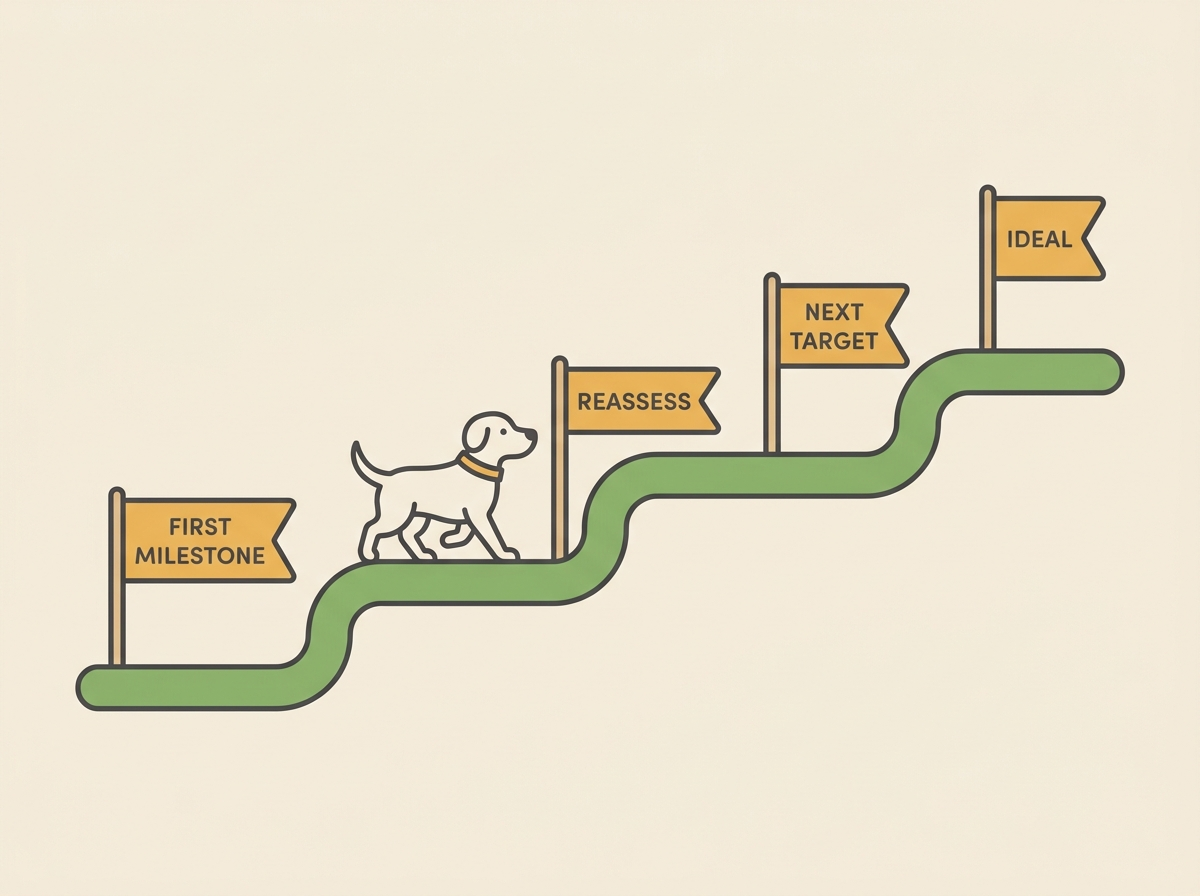
If the gap between today's weight and the target looks daunting, there's a way to make a long journey manageable: don't treat the final number as the only goal. Set a first milestone, a sensible early chunk, reach it, reassess, and then set the next one.
This isn't a shortcut or a fudge. It's exactly what your vet does at rechecks. Rather than fixating on the distant endpoint, you aim for the next achievable step, and you re-score the body condition each time you get there. That second part matters, because as your pet actually shrinks, the right target can shift slightly, and re-scoring keeps it accurate the whole way down rather than locking you to a number you estimated months ago. A pet who's lost a good amount may turn out to need a little more, or a little less, than the first sum suggested.
Breaking it up does something for morale, too. A 5 kg goal feels hopeless. A first kilo, with a recheck booked, feels doable, and then you're moving. Most weight-loss journeys that stall, stall because the finish line felt too far away to keep going.
For cats, hold one extra line firmly in mind through all of this: slow and safe. Safe weight loss runs at about 1 to 2% of body weight a week for dogs and about 0.5 to 1% a week for cats, and a cat should never be crash-dieted down to a target. Cutting a cat's food too hard, or a dieting cat going off its food, can trigger a serious liver problem within days, which is why the pace is gentle and the food never stops. Our guide on why you must never crash-diet a cat covers that safety rule in full, and it's essential reading before you start a cat. Slow isn't just the safe way, it's the way that actually sticks, for cats and dogs both.
So, the next steps from here. If you haven't scored your pet yet, start with how to body condition score at home. Then pop the estimate and the agreed goal into the Healthy Weight Tracker, which stores both and plots the weigh-ins against the target so you can watch the trend. And once you've got your target weight, work out the food with our Feeding Calculator and the calorie guide. You've already done the hard part, which was asking what your pet should really weigh instead of trusting a chart. The rest is a number, a plan, and a few weigh-ins.
References
Keep track of how your pet is doing
The owners who cope best are the ones who notice changes early. A simple health log shows you what is working, and what is not, before the next vet visit.
Start tracking, freeYou're not doing this alone
Compare treatment journeys and talk to owners managing weight management. Free to join.
Join PetsLikeMine